Showing posts with label Top 10. Show all posts

Saturday, October 8, 2011

I [Heart] Nemo


My son, on his 18th birthday this last December decided to celebrate this first step into adulthood by inviting a couple of his friends to our home to watch Finding Nemo while eating homemade Portal Cake (recipe changed from the original).  This was a marvelous idea and a great opportunity for me to reevaluate one of my favorite movies of all time.

When I first watched Finding Nemo, my reaction was much like a comment made about this film, “A talking animals movie—how unique!”  The story was simple, and while Dorry is hilarious, overall the impression it left me was “meh”.   After watching it with my children more times than I can count, my appreciation for this film knows no bounds.  This is a deep film, a touching film, a truly human film that has to be told in the sea, for only the sea has the complexity of human society.  Yeah, it’s played for laughs—a lot of wonderful, freeing, joyous laughs—but it isn’t just a funny film.  It’s a film about love and relationships.
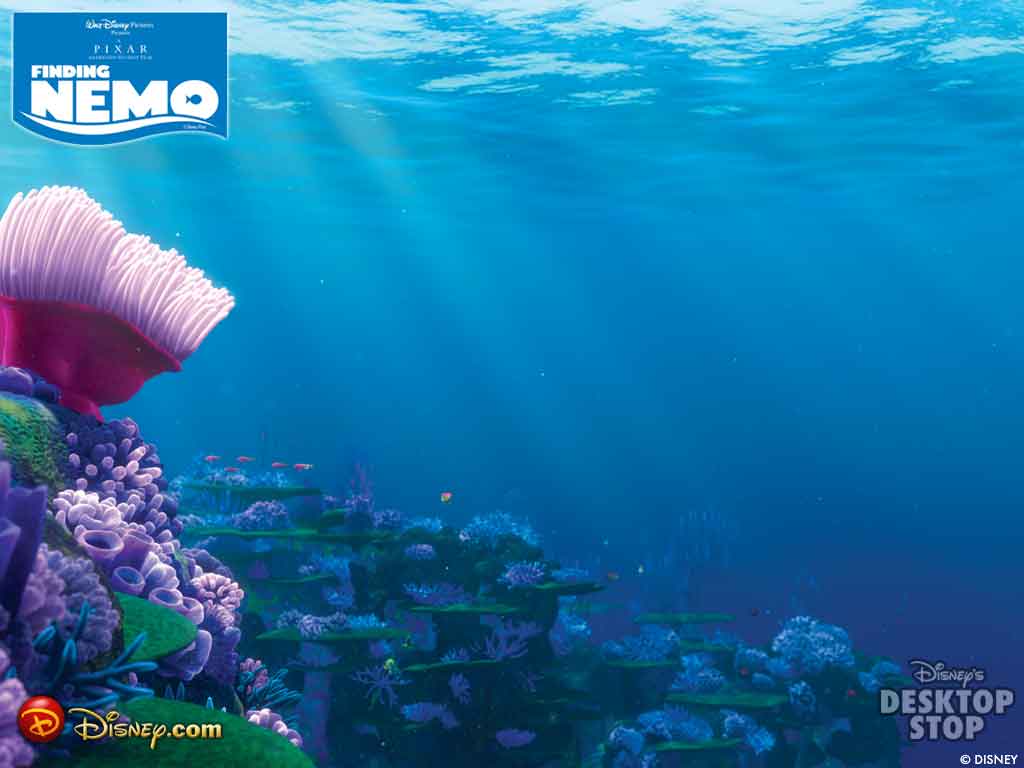


Technical—5/5—Amazing.  This is one of the peaks of Pixar’s art.  Every plant, every tentacle, every fin is perfectly realized.  The characters are completely fish and completely human, much in the way Disney has done at their best.  This is a marvel of computer animation.


Interest—5/5—How can I turn away from this film?  Every second is interesting.  It’s funny, then tense, then touching, then funny again. 


Tension—5/5—This is the first film I remember Mercy and I watching together.  We saw it in the theatre, she was three, and was scared to death.  The sharks, the lantern fish, the whale… it was all too intense for her (she still gets nervous about too much tension).  She wanted to leave, but I just held her in my lap and told her to shut her eyes if it was too much.  By the end of the movie she loved it, but it was touch and go for a bit.  Sure, it’s not really scary for adults, but the lantern fish still creeps me out a bit and the jellyfish scene still makes me tense.

Emotional—5/5—Yeah.  When the Pelican tells Nemo the story of his dad braving all of the dangers of the ocean to find his son, I get tears in my eyes.  Heck, they are there right now, just thinking about it.


Characters—5/5—This is the best.  Rarely is character better shown through plot than in this film.  The prologue which establishes the reason for Marlin’s fears, but especially the time taken for Marlin’s attempt at humor.  He can’t tell the joke because he needs to over explain everything, and that tells us everything we need to know, and we can see from the beginning how this damages his relationship with his son.  And instead of Dory and Nemo just being “the funny one” and “the object of desire”, they are given character arcs as well, where all three of them learn to trust.  Marlin learns to trust his son, Dory learns to trust a family and Nemo learns to trust himself.  Brilliant.


Theme—5/5—There’s a lot going on in the film, as it is a quest movie.  Most quest stories rely on the next thing coming to keep the interest, as does FN.  But this is the most human of quest stories, because it is about relationships and how trust is essential.  It isn’t just that the father needs to give the son more freedom (like the shallow Little Mermaid), but that they all needed to trust each other, and to trust the love that they have for each other.  And the way to develop trust is to see each other (and oneself) in crisis.  After the worst has happened and every acted heroically, there is no more need for fear.   This is simple, a child could get it.  But there’s enough in the telling of it that a psychologist or ethicist to spend hours on it, understanding how it works.

Ethics—5/5—Fear leads to overprotection, trust—even dangerous trust—builds love.  That’s powerful.


Personal—5/5—Despite it’s depth, its hilarity, its ethical nature… Finding Nemo is a story about parenting.  We all have a tendency to overprotect as parents (unless we are so wigged out on addiction we don’t notice our children).  It is interesting that a significant part of the story is Nemo learning from Gil what Marlin couldn’t teach him.  It isn’t that Marlin didn’t get Nemo back, but Gil is just as important to Nemo’s growth as Marlin was.   Letting go, in parenting, often means letting others teach what you cannot.  That is real trust.  It is hard to let our children go, and necessary.  These are all lessons I am still learning.

Okay, yeah.  It still belongs in my top 5. 

Saturday, July 9, 2011

The Double Life of Veronique: Review and Analysis


Two girls are born on the same day in 1968, one in Poland, the other in France. One is called Weronika and the other Veronique.  They both are raised by loving parents, both of their mothers died young and they both have good relationships with their fathers. And even though they grew up thousands of miles apart, they both had this sense that they were not alone.  That somewhere there is a counterpart to themselves.


This is the heart of the Double Life of Veronique, and yet the film is so much more than this.  Directed by Krzysztof Keislowski, the film is much like his other films.  Like all his later films, it explores metaphysical and ethical issues.  Although the subject is very down-to-earth, the cinematography is full of ethereal beauty, full of golds and greens. It is simply one of the most stunning pieces of art ever created.

Why do you play out of tune? Is it because W sang out of tune when she died?.


In addition to that physical beauty, there is the beauty of the music.  The score was composed by Zbigniew Preisner who later also composed the beautiful score for Keislowski's next film, Three Colors: Blue.  Most of the score is a single piece of music, played or sung in different ways, different tempos with different instruments.  But the haunting, spiritual nature of the piece is perfect for the mood of the whole.


I've watched it twice now and each time I am drawn in, stunned by the beauty and power of the simple story.  It is intellectually stimulating and sensual, but somehow it is the beauty of it that captures me.  I am misty-eyed at the end of the film, and I don't know why.  It moves me as no other film does, and it is a mystery how it stirs my soul at all.  In all, The Double Life is one of my favorite films of all time.


Why the ring? Is it simply a connection between the two doppleganers?     


*   *    *


Below is the analysis, which contains spoilers and discusses details of the film: 


All of this gushing praise doesn't mean that Double Life is easy to understand.  There are a lot of seemingly meaningless details, but like all Keislowski films, the details add up to a singular whole.  Of course, the puzzle is, what is that whole?


I believe that the title is a misdirection, as is the main plot of having Veronique/Weronika be doppelgangers. Of course, it is significant, but it doesn't really add much to the main point of the theme.  This theme can be found right at the first two shots of the film.   


First, we see Weronika as a small girl, being held by her mother.  Her mother is interpreting what little Weronika is seeing: an upside down Polish city.  But rather than draw her attention to the city itself, her mother tells her to "look" at the stars.  And this heaven-gaze directs all of Weronika's life, which takes up the first half hour of the film.


Weronika is pulled back and forth between joy and a kind of an illness throughout her portion of the film. She is addicted to heaven, to the spirit realm. Keislowski puts many different symbols of this spiritual, non-earthy, viewpoint throughout the film: stars, rain, seeing the world upside down, but the main basis of spirituality in this film is art: music, dancing, drawing. And the purer the art, the more it is art for its own sake, the more spiritual the art is.  And thus, the less it belongs with the earth.


The illness Weronika struggles with is, frankly, a spiritual sickness.  She is so caught up with the spirit world that her body has a hard time living.  When she sings to practice for her recital, she is so weak she can barely walk.  She becomes pale and her eyes wander.  The connection to the spirit is the greatest joy in her life, but it finally kills her when she completely surrenders herself to the music.


Why did she not die before?  Because of her connection to the flesh, to the earth.  The earthly is seen in her relationship with her boyfriend, in her helping a friend in a legal situation. And whenever see connects in those ways, she becomes grounded again and her body is able to endure.  The funniest example of this is when, after a particularly spiritual practice for her concert, she wobbles out to the street and almost collapses onto a bench.  A man in a trench coat comes by and opens his coat, exposing himself.  This "grounds" Weronika, giving her a connection to the earth once more, so she feels better and gets up. 


In the end, Weronika's commitment to the spiritual kills her, because a soul so connected to the heavens can no longer live on earth.


Veronique, although a copy of Weronika in so many ways, is, in this aspect her opposite.  In the opening scene, Veronique is also with her mother, but her mother is showing her a leaf, describing the details.  Veronique is the one who is focused on the earth, on the flesh.
Love's not enough, in itself.  Or is it? 


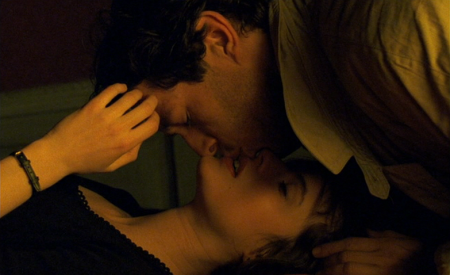
The first scene in which the adult Veronique is focused on, we see her having casual sex with someone she hasn't seen for a long time. This demonstrates her groundedness.  But this is happening right at the same time as Weronika's death, an Veronique feels it.  Suddenly, in the middle of the lovemaking, she grieves.  She can't stop herself from crying and it makes no sense to her. This is because she has been free to live a life completely grounded, because her counterpart was living a life in the spirit.  Both are unbalanced, both are one-sided, because they had the other who unknowingly balanced them. Veronique has remained somewhat balanced, seeking music in a class instead of the pure form (she quits personal development of her music after her greiving).   


When Weronika dies, however, Veronique is imbalanced, undirected, seeking stasis.  And she finds this balance in the form of a marionette artist, Alexandre (as a side note, W's boyfriend and V's sought lover's names both begin with "A").  Just his art communicates balance, in that his art is embodied, grounded at all times.  There is always an audience and always a human shown behind the puppet.  His art is the kind of balance Veronique now so desperately seeks.


And for the rest of the film she seeks him and he seeks her.  In the climax, her grief for the loss of Weronika threatens to overwhelm her, but Alexandre makes love to her through her grief.  He brings her back to earth.   Because, for Veronique, her grieving of her lost spirit-component threatened to undo her. But the love of another, frankly, sex itself, grounds her, gives her balance between the grief and continued living in the world.  In the final shot, Veronique is touching a tree, even as her mother showed her the leaf, guiding her to the path of embodiment


I'd love to hear any comments on my analysis.                            

Thursday, June 30, 2011

Day 30 - Your Favorite Film This Time Last Year


My top 100 changes a lot over time.  I’m trying to watch all my top 100 films, plus others that could make my top 100, and make a definitive list.  But in another five years I’ll have to do it all over again because a top 100 is supposed to be flexible, moldable, especially for a film buff who is still going through his film education.


But my number one hasn’t shifted or moved an inch from the time I first saw Spirited Away.  It was like a revelation of cinema. It touched me as no other film had and, perhaps, never would.  I will get older and I know that my personality will change.  One day, a film will come along that will stun me like Spirited Away did.  But I don’t expect it to be soon.  For me, I have a rating system.  It is from 1-5.  If I give a film a one, then I despised that film.  A two means that I didn’t care for it.  I rarely give ones or twos.  A three means “Meh, it was okay, but don’t expect me to remember the plot next week.” A four means “I really liked this.  Maybe I’ll watch it again, someday.”  A five means that it is one of the finest film experiences I have ever had.  I just want to let you know, however: Only Spirited Away on my rating scale gets a ten.   That’s true love, folks.   The real thing.


Wednesday, February 9, 2011

Spirited Away: The Greatest Film of All Time


"An alternative universe coinciding with our own"

I really appreciate what a co-movie lover said recently, that as one gets to the top of one’s all time favorites list, that it becomes more personal. I think that is really true. My top ten is peppered with films that mean something important to me personally, but may not be as thrilling to others: Wendy and Lucy, The Mission, Being There. They all carry double meaning for me: not only being well done films in their own right, but also expressing messages that are important to my life. They not only speak to others in a general way, but they speak to my life directly in a way others might not understand.

So, with Spirited Away, I can give you the many reasons why this favorite film of my favorite director is generally excellent. The animation is top notch, for one. In re-watching Ponyo, I realized how much we are missing in focusing on computer animation instead of hand-drawn. It has taken hand-drawn animation almost a hundred years to reach this place, while computer animation is still a teen. Computer animation is wonderful, but it still has a long ways to go to establish a set of symbols we recognize as human emotion. Miyazaki, however, has taken the step that Disney never did to make characters that are so real we feel that we know them. This is certainly found in the writing and the voice acting (even the dubbed vocals!), but especially in the drawing. It is not because they are more realistic looking, but because we grew up with this kind of animation, and Miyazaki, adding in expressions found in manga and older anime, has given us a visual language we can truly connect with.


"Living in the stream of life, led by love"

Also, Spirited Away is one of the magnificent stories of imagination. Setting aside the Japanese spiritism (which we will talk about in a moment), the amount of imagination that creates both the setting—a bath house for spirits—and specific unique characters such as No Face and the Radish Spirit, takes even the imaginative achievements of The Wizard of Oz, The Neverending Story and Labyrinth to new heights. But more than that, this imaginary story is realized perfectly visually. We can see this world existing. This isn’t just an amusing tale with muppets or dressed up humans or poorly executed claymation. This is another world that we have the opportunity to visit for a couple hours, and that experience gets added to our own.

I am just saying what could really be said of almost any of what I call “first tier” Miyazaki. As well as this: Miyazaki’s characters are fully realized. These are real people, even the spirits are of a type of character we recognize. While there is sometimes comedy, it is the comedy of real life, not just pratfalls and one liners. When there is achievement, it is rarely of the deeply heroic kind. Rather, it is the daily success of those who act noble in small ways. In this way, Miyazaki can connect to us in ways that blockbusters rarely do. There are scenes in Miyazaki that, despite the outlandish settings, we can see as reflections of our lives. Or our lives as we wish them to be.


"Look, I can do it, too!"

There are two reasons, however, that Spirited Away especially speaks to me personally. First of all is because we get to see Chihiro/Sen grow up. I have three children of varying ages—17, 14 and 9—and they are all in different stages of development. All of them are, in a sense, Chihiro. At the beginning she is whiney and grumpy and self-centered. The move is hard on her, her parents realize this, but it is necessary and they need her to stay strong through the difficulty. But it is when her parents become self-centered that she is forced to grow up and become stronger than she—or her parents—ever thought she could be.

Step by step we can see her shed her self-centeredness and fully take on the task of being responsible as the best of grown-ups are. This is in contrast to Kiki of Kiki’s Delivery Service who begins the movie responsible and hard working. Chihiro had to struggle through every step of the way. First she expresses the moral outrage many young people express when they see grown ups acting irresponsibly. Then she follows important instructions for how to live in the new world (something most fairy tale protagonists fail to do). Then she learns boldness and tenacity in the face of threat. Then she learns about hard work under someone else’s orders. Then she learns about loving people even when they seem to not be lovable at times. Then she learns about sacrifice for love. And finally, she learns that intelligence balanced with care and wisdom is what truly saves the day.


"Soaring high"

These are the life lessons I want all of my children to learn. They are the lessons I see them learning, bit by bit. The art of raising children is the art of seeing them become the Chihiro at the end of Spirited Away. Every once in a while, as a parent, you can think to yourself, “I taught them that”, but most of the time you can’t. These are lessons they have to learn themselves in the midst of the struggles they have to face in life. But at the end of the movie, I am so proud of Chihiro, the buttons on my vest would burst, if I actually wore a vest. She is my children. My son becoming a responsible adult. My oldest daughter being self-confident and self-reliant. My youngest daughter learning to speak with respect and act in mercy. This is all I hope for my children, in the strange worlds they will have to challenge.

My final reason is my strangest, and probably my most significant personal reason why I love this film. I am only going to tell you guys, and I hope you won’t tell anyone else. Not because I’d get in trouble, but because it’d be difficult to explain to my denomination and especially my congregation. I could do it, but it wouldn’t do any good, so why bother? Anyway, here it is: the metaphysics of Spirited Away is pretty close to how I see the world functioning.


"Christianizing Shintoism"

No, I don’t think that spirits have their own bath house and restaurants. I don’t think that if humans eat spirit-food that they turn into pigs. Nor do I think that young girls could be hired by someone to serve spirits. I do, however, believe that there is an alternative universe, that runs on its own physics, that runs parallel to ours. I do think that there are beings—and you could call them spirits—that live in that universe. I also think that most of them are morally neutral, neither good nor bad, just trying to live their lives by their own values. And I think that, at times, the two universes can converge, and allow communication between them.

This is not an unusual worldview, in the broader scheme of things. Historically, before the Christian era, almost everyone in the world believed that summary of mine. Certainly the ancient Jewish people did, as well as the first Jewish Christians. It is Plato and his disciple Augustine that began to turn the world away from this notion. They saw the spirit world as either the realm of ideas or as under the control of a single unified being. Under their philosophy, the spirit world is neat and orderly, with everything politely lined up perfectly, within the mental grasp of humanity.

The ancient pagan world, the ancient first temple Judaism and the first century Christian church saw the spirit world as full of chaos as it was of spirits. Each spirit had its own focus and desires and hopes. They had their own realms of responsibility—jobs, if you will—of rivers and vegetation and winds and planetary beings. Part of the spirit world is described as a sea, filled with dragons of chaos, battling against spirits who desired order and peace in both the spirit world and on earth.

Spirited Away, although a fantasy, is based on Japanese spiritism, a form of that ancient worldview. In a twisted sense, the metaphysical basis of that movie is somewhat the same as the writers of the Bible. This is how I see the world working. I do not deny scientific reality—our world does operate on the laws of physics and development of life as discovered by scientists. But looking at the physical realm is only a part of the story, like Chihiro’s parents seeing an abandoned amusement park.

Some are content with this world and understanding its laws. Others get to see the wonder and magic of the world below the surface, on a level not usually seen by eyes. I wish to be one of the later.

Any who are concerned about my right to be a pastor, or my sanity, I would be glad to give the phone number of my denomination, and you can rat me out. I understand. Sometimes I don’t think I’m completely sane, either. By the way, my wife already knows, so you don’t need to bother calling her.