Showing posts with label Certified Copy. Show all posts

Wednesday, October 3, 2012

Does a Relationship Ever Actually Change? (Certified Copy 2010)

#90-- Certified Copy (2010)


I have been married for (carry the one, twelve minus nine) 23 years, which is half of my life.  And when my wife and I married, and for the eight years before we were married, we were completely different people than we are now.  I was more stoic and aloof.  She was more carefree and had more energy.  There is much that we haven’t changed: we both still love books (we spent half of our first three months of marriage reading), we are both still introverts, I am still ambitious and she is still anti-ambitious.  But there still seems some fundamental things that have changed.

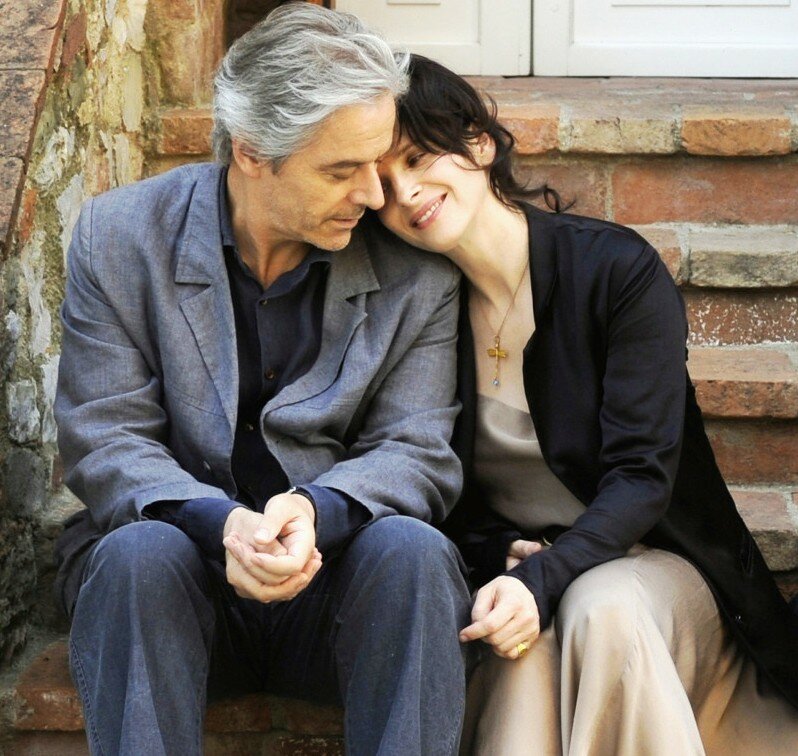
But have they really?  Are we really all that different?  The male and female protagonists of Certified Copy (Juliette Binoche, William Shimell) seem to make a radical change toward each other in the middle of the film.  Although no time has gone by, their relationship changes from courtship to married to several years.  The heat in their relationship increases.  But the issues in their relation remains the same.  They are fundamentally still the same people, with the same opinions, with the same attraction toward each other, and with the same anger at each other’s’ idiocy.   They are different people, and yet, over the years, their relationship remains oddly similar. (There are different interpretations of the film, but this is mine and I’m sticking to it.)

What if, no matter how long we lived together, we are continually rehearsing the same relationship joys and sorrows, again and again?  Perhaps each relationship is fated to be a loop, with the highs and lows repeated, with the same arguments.  Perhaps, in the worst as well as the best times, we need to re-consider our relationships before we commit to them.  Perhaps we need to ask these questions before our marriage, before our divorce: Can I live like this the rest of my life?  Can I live without this for the rest of my life?  I know for me, despite any hardships or desperate weaknesses in our relationship, I couldn’t imagine my life without her.  I can only hope she feels the same about me. 

Fun Fact: Certified Copy is a French film with a French actress, a British actor and an Iranian writer/director, Abbas Kiarostami.  Kiarostami also directed Iranian films, such as A Taste of Cherry which won the Cannes Palme D'Or of 1997.

Tuesday, May 15, 2012

Scenes from Scenes From a Marriage


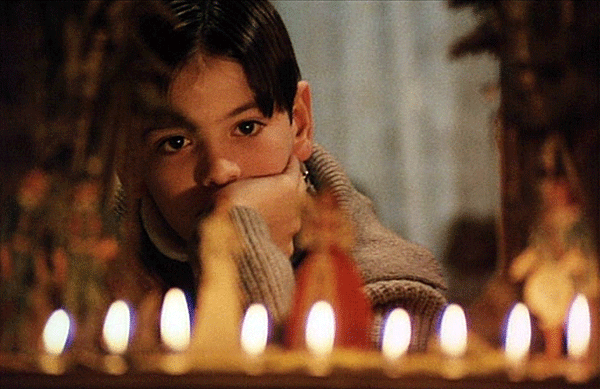
Alexander was bored too

Scene 1: Seed of Hatred

I knew I was caught by the time Ullmann started rejecting Josephson’s  sexual advances.  The characters added another layer, right there.  Although it was suspected that they were lying to their friends, it is at this moment that we know that they are lying to themselves, deluded that they are in a happy marriage, when their real desires in a relationship are openly uncommunicated.

How different from other Bergman films I experienced.  I saw my first Ingmar Bergman film in high school with Fanny and Alexander in a theatre.  I was supposed to like it, so I said it was good, but I didn’t really get it.  It wasn’t until my second viewing of the film that I realized I didn’t have a clue what Bergman was doing or saying here. 

I looked forward to The Seventh Seal, for it was about death (I love the metaphysical) and was an “important” film.  It left me cold (like death, get it?).  It was then I realized that Bergman may not be for me.
Then Through a Glass Darkly, then Winter’s Light (half of it).  I understood what was being communicated,  it just wasn’t compelling to me.  Bergman, although he is loved by many, just wasn’t for me.

My distaste had run its course
Scene 2: Deliverance
I didn’t give up on Bergman, though.  Why?  Because my fellow film lovers insisted that I just needed to keep trying.  Honestly, I wasn’t looking forward to another dull, mystifying journey.

It wasn’t until Wild Strawberries that I finally gained a spark of interest for Bergman’s films.  Spark?  I loved this film of a man reflecting back on a life of distance and wondering what he was leaving behind.  I had been impressed with other performances (Harriet Andersson in Through a Glass Darkly especially), but Wild Strawberries was just stunning.

But was Wild Strawberries just a fluke?  Clearly Scenes From a Marriage indicates not.

Talk, talk, talk
Scene 3: Dialogue Reigns
The structure of Marriage is in six “scenes”,  each revealing (to us and themselves) a different aspect of the central couple’s relationship, and thus changing the relationship.  The method is dialogue, which has always been a favorite method of communicating ideas for me.

Dialogue has been around for as long as there has been stage plays, some three thousand years.  Some of my favorite dialogues were written by Plato and Sophocles, written in ancient Greece.  And some of my favorite filmmakers use dialogue as the central method of communicating: Linklater and Rohmer are two of my favorites and some of my favorite movie scenes are the simple but intense dialogue by Tarantino.
Scenes from a Marriage, after the first scene, are just dialogues between the central couple, Johan and Marianne, even as the films Before Sunrise and Before Sunset and the recent film Certified Copy are dialogues between one couple.   

I wonder if we realize how much of the drama of our lives—and the pleasure and the comfort—takes place in simple conversation, especially with those we love and respect?  Conversation changes us and so changes the reality we live in.  Our whole world can powerfully shift because of a sentence.  A well-placed word can cause us to spiral into depression or to dance with joy.  To converse is to be surrounded with life.

Making it up
Scene 4: Making a Marriage

To converse is to relate.  And the most intimate, the most vulnerable, the most mystifying relationship is that of a marriage.  Most people marry.  There are billions of marriages.  Yet every marriage is mostly a mystery.  Each is unique.  As humans we are clearly driven to marry—it crosses all religions and almost all cultures.  But since every human is a complex of personalities and drives and contradictory emotions, each marriage is as much a collision of two societies as it is the joining of two people. 

And so it is quite possible—even likely—that a couple, married for ten years, still are confused and bumbling about their relationship.   In this unification of souls, the souls in question shift and morph.  If the souls change, can the marriage remain the same?  Of course not.  One soul is changed by close proximity to another, and so the very relationship between the souls shift and so both souls change again.

So marriage cannot be seen as an entity as much as a shape-shifting organism, forced to be completely different or to die.  And this is not the story of a relationship that can change.  It does change, but only through internal struggle and brokenness.

Scene 5: Partner in the Dance

(Warning: This section has spoilers)
The marriage is broken upon two solid features of the soul’s personalities: Marianne’s need to please others and Johan’s need/desire for more sex than Marianne is comfortable to give.  In their marriage they only drop hints as to the need to change and when it finally is communicated, it is too late for the marriage.  The marriage unravels, dissolves, almost in a single night. 

And the film insists that it must be so, for while they were in that marriage they could not change or become the different people they need to be to make the marriage work.  Only when they are out of the marriage, married to others, have they grown enough to be the people that they needed and deserves.

And by this time are they addicted to adultery?  Do they see each other, their former partnership, as a release from their current bonds, or do they see each other as the match they should have had from the start?  The violence and expression of hatred in the penultimate scene seemed insignificant compared to their need of each other in the final scene.   How can anyone love after such a scene?  Is it love for each other that blinds them to that night, or simple, driving need?  Or is it that they are the true couple, the eternal couple that will not ever completely be apart because they were joined by a purpose that cannot be gainsaid by human will?

These questions are not answered in the film, and it is in the questions that the film remains so true.  Because every enduring erotic relationship truly is a mystery.  I would love to have every new couple watch this film.  Not to tell them that their relationship is pointless, surely to end in agony.  Actually, my wife and I have been married for 23 years and we are content with each other.  If there is one secret to our marriage, it is because we chose to make every life change together.  The changes always came, but we are committed to face change by each of us changing, so changing our relationship.

No, I would want newlyweds to see this film to tell them that they need to communicate.  That they need to navigate the waters together as a school of fish, each swimming individually in unison.  That they need to see their spouse not as the answer to their needs, nor as the canvas for their imagination, but as a partner in the freestyle dance we call life.  That the partnership only ends when one or both decides that it does.  And even then, like many dances, the partnership is never truly dissolved.  The intimate touch of another’s soul never goes away.

Thursday, March 15, 2012

Why Jessica Should Give Certified Copy Another Chance


My friend Jessica, aka “Lobby” of The Velvet Café and the Filmspotting Forum is a wonderful film blogger.  One of the best, actually (you can see a link to her site on the sidebar).   She has wonderful opinions of film and she expresses them in such a personal, interesting way.  However, sometimes—only occasionally, mind you—she is terribly wrong.

For instance, I would claim that 2011 has produced three masterpieces of film.  Perhaps more, after all I haven’t watched A Separation yet or This Is Not a Film.  But there are three that will be discussed and watched happily for decades to come: Tree of Life, Melancholia and Certified Copy.  Jessica didn’t really care for two of them, and hasn’t watched the third and probably is now nervous about watching the third, because I have lumped them all together.

Although I might want to defend Tree of Life, I am here to talk about Certified Copy.  Jessica said that she wasn’t really interested in a very long art discussion.  And it’s true, I wouldn’t either.  And that’s what the film begins with—a discussion about whether a piece of art is to be valued equally as it’s certified copy.  It’s an interesting notion, but one that has been discussed to death in other good films like F is for Fake, My Kid Could Paint That and Exit Through the Gift Shop. The subject has been exhausted, and I would be exhausted to watch another film about it.

But Certified Copy is not about art.  It’s about relationships.

It is using the example of a single relationship, which at times is a courtship and at times is a couple fifteen years married,  to talk about the nature of relationships in general—all of our relationships, but especially our most intimate, long-standing ones. 


There are many questions the film brings up about our relationships:

Do we change over time or are we just perceived differently by others?

Is our value intrinsically our own, or do we only have the value others give us?

Must our relationships have a goal, or is it enough that we just enjoy the experience?

Is the goal of life to produce, or to be happy?

Is it acceptable to avoid the difficult things in relationships, or should we work at “fixing” them?

I admit that the film is a difficult one to watch.  The two principles, brilliantly portrayed by Juliette Binoche and William Shimell, spend most of the film arguing, bickering.  The fact that we don’t know whether the couple are complete strangers or deeply intimate is a distraction. 

Actually, let’s talk about that—see how much of a distraction it is?  But it goes into the  theme of the film.  At the beginning of the film, it seems obvious that William and Juliette don’t know each other, that she’s attracted to him, but also extremely upset at some of his opinions.  About halfway through the film, they speak as if they have had a rocky marriage, one in which he separated himself from her and their son for most of the marriage.  They also have connection with another couple who are getting married in the same place they got married 15 years ago.  And most of the way through the film, they pass an older couple, leaning on each other in order to walk. 

I believe that all four of these portraits are of their marriage, or that they all speak to different parts of the same marriage, or all marriages.  There is the courtship, where we are getting to know each other.  Then the wedding, in which the relationship is most idealistic.  Then a number of years later when the ideals are cast aside and a choice is made to continue to live together or to separate.  And, finally, old age where the decision to remain together leads to interdependence.  

What I believe the film is saying is that all four of these stages are the same marriage.  They aren’t different relationships, but the same one.  The individuals haven’t really changed.  But each stage gives them a new opportunity to perceive each other and how we value each other differently.

And this is why I love this film: I have never watched a film that more helps me understand the nature of long term relationships.  Mind you, I haven’t seen Scenes From a Marriage yet (although I will soon), but this film is deeper and more thoughtful about relationships than any film I have ever seen.

So, Jessica, if you are reading, I hope that give Certified Copy a chance.  Another chance.  I think there’s a lot there, more than anyone can catch in one viewing.  Really, it’s the up and coming thing.  Like indoor plumbing ;)