Sunday, June 19, 2016

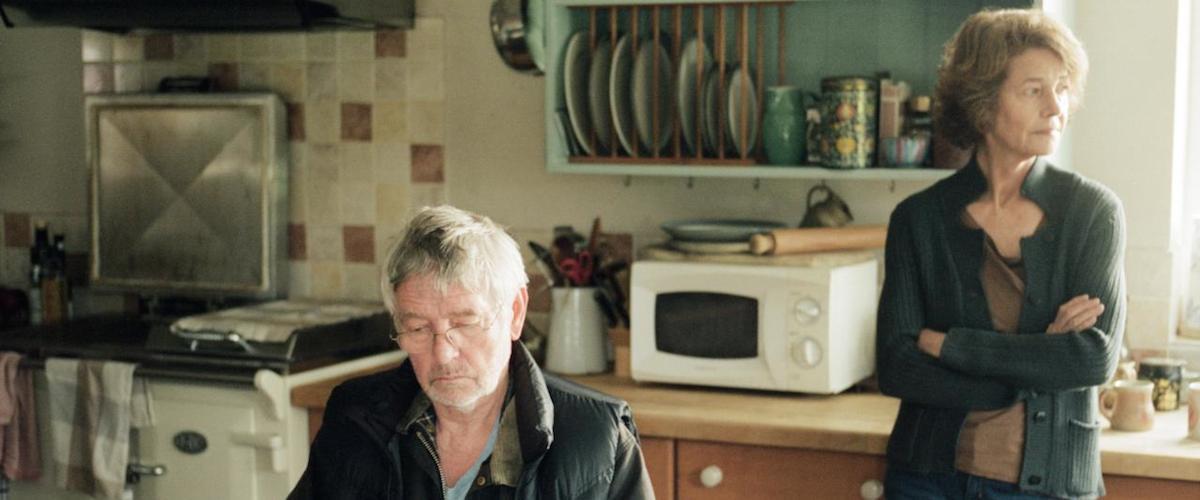
45 Years

"Muted cries and echoed laughter, banished dreams that never sank in sleep/Every ghost that calls upon us brings another measure in the mystery..." -Dan Fogelberg


Can the spirits long past, ghosts of who we once were, haunt us so impressively that our future is irrevocably transformed? The past selves are never disappeared ages ago, for our former selves has made us who we are. Without them there is no us. And our feet are forever trapped in the clay of our former actions, beliefs and experiences.

My real question about the film is that an event in the far past, overwhelmed by a lifetime of memories, settled arguments and decisions to remain... would the memories, no matter how potent, really cause such an earthquake?

Almost perfect acting by the two leads.

Sunday, May 29, 2016

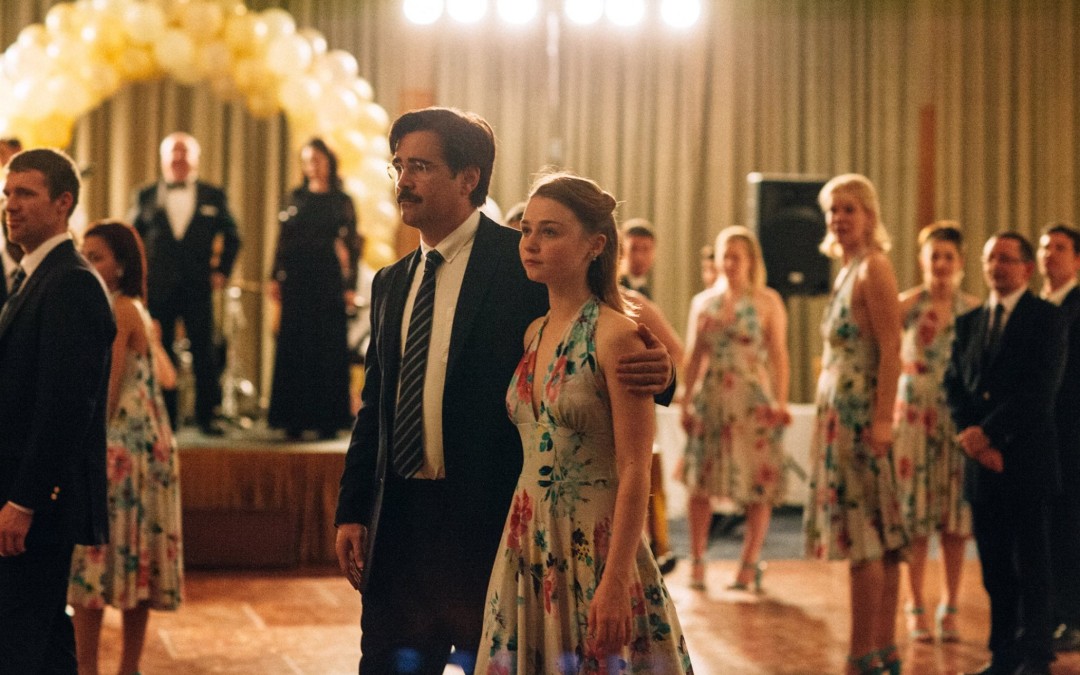
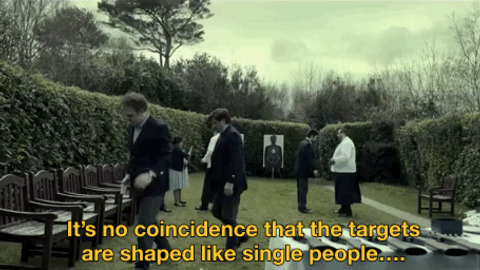
The Lobster: An Existential Fable

I found that the danger of watching the Lobster is laughing too hard at it.  Unless I am willing to laugh equally hard at myself.

The director/writer of a trilogy of film said of his first two films that Dogtooth was about a created fiction to protect their children from reality.  That Alps was about a self-imposed fiction in order to protect oneself from grief, for our own good.

In taking that idea to the next stage, what if all of society was a fabrication?  What if we needed to hide reality from our own eyes in order to keep us all conformed to an artificial structure?

It might be easy to look at The Lobster and see it as a ridiculous comedy, full of insane situations.  But we see situations like these daily.  Do we not feel the threat of sexual nonconformity, the ostracism, even physical threat?  Are not many willing to accept idiocy and clear fiction for the sake of conformity? 

Are many not willing to go through gross and disgusting physical deformities (which might be called “augmentation”  in order to maintain the façade of love that has nothing to do with those deformities? 

Does not our society create a series of verbal and physical facades in order to perpetuate a false pretense of romance and marital bliss?   Of course society’s restrictions are not just about sexual mores but also class and culture and security and on and on.  When we look at society’s fictions they pile ever higher.

Our fictions go ever deeper.  As if presidential elections change anything, as if our jobs our meaningful, as if our enemies were really enemies and no fellow human beings, as if making changes in our lives do anything else but establish our placement in a different level of the self-appointed façade.

The Lobster invites us to laugh at ourselves.  To see the facades for what they really are. And also to see the dangers of the fictions we blindly accept.


I am tempted to ask the question, "Was it good?".  But I'm not sure a vision of a subversive, existential prophetic vision should be limited to such words as "good" or "entertaining."  That kind of misses the point, doesn't it?


Personal Reflection on After the Wedding

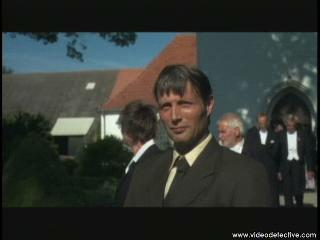
Jacob runs a struggling orphanage in India, but he is no distant administrator.  Rather, he is personally involved with the children, loving them with all his heart.  He is committed to the cause of poverty and he had dedicated his whole life to doing his part.  He visits his origin hometown in Denmark, to attend a wedding.  After the wedding he is made an offer: never go back to India and a very wealthy supporter will give enough money so that the orphanage might be established firmly for decades to come.

I just love how awkward he looks
I could see myself being places in that same vice.  I run a church for the homeless, and we provide services for hundreds of economic refugees in Portland Oregon and its neighbor Gresham.   I’ve been doing this work for twenty years and it has grown as homelessness itself has grown.  We monthly struggle financially, and given that we have very limited political support in city or church, we regularly face extinction.

What if someone gave me the opportunity to make sure that all of my people were cared for, at least as well as I could or better, but I would never see them again, I would not even be able to say goodbye.  Not only could I get a break, but I could do what I have been longing to do for more than a decade: give the work over to someone who isn't exhausted and overworked every day.  However, I would belie one of the principles that I base my work on.  That this work for the poor wouldn't be clinical or two dimensional, but would be personal, based on true friendship and care. To trade my relationships for what fundamentally is a sum of cash changes the very structure of the work I have established, transforms it possibly into a monster, a facade into which a stranger would insert their own motivations and principles.  It is not just my own retirement, a breaking of deep relationship, but turning my back on everything I've created.  I think of this, deeply consider this, on a regular basis, without the sum of money (the possibility, say, of housing half my folks) because I am that exhausted and I often look for an escape route.  But the cost is the trust that I have built.

All this to say that After the Wedding isn't a thought experiment for me.  Well, I suppose it is.  I created and maintain my work with no one but those I serve wanting to continue it, so no one is offering me a sum of money for the name and shell of my work. In the last month I have been rejected from two opportunities to work with the main cities I work with, because my answers are too radical, too insistent that the homeless are equal citizens of anyone else in the city and so worthy of equal rights.  I enact illegal actions, again and again, in order to save lives the city find inconvenient.   I suppose they find my solutions inelegant, or impolitic.  My point is this: there is no one who has a sum of money who would like to infuse it into the structure I created.  I can't get grants, I can't gain support from other churches, I can't even get food from the local food bank.  My work is formed out of a twenty year growing emergency, that the powers that be finally recognize, but they don't want me or my work on the team to create solutions.

After the Wedding threw this moral dilemma in my face, and I "knew" what Jacob should do.  But do I now choose a different option for myself?  Am I a hypocrite because I choose a path for a fictional character, but in my life I would chose the opposite direction?  Pramod, the orphan in India who does not stay with Jacob because he denies his own principles, would he look at me and gently accuse me? 


All this to say that a powerful movie like this causes us to question our whole lives, to re-examine our motivations and hopes.  This one just shaves a bit too close.  It is one of the great films, especially for me, but damn.  


Wednesday, May 25, 2016

The Coen Religion in O Brother Where Art Thou

"O Brother Where Art Thou?" is the title of the movie that was going to be made in the film Sullivan's Travels, a film about the depression, poverty and reality.  Well, it's close.  I am watching the film for the third time, but each time that I watch it, I gain insight.

The Coens' claimed that they were deeply influenced by Homer's Odyssey in the writing of this film, although they had never read the poem fully.  I'm sure they read a summary.  But deeper than this, they were interested in placing their own philosophy of life in the film.

Homer's Odyssey:
Our Ulysses is on the run from the law, just as Odysseus was running from Poseidon.   Like the epic poem, the gods of O Brother are capricious and fickle-- we have the governor of Mississippi, his opponent in the coming election and the representative of unmerciful justice.  There is a debate in the film as to whether there is another, all-powerful god over all these other human.  The power of these gods are not magic, but music, which can stir the hearts of humans and create powerful actions to occur.  Ulysses is fated to the poorest luck possible, just as his epic counterpart.  He and his travelling companions are beaten, tricked, betrayed, and run into the worst of characters-- one-eyed monsters, women intent on their destruction, and chased by powers of destruction.  Finally, they find that they have their own music that can guide their own fate, which leads Ulysses to his true treasure-- his family and his wife who is being wooed by another man. Through the power of a merciful god?  Or fate? Or luck? Ulysses achieves his goal-- home and hearth and family.   Perhaps.

Coens' philosophy:
The Coens' philosophy begins with a universe that cannot be determined.  Is it God?  It is fate?  Is it luck?  Whatever the case, for the most part we are all a sad sack, trapped in a cycle of bad luck.  The way to move ahead is to grasp onto our fate, to take action in every moment that it presents itself. That action might be theft, it might be earning money, it might be working with people who are perhaps unsavory.  But we will never achieve the next step we need in life unless we keep moving.  Death is stillness, passivity, inaction.  Only when we keep acting do we know who we are.  And when we keep making those steps, we find that the universe isn't opposed to us, but in the end it fits together, for the best.  And the best for us is home, hearth and family.


Besides the themes of this film, the music is marvelous.  This is one of my favorite soundtracks of all time, brilliantly produced by T Bone Burnett.  I listen to the music all the time so it is so wonderfully familiar when it appears between the cracks or in the forefront of the film.  Each song is the magic of the film: not just the tone, but the power of each scene, the sound of the god or monster shaking the universe, all attempting to fruitlessly force their own will upon humanity.


Sunday, February 21, 2016

Is Hail, Caesar! Worth the Suffering?

In my mind, there are three general types of Coen Bros. films:
a. crime
b. comedy
c. existential
    ...or some combination of these.

I think Hail, Caesar is some mix of the last two categories. On the surface, it is all comedy with a love-letter/critique of golden age Hollywood. The five mini-films included are perfect renditions of the classic genres, all with a comic twist. And there is a perfect comedy routine between Ralph Fiennes and Alden Ehrenreich, which although given in a trailer is still a joy.

In the end, however, the meaning is existential. The bookends are of Eddie Mannix, the historic "fixer" of MGM studios, (not a good man, in any way) in confession, attempting to reconcile himself with his sins. The struggle is whether small bad acts can add to a good end.

And anyone looking at the history of Hollywood could easily question whether movies are worth it. Lately I have been pouring over thepodcast You Must Remember This where Karina Longworth goes through the"hidden or lost history of Hollywood of the Twentieth Century", in aset of audio essays, brilliantly told. But the stories she tells are dark, at times disturbing. Like the story of Eddie Mannix. All these broken marriages, all this money spent for lighthearted fluff, all these twisted lives-- are the movies we enjoy worth it?

I suppose the Coens ask themselves the same question. All the money they spend for their films, all the hurt, all the hardship... is it worth it? To a certain degree, I think they are giving themselves a cop-out-- sure, guys, compared to participating with the atomic bomb, making movies is a much better occupation.

But is it better than spending the same money on the homeless, on AIDS victims, on immunizing the world's children, on providing clean drinking water? Can the billions we spend on movies be better spent?

For the Coens, I'd say the answer is a clear "yes." In the end, there are a lot of bad things that go into making films, including the amount of money spent, but there is a "spiritual message" a heroism, an opening of the conscience that we might not be able to get any other way. There is a cost, sometimes a horrible cost, but in the end, it's all worth it for that message.

I am still torn. Admittedly, I spend a moderate amount of personal dollars on movies and personal time. I do that so that I can get a break from my other work, to "forget about life for a while." I think about the end message of Sullivan's Travels, that movies provide joy for the joyless. But are they just an opium for the masses? An evil, although small, that could do more, that harms some, but we accept because of the small good they produce? It is entertainment we receive worth the megalomania of Lars Von Trier and Errol Flynn? Is it worth the destruction of the Madonna/Sean Penn marriage, the downfall of Judy Garland?

What about the children, the grown-ups who take movies as a blueprint for their misguided lives?  Me included?

But aren't movies, and the celebrities they inevitably create simply a microscope of the lives and thoughts we struggle with as society? An opportunity to see the result of our thoughts on a big stage? The outgrowth of philosophies we actually hold to? In movies we can see the result of the redemptive violence philosophy, both good and bad. In movies we can see the romance myth encouraged and debunked. In movies are laid out bare the cowardice and hopes of all humankind.


I'm not the one to say whether movies are moral or not, I guess. For now, they are here to stay and they are essential to my life and many others. I guess, in the end, I have to say that they are important to me. After all, were it not for a movie, I would have never had this reflection.
Thursday, February 18, 2016

Experimenter: Obedience and Ethics

Experimenter is a playful biography of Stanley Milgram, a professor of socio-psychology in mid-20th-century New York.  It is an experiment, aiming toward a point, just as if it had been directed by Milgram himself.  It goes back and forth between biography and ideas, constantly rephrasing the truths that made up the foundation of Milgram's life.

Stanley Milgram is a cold fish. He speaks with a monotone, views crowds of people as experiments, and is willing to deceive in order to discover truth.  Sure, he has a wry sense of humor and a quirky way of looking at the world, but still, he seems almost alien.

That's the way many people feel under the gaze of an INTJ (a personality type, sometimes called "the scientist").  A person whose inner thoughts drive her to improve the world, but in strange ways that might seem manipulative or rebellious.  Yet people regard her as distant, removed from everyday life.

I have personally experienced this.  I'm an INTJ, too.  We make up less than two percent of the population, and for many people that's all for the good.  We don't follow rules very well.  But we figure things out in unique ways.

For myself, I have set my sights on the "homeless problem" (not that any people are a problem).  And so I am constantly battling city code so that my homeless friends might have places to sleep, and opportunities to survive and thrive.  I created a work program and a three-day homeless camp, and gave the homeless people jobs with housing and formed networks of churches to open their doors to allow the homeless in.  For my unique ways of working with the poorest in our society, I've been told that I cause homelessness and that I am to blame for the "homeless problem" in my community.

You gotta shrug that stuff off.  It's gunna happen.

Professor Milgram understands this.  He was trying to understand the basis of how a community can participate in evil, such as many nations participated in the destruction of the Jews under Nazi rule.  So he created a famous experiment which shows how deeply we hold obedience to authority.  He had people apply (fictional) electric shocks to a subject when he failed a question on a test when an authority took the responsibility for the results.  Authority, he discovered, erases personal responsibility, and allows one to participate in acts that they know are evil.  They give one allowance to ignore and to even support the worst actions.

And for this he discovery he was persecuted.  Of course, he was a cold fish, a person many people wouldn't like.  Removed, like the authorities he pulled the rug out from under.

And can truth be discovered through deception?  Can authority be undermined by imposing authority?

But I think Milgram wasn't trying to undermine authority.  He is trying to give a basis for acting morally, no matter what the circumstances.  To say that there is a time to do what is right, to speak up for what is right no matter who is telling us otherwise.

Like when we see someone being harassed and moved on by the police in the middle of winter.
Like when churches are told they can't open their doors to let people in from the cold overnight.
Like when the homeless are told to leave and go somewhere else-- anywhere else--
again
and again
and again
and again.

Sometimes we just have to do what is right, no matter what anyone else says. 

Wednesday, February 17, 2016

Saw

I avoided this film for a long time. It is on Netflix Instant, and I've had it on my list, but I couldn't make myself watch it. The phrase 'torture porn' kept running though my head, and I'm not a fan of gore. Honestly, I kinda despise it. Still this film is on so many lists and it's generally considered positively. Yesterday, my kids and I sat down to watch Ringu, and I slept through the whole movie. Waking up, I was still really groggy, so I decided I needed a movie to keep me awake. It was time to watch Saw.

And I am surprised at just how great it is. "Torture porn" is certainly not the phrase that would come to mind. Rather it is a psychological thriller, that amps up the tension about every ten minutes. It doesn't linger over torture. Frankly, it doesn't linger over anything. I was amazed at how fast-paced it was. It even eschews real-time speed when the action is a bit too drawn out. Having a fast drive between action? Just speed up the film, to get to the next action sooner. There is no filler in this movie, no time to really develop dread. Just intensity.


The whole time, as well, I thought I was smarter than the filmmakers. Nope. They played me every step of the way. It is a stunning, enjoyable film, and a great example of how entertaining and smart a horror film can be.