Monday, May 21, 2012

Les Miz: 1934 Style


I am a huge fan of the Victor Hugo novel, Les Miserables.  And this poses a difficulty when watching  film based on the subject.  

Honestly, adaptations are tricky.  I’m very particular.  I don’t mind if a film diverges from a book some, but I want there to be respect for the material, I want it to be a work of art itself, but I want it to reflect the themes and most of the plot of the original.  This is why it is almost always better for me to have watched a movie before reading the book.  I hate the first two Chronicles of Narnia movies because I feel that they took out all the charm of the books and left us with wars filled with children.  Yet the third movie I could forgive because although they changed some of the plot, the central story of Eustace was unchanged.  The Children of Men I love because it actually delved deeper than the book, giving us the sense of misery and loss that every person experienced. 

As far as I’m concerned, Les Miserables is a complex story about a compassionate saint and the man who must judge the saint for his past.  LM was important to me in my spiritual life.  The bishop at the beginning of the book, who lied to the police to say that Jean Valjean was given the silver to sell and then he turns to Jean and says, “I have now bought your soul.”  As much as that incident inspired Jean, it also inspired me in my endeavors to be charitable and to  work to change people’s lives.  So I would be pretty particular about any adaptations that come down the pike.

I never saw the Broadway performance, but I listened to the soundtrack, and it didn’t seem to be taking its subject very seriously.  At least, not serious enough for my taste.  I watched the 1998 film and it was slight.  And why shouldn’t it be.  Admittedly, the novel is bloated (it spends a hundred pages on the battle of Waterloo to introduce a couple characters), but an 800 page novel deserves more than a couple hours.

I had heard some good things about the 1934 film so when I found it on the local library shelf, I snatched it up.  Then I found out that it was almost five hours long.  A five hour movie!  That’s insane!  How can it possibly keep my attention for that long!  But then I realized I was just thinking about it wrong.  I don’t consider a good television series to be too long.  A single season of The Wire was about twelve hours, and it was one story, but I would watch that for hour after hour.   No, it is the quality of the film that is important, not the length.  And the film is conveniently divided into three acceptable lengths. So I dove in.

The film is almost everything I could hope for.  First of all, surprisingly, it is fast-paced.  I guess I expect a five hour movie to be full of slow visuals, but this film has a story to tell, a long story, and they get to it.  It has the feel of a silent melodrama like Sunrise or 7th Heaven, except the plot is more intricate and it has many more characters.  It really feels like a miniseries.  Each of the three films have their own theme, but there is a continuing story as well.

And the well-told story is one of my favorites.  The last time I really delved into the story was watching the 1998 film.  That was right at the beginning of my work to help the homeless, to create homeless community and to improve everyone’s life.  I don’t know how much I was influenced by Hugo’s work, but I realize that my ideals in beginning this work is remarkably similar to Hugo’s vision.

A single saint can change the world.  One act of sacrificial charity with compassion and wisdom can  redirect another person.  And an extreme act of generosity can reproduce generosity in others.  Yes, I will admit that these are some of my goals.  I’ll even admit the hubris that I am attempting to be a “saint” in Hugo’s sense, in order to change the world through generosity.  Not enablement, mind you, but generosity.  And not that I have arrived as some "saint"-- as God and my wife would gladly confess-- but that has been my goal for a while.

I do not see myself as becoming Jean Valjean, as great as that man is.  I do not have his background, nor the violence in my core.  Rather, I see myself as the bishop who inspires Jean to be an even greater saint than the bishop.  The man who renounces violence and instead puts all of his resources and talents and authority into helping those who desperately need a hand up.   Jean is accused of many things: of continuing his criminal activity, of despising the “sinner”,  of rebellion.  He answers none of these accusations, but quietly continues to do the most remarkable acts of charity until even his harshest critic must admit that he, of all people in the world, does not deserve judgment.

What I have done over the last 17 years is not become a saint like Jean Valjean, but to surround myself with these saints.  People who sacrifice themselves for the ungrateful and wicked.  People who were wicked themselves—drug dealers, thieves and whores—who are now focused on helping others. 
Watching this film—experiencing this marvelous story of the making and unjust persecution of a saint—has made me realize that we have gone further, in one way, than the hyper-dramatic tale.  For we have made a community of saints. 

As for the movie itself?  I was a bit disappointed in the final third.  It slowed down some, and the scenes at the barricade weren’t as compelling for me.  Overall, it was marvelous and I would watch it again despite the length.

But I will never forget two amazing performances.  Of course, the lead performance of Harry Baur was perfect, and he gave a quiet depth of the main character that I have not seen elsewhere.  But one performance I will remember is that of Charles Vanel as Inspector Javert.  He doesn’t play it comic or overstate the judgment at all.  He is a police inspector, doing his duty, making the necessary judgments that is necessary for his work.  He isn’t actually a judgmental person, the way that most portrayals show him.  Instead, he is a normal, rational person with the natural judgments we all have.  The performance is brilliant and I wish they had given Vanel more time in his final scene to spell out his internal contradiction.

The other performance is Max Dearly as M. Gillenormand, Marius’ father.  This is a wonderfully comic performance, with his internal contradictions intact and a number of physical eccentricies. He reminds me a bit of Rowan Atkinson.   I would love to see him as a lead in his own comic film simply because he was so entertaining.

Overall, Les Miserable is a wonderful mix: inspiring, exciting and spiritually insightful.  4.5/5

Tuesday, May 15, 2012

Scenes from Scenes From a Marriage


Alexander was bored too

Scene 1: Seed of Hatred

I knew I was caught by the time Ullmann started rejecting Josephson’s  sexual advances.  The characters added another layer, right there.  Although it was suspected that they were lying to their friends, it is at this moment that we know that they are lying to themselves, deluded that they are in a happy marriage, when their real desires in a relationship are openly uncommunicated.

How different from other Bergman films I experienced.  I saw my first Ingmar Bergman film in high school with Fanny and Alexander in a theatre.  I was supposed to like it, so I said it was good, but I didn’t really get it.  It wasn’t until my second viewing of the film that I realized I didn’t have a clue what Bergman was doing or saying here. 

I looked forward to The Seventh Seal, for it was about death (I love the metaphysical) and was an “important” film.  It left me cold (like death, get it?).  It was then I realized that Bergman may not be for me.
Then Through a Glass Darkly, then Winter’s Light (half of it).  I understood what was being communicated,  it just wasn’t compelling to me.  Bergman, although he is loved by many, just wasn’t for me.

My distaste had run its course
Scene 2: Deliverance
I didn’t give up on Bergman, though.  Why?  Because my fellow film lovers insisted that I just needed to keep trying.  Honestly, I wasn’t looking forward to another dull, mystifying journey.

It wasn’t until Wild Strawberries that I finally gained a spark of interest for Bergman’s films.  Spark?  I loved this film of a man reflecting back on a life of distance and wondering what he was leaving behind.  I had been impressed with other performances (Harriet Andersson in Through a Glass Darkly especially), but Wild Strawberries was just stunning.

But was Wild Strawberries just a fluke?  Clearly Scenes From a Marriage indicates not.

Talk, talk, talk
Scene 3: Dialogue Reigns
The structure of Marriage is in six “scenes”,  each revealing (to us and themselves) a different aspect of the central couple’s relationship, and thus changing the relationship.  The method is dialogue, which has always been a favorite method of communicating ideas for me.

Dialogue has been around for as long as there has been stage plays, some three thousand years.  Some of my favorite dialogues were written by Plato and Sophocles, written in ancient Greece.  And some of my favorite filmmakers use dialogue as the central method of communicating: Linklater and Rohmer are two of my favorites and some of my favorite movie scenes are the simple but intense dialogue by Tarantino.
Scenes from a Marriage, after the first scene, are just dialogues between the central couple, Johan and Marianne, even as the films Before Sunrise and Before Sunset and the recent film Certified Copy are dialogues between one couple.   

I wonder if we realize how much of the drama of our lives—and the pleasure and the comfort—takes place in simple conversation, especially with those we love and respect?  Conversation changes us and so changes the reality we live in.  Our whole world can powerfully shift because of a sentence.  A well-placed word can cause us to spiral into depression or to dance with joy.  To converse is to be surrounded with life.

Making it up
Scene 4: Making a Marriage

To converse is to relate.  And the most intimate, the most vulnerable, the most mystifying relationship is that of a marriage.  Most people marry.  There are billions of marriages.  Yet every marriage is mostly a mystery.  Each is unique.  As humans we are clearly driven to marry—it crosses all religions and almost all cultures.  But since every human is a complex of personalities and drives and contradictory emotions, each marriage is as much a collision of two societies as it is the joining of two people. 

And so it is quite possible—even likely—that a couple, married for ten years, still are confused and bumbling about their relationship.   In this unification of souls, the souls in question shift and morph.  If the souls change, can the marriage remain the same?  Of course not.  One soul is changed by close proximity to another, and so the very relationship between the souls shift and so both souls change again.

So marriage cannot be seen as an entity as much as a shape-shifting organism, forced to be completely different or to die.  And this is not the story of a relationship that can change.  It does change, but only through internal struggle and brokenness.

Scene 5: Partner in the Dance

(Warning: This section has spoilers)
The marriage is broken upon two solid features of the soul’s personalities: Marianne’s need to please others and Johan’s need/desire for more sex than Marianne is comfortable to give.  In their marriage they only drop hints as to the need to change and when it finally is communicated, it is too late for the marriage.  The marriage unravels, dissolves, almost in a single night. 

And the film insists that it must be so, for while they were in that marriage they could not change or become the different people they need to be to make the marriage work.  Only when they are out of the marriage, married to others, have they grown enough to be the people that they needed and deserves.

And by this time are they addicted to adultery?  Do they see each other, their former partnership, as a release from their current bonds, or do they see each other as the match they should have had from the start?  The violence and expression of hatred in the penultimate scene seemed insignificant compared to their need of each other in the final scene.   How can anyone love after such a scene?  Is it love for each other that blinds them to that night, or simple, driving need?  Or is it that they are the true couple, the eternal couple that will not ever completely be apart because they were joined by a purpose that cannot be gainsaid by human will?

These questions are not answered in the film, and it is in the questions that the film remains so true.  Because every enduring erotic relationship truly is a mystery.  I would love to have every new couple watch this film.  Not to tell them that their relationship is pointless, surely to end in agony.  Actually, my wife and I have been married for 23 years and we are content with each other.  If there is one secret to our marriage, it is because we chose to make every life change together.  The changes always came, but we are committed to face change by each of us changing, so changing our relationship.

No, I would want newlyweds to see this film to tell them that they need to communicate.  That they need to navigate the waters together as a school of fish, each swimming individually in unison.  That they need to see their spouse not as the answer to their needs, nor as the canvas for their imagination, but as a partner in the freestyle dance we call life.  That the partnership only ends when one or both decides that it does.  And even then, like many dances, the partnership is never truly dissolved.  The intimate touch of another’s soul never goes away.

Wednesday, May 9, 2012

Your Mission: The Top Actress Relay Race

Mission Impossible Theme

Alex Thompson, from Benefits of a Classical Education handed me an 8-track tape.  "Here are your instructions," he told me in a hushed voice.

"How am I supposed to play this?" I demanded.

He looked bemused. "We always use tapes," he said with a superior tone.

"Cassette tapes.  Or reel to reel.  Haven't you seen the original series?  Anyway, what did you want to tell me?"

A bit crestfallen, he waved at me to come around a corner and mumbled something about needing a Cone of Silence.  Finally, he began.

"Your mission, should you choose to accept it, is to carefully study this list of great film actresses..."

"Study actresses?  That doesn't sound too impossible to me."

"That's not the hard part," Alex chided me.  "One of these actresses must be eliminated."

"What?  You don't really mean..."

"Yes, you must declare one of them unworthy to be called one of the top greatest actresses of all time. In fact, four actresses have already been eliminated:
My Film Views came up with the original list of ten.
Jessica of The Velvet Cafe crossed Marilyn Monroe off the list.

MartinTeller massacred Natalie Portman.

Bondo of The Movie Review Warehouse brutally cut off Tilda Swinton.

And I..."

"Alex, you?"

"Yes.  I eliminated Julie Delpy.  Without discretion.  Or mercy."


"How could you?"

"Now it is your turn, Steve.  One of the following actresses must be eliminated by your hand:

Cate Blanchett

Kathrine Hepburn

Frances McDormand

Julianne Moore

Barbara Stanwyck

Meryl Streep

Emma Thompson

Liv Ullmann

Kate Winslet

and my own addition, Viola Davis."


"Wait, you add an actress?"

"The principle of the mission is this: for every actress eliminated, another must be included.  A great film actress.  The best.  One who, without question, belongs on this list."

The 8-track began smoking in my hand.

Alex whispered, "I must depart," and in a whirl of his cloak, he was gone.

Now I must consider my choices.  First, there is an actress to do away with.

There are four that are practically untouchable.  Meryl Streep is the Queen of Actresses.  And the three K(C)ates are a trinity that are highly exalted.  There is no possible way to eliminate them.  I don't know enough about Liv, and the rest are all so good.  But Alex gave me the mission.  I must decide.  The weakest must go.  It was a choice I didn't want to make... couldn't make... but I pulled out my eraser and Emma Thompson was gone.  Just like that.
"I want Just Another Movie Blog shut down"

Sorry, Emma.  It was nothing personal.  I have really enjoyed your performances.  But you just aren't top ten material.

Then I turn my attention to the wide world of film.  Who could be worthy to take Emma's place?  Certainly Alex was wrong about kicking Julie Delpy off.  He never even saw Before Sunrise or Before Sunset! She deserves a place.  I seriously considered placing her.  But Alex's decision was irrevocable.  I must choose another.

Honestly, I knew who I would choose almost immediately.  The name came, unbidden to my mind.  But surely, I thought, I can't just raise someone up without due consideration of who else might be worthy.  Helen Mirren is certainly a Queen among actresses.  Deborah Kerr is a Mother Superior.  Could I truly leave Ellen Burstyn alone in her room?  
"Would someone please brush my hair?"

But after all the considerations, I went back to the first one I considered.  Juliette Binoche.  As wonderful as all these other actresses are, only she has been consistently solid throughout her performances.  And she has had so many great performances: Three Colors: Blue, Summer Hours,  and most recently, Certified Copy.  Even in smaller roles, such as in Cache, she stands out.  Never has she played a false note, and often she has been magnificent.  The Binoche abides.

However, my mission remains.  Until I find another blogger to carry it for me, I must keep it.  Who will take this weight from me?  No one knows.  


Until now.  Squasher88 of Film Actually will eliminate an actress.  Hopefully he will do it kindly.


Wednesday, May 2, 2012

Why Is Mad Men So Addictive?


I need to apologize to my readers, both of you.  I haven’t been posting for the last few weeks.  I just need to be open and honest now.  I haven’t just been taking a break from film.  I’ve been seeing another medium.  That’s right.  I’ve been spending time with television.

I don’t usually watch TV series’ because… well… I don’t have a TV.   When I was growing up, I spent way too much time with television, watching cartoons over and over again because they were there.  When my wife and I got married, we made the decision not to get a TV.  My problems with TV were twofold:  First, it doesn’t have an automatic “off switch”, so as long as you don’t take action, it will just keep going.  It is the ultimate in passive brain numbing inactivity.  Second, is the commercials.  I hate ads.  Almost all ads.  They are deceptive and manipulative and makes you “need” what you do not need.  Television ads are the worst, for they are repetitive and the best of them draw you in like tiny films.   Now, the internet is almost as bad.  I see my children hooked on online games as much as I was hooked on daytime television.  And while the internet ads aren’t as compelling, they are as omnipresent.

So it is ironic that the TV show I get hooked on this year is Mad Men.   Not only is it television, but it is about ads and those who make them.  So it is like getting twice the ads.  Well, not really.  Like I said, I don’t have a television.  I have a computer.  So I watched Mad Men on Netflix that only advertises other films, which I don’t mind.   And I do occasionally catch some other TV series’—Lost, House, Bones, The Wire—usually on DVD from the library.  I’ll usually watch one season at a shot, often with my wife.  We’ll finish a season in about a week, and then go sometimes months before watching another.

But why Mad Men?  Honestly, it’s pretty much a soap opera, which as a genre has never caught me.  And it’s a pretty quiet soap opera, the drama builds, but it’s not especially intense.  No violence, plenty of clothed sex, but once who know who the philanderers are, there’s not much interest there.   No science fiction or fantasy to distract one.  Some of the characters are charismatic, but they don’t do anything that interesting, really, and they are often so unpleasant and immoral.  Just normal people, living their daily lives in the early 60s.  Yet I watched between one and three episodes a day in four weeks (finishing out four seasons in that time).  Once I’d watched the first few episodes, I was hooked.  Why?  What is so compelling?  Below are some reasons.  I’m not trying to be deep here.  I’m just trying to understand my own compulsion.

1.       The short stories are really well written
A great insight from David Bax on the podcast Battleship Pretension is this: Television, at its best, is a series of short stories (episodes) that build on each other within a larger story (series).   While this isn’t always true for good television—30 Rock, for example—  I think that it does hold true for the best television.   And one of the main strengths of Mad Men is that each episode is complete, well-written and containing its own themes, but keeps you wanting to see the next part in the overall story.   Lost was good at keeping you hungry for the next part of the story, but rare is the episode that is good in and of itself.  Mad Men presents you with one gem after another.  I could write an in depth essay about the themes and development  on easily half the episodes of the series.  I can’t imagine doing that about any other television series I have seen.  Maybe The Wire, but that’s it.

2.       The era is like a foreign world
Next year we will commemorate the fiftieth anniversary of the assassination of John F Kennedy.  Fifty years isn’t that long, historically or even culturally.  Rarely is the era that changes a lot in fifty years.  But the changes over the last fifty years are so remarkable and vast that to watch an accurate drama that takes place in that by-gone era is as different as watching a drama that takes place among a common family in Tibet.  I was born in 1965 and I can barely remember some of the differences, but Mad Men is such an accurate portrayal of that gone era that it is amazing to consider that people actually lived this way.  Cigarettes and alcohol everywhere, women considered to be idiots, black Americans are clearly separate and unequal, even the lines rolling through the TV screens—it seems so odd, so quietly insane.

3.       The satire is exceeding subtle and thoughtful
One of my favorite scenes is the Draper family having a picnic together, relaxing, having a good time.  When the picnic is over, Mrs. Draper picks up the cloth with all of their trash and leftovers and shakes it off, leaving all their debris for someone else to clean up.  My mouth dropped open… but I can barely remember that this was the attitude of people in the early 70s.  We would throw trash out of our car windows and think nothing of it.  All throughout the series there are jabs at the different attitudes of the 60s as opposed to today.  But there are also jabs at us, at our business and personal practices that would seem horrifying to someone in the 60s. 
 
4.       The changes are slow but revealing
Related to the last point, Mad Men is fascinating because as the seasons go on, we can see the transformation of culture, ethics, media, family life and so much more step by step into the world us Americans live in today.  It is a class in the everyday life of Americans of the 60s.  And if the series continues to be successful, it may go into the 70s. 

I recently read a book called Coming Apart by Charles Murray, which opposes the sociological structure of the United States from before JFK’s assassination to today's structure, and he describes in detail how remarkably different things are.  It is telling of Mad Men’s accuracy that he referred to the series a number of times.  As opposed to That 70s Show or The Wonder Years, (which are mostly nostalgia fests) I think Mad Men will remain a document accurately describing an era and gives us compelling drama to understand why this glimpse back is important. 

Wednesday, April 11, 2012

Denying the Subversion: Musicals of 1957


Genre movies have a special place in my heart.  There is a comfort with them, you pretty much know what to expect, and that is a good thing.  There is a time for a film that shakes ones expectations, that brings us to places we’ve never been before, but sometimes we need the familiar.  We need tropes that affirm that the world is regular and follows certain rules—at least the film world, if not the world around us.  A good genre film may not make us laugh or cry, but it is a cozy flame in a fireplace on a winter day.  And sometimes we need just that.

The balance a genre film—whether noir, romantic comedy, western, musical or other—must achieve is to maintain that familiar, but to also be interesting.  There must be both the trope and the novel, the familiar and the surprise.  Because no film should make us so comfortable that we fall asleep.  But where that line is drawn is different for different people.   Some can find the unique in very subtle ways,  while others are more demanding of their genre films, demanding some kind of subversion of what is often expected. 

I usually prefer the remarkable as opposed to the comfortable, but this week I sat down to two musicals very comfortable in their genre: musicals.  In looking at their performers, we know that we shouldn’t expect much in the way of subversion:  Doris Day in The Pajama Game and Fred Astaire in Funny Face.  So I settled in to the familiar, and hoped that there would be enough uniqueness to keep me awake.

First comes The Pajama Game, which from the first scene we know that it is imitating a Broadway-style song-and-dance, which makes sense since the musical and all the performers (except from Doris Day) came straight from the successful stage play.   Doris Day is unexceptional here, but her co-lead John Raitt has a remarkable voice (I found myself wanting to sing along).  But the real star here is Carol Haney in the supporting role of Gladys.  Every time she participates in a song, the film brightens and gathers energy.

And, honestly, it needed some energy.  There is a wonderful scene when there is a revisit of an earlier song, except done at half speed.  In the end, this is how I felt the whole movie to be.  The dancing was uninspired, the songs unexceptional.  And there was something else missing… but I just couldn’t put my finger down on it.  With the exception of a few musical numbers—“Hernando’s Hideaway” and “Steam Heat” especially—this film was pretty much a snooze.

Then came Funny Face with Fred Astaire and Audrey Hepburn… and Kay Thompson playing a pivotal third wheel.  I have two confessions to make before I begin.  First, this is the first time I have seen Fred Astaire in a film since I saw Easter Parade as a young teen.  And I am not a fan of Audrey Hepburn.  I have seen both Breakfast at Tiffany’s and My Fair Lady and both films are wonderful—except for Ms. Hepburn.  She seems flat in both roles, just filling dresses, but not the characters (and this isn’t because of my deep disappointment that Julie Andrews wasn’t able to reprise her stage role as Eliza).  So I entered into this film not expecting much.

I was quite, quite pleased.  First, the Gershwin songs were clever, jazzy and fun—everything good you expect from Gershwin.  The dance was energetic and fun, a true pleasure to watch, all except Fred Astaire.  Okay, now I get it.  I mean, I’ve seen the rotating room dance, and some tap dancing by the master, but now I know why Astaire is the dance Master—it was like he floated, defying gravity.  When he and Audrey dance upon the water platform and drift to the middle of the stream, I gasped aloud—that was musical perfection.

But I also found in this film what I was unknowingly missing in The Pajama Game—chemistry.  Both movies are musical versions of a typical romantic comedy.  The secret to a good romantic comedy is chemistry.  You can put in as much ridiculous, insane, unrealistic situations and characters around the main characters, but the central relationship has to be believable.  As much musical time as The Pajama Game spent on the central relationship, I just didn’t buy it.  These were strangers, not lovers. 

Funny Face played it almost perfectly.  Fred, the experienced actor, acted the experienced man.  He expected nothing out of Audrey, and his love was pushed deep, coming out only in his plan to make her the next fashionista.   Audrey is the girl next door, even when she is a fashionista, and her performance is perfect in every scene.  Her love is intellectualism, but her attraction to Astaire seemed natural and wonderful.   The only fault I find in their relationship is when they confess their love to each other, which is so sudden and silly I’m surprised the performers didn’t burst out laughing in the midst of it (perhaps that was an earlier take). 

But overlooking that, the film was wonderful.  It was everything I expected from a great musical: perfectly performed and full of joy and great dancing.  I don’t care that a photographer and his subject doesn’t break into dance in the middle of a shot.  In this film, I believed it and I was glad to be with them, appreciating their happiness. 

Friday, April 6, 2012

Classic Cartoons of 1957

You may find that I am posting more about movies of 1957, like Paths of Glory in the last post.  The reason for this is because my movie comrades and I on the Filmspotting Forum are participating in Retrospots, where we grant awards for film of years gone by.  For our first round of Retrospots, we have chosen the year 1957.  This is a year of truly great film, like 12 Angry Men, The Sweet Smell of Success and Witness for the Prosecution and many others.

It was also a pretty good year for cartoons.  Yes, cartoons.

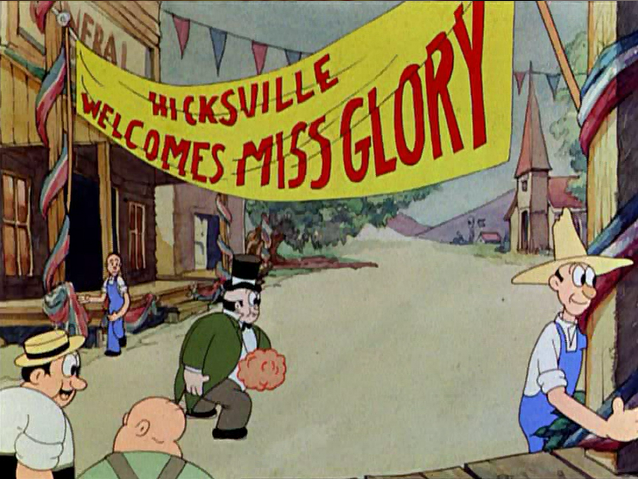
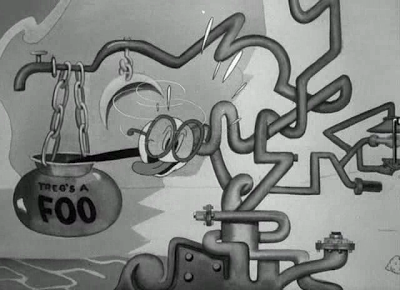
I like cartoons.  I grew up watching repeats of classic Popeye, Loony Toons, Woody Woodpecker, Droopy, Hanna Barbera, Japanese anime, and even Super Chicken.  And so, to provide a *ahem* service for the Filmspotting community, I watched a whole bundle of cartoons from 1957 and reviewed them.  For your reading pleasure, I share them with you, along with my rating out of five stars.  If you'd like to watch any of them, they are all available on YouTube under the name given.


The Candlemaker
A pretty standard Christian moral tale with a conclusion of working hard.  Occasionally the animation is interesting, but nothing exceptional here.  2.5/5


Ali Baba Bunny
A Bugs Bunny/Daffy Duck classic.  Some good laughs.  The tension the duck causes and the brains of the bunny are always enjoyable, and it’s a standard good time.  Hassan chop!  4/5


Piker’s Peak
The Bunny and Yosemite Sam, climbing the “Shmaterhorn”.   Sam is just sad.  3/5

Hooky Spooky
Casper the friendly ghost.  It started out so well, with a “night school” for ghosts, but as soon as Spooky wants to go to the zoo instead, the imagination ends. 3.5/5


The Story of Anyburg, USA
A Disney moral tale of who is responsible for good driving.  It’s not funny, and the point is pretty dumb, actually.  2/5

The Truth about Mother Goose
A history lesson on the background of three nursery rhymes by Disney.   Disney proves once again that they know how to educate better than anyone and that they really don’t know solid history.  Still, it was fascinating to watch. 4/5

Bedeviled Rabbit
Taz v. the Bunny.  Taz is smarter than he is in other cartoon, and it is better for it, although it really only makes him a substitute for Elmer.  Amusing.  3/5

Red Riding Hoodlums
A Woody Woodpecker knock off with his niece and nephew.  They try so hard and are occasionally funny, but they are just stealing jokes from Warner Bros, and the animation isn’t near as well done. 3/5

Byl Sobie Raz (Once Upon A Time)
A first effort by Polish/French director Borowczyk.  It’s got a lot of imagination put into it, but in the end it is simply too basic.  Not enough to keep ones interest even for its eight minute run. 

What’s Opera Doc?
Well, this is the star of the year, and no wonder.  It isn’t really funny, but it draws in a lot of elements—from Fantasia, Wagner and the basic plot from Bugs and Elmer—and it is dark.  Really dark.  It is the most different of any of the Warner Bros. cartoons, and the animation is truly artistic.  If you haven’t seen this since you were a kid, try it out.  (I still prefer Duck Amuck)   Kill the rabbit! 4/5

Romeo Rabbit
Elmer has to babysit a romantic (enormous) rabbit for his uncle who promises him 500 dollars to do the job.   Frankly, Elmer deserves every penny.  He forces Bugs to help him out, and Bugs at first is no match for the duo.  Of course,  he wins in the end.  A couple surprises, but a lesser Bugs. 3/5

Steal Wool
One of my favorite WB series is the Sam the Sheepdog and Ralph the Wolf (who is just Wile E Coyote behind a red nose).  These are just two working stiffs, doing their jobs, one to protect and the other to steal sheep.   The action between the bookends is pretty typical Road Runner stuff, except that Sam is almost miraculous in getting out of Ralph’s traps.  The ending of this one is one of my favorites. "Morning Sam."  "Morning Ralph."  4.5/5

Mucho Mouse
Time for a Tom and Jerry mini marathon.  Jerry is a Spanish mouse, who can never lose.  Tom is the champion mouse-catcher from the States.  Tom is too outmatched, it isn’t really fair and all the characters speak, which to me is breaking the rules.  I had no idea the series was created by Hanna Barbera, but this cartoon certainly has the look of later H/B series.  3/5

Tom’s Photo Finish
Spike is framed by Tom for eating the chicken, but Jerry has it all on film, and he begins placing copies of the photo all over the house where the masters will see them.  This is classic T & J.  And Tom doesn’t get beat up too badly.  4/5

Feedin’ the Kiddie
Jerry has a nephew visit for Thanksgiving, who is so focused on food that he doesn’t pay attention to the trouble he gets into with Tom.  I prefer the ones where Jerry actually has a challenge—he’s more fun on the defense than the offense.   3/5

Timid Tabby
Tom has his cousin George visiting, who is scared of mice.  Jerry thinks he can use this to his advantage, but because he can’t tell the difference between Tom and George, he is fooled.  Nice to see Jerry on the taking side for a change.  3.5/5

Tops With Pops
Tom and Jerry and Spike with his son Tyke.  Jerry hides with Tyke, whom Spike loves and protects from Tom.  Some good laughs here, although Jerry is infernally smug.  4/5

Give and Tyke
An unnamed dog is stealing Spike and Tyke’s dog collar so he doesn’t get taken into the pound.  While Spike’s voice is an imitation of Jimmy Durante, the unnamed dog is exactly like Yogi Bear.  However, Yogi Bear doesn’t appear until 1958, when Hanna Barbera open their own studio.  So this cartoon must be part of the vocal development of that most famous character.   There’s a lot of give and take here, but little decent comedy.  Still, this is historic, showing the development of MGM Hanna Barbera to their own studio work.  3/5

Scat Cats
Spike and Tyke have to keep a group of alley cats from getting into the masters’ house when they are away.  Another historic document.  Not only does the voice of Yogi return, but the alley cats clearly precede the series Top Cat, which began in 1961.  Some good laughs in this one.  3.5/5


Thursday, April 5, 2012

Paths of Glory: System of Leadership


The court martial movie is a well-trodden path.  And no wonder: it has the semblance of rebelling against authority, while supporting the system of authority.  It provides an opportunity for true actors to really shine in highly dramatic roles.  It has the best of both stage-- a presentation before a limited audience-- and the movies, providing context and drama outside the courtroom.  Some of the greatest movies have been court martial films: Mutiny on the Bounty, The Caine Mutiny, Breaker Morant, and A Few Good Men are among them.

Paths of Glory is certainly among them.  It stars Kirk Douglas as a Colonel in World War I, who is first ordered into a dubious battle and then forced to defend his men from accusations of cowardice.  Beside being a marvelous court martial movie, it  has one outstanding characteristic above the other films: it has amazingly good war scenes as well.  It isn't focused on the court, although it's focus is upon justice and the misuse of authority.  The most dramatic scenes are on the field.  Like another great war movie, The Life and Death of Colonel Blimp, PoG allows us to see inside the whole war machine, from those who command generals to the lowliest private.

The amazing thing about this film is that it doesn't just target a single bad commander.  Rather, it shows how the system as a whole is built to create those commanders to make decisions that unnecessarily costs lives.   How both a general and a sergeant are supported in evil decisions in order to cover their butt or to obtain a little more glory at the cost of many lives.  And it also shows how such a corrupt system cannot abide by integrity, nor even understand it.

And this makes Paths of Glory unique.  It isn't exactly an anti-war film, because Kirk Douglas, our hero and man of integrity, begins and ends a soldier.  And it doesn't just decry the misuse of authority.  Rather, it says that there is a systemic problem in all military leadership.  That is a remarkably bold statement.  Especially for a film made in the mid-50s.

I do wish that more of the supporting cast had been as stellar as some of the lead roles.  But the sound and cinematography are worthy of Academy Awards-- although the Academy didn't even give it a single nomination. The central battle scene is amazing and it seems to have influenced at least Spielberg, as I can see Saving Private Ryan and War Horse borrow aspects of it.   While not a perfect film, it's a keeper and worthy of the Kubrick label.

Oh, did I fail to mention that it was directed by Stanley Kubrick?