Showing posts with label John Wayne. Show all posts

Saturday, March 7, 2015

Stagecoach: The Breakfast Club of Classic Westerns

Stagecoach begins like a pulp fiction western. Geronimo is on the warpath and a set of stereotyped characters are all put on a stagecoach to travel through dangerous territory.

The Breakfast Club of classic westerns. So many tropes and types:
-The noble marshal
-The drunk doctor
-The prostitute with a heart of gold
-The comedic driver (classically played by Andy Devine)
-The lady with a secret
-The gambler
-The pompous financier
-and, of course, the just outlaw played by John Wayne
Put them all in what amounts to a locked room and you get some fun personality clashes.

In any classic western, you have to have landscapes, an Indian battle, fine stunts, lot of horses, a cavalry, and, of course, a shootout.


Most directors would just shake all the parts up and pour it out, but the writers put this one together carefully, creating a great blend of tension and comedy and enough character by-play to make it all interesting. Not deep, but a lot of fun.

Wednesday, July 18, 2012

The Searchers, Racism and Ethics


Scar, the brutal Comanche warrior
Amidst my friends on the Filmspotting Forum, there has in the past been a debate as to whether the classic John Ford Western is racist. 

It’s a very good western.  Most of the performances are weak, but the direction and storytelling are powerful.  The buildup to the first Comanche attack is a perfect example: The audience knows what will happen, but the family in the farmhouse doesn’t, but they gradually gain more signs and it builds until the oldest daughter screams.  What a perfectly done scene.

Our heroes?
The story is pretty basic:  John Wayne and his companion Jeffery Hunter seek out a kidnapped girl and perseveres until they find her.  It is the many details that make this film.  The hints of an old crush a woman has on her husband’s brother.  The casual avoidance of telling any details because of the horror seen there.  The occasional perspective of a woman waiting for her noble, tongue-tied paramour.  A couple characters that are Swedish immigrants.  Just as interesting is what the film doesn’t tell us.  We never find out what happened to Ethan in the three years between the Civil War and the beginning of the film, even when certain things are begging to be explained.  Nor do we find out what happens to Ethan after the film, although he was going to be taken to trial for murder.  Each detail means nothing in itself, but put together,  this film is a whole world, a complex of activity and life.

But is it racist?

There is no question that John Wayne is racist.  Not the actor, but his character in the film, Ethan.  A point is made of it in the film.  There is one group of Native Americans, the Comanches, whom Ethan completely despises.  He will kill them if he has a chance, his companion, Martin, is concerned about what he would do when he meets the Comanches and when another main character identifies with this group, he attempts to kill that person as well.

However, just because a character in a film is racist doesn’t make the film racist.  Martin, a fifth-blood Cherokee isn’t racist at all, and sees Ethan’s racism as a danger in their overall goal: to rescue the girls of a destroyed farm family.   Certainly in other films, pro racist statements are make more boldly, such as American History X or Do the Right Thing, yet the films are clearly anti-racist.  Just because a main character is racist doesn’t make the film so.
Ward Bond and John Wayne

The confusion comes in because of the strength of Wayne’s character.  John Wayne, as usual, is the strongest presence in the film, with only occasional scene stealing from Ward Bond, playing the Reverend Captain Samuel Johnson Clayton.   But, oddly enough, he is also often the wise and even the ethical voice of the film.  Ethan shows knowledge beyond what one might expect, including multiple languages.   He knows the habits and customs of many different cultures.  He knows when to allow the horses to rest and when an informer is really a betrayer.  Everyone else in the film is slow or simply average.  Ethan alone shines.

Perhaps Martin is the ethical voice.  He stops Ethan from killing and expresses more liberal values.  But if he is the ethical voice, it is a weak voice.  He is committed to doing right, but at the cost of his girl and the life they should be having together.  He returns home to disrupt her wedding to another man, and then he leaves again.  This seems like a strange action for a moral model.
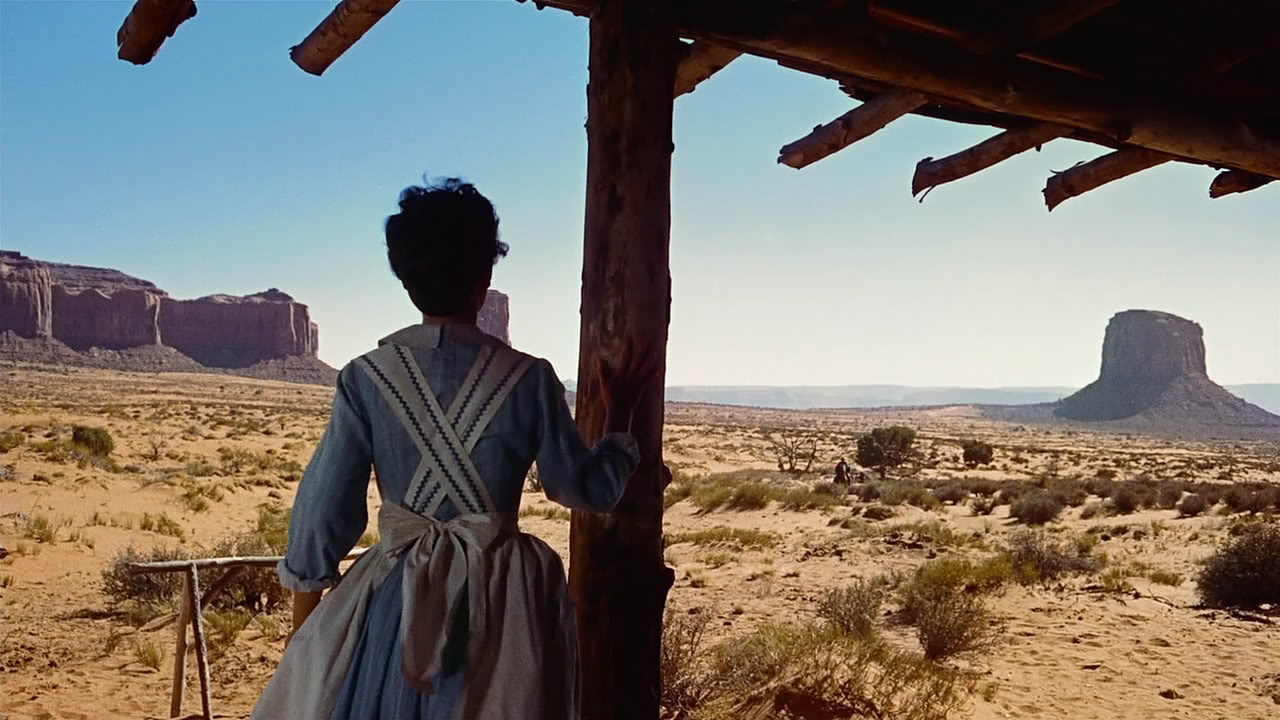
Monument Valley is the beautiful backdrop of the film

In the midst of a confusing mix of details, we could get bogged down for a long time.  Perhaps it would be better to focus on the main moral theme of the film, and see if we can make any headway there.

There is one strong recurring theme in the film, and that is family.  Martin constantly chaffs at the fact that Ethan doesn’t consider him family.  Martin was found by Ethan as a baby, and was raised by Ethan’s brother.  Yet Ethan makes a clear distinction between blood family and others.  There is a responsibility, an eternal loyalty to blood family, but others can come or go—it doesn’t matter.   Family was attacked, family values attacked and family loyalty is tested over a period of years. 

For Ethan, this loyalty to family extends to peoples.  Ethan has a great respect for almost all peoples.  They have their own values and culture and Ethan gives them enough respect to learn their languages and ways, so he can best communicate with them.  But when a member of his family verbalizes a rejection of their people, the Ethan must kill that traitor.  There are clear lines between peoples, and these lines must not be crossed, which is probably the reason Ethan has a hard time accepting Martin.  Ethan’s philosophy is a consistent one, and one’s loyalty to family is strongly connected to race, and thus to racism.

Martin, of course, voices a different way of looking at things.  He is mixed race himself, and believes that one’s family has more to do with love and connection rather than blood.   He searches with Ethan in order to protect the world from Ethan’s prejudices.  In this way, Martin is the most redemptive person in the film, the one with the noblest quest.  Nevertheless, the film is not really about his quest.

Natalie Wood as Debbie
In the end, which point of view wins?  The only way to determine this is to discuss the ending of the film, so if you want to avoid spoilers, please stop reading now.

Debbie, the kidnapped girl, is found by Ethan and Martin after years of searching.  When found, she meets them and tells them to go.  She has married a Comanche warlord and they are now her people.  This is when Ethan tries to kill her, but Martin stops him.  When the Comanches follow the duo, they find Debbie again, and after her husband is killed, she gleefully returns back to the European world, making it clear that she never wanted to be with the Indians at all.

I believe that Debbie’s decision indicates the leaning of the film.  She, too, holds to the same values as Ethan.  She is loyal to her family, and only rejected them to save their lives.  Her real people are the people of her blood, not the people she had lived with for so many years.  And the final scene, that of Ethan carrying Debbie away, is the glorious and right conclusion.  Blood is thicker than experience.

I will not go so far to say that The Searchers is a racist film.  It is not preaching racism, and it does have Martin as a counterpoint to Ethan’s extremes.  But it is a movie about blood.  How important it is to be loyal to blood.   How blood is more important than anything else.  This is not racism, but it is it’s cousin.  Because to demand loyalty to blood before all else is to make other relations secondary.  So the brother who is in need of a new car is a greater requirement to meet than the homeless man who needs a meal.  And the cheap oil one needs to give one’s family a better lifestyle is more important than the hundreds of thousands of non-Anglos killed for the sake of that cheap oil.

In the end, Ethan’s fate is left open.  So is the fate of his philosophy.  The film leans toward Ethan’s ideals.  As do most conservative philosophies and religions.  But  it is still possible that Ethan will be hanged for his murder.  

Thursday, July 21, 2011

Heroes: Gladiator and Lawrence of Arabia


In the ancient world, one of the most popular forms of literature was hero-stories.  Heracles was the greatest of these tales, but Theseus and Perseus were marvelous culminating in the epic of Odysseus.  The love of hero-stories has never abated.  One thing about us epic-loving, Hollywood-style film goers: we love our heroes.  We like them to be gruff, manly and ready to face down any and all dangers.  We love our heroines, too, they’re fine in their feminine, maternal manner (Ripley, Erin Brockovich), but heroes can get the heart pounding and ready to do battle in whatever realm we do battle in.  Indiana Jones, James Bond, Robin Hood.  Some actors are just destined to play heroes: Denzel Washington , John Wayne, Bruce Willis, Charlton Heston.  To watch them is inspiring and their exploits are powerful.


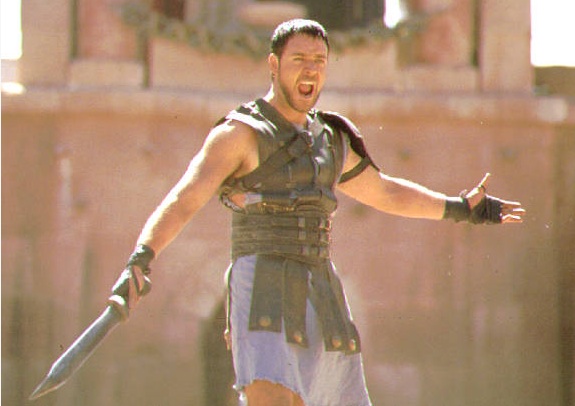
There is a form of epic which focuses on a single hero and really tells the story through their eyes.  This give us the opportunity and the story develops as we see the action from their persepective.  They are a kind of a bio pic, except often the hero is fictional (not that most bio pics aren’t fictional).  Frankly, the Ten Commandments is one of these stories, as well as Braveheart  and Rocky.  One of the great examples of a recent version of this story is Gladiator, the fictional story of Maximus, a general whose only desire was to go home to his wife and family.  Unfortunately, through political intrigue and the mechanizations of an evil Roman prince, he ended up without his family or farm, enslaved and forced to fight.


One of the great aspects of the film is the complexity of Maximus’ character.  His motivation shifts from scene to scene, even as our motivations for what we do changes in slightly different circumstances.  He isn’t bent on revenge throughout the entire film, neither is he some sad sack who just does whatever comes his way (of course, if that was the case, he’d make a pretty poor hero).  Even as a slave, he bends the circumstances around him.  And in the end, he turns the whole empire upside down.  


It is a marvelous performance by Russell Crowe, but even greater is the direction by Ridley Scott.  One of the most telling transformations is the brightness of Spain, even in the midst of overwhelming sorrow, to the darkness of Rome, despite the grandeur of a victor’s parade.   The way the story was told was perfect.  I watched the extended cut and while there could have been some trimming, there isn’t a scene that isn’t necessary, that doesn’t forward the story.  And while the conclusion might be inevitable, we believe that it was in serious danger.  A powerful film and worthy of honor.
Are you not entertained? 

One of the most powerful aspects of the film for me was the bloody entertainment that was demanded.  The people wanted blood, wanted death and the master of the gladiators (masterfully played by Oliver Reed) gave it to them. But isn't this the position of Ridley Scott as well?  Isn't he just granting his audience what they wanted, even though it is a bloody, horrific show?  Yet, the film implies, to woo the populace with blood is akin to democracy, the hidden secret of power.  Whether warriors or gladiators or heroes of any sort, this is the stuff of power, the building blocks of nations. Ultimately, a nation is a shared narrative of heroism that a large group of people all sense that they participated in.  


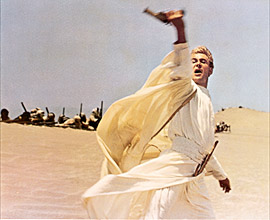
But the greatest cinema hero, in my estimation, was the focus of David Lean’s epic of 1962: Lawrence of Arabia.  The debate over the “true” Lawrence is due partly to the power and majesty of this film which depicts Lawrence as a charismatic genius, tortured megalomaniac, brilliant madman and physically impervious warrior, who died in a motorcycle wreck near his home in England.  The film not only depicts Lawrence as changing but as contradictory and impulsive. 


Most heroes, like Maximus, are solid, powerful, a brick wall. O’Toole’s Lawrence, however, is sometimes  doubtful and broken.  His greatest later deeds would not have occurred were he not coerced by those around him.  Lawrence of Arabia’s approach seems more realistic.  A hero is not a hero on his own, but must have support and help to be that hero.  And once that support falters, so does the hero.

Peter O’Toole of course deserves acclaim, but so do his co-stars Omar Sharif, Anthony Quinn, Alec Guinness and Jack Hawkins, who try to piece together Lawrence even while they try to manipulate him to their causes.   The great mystery of the film is who Lawrence was, what made him tick.  It seems that the answers the film gave was adventure and glory.


But I think a significant aspect of the film is the un-ending self-confidence of the man.  That no matter how many obstacles or failures Lawrence faced, his achievements occurred because he knew that they could be done by no one else but himself.   That no one else would even think of them because they were too outlandish to even consider.  Only a man who knew he could not fail would succeed in such accomplishments.

One of the last lines in the film give us wisdom about heroes and what they can actually accomplish: “Young men make wars, and the virtues of war are the virtues of young men. Courage and hope for the future. Then old men make the peace. And the vices of peace are the vices of old men. Mistrust and caution. It must be so.”  Heroes are powerful, but heroes cannot build community of normal people, because, frankly they are not normal and do not know how to be normal.  Heroes do great things and accomplish much.  But when it is time for small things, heroes are not welcome.  In the end, heroes must fail.  Their accomplishments must rot.  Were it not for these heroes, the more solid, quieter accomplishments could not have occurred.  But they must step aside.


For this reason, in both of these films, the hero must do what they must do and then step aside.  Even like The Man Who Shot Liberty Valance.  In order to accomplish a greater, more peaceful West, John Wayne must do his accomplishments and step aside for Jimmy Stewart to be the statesman.   A true hero knows when to change the world, but also when to ride into the sunset.