Wednesday, July 3, 2013

Ambition and Sustainability: Princess Mononoke

#29—Princess Mononoke

Princess Mononoke is the most male-oriented of Miyazaki's films.  It has a lot of action, and although there is a love story, it isn't a significant part of the plot.  It is seen through the eyes of a young man, and it certainly is more gruesome than other Miyazaki. 

Alongside of Spirited Away, this is Miyazaki's most visually stunning films.  Every frame has so much to see and as ugly as some of the action sequences get, so many of the forest scenes are gorgeous.  Every movement is perfect, every background communicates as much as the foreground focus.  You could just turn the sound off with no subtitles and it is amazing to watch.

The setting is ancient Japan, just at the beginning of industrialization.  Gods roam the countryside, and every healthy tree has a spirit living with it.  The plot is focused around the wanderings of Prince Ashitaka, who is forced out of his idyllic home because he was cursed by a demonized boar-god. He gets involved in the ongoing battles of the up and coming industrial Iron Town and the gods of the nearby forest.  Ashitaka tries to remain neutral, but finds it difficult after seeing the desires to thrive on both sides of the war, and he is torn by the hatred on both sides.  And there are, of course, complications.  For one, he has fallen in love with a human on the forest side, San, who grew up with the wolf god.  And the Emperor, seeking the key to living forever, has sent a monk to retrieve the head of the forest spirit, which has the power of life.

For many of Miyazaki's movies, I think of them in pairs.  The partner to this one is Nausicaa.  They both deal with wars between communities and the connection between nature and humanity.  The great evil of Nausicaa is fear, while in Mononoke it is hatred.  At one point Ashitaka breaks up a fight between San and Lady Eboshi, saying, "You both have the same spirit," meaning hatred.  It is hatred that causes a god to become a demon and hatred that causes a human to become a monster, even if their appearance does not change. 
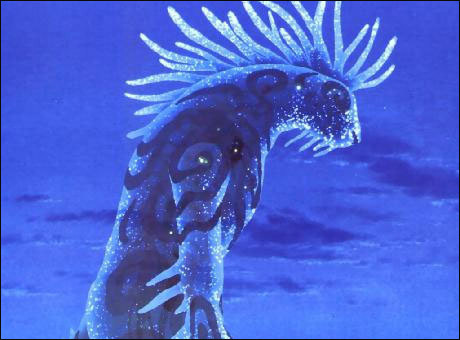
The point of the movie, as with Nausicaa, is that nature and humanity should be working together for the benefit of all, rather than battling each other for limited resources.  Ashitaka yells out at one point, "Why can't humans and the forest live together?"  Ashitaka is seen with distrust from all sides because he won't take a side.  But in the end, at least Lady Eboshi considers rebuilding Iron Town in a way that would not harm the forest.

Although Nausicaa takes place long after Mononoke, I think it is better to see Nausicaa before Mononoke, because the potentially idyllic relationship between humanity and nature is more clearly seen there, and the tradgedy of Mononoke can be better seen in this light. 

A question one might come from the film: "Why is it called Princess Mononoke?  She seems more like a supporting character."  I think the key is in the term.  "Mononoke" is not a name, but a word that means "spirit" or, more tellingly, "monster".  The title obviously applies to San, being as much wolf as human and siding with the spirits in the battle.  But the term also applies to Lady Eboshi, who is a marvelous ruler of her town, but when she is ruled by hatred then she is monstrous, horrific.  They are both a "princess mononoke" and it gets to the heart of the film.  For the true monster is the one who is filled with hatred for either humanity or nature-- the one who is controlled by hatred and pours it out on one's enemy. 

Because of this, I think that Lady Eboshi is the moral heart of the film, the driving force.  At first she truly does seem like a monster because from the perspective of the forest, she is ambitious, and doesn’t care what she harms in order to meet her goals.  But she is not a monster, rather she sees the needs of her people, and is just seeking peace and sustainability for them, not knowing that there is another equally sentient people that she is harming.  She and Sen despise each other and each other’s people’s because they see their opponent’s people as less than sentient, less than “human”, less than fully moral.  They hate because they do not recognize the other as an equal.  By the end of the film, Lady Eboshi especially realizes that both peoples are equally “human” and that her ambitions for sustainability can also embrace the forest.

It is easy to say that Miyazaki’s ideal is to have town and forest live together in harmony (which I just did up above).  But more than this is the ideal that the inhabitants of town and forest are equally deserving of peaceful life, and that any ideal of sustainability has to include all inhabitants of the land, not just the humans.

When I first saw Princess Mononoke almost ten years ago, I didn't find it that great.  The themes were beyond me, I think, and I couldn't grasp whether the movie was ugly or beautiful.  After seeing so many other Miyazaki, however, I can understand it better and appreciate it much more.  It still has weaknesses: I think that the motivations of the characters, especially Ashitaka, are unclear, and I spend part of the film in confusion. 

Nevertheless, I can now see that it belongs with the top Miyazaki films.  It enriches Miyazaki themes, and displays the power of animation in ways that few films can.  

Humanity and Nature: Nausicaa of the Valley of the Wind

#3--Nausicaa of the Valley of the Wind

Someone once mentioned that it is a pretty long title, but with Miyazaki one must expect that occasionally, such as Ponyo on the Cliffs By the Sea.

Nausicaa is Miyazaki's second feature film, and the first that begins using the themes that reflect his later films, among which are relationship between humanity and nature, flying machines, and war. It is based on a much longer, more complex manga written and drawn by Miyazaki.

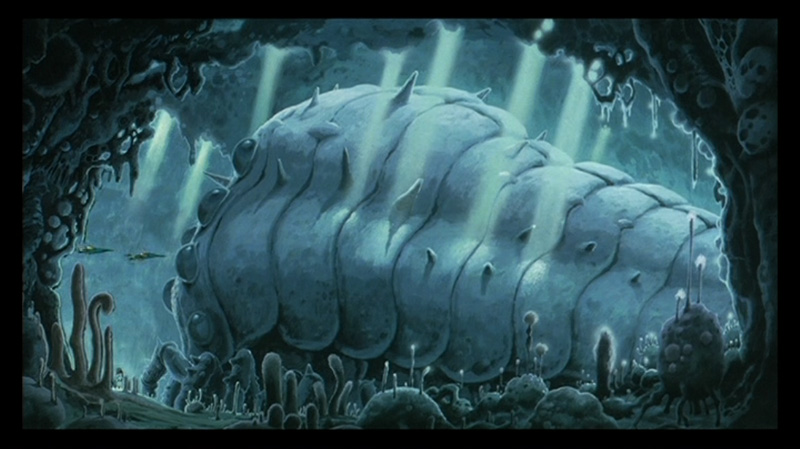
Nausicaa takes place a thousand years after human war has poisoned the soil of earth to such a degree that poisoned jungles grew up, insects became gargantuan and huge protectors of nature were created-- Ohms.  There are a number of human kingdoms, but the film deals with only three, Tolmekia-- a war-like kingdom that wants to rule the others; Pejite, the sworn enemies of Tolmekia; and the Valley of the Wind, a struggling utopia that gets caught up in the other kingdom's war. 

Nausicaa herself is Miyazaki's saint-- the ultimate peacemaker.  She is frankly an ideal Buddhist saint, who communes with all creatures, and seeks to make peace with all.  She is especially focused on creating harmony between humanity and nature, trying to heal the 1000 year old rift.  Throughout that thousand years, the poisoned jungles and humanity have been warring with each other, each attempting to overthrow the other's rule.  Only Nausicaa realizes that humanity would perish without the jungle and that the jungle can flourish under humanity's enlightened guidance.  Nausicaa is somehow able to understand the true nature of whatever she is facing.  Instead of reacting to a threat, she responds to the fear behind the threat.  Instead of seeing the death of the toxic jungle, she sees the beauty of it.  She works with the nature of whatever is before her in order to create harmony with all creatures.

Like all saints, Nausicaa presents us with an ideal of how humans should live.  We, as humans, should seek to discover the true nature of what is around us, whether human or natural, and respond to all with the care that they need. Sometimes she has to seek that true nature with research, such as the toxic forest.  Sometimes she responds with intuition, such as the fox squirrel.

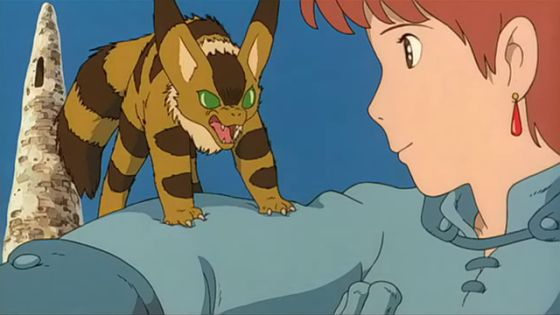
Honestly, the scene with the fox squirrel both amazes me and it is symbolic for the saint-like way Nausicaa acts throughout the film.  Master Yupa warns Nausicaa that the fox squirrel is dangerous, but she treats the small creature as if it were the cutest thing in the world.  To prove Master Yupa correct, the fox squirrel bites Nausicaa on the finger and won't let go.  But instead of reacting to her pain or to an attacking creature, she still coaxes him, comforting him.  She understands that his attack isn't personal, but a reaction to his fear.  She allows him to attack her, with no repercussions so that he can know that whatever he does, he has nothing to fear. Fear is the source of harm, the source of attack and oppression. Throughout the film, Nausicaa is placing herself in harm in order to convince others that there is nothing to fear, no need to attack or oppress. This is peacemaking in action.

On the surface, this film seems weaker than other Miyazaki.  Most Miyazaki are amazing in the detail of the world that was created for the film, and Nausicaa is no different in that.  But the dialog is less rich and entertaining, the colors seem washed, and the style of animation is not as fluid as other Miyazaki films.  Part of this, though not all, is due, I think because Miyazaki is trying to communicate the bleakness of the world in disharmony with nature.  War-- both human and natural-- has taken its toll, draining life from everything.  At the end of the film, [spoiler]after Nausicaa's messiahship is realized[/spoiler], the colors suddenly are brighter and everything changes. 

Despite it's weaknesses (including a truly lame 80s score), this film is one of my favorites of all time.  Despite it's bleakness, it is possibly the most joyful and optimistic of Miyazaki's films, and it plots out the general outline of hope for the future.  Other Miyazaki films may communicate that war is bad and that bad guys aren't really all that bad, but this film actually lays out what would need to be done to end war, to change people's hearts.  It isn't childish in any way, nor simplistic, if perhaps naive.  It communicates that self sacrifice, listening to the another's heart, boldness for another's good and some basic reasoning can create a path out of the bleak world.


Perhaps I like this film because it is very much a religious philosophy I agree with.  Perhaps it is because Nausicaa is such a strong character that to me she is the perfect moral hero.  But with each time I watch it, the higher my estimation of it is.

Friday, June 28, 2013

Samurai Psycho: Sword of Doom

If "Sword of Doom"  (1966) were a title for a fantasy for sci-fi film, it would be awful.  But if it's a samurai film, you've got to give it a chance, because it could be great.  Especially because it is certainly not the original film title.  The original title of Sword of Doom is actually, directly translated from Japanese, Great Bodhisattva Pass.  Okay, so that's not such a great title, either.  But my friends say that it's worth giving a shot. 

And I'm glad I did.  It is amazing.  The darkest samurai film yet.  Samurai-noir.  The Psycho of samurai films.

Ryunosuke Tatsue is a samurai of the 17th century, and he is cruel.  It is the adjective applied to him again and again.  And it cannot be denied that if there is a way to grant more dishonor to his opponent, he will take it.  And he has a really unique style of swordplay, in which he mimics a fish out of water, ready to be gutted and just as his opponent comes close, he guts them instead.  It never loses.

This is a character study of this man, and a study of how his opponents try to finally defeat him.  As a study of an evil character, this is one of the best.  There are points in this film that can be compared to the dark view of Unforgiven, but frankly the character portrayal here is better, less obvious. 

The final quarter of the film it blossoms into one of the best films I've ever seen.  The acting is superb, and the descent brilliant.  The use of the camera and shadows are fantastic, as well as the scenes in the snow.  Darkness descends and no one escapes it. Nakadai helps us see aspects of the character not in the script by his subtle but powerful face expressions, even though his body can remain completely still.

Another great aspect of the film is the balance between story and choreography.  I love the fact that in samurai movies it isn't all about the battles, but about character and relationship.  But you know, I like a good duel as well.  In many of the samurai movies I've seen recently, choreography has taken a back seat to story, and this isn't bad, but let's say that it's a bit disappointing at times.  In this film, the duels and battles are fantastic, intense, and the story is suspenseful and as dark as they come.


I am shocked I would be saying this, but I'll have to put The Sword of Doom above Harakiri for great samurai flicks (but still below Seven Samurai).

*** Spoilers below ***


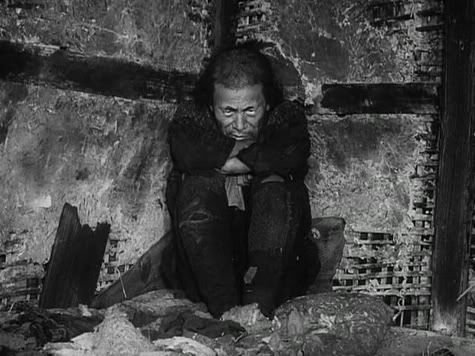
One of things I love about this film are the deeply disturbing things that Ryunosuke Tatsue does.  He kills pilgrim in cold blood.  He accepts sexual favors from a man's wife to keep her husband from losing a match, and then he kills her husband in the match.  He accepts her as a mistress, only to remain aloof and hateful and he eventually kills her, leaving her infant screaming alone in the night.  And he does all this with a cold lack of consideration that one might give the dispatching of a gnat. 

If you know me as a reviewer, you might think that this is exactly the kind of movie I wouldn't care for, focusing on such an evil character.  Well, there are good characters that play out in his story, like the noble sensei played by Mifune or the young samurai that must confront him against all odds.  But frankly, it is Nakadai's character that strikes me.  Yes, he is an evil man, but in unexpected moments he would realize that something is wrong about his approach, his life.  For instance, the scene where Mifune must fight off a horde of samurai assassins, Ryunosuke is motionless, struck with the impact of what played before his eyes.  

Why did he stop?  Why didn't he simply run, since he didn't want to participate in the assassination?  Why didn't he go ahead and finish what was started?  Some say because he realizes that he could have been defeated.  But I wonder if that is his focus.  He seems horrified.  Perhaps it is the beginning of a moral conscience.  He had said before that they shouldn't fight if their target wasn't there.  Mifune was there instead, and his fellow assassins decide to attack.  Perhaps he is beginning to see what an evil act actually looks like. And perhaps he is realizing that he has participated in such acts himself.

If that is the case, it opens up the final scene of the film more.  Ryunosuke is sitting in an off room in a brothel, waiting to fulfill his latest assassination.  Suddenly ghosts appear which frighten him terribly.  Who are these ghosts?  The souls of those whom he had killed.  But these ghosts weren't there, they were only in his mind.  A man such as he develops irrational guilt along with a moral conscience.  And these ghosts lead to his destruction.  We see him participate in a long swordfight with many opponents, and it looks hopeless.  But before we are sure, the movie ends.

I guess this movie was planned to be the first film of a trilogy.  It is actually based on what was, at the time, the longest novel ever written (1553 chapters long), and it was certainly supposed to continue.  It makes me wonder, where would the story have gone?  Would Ryunosuke have survived this attack, and develop his moral character more?  I can only guess that this would be the case.  How I wish it had been continued.

However, even with the ending being somewhat ambiguous (or at least abrupt), I still think this is a masterpiece of a samurai film, and a masterpiece of moral instability.  


Wednesday, June 26, 2013

The Fictional Life of a Real Samurai Master: The Samurai Trilogy

The Samurai Trilogy is a three-part story of Musashi Miyamoto, one of the greatest samurais in history, and author of The Book of Five Rings, a classic book of strategy.  The trilogy certainly presents a heroic figure, staring the John Wayne of Japan, Toshiro Mifune, but it also deals with his failures, his weaknesses and his learning process.  In a sense, it is a class of how to be a samurai, but more significantly than that, it is a number of lessons of how to live an honorable life.

In a sense, the film trilogy presents a Plutarch biography, full of moral lessons we can take home and learn from ourselves.  If this makes it feel like a novel written by William Bennett, I suppose on occasion it feels like that, but overall, it is more complex and less straightforward than a simple morality tale. Certainly a couple of the performances make it a worthwhile and entertaining watch.

Samurai I: Musashi Miyamoto (1954)
The first part of the Samurai Trilogy, and it feels very much like an introduction.  But it is a snappy introduction, one with character and growth and power.  And, frankly, a couple twists I wasn't expecting.

It is about the making of a samurai.  Even if a person has talent with a sword and in fighting, this doesn't mean that he is a samurai.  There must be discipline.  But if one has no master, how do you learn that discipline?  Where does discipline come from?

It comes from noble character of those around you.  One must have a character of gracious punishment-- not wanting to destroy you, but to build your character into strength.  And one must have a character of merciful love that coaxes you and upholds you and desires your well-being at all time. 

We see these two elements at work in this film, as well as that which destroys our discipline: weakness, betrayal and harsh punishment.  Although this is the story of one specific and fascinating character, it is also the principles of every person of strength.

Samurai II: Duel at Ichijoji Temple (1955)
The second of the Samurai Trilogy by Hiroshi Inagaki.  The powerful swordsman, Musashi Miymoto, continues on his journey to be a great samurai.

I have to say, though, that I'm beginning to think that his standard of being a samurai is pretty high.  I mean, at the beginning of the trilogy, he was an amazing swordsman-- no discipline, no master, but still.  Okay, he wasn't a good samurai then, but by the end of the first film, he's got everything he needs and will make some master proud.  But no, he's got to be better than that, he's not ready to be a real samurai yet.  So he leaves his girl and goes off to learn to be samurai.

This film begins three years later.  His girl is still waiting for him by the same bridge he left her, his faithless friend is still faithless and he still doesn't consider himself to be a good samurai.  Why?  Because he's TOO strong.  Too confident in his own skills.  What?  Really?

Nevertheless, this film has more to do with his failure as a lover.  Women throwing themselves at his feet, and he wants none of it.  As he tells his girl, "I thought much about you.  But I have to choose between my love for you and my love for my sword."  Guess which he chooses?  Wow, what an idiot.  The real question is: Will the love of a woman save him in the end.  I'm not telling.

I would write this one off, but it's Mifune.  Dang, how I love Mifune.  He was good in the first film, but in this film he's a movie star and he knows it.  He's John Wayne and Charlton Heston and Clint Eastwood rolled up into one.  I think I've got a little man-crush going on here.  It's a good thing because he's in a lot of these films in my samurai marathon.

Samurai III: The Duel at Ganryu Island (1956)
"If you wanna be old school about it - and you know I'm all about old school - then we can wait till dawn, and slice each other up at sunrise, like a couple real-life, honest-to-goodness samurais." -Kill Bill Vol 2

The Samurai Trilogy concludes, and I have to say that I held my breath right up to the end.  Given that it's a 100-minute film, that's no mean feat.

As an epic, the Samurai Trilogy is slow and drawn out.  It really didn't need to be three full-length movies... or it should have incorporated more of the book to flesh it out a bit.  

But as an essay on honor, it does quite well.  I am beginning to understand that the best of samurai movies explores honor, what it really means and how many people can proclaim honor when really they are simply ambitious and full of pride.

Since the Trilogy explores the growth of a single character, and his determination to be a samurai of the highest honor, we see a lot of exploration of this theme in different contexts.  Honor in battle, honor in enmity, honor in promise-keeping, honor with the opposite sex, honor as a samurai, honor as a peasant and even honor as a brigand.   The scope of the subject is massive, and goes much beyond the limitations given in most samurai films-- that of the life of a warrior.

At the same time, I wonder if the whole trilogy explored the concept of honor as deeply as Harakiri did, in a much shorter running time.  Harakiri also upheld the idea that honor is not only a saumrai code, but the code for a father, husband and community.   And while the trilogy explored certain unique concepts-- can honor truly thrive while one remains overwhelmingly strong?-- but Harakiri explores many of the same ideas, but in subtler and more thoughtful ways.

I appreciated the conclusion of the Trilogy, and what it seemed to be saying.  But I wonder if I wouldn't have a more thoughtful presentation of the life and character of Musashi Miyamoto if I had read the novel.  Perhaps I might read the graphic novel The Book of Five Rings, a re-telling of the life of the real Musashi Miyamoto.

Tuesday, June 11, 2013

Steve's Summer Samurai Spectacular! Part 1

Mifune, don't be a hero! Too late.
I have made a momentous decision: This summer I will have a marathon of Samurai Movies!

I don't know why.  Why does anyone do anything?  I like samurai movies, I don't feel like I've watched enough of them, and now's as good as a time as any.

I will be watching a number of films I haven't seen before, like The Samurai Trilogy and Sword of Doom.  I will probably drop in a couple favorites I've already seen like Ghost Dog: Way of the Samurai and Seven Samurai.


Here's a couple reviews to get us started:

Harakiri
All I can say is, watching this at the beginning of the marathon, it will be a tough one to beat.

The best of all possible movies is a marvelously scripted one which is marvelously played by marvelous actors.  And that is what we have here.  The script unfolds like Rashomon… or perhaps like the end of a Colombo mystery… step by step pulling us in, revealing to us a bit more truth.   This is the very rare samurai movie where action is almost unseen because it is about people and events, carefully plotted, carefully paced.

The centerpiece performance of the film is played by Tatsuya Nakadai, who here is equal to Mifune at his best.  In fact, I wonder if Mifune didn’t borrow some of Nakadi’s inflections for his performance in Red Beard a few years after Hara-Kiri.  But I also have to laud Rentarō Mikuni, who played, but didn’t overplay, the perfect foil.   The conversation between these two was not only believable, but grew in intensity as the film wore on.

I'm ready!  Where's the ice cream?
The only weakness I would have to give the film is the choreography at the end.  The action suited the plot well, but it was simply unbelievable.  Let’s face it, our hero should have died many times over, and it was obvious with what we saw.  But that’s just five minutes of cringing for me in the midst of two hours of 12 Angry Men-level  performance.  It’s worth it.

One thing I noted is the placement of this film historically.  It speaks of the habit of ronin (masterless samurai)  asking to commit suicide in a town in order to obtain money.  This particular town is horrified at the dishonor of the samurai and determines to force honor, even if the samurai has no honor themselves.   This film was made in a time when Japan’s suicide rate soared, and people were desperately impoverished after the end of WWII.  I wonder if the film isn’t encouraging those contemplating suicide to not do so, but to fight back.
But even today, it speaks to  all societies of a too-high code of honor and how that effect the most vulnerable parts of society.  

Ichi

As much as Hara-Kiri wasn’t about the choreography and battles, Ichi is full of them, with plenty of blood to go around.

Ichi is a goze, a blind woman who has learned the trade of playing her musical instrument in order to make her living.  And she also learned a few tricks with her hidden blade in order to protect her from unwanted attentions.  In these tricks, she is a master and always takes her opponent by surprise.  She runs across two friends,  Toma, a samurai inflicted with trauma, and Kotoro, a boy who wants Ichi to be his stepmother. 

"Good thing I saved you back there"
There’s some fun action, but the plot is full of tropes from the Zatochi stories as well as Yojimbo and the occasional nod to spaghetti westerns and John Ford.  In the end, this is a comic book, and it has the feel of one.  It is interesting that it is distributed by Funimation, a company best known for their anime series, because this film could easily be one of their middle-of-the-road series.  Most telling is the bad guy, head of a series of bandits that have overrun the inn town.  Honestly, he reminds me of no one else more than Quentin Tarantino, the actor.  I mean, really, did he look at Tarantino’s films and say, “I want to be just like that guy.”  Not just when Tarantino is trying to act, but in his most gut-clinching overdrawn performances.  Wow, that was bad. 

There’s nothing believable here, but it’s still a decent action flick to while away the time.  3/5

Mild Spoiler:

P.S. I almost forgot my favorite part of the film where they keep looking for an unnamed blind samurai.  They never find him, but find out that he passed away before the film began. If you know your samurai lore you know that this is Zatoichi, the famous blind samurai.  Awesome

Saturday, June 8, 2013

On the Edge Between Truth and a Lie: Close-Up

Sabizan, the deceiver 
Close-Up (1990) could also have been called, "This is not a documentary."  Although based on true events, and the central act actually is a filmed courtroom trial, Kiarostami directed all the events of the film, creating a fictional, at times poetic account of a man in love with art.

Yet the direction on the fly (the film was invented and filmed in a month) proves Kiarostami's genius, for it is focused, touching and full of small touches that make this film brilliant.

Kiarostami, the storyteller
I don't know who I will remember more: The sensitive Sabizan who presented himself as a famous director in order, for a while, to not be the poor, unemployed divorcee, but a man with artistic vision and power;  or Kiarostami, who manipulates every event for his own artistic vision-- whether a courtroom or the very subject of his story.

In the end, Iranian cinema is balanced on the precipice of truth.  We are presented with a photograph, but it is clear that it has been shopped.  We are left with many questions:  Why was it shopped?  What was the original like?  Why did they want us to know it was shopped?  What is the truth we are supposed to see?  Or do any of these questions really matter?

I can't help but wonder if the Iranian fixation on truth and lie, hypocrisy in art, has something to do with the state of the nation they live in.  Every day millions of people are forced to live a lifestyle.   Even if people agree with this lifestyle, the fact that it is forced upon the populace means that everyone feels like a hypocrite, as if they are only living a hyper-religious life because there is societal pressure to do so.  Is this really hypocrisy?  Does it matter, since everyone is living out certain principles, whether they agree with them or not?  In the end, just how important is sincerity?  Perhaps it is enough to say that we are how we live, even if how we live isn't how we intended to.

Even so, Close-Up is a humane portrait of a man fixated with art.  Yes, there are layers here, but perhaps, in the end, the layers mean nothing.   4.5/5

An excellent article on the making of Close-Up (please read only after having watched the film) can be found here

Thursday, June 6, 2013

Human Garbage: The Lower Depths

Very theatrical, great stage, great script, fantastic actors.  It hardly matters what else you put in the film, that's seems like enough.  But that's not all that's here.

It begins darkly, letting us know that our setting is considered a garbage heap, and our focus characters for the next couple hours are garbage.  But they are deeply human garbage.  The brutal thief in love with the oppressed inn girl.  The drunk actor, the angry tinker, the dying wife, the commitless gambler, the wise old pilgrim.  And, of course, the greedy innkeeper and his faithless wife.  Garbage?  Perhaps, from one perspective.  But reflections of our true selves, enhanced by poverty.

This film is really all about hope.  Yes, a few glory in their past, but for most of the poor, hope is their bread and butter.  Hope for more money, for a good spouse, for sobriety, for complete rest.   Just as the poor today might hope for the lottery or for someone to give them a safe place to sleep.  It is said that hope does not disappoint, but the poor know better.  Hope is rarely realized when you are impoverished.  But that doesn't mean that your life isn't about that hope.  Even when you understand that hope is a lie, you cling to that lie because without it despair floods you and you are over.

The most wonderful aspects of this film is when it suddenly turns vaudeville, as if Kurosawa invited the Marx Brothers in for a scene or two.  There is singing, running, dancing and silly humor.  Because, as Sullivan's Travels reminds us, what the poor needs most isn't money, but an opportunity to laugh and to forget their troubles.

A very wise, very entertaining theatre piece.