"A movie review is a reflection of your life." -Michael Phillips
What's my spin? I'm often looking at film from an ethical (not moralistic) stance. What does a film communicate about right and wrong especially in relationships?
This movie was made for activists, presenting the ideas of
an extreme activist. I'm a moderate activist, myself, but I've spoken to the
extreme folks and I get it. Here's the basic viewpoint: The United States is
falling into poverty because of leaders who are taking resources and using them
for nefarious purposes. They are paying off people who might whistleblow and so
keeping them quiet. Meanwhile, your average person is on the edge of being
homeless, pushed around by those in power, numbed by television and other forms
of mass media which convince us all to consume and obey the powers.
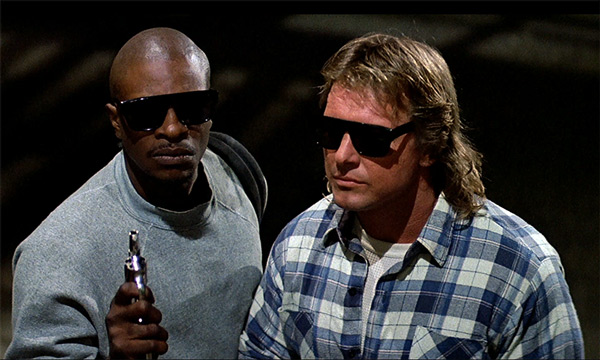
Of course, since They Live is a science fiction story, the
leaders are alien businessmen and you need a pair of special glasses to see
what's really going on.
In one sense, They Live is a spoof of this viewpoint, and a
comedy. Two guys spend almost ten minutes in a fistfight, trying to get one to
put on a pair of sunglasses, after which they are the best of friends, walking
around with bruises and puffy faces. I'm still laughing at the ridiculous of
that scene.
On the other hand, the insidiousness of the paranoid
scenario is scary, because it is partly true, and we know it. All I have to do
is mention Dick Cheney or Edward Snowden and we know that there's something to
it. That same fight scene touches something deep, because the man who won't put
on the glasses knows that this new knowledge of the world will change him,
place him and his family in danger, and so he desperately is resisting that
insight. He has too much at stake.
But the knowledge is there, in the real world, and sometimes
we can't avoid it. We will often stumble upon it, pursuing our own interests. I
am involved in homelessness and I know that there are blocks to certain kinds
of homeless folks ever succeeding to fit into society, even though they are
doing nothing wrong. I also know that others are being paid hundred thousands
of dollars a year to shuffle homeless people from one street corner to another,
and to make it look as if they are really accomplishing something. I personally
know pastors and churches who are professional level societies, who talk about
justice and peace, but won't do anything about the beggars around their corner.
But I also know that this is nothing new. The issues of
homelessness and of white trash are older than the discovery of America. I wish
that we could blame our callousness and ignorance on aliens or the Illuminati
coming to take our resources. But more often than not it is bureaucracy that
stands in the way of relief. I wish that we couldn't see the messages,
"Sex is success" or "conform" without a pair of glasses on
every magazine. But it is all human, all coming out of our everyday natures. It
is all easy to see, if we would but look. The ignorance is within ourselves,
because, like Frank, we'd rather be secure than know. Because if we admitted
that we really knew how evil our culture was, then we'd have to do something
about it.
As far as the film itself, it is really well done, balancing
the two sides of hinting at paranoid reality and laughing at the same point of
view. There is but one problem: the lead actor. Roddy Piper as the lens through
which we see this world is a very poor choice. He can't even rummage through a
box of glasses believably, let alone give us a believable line reading. Never
have I missed Kurt Russel more.
In the ten commandments, the word “adultery” is used
exclusively for the breaking of a marriage covenant through
unfaithfulness. In Leviticus 18, there
is a long list of other sex offenses, including incest, homosexuality and
having sex with one’s wife while she is on her period (don’t ask me, I’m just
letting you know).
Interestingly
enough, in Christian ethical discussions, one of the main sins that fall under
“fornication” is sex before marriage.
The Bible does speak about this.
It assumes that a man would want a woman who is a virgin when they are
married and if a bride deceives her husband about this fact, then she might be
killed. If a virgin is raped, then the
man’s punishment is to marry her. Let’s
just say that those were different times.
The Bible doesn’t come close to speaking of the situation in
this context. Magdla (named after the
“prostitute” in the Bible, Mary Magdalene, who wasn’t a prostitute at all, but
possessed by seven demons), has a boyfriend or two, with whom she romps gladly
in bed. She leaves the curtains open,
not only because she is on the third floor of her apartment, but because she is
open and not ashamed of what she does.
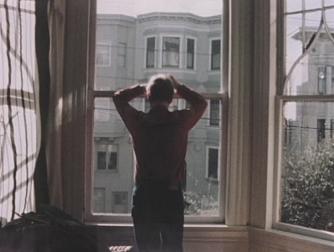
Tomek (possibly named after the Bible’s doubting Thomas?) has stolen his
friend’s small telescope and spies on Magdla from across the courtyard that
separates their two apartment buildings.
But this peeping “Tom” is not only looking, but he enacts his obsessions
with her in other strange ways. He sends
her notices, that informs her to go to the post office where he works to obtain
money; when he sees that she has a lover with her, he might call the gas
company to tell them her apartment has a leak; he gets hired as a milkman so he
can ask her questions in the morning, allowing her to talk to her. Frankly, he’s not healthy.
Finally, he is caught, and he confesses to her his
spying. She is offended, and then
bemused. She sees him only as a bundle
of hormones, quivering with sexual tension.
He assures her that he is not, that he only wants to go out on a
date. But his humanity is blocked by her
previous encounters with men, convinced that sex only has to do with a physical
need and the release of tension. There are three “loves” in this “Short Film
about Love”: lust, romantic love and a third: the recognition of the person
before us as an equal human being, a person of value and substance. Magdla doesn’t experience that third love
until the end of the film.
As much as this film is about love, it equally seems to be
about privacy and shame. Magdla flaunts
that which most people consider to be private, and she sees herself as very
open. Tomek is full of shame and is
always in a dark room, behind doors, fearful of what would happen if his secret
were known. But it turns out that his
greatest fear isn’t to be found out, especially by the focus of his love, but
to be spurned and mocked. To have his
most precious private thoughts cast back at him with spittle. He is private, not just due to shame, but
from protection, for if his love were laughed at, then the structure on which
he has built himself would collapse.
This film is a tragedy, not unlike Romeo and Juliet, two
people who are torn apart by assumption and misunderstanding. It is a perfect film, without a single extra
scene, a gem of plotting and character building.
The Dekalog, a Polish TV series by famous film director
Krzysztof Kieslowski, is an odd duck. It
is ten hours with ten stories, focused on different characters. But sometimes a character in one story will
show up in another, and a sad-faced young man often appears throughout the
series. All ten take place in the same
set of apartment buildings in Poland.
The depth of writing is a norm for Kieslowski, dealing strictly with the
practical, but the stories have deep philosophical and moral questions, which
are left as questions. It is quite
possibly the most significant TV series ever made.
One might think that the ten stories have to do with the ten
commandments in the title, but they don’t firmly rest on one story or
another. Although they could be
understood relating to a particular commandment, more often than not they
question the idea of commandments with moral quandaries that don’t give us
clear answers. Yet there are such
immense value in the questions, in the stories we are presented, we become
richer people just by considering each item in the set.
Dekalog 1
“You shall have no other gods before me.”
We see scenes of a great dad raising his kid with the help
of his sister. The kid is borderline
genius and is joyful about almost everything in his life, chess, his computer,
feeding pigeons crumbs. The only disagreement
between dad and aunt is a matter of faith.
She believes in God, the soul, the church, and dad doesn’t. But they work it out. If Pavel wants religious education, that’s
fine with dad. When dad says something
is true, aunt doesn’t disagree with him.
Underlying all of this is the question of knowledge v.
faith. Everyone: dad, aunt, the computer
all admit that there are realms in which they do not have knowledge. The government official displays a distinct
lack of knowledge about the milk he is providing free for schoolkids. Dad’s “faith” is in knowledge, the fact that
truth can be measured and determined, and if it cannot be measured, then it
cannot be known or believed in.
Yet, in the end, we are shown that no matter how careful we
are in knowledge, we cannot depend on it. There is a range of knowledge, but we
are limited as to how much we can trust that it is true.
There is a place for faith.
Faith may or may not express truth, but it can help us appreciate and
embrace mystery, the realm where our minds cannot go. It creates community to help us when we cannot
express our emotion. And it helps us
meet the broader universe, who is honestly concerned with our crises and
tragedies. Religion is the realm of the
in-between, the unknowable but real.
Is there a “god” replacing the real “God” in this film? It is not the computer, whose “I am ready”
communicates service, not lordship. The
computer is in the film to illustrate how difficult it is to express our
thoughts to another, working with different languages or assumptions on how the
world works. The only false “god” in
this film is dad’s reason, his ability to make determinations. He seems so wise, and to Paval, he seems to
know everything. But we see his
irrationality when he is stressed, his inability to draw a conclusion when it
is obvious to the rest of us.
We are weak, and we need something to fill the gaps, to help
us and comfort us when we are in error.
Timing may not be everything, but it can change how we see the world.
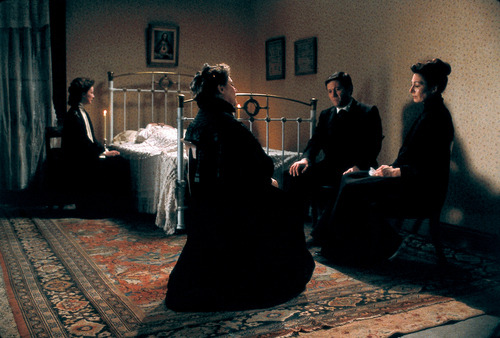
In my second year of college I read The Dead by James Joyce, beside the woman who would later be my wife. We both agreed that it was probably the most dull text we had ever read in the arena of fiction. I cannot deny that Joyce is a genius of the highest caliber, but that couldn't keep me from sleeping again and again through the story which seemed to be about nothing. A party full of non-events to non-people. Our teacher, when we dragged into class to discuss the story, said that boredom was the point. That these people were not actually living, but they were, in fact, more dead alive than the memories of their dead. Because of this horrid experience, I avoided the film. Even though the film took only as long as it did to read the story, I didn't want to experience that "hour that felt like five" again.
But my film friends prevail, in time, and today I watched the film. I had received it last week, before my good friend fell upon his bed without spirit and the paramedics struggled to return to him his breath and a self-perpetuating heart, to no avail. That was before I sat at the bedside in a hospital with another friend, dying of liver cancer, unconscious but comfortable. Before he passed yesterday afternoon, with his final words being three days previous. That was before I could no longer control my tears, not at the death of my friends, which was good for them, but for my own loss of their souls, gone until I see them again.
Unlike the story, this film is bright with characters and the language, cloth and candles of the best costume dramas. The script is about everyday people, but unlike the story, they shine in their mediocrity, representing Salieri's final cry in Amadeus in praise of the mediocre than J.K. Rowlings demand that our talent be worth more than "good job." It is a celebration, not of Epiphany, but of lives half lived, and the dead who burned out in glorious moments.
Why are the dead so celebrated while the living so depreciated? Because of the dead we recall an edited life. I remember my friend's smile, his soft but wise words, his work in the church kitchen for his friends. Over time, I will almost certainly forget his days, sometimes weeks of being so dizzy he could barely get up, watching movie after movie because he could do nothing else. I will remember his small cardboard sign "One Coin Helps", begging for a few dollars to buy his Mountain Dew and his weed. I won't remember the times I saw him drunk. I will remember how he accepted abuse from his friend when he didn't deserve it. I won't remember his anger against his other friend who disappeared and didn't call for a year and so ended up never talking to him again. I will remember him noble, gently strong, loving, big-bearded, a pillar of strength amidst weakness.
Who can compete with memories of a noble man? Who can compare? No living person can ever be as good as the dead. We honor the dead because they are no longer alive and, should they happen to die at the right time in their lives, we will never remember their weaknesses, only their strengths. And so it should be, if we can. If we have done more good than abuse, if we have saved the lives of those who are grateful. A luck of the draw, perhaps, between saint and sinner.
I will never forget this film. Not because of it's qualities, although they are many. But because I watched it now, today. This film will always be connected to this time, and like the dead, I will only remember the powerful emotions it pulled out of me.
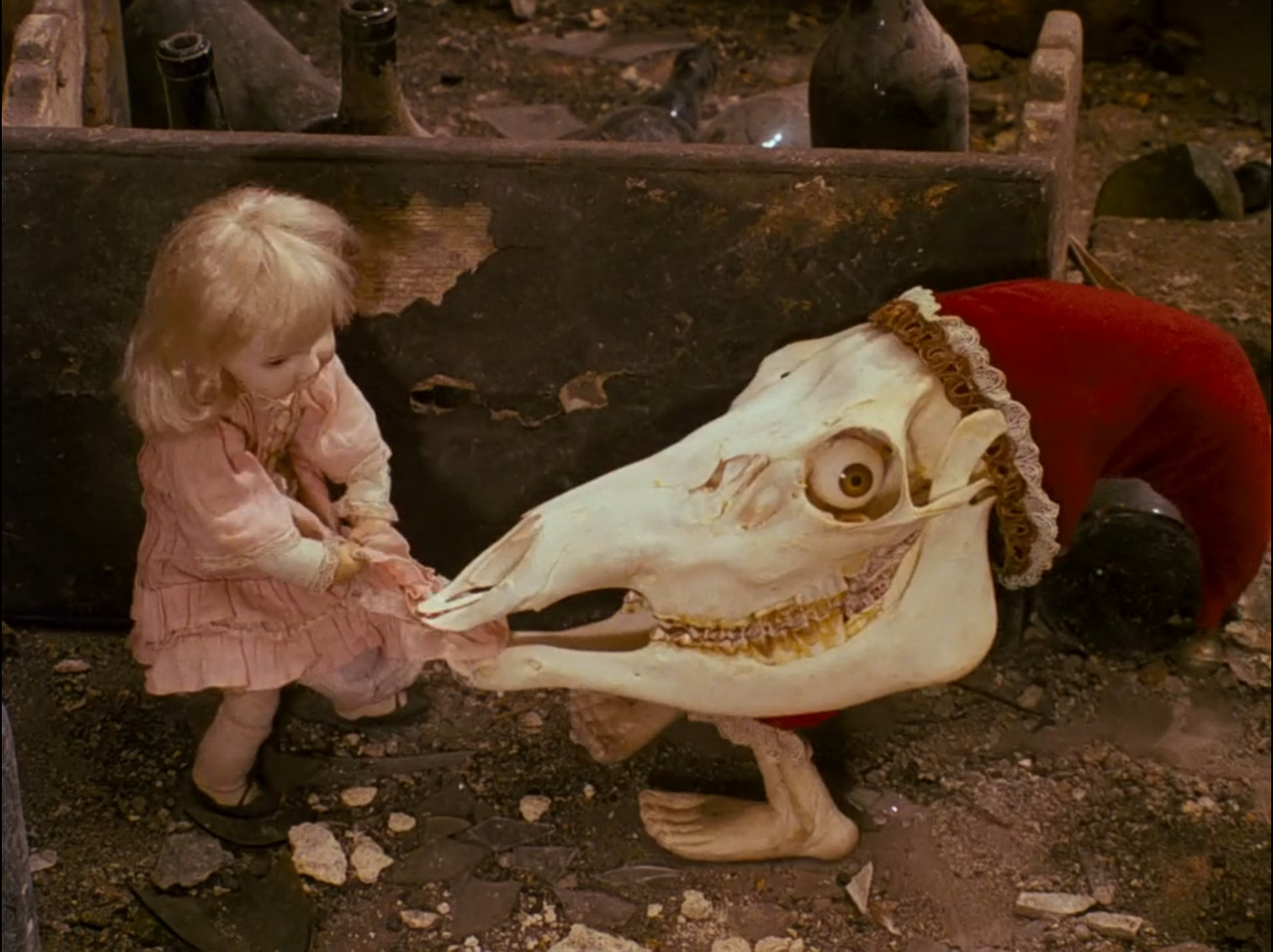
The director, in considering adapting Carrol's bizarre work,
decided it was not odd enough, so another layer of truly horrible images were
placed upon it.
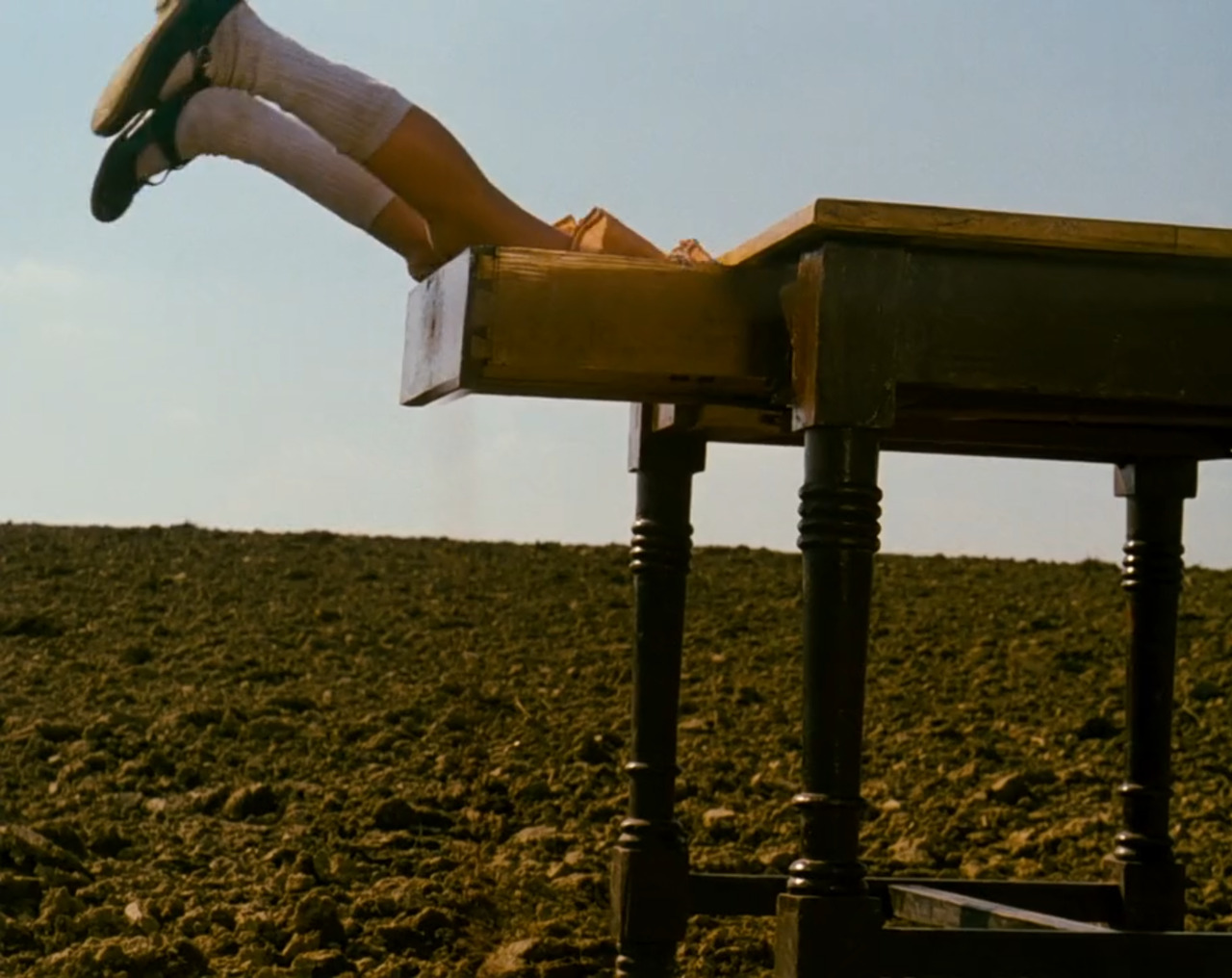
This is the stuff of which surrealistic nightmares are made:
skulls coming out of eggs, socks turning into boring worms, displaced heads.
It's bedtime, but I'm afraid I'll have Dali dreams tonight.
A family travels to paradise. Paradise, in the ancient world, was a garden,
a huge, never ending garden that had everything the family needed. They would never have lack.
In every garden there is a temptation, a manifestation of
evil that tempts them to harm and destruction.
For the man, the temptation was his entitlement, his sense that the
world revolved around him and that anything that deviated from his orbit was in
opposition to him. For the woman, the
temptation was her fear—partly her fear of the man, but also her fear of her
inadequacy to be a good mother, to care for her child.
For the child, the temptation was Room 237. The Hotel Overlook was the tempter, the
snake, causing them all to give into their temptations, to destroy each
other.
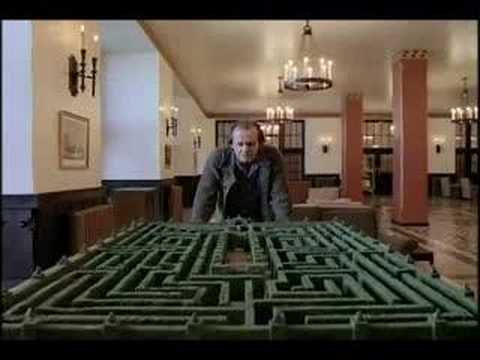
The Shining is a film that encourages thinking, and, as we
see in the documentary Room 237, overthinking.
There is so much detail, so much complexity in a relatively simple story
that we want to assume that it is more than it is. And the movie is slow enough, constantly
taking us through labyrinthine halls and mazes that never end, giving us ample
room for our interpretations to hang themselves.
It is this that makes the Shining a work of art. And it is The Shining’s weakness. Is it
possible for a work of art to be full of so much detail that no real
interpretation is likely? Is the real maze not in front of the Overlook
Hotel, but in our minds, and Kubrick has given us just enough to allow our own
subconscious to be the true director?
In 1987 I was in college and we studied hard. A local three-dollar theatre was available and we
were always looking for cheap entertainment.
A friend of my friends had seen The Princess Bride in its first run, and
asked… no, actually, she demanded… that we go with her to see it. We loved it.
It provided the perfect break from our everyday lives. Pretty soon, we were seeing the film every
week during its run at the theatre, which was a number of months.
At this point, I am a died-in-the-wool fanatic about the
film. It is a family favorite, along
with a handful of Miyazaki and Monty Python and the Holy Grail. Why do we love this film? Let me count the ways…
1. The Two Frames
There are two versions of The Princess Bride—the movie and
the 1973 novel written by the screenwriter, William Goldman. In the movie, a
grandfather reads the old fashioned adventure story to his increasingly
convinced grandson. In the novel, we
have a different frame. To read the
novel takes nothing away from the movie, but adds so much. Primarily is the story of how the author of
the “original” Princess Bride is S. Morgenstern who was writing a long satiric
tome rejecting royalty. Goldman’s father
so loved the book he would read it to his son, but skip all the boring parts
and spruce things up a bit. Goldman
sought this book for years and finally found it to read to his son, only to
find it was a dusty, dull historic story.
So he rewrote the story in the way his father told it: the “good parts”
version. This story is as fictitious as
the rest of the novel, but adds so much to the overall story.
2. Sincerity of the
characters
No matter how silly the story gets or the names, or the
dialogue, almost every character isn’t playing as if they were in a comedy, in
which they are winking at the audience.
They are serious, at times deadly serious. It is an old-fashioned, classic movies seriousness,
a Douglas Fairbanks seriousness, but it is beautiful for that. The comedy is deepened by the sincerity of
every line. But this just goes to prove
that the film isn’t just comedy. We are
truly impressed by the honor of the Dread Pirate Roberts as he dispatches but
does not kill Inigo or Fezzik. We are
furious at the hypocrisy of Prince Humperdink and feel a chill at the quiet
sadism of the Count. Not only is this
one of the greatest comedies, but also one of the great adventure stories ever.
3. Great names
William Goldman pulled out all the stops, becoming one of
the great namers next to Dickens, Rowling and Terry Pratchett. The Cliffs of Insanity makes us wonder why
people go insane at these cliffs. Are
they so tall that looking to their top causes an aneurysm? Humperdink
sounds vaguely nasty, almost as if Miracle Max had named him. The Machine is chillingly vague, as if once you have experienced this machine, there
really is no other machine you would ever think of. Buttercup is so over-the-top silly that every
time I hear the phrase “Princess Buttercup” I smile and have images of Saturday
Morning Cartoons made to sell another cereal.
ROUS, Fire Swamp, Dread Pirate Roberts—all classic names.
4. Peter Falk
One of the great comedy/drama character actors of all
time. He is usually undersung, because
after Colombo it was hard for anyone to take him seriously. But he is so memorable in so many films:
Wings of Desire, A Woman Under the Influence are two of many amazing
performances. He makes it look so easy,
as if anyone could be slyly sincere, and underhandedly benevolent. Not anyone can. And no one could like Peter Falk.
5. Wallace Shaun
Wallace Shaun is another undersung performer and
writer. His day job is writer,
especially small plays. But he has some
excellent roles as an actor, especially in My Dinner with Andre and as Rex the
Dinosaur in the Toy Story films. But I
will always remember him as the proud Vizzini, self-confident to a fault,
always proclaiming “inconceivable.”
6. Excellent quotes:
“There’s not much money in the revenge business.”
“Tyrone, you know how I love to watch you work, but I’ve got
my nation’s 500th anniversary to plan, my wedding to arrange, my
wife to murder and Guilder to frame for it.
I’m swamped.”
“Life is pain, Highness. Anyone who
tells you differently is selling something.”
“Anybody got a peanut?”
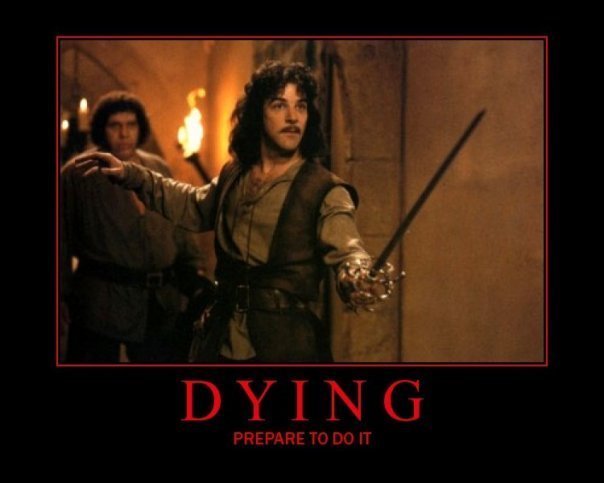
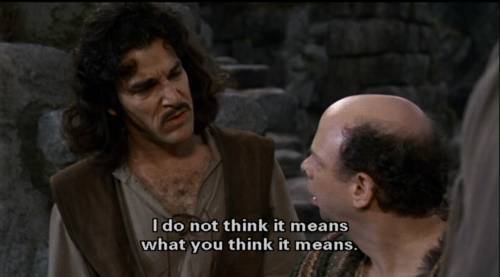
And we cannot forget the classic quote: “Hello.
My name is Inigo Montoya. You
killed my father. Prepare to die.”
That’s just a sampler.
I could fill this page with quotes.
And I will, if given half a chance. Post your own favorite quotes in the comments, if you like.
7. Beautifully silly
ideas
Goldman has created a number of concepts that enrichen the
movie with comic gold:
“Mostly dead”—A person can be dead, but not really dead and
then revived by forcing a large chocolate-covered pill down his throat.
“True love”—There is your regular, every-day love, but once
in a while there is “true love” which cannot be broken by governments,
kidnappings or even death. And it
results in remarkably effective kisses.
Brawn + sword +
brains= Unassailable plan. Unless
someone has greater brawn, sword technique and smarts.
Iocaine powder—Odorless, tasteless, mixes well in liquid and
kills instantly. Yet a great tracker
like Humperdink can sense it immediately.
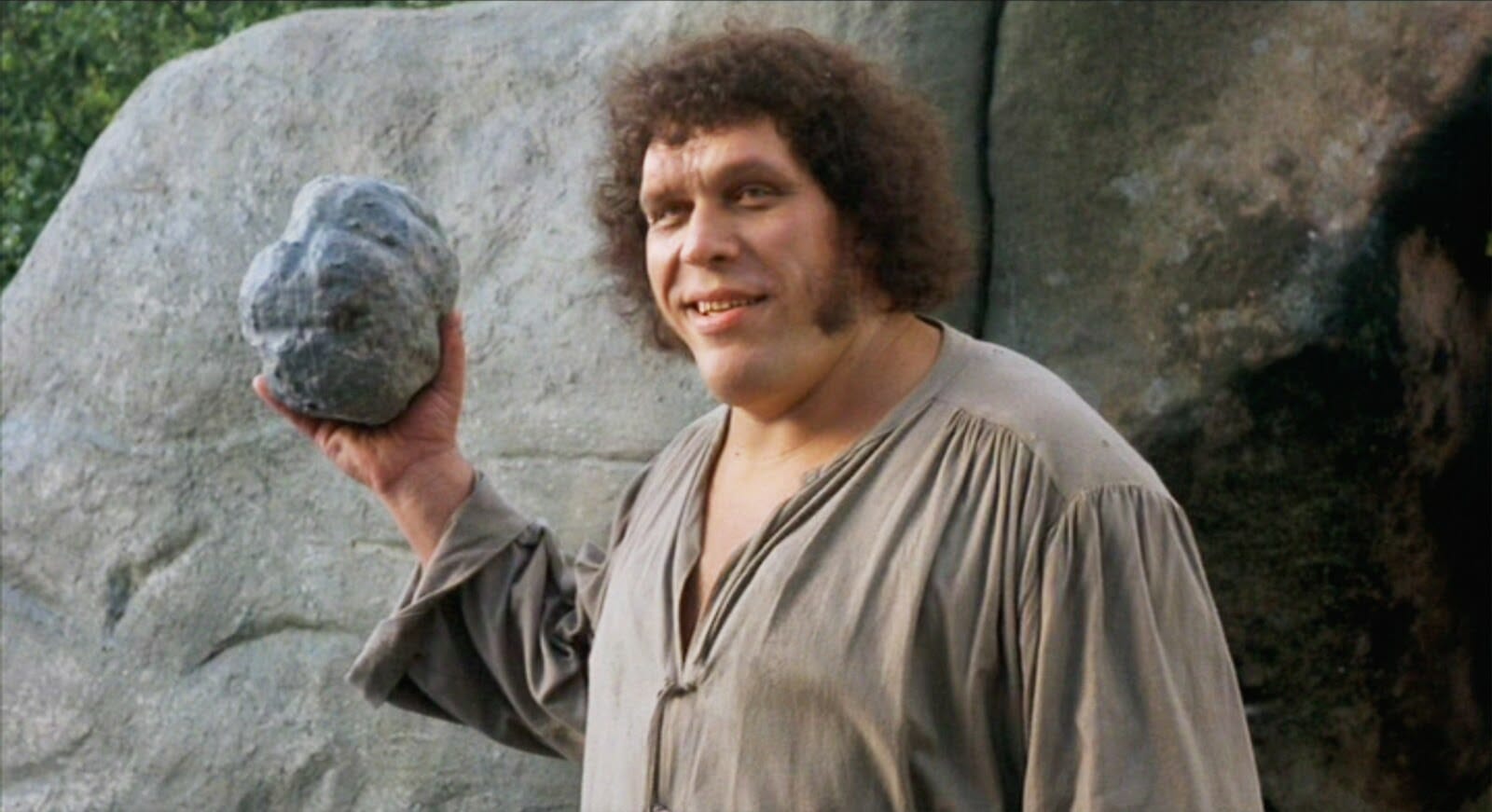
8. Andre the Giant
Andre first gained his fame by being a villain in opposition
to Hulk Hogan in wrestling. I never saw
any of these bouts, but I find it hard to believe that he could be seen as a
villain. He was the gentlest, most
wonderful people in the world. Billy
Crystal, after meeting him on the set of The Princess Bride, was inspired to
make the film My Giant, in an attempt to show Andre’s real character. Andre was famous for wanting to pay for a
meal whether he was the host or guest.
At one point Arnold Schwartzanager snuck away to pay the bill ahead of
him. Andre caught wind of what he was doing,
and he and Wilt Chambrilen picked Arnold up and deposited him at his car. (Can
you imagine serving these three giants? Is there a restaurant that could hold
them all?) In this movie the role of
Fezzik Goldman writes of Andres real nature, strong but gentle. He died of heart failure in 1993.
9. A movie for all ages
The Princess Bride stands alongside of many Pixar films as
being a true “family” film, good for both children and adults. And it grows with one as well, even as the
Wizard of Oz does. As a child we might
appreciate some of the humor and the adventure, but as we get older more and
more of the humor hits home, as well as the abiding nobility.
10. A movie for all eras
Although the frame is clearly placed in the 80s as the
opening scene of the old-time baseball video game shows. But really, this film is timeless. The majority of the story takes place in a
vaguely 18th century European fairy tale world, which could really
be anytime, anywhere. And the themes of
the relationship between the grandfather and his grandson, romantic love,
desire to right wrongs, and a sense of fairness never changes.
In the end, The Princess Bride is a film for all ages, for
all people. Not everyone will appreciate
the humor, for all such appreciation is subjective. But there will never be a time in which a
group of people won’t appreciate The Princess Bride, as it is one of the
classic entertainments of cinema.
Someone once mentioned that it is a pretty long title, but
with Miyazaki one must expect that occasionally, such as Ponyo on the Cliffs By
the Sea.
Nausicaa is Miyazaki's second feature film, and the first
that begins using the themes that reflect his later films, among which are
relationship between humanity and nature, flying machines, and war. It is based
on a much longer, more complex manga written and drawn by Miyazaki.
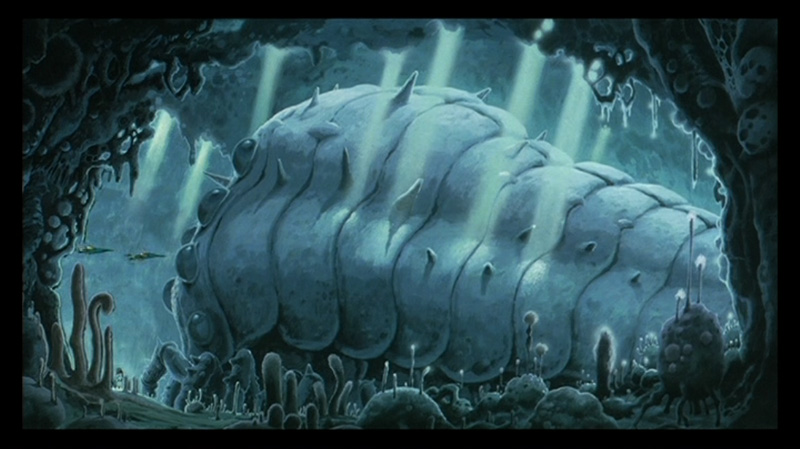
Nausicaa takes place a thousand years after human war has
poisoned the soil of earth to such a degree that poisoned jungles grew up,
insects became gargantuan and huge protectors of nature were created--
Ohms. There are a number of human
kingdoms, but the film deals with only three, Tolmekia-- a war-like kingdom
that wants to rule the others; Pejite, the sworn enemies of Tolmekia; and the
Valley of the Wind, a struggling utopia that gets caught up in the other
kingdom's war.
Nausicaa herself is Miyazaki's saint-- the ultimate
peacemaker. She is frankly an ideal
Buddhist saint, who communes with all creatures, and seeks to make peace with
all. She is especially focused on
creating harmony between humanity and nature, trying to heal the 1000 year old
rift. Throughout that thousand years,
the poisoned jungles and humanity have been warring with each other, each
attempting to overthrow the other's rule.
Only Nausicaa realizes that humanity would perish without the jungle and
that the jungle can flourish under humanity's enlightened guidance. Nausicaa is somehow able to understand the
true nature of whatever she is facing.
Instead of reacting to a threat, she responds to the fear behind the
threat. Instead of seeing the death of
the toxic jungle, she sees the beauty of it.
She works with the nature of whatever is before her in order to create
harmony with all creatures.
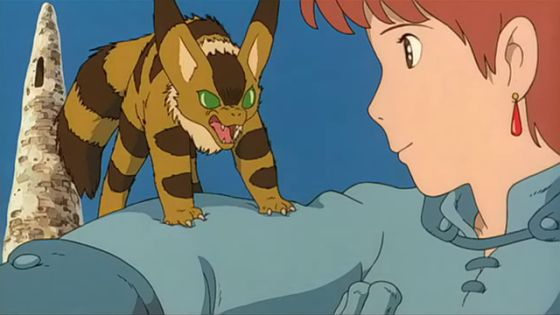
Like all saints, Nausicaa presents us with an ideal of how humans should live. We, as humans, should seek to discover the true nature of what is around us, whether human or natural, and respond to all with the care that they need. Sometimes she has to seek that true nature with research, such as the toxic forest. Sometimes she responds with intuition, such as the fox squirrel.
Honestly, the scene with the fox squirrel both amazes me and it is symbolic for the saint-like way Nausicaa acts throughout the film. Master Yupa warns Nausicaa that the fox squirrel is dangerous, but she treats the small creature as if it were the cutest thing in the world. To prove Master Yupa correct, the fox squirrel bites Nausicaa on the finger and won't let go. But instead of reacting to her pain or to an attacking creature, she still coaxes him, comforting him. She understands that his attack isn't personal, but a reaction to his fear. She allows him to attack her, with no repercussions so that he can know that whatever he does, he has nothing to fear. Fear is the source of harm, the source of attack and oppression. Throughout the film, Nausicaa is placing herself in harm in order to convince others that there is nothing to fear, no need to attack or oppress. This is peacemaking in action.
On the surface, this film seems weaker than other
Miyazaki. Most Miyazaki are amazing in
the detail of the world that was created for the film, and Nausicaa is no
different in that. But the dialog is
less rich and entertaining, the colors seem washed, and the style of animation
is not as fluid as other Miyazaki films.
Part of this, though not all, is due, I think because Miyazaki is trying
to communicate the bleakness of the world in disharmony with nature. War-- both human and natural-- has taken its
toll, draining life from everything. At
the end of the film, [spoiler]after Nausicaa's messiahship is realized[/spoiler],
the colors suddenly are brighter and everything changes.
Despite it's weaknesses (including a truly lame 80s score),
this film is one of my favorites of all time.
Despite it's bleakness, it is possibly the most joyful and optimistic of
Miyazaki's films, and it plots out the general outline of hope for the
future. Other Miyazaki films may
communicate that war is bad and that bad guys aren't really all that bad, but
this film actually lays out what would need to be done to end war, to change
people's hearts. It isn't childish in
any way, nor simplistic, if perhaps naive.
It communicates that self sacrifice, listening to the another's heart,
boldness for another's good and some basic reasoning can create a path out of
the bleak world.
Perhaps I like this film because it is very much a religious
philosophy I agree with. Perhaps it is
because Nausicaa is such a strong character that to me she is the perfect moral
hero. But with each time I watch it, the
higher my estimation of it is.
Agnes Varda finds in film a playground of life. She seems to have ADHD, unable to focus on
anything, insisting upon total freedom of mind and thought. But she knows what she wants to say and
continually returns to the themes she is considering, making a whole. Her narrative might be difficult to follow,
but patience gives one the depth that is found in her films.
At one point a character in her film Vagabond (1985) has a
near-death experience and she exclaims, “It is true! As you are dying you see flashes of your
life!” In a sense, this is exactly what
the film Vagabond is: flashes of a life in the midst of death, shown right at
the beginning of the film.
It is amazing how much of a single life can be contained in
just a two hour period:
Judgment and sympathy
Work and irresponsibility
Love and lust and sex and rape
Fear and comfort
Relating and separtation
Connection and misunderstanding
Pogniancy and laughter
And, of course, sorrow and regret.
In the end, it is very disappointing that all life ends in death. An anticlimax, really.
The memories we have left in the minds of others is all that is left.
2. Double Helix
Freedom and faithfulness seem to never be found at the same
place and time.
We all desire freedom:
Freedom from bosses, from lovers, from commitments, from boredom, from demands
Yet we also need security:
Houses, warmth, peace, safety, regular meals, people we trust
In order to reach a balance of freedom and security, we must have faithfulness:
The keeping of promises
Unspoken agreements
Work for each other
Unbroken trust
Those who deny this balance, who insist on either complete freedom or complete
security, are both the object of envy and scorn.
3. Trust
Means being taken advantage of
Means hoping instead of requiring
Means walking away when you want to control
Means allowing another to grow at their own speed
Means relying on God, less so on others
4. Speedy Compassion
“I’m too busy to be compassionate”
Compassion requires less time than consideration
The thought to pick up socks for the needy when buying clothes
The thought to keep breakfast bars in one’s car
The thought to give away clothes instead of throwing
The thought to speak a kind word instead of harsh
The thought to step toward instead of away
The thought to smile and listen instead of turn away and ignore
But speedy compassion changes no one
It is only love in the short term
Opportunity for change only occurs in long words:
Patience
Endurance
Longsuffering
(Long in time, not letters)
Opportunity is found in creating new contexts
in which another might thrive.
Opportunity is found in seeing the positive change
(and diminishing the enduring
negatives)
Opportunity is found in the trusting, sacrificial welcome
5. Lost Hope
There were two characters who could have changed the end of
Mona, wanderer, without roof, without law.
One is the Tunisian who truly loved Mona, and gently prodded her to a secure
life of work and care. But his concern
about the opinion of others was stronger than his love of this woman. The shot of his face, deep with regret
brought a tear to my eye.
The second is the arborist, the professor, who truly
appreciated Mona’s company. After spending
two days with her, appreciating each other’s company, enjoying each other’s
vibrancy, the professor dropped Mona off, away from her home. She could appreciate, but she could not
trust. She also regretted her action,
realizing at the end of her life, that this relationship was essential, not
passing.
Without trust there is no community. Without community, there is no life. If you would like to find out more about Steve's community of the homeless and the mentally ill, check out Nowhere To Lay His Head, the website of Anawim located in Portland, Oregon, USA.
For All Mankind does what many movies attempt to do, but
few as successfully: Take the viewer on one of the greatest adventures of all
time, in under two hours. It is a road movie without a road, a travelogue with no
walking.
It is a master of editing. This film has taken the footage of a number of Apollo missions and created a single hour and twenty minute adventure with them, connected with interviews with astronauts, music from Brian Eno and the sounds of the time. This gives us a feeling of having been on this trip ourselves, a sense of what it means to leave our gravity and go to the most alien landscape humanity has ever touched.
There are some unique, perhaps even strange, but certainly extreme
photos: The earth from afar, one of the most positive but powerful explosions
on the earth, the desert of the moon, earthrise, the blackness of space. Few have seen these images with their naked
eye and we have the opportunity to share it here.
These are the films that inspired Dark Side of the Moon, and
Space Oddity. There is a depth and a
majesty to them that must be expressed slowly, carefully but with deep
passion. As often as the astronauts may
jest, they and we all know that this exploration is the serious business of
mankind. The weariness and steadfastness
of the staff at Huston really shows the intensity and stress of what is
involved. Every button pressed has a
sense of history, of enormity. And so it
should. There is a drama here that
cannot be acted, for it was lived.
The landing on the moon, the touch of a human shoe on truly
alien soil—was it real? Many claim it
was not, that the films were created in a studio, perhaps by Kubrick. But looking at them again, hearing the
commentary, seeing the shadows, glimpsing the shadow of the Eagle on the
surface of the moon… but most of all the beating of my heart and the excitement
as I watch that final leap—it is real.
It must be. I know it in my heart
of hearts. As impossible as it might
seem that such a modern scientific miracle might occur, I truly, humbly
believe. I can do no other.
Why go to the moon?
There were certainly political reasons, but just as many economic
drawbacks. In the end, it cannot be expressed
better: “Man must explore.” There will always be political excuses to explore,
or economic reasons. But humanity’s ‘satiable
curiosity, the need to see what has never been seen, to step where no one has
ever stepped, that is one of humanity’s deepest destinies.
The drive that causes the two year old to strike out on his
own and walk past the corner onto the asphalt.
Perhaps his parent considers it too difficult, insignificant, and simply
dangerous for him to attempt. But he
must do it. His independence demands it,
and his love of the new demands it.
It is this same self-serving curiosity that created the
hadron collider, that caused men to stand at the South Pole, that causes James
Cameron to explore the deepest ocean. It
is the desire to find knowledge, to discover beauty, to find the surprise that
no one expected. We must do this, not just for personal
accomplishment, not just for glory, but for the benefit of all, although we
ourselves may not know what that benefit will be.
“Sonny, True Love is the greatest thing, in
the world-except for a nice MLT – mutton, lettuce and tomato sandwich— where
the mutton is nice and lean and the tomato is ripe…” -Miracle Max
Not once in the midst of the Princess
Bride, do we get a definition of True Love. Nor do we see it in action, unless True Love
is found in uncontrollable passionate kissing.
But we see the consequences of True Love.
Let’s just take Westley for example
(spoilers ahead for both of you who haven’t yet watched the film). For the sake of True Love, he leaves the only home he knows, is attacked
by Rodents of Unusual Size, drinks poison, becomes a pirate, climbs a cliff, defeats a master swordsman,
defeats the brute squad while paralyzed, and dies.
You know, I don’t think that The Princess
Bride is the best advertisement for True Love.
Seems to me that this nebulous idea causes an untold amount of
suffering.
Yet, oddly enough, like Fred Savage, I am strangely
attracted by this odd mystery. After
all, if someone is so willing to suffer for something I do not understand,
perhaps I too would like to hear more about those kissing parts. There’s got to be something to it.
The Princess Bride is based on a novel by William Goldman where he recounts his rediscovery of the fictional S. Morgenstern classic The Princess Bride, which was primarily a political satire, but Goldman re-edited it so only the "good parts" were left. If you loved the movie, you'll love the book just as much.
Sam is a low paid but expert bureaucrat who
has a very specific woman in his dreams, drawing him to a utopia. He accomplish his tasks with the utmost skill
until he actually meets the woman he sees in his dream. From that point on, he gives up on his life
and pursues his dream, despite the objections of all the knows, the woman
herself and the opposition of the entire system.
Imagination and love is all well and good,
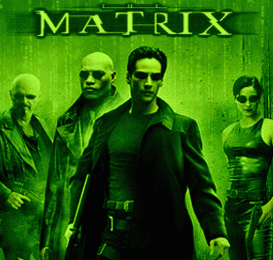
but is that worth trading in an existence in the real world? In The Matrix, Neo trades in a false life for
a harsher real one. In Brazil, Sam makes
the opposite decision—he would rather live in a glorious, unreal dream than to
live in the harsh, stupid real world.
Who is to say which is the better choice?
In the end, does not the choice between the
red and blue pills depend on our own deepest, heartfelt, intimate desires? Will we not, in the end, pursue our desire,
wherever it leads us? And even though
Neo chose reality and Sam chose fantasy, didn’t they each make the same choice:
to pursue their true selves?
Dealing with spirits is tricky business. There are the low-level ghosts, who can be…
slimy. Then there high level gods, who
can decimate large populations. Tricky, very tricky.
Especially tricky for scientists. Even pseudo-scientists. When you are trained to be skeptical, to
doubt, to question everything, it may seem that you might never actually get
around to dealing with real, live (so to speak) spirits. When you finally do connect to spirits,
proper etiquette might be lacking. Not
because you don’t want to be polite, but because you just haven’t had the
experience.
So when Ray is approached by a spirit and asked, “Are you a
god?” He answered simply and honestly, to the best of his knowledge, in the
negative. How was he to know that it was
the wrong response? That such honesty
might actually get him and his companions killed? Or at least mortally wounded. Peter corrected Ray’s error: “Ray, when
someone asks you if you are a god, you say YES!”
Obviously, such an answer must come from
studying the classics. Alexander said “yes”. Augustus said “yes”. Titus said “yes.” Perhaps we should all learn from their
example. Peter thinks so.
Of course, there’s that niggling little aspect of
blasphemy. When Herod Antipas said “yes”
to such a seemingly basic question, he was eaten from the inside out by
worms. Perhaps this should be given more
consideration.
This whole review is pretty much one big spoiler. If your stomach isn't weak, go, watch The Fly (1986), and then come back and read this.
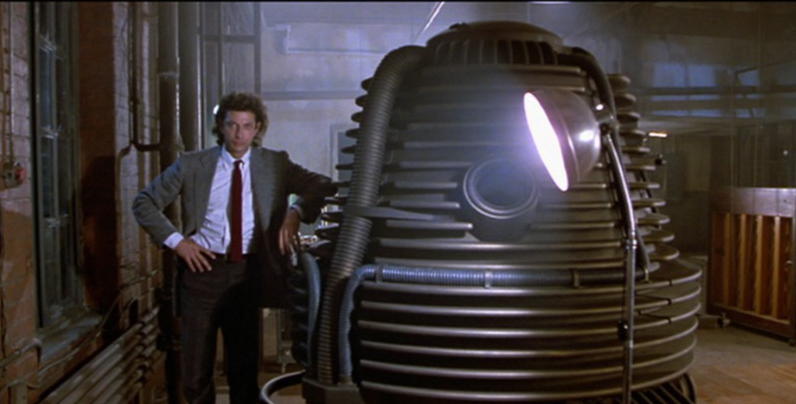
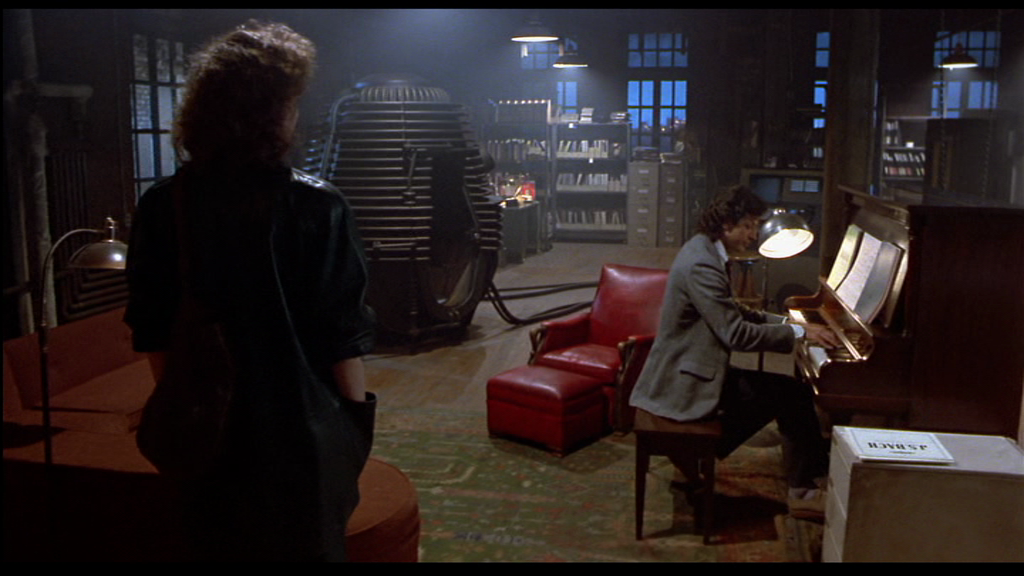
On the surface, The Fly is a pretty common 80’s horror
flick. The acting is pretty spotty (but
Jeff Goldbloom is great), the makeup is pretty awful (by the artist of the
campy Gremlins), there are some supremely unbelievable actions by some
characters (you go to the monster’s lair and THEN you put the gun together?),
and an overuse of dry ice fog. Still, it
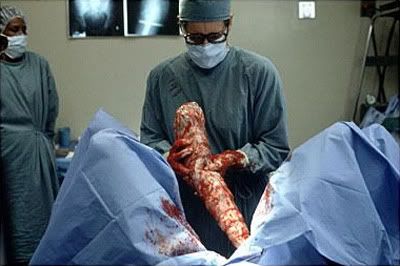
is a remarkably intense film, which I’m glad I had not seen in the theatre,
because some of the scenes make me sick to my stomach as it was.
In the end, though, I was left with the thought: What is this film really about, anyway? Okay, it’s about a scientist who isn’t
careful with his experiment and ends up transforming himself into a fly, much
the same as the classic 50’s horror flick of the same name (with the wonderful
Vincent Prince). But all the talk of “flesh”
and “insect politics”… is that really the product of the typical genre
film? Of course not. David Cronenburg is famous for his films
about flesh, and there is clearly a deeper message intended. It is interesting that Cronenburg received
the original script from Charles Edward Pogue, which had many of the same elements of the finished film, but
Cronenburg asked permission to re-write the script, and he did so, imposing his
own philosophy and intent upon the film, making more than simply horror. I have never seen a Cronenburg film before,
so this is my first exploration of his ideas.
But I’d like to explore this, and then I can expand on Cronenburg’s
philosophy as I see more of his films.
It seems that The Fly is approaching metaphor similarly to
Kafka’s The Metamorphosis. In the famous novella, Gregor Samsa awakes one
morning to find that he had transformed into an enormous cockroach. But this was not simply a fanciful romp on
Kafka’s part, but a metaphor of a man who no longer is going to live according
to other people’s expectations. Even
so, the transformation of Brundle isn’t simply a literal gene-splicing, but is
a moral transformation of a man.
The transformation can be seen right from the very first
scene. Brundle approaches Veronica,
talking about how he will change the world.
It is clear that Brundle is using this as a line, a come-on, and
Veronica certainly takes it that way, planning on brushing him off. Then he makes it clear that he is serious,
that he has some serious science going on.
So Veronica pursues the story.
Arriving at his home, he indicates his real intentions by attempting to
entertain Veronica, to woo her. When it
is clear she is only interested in his science, he uses that to convince her to
spend more time with him.
It is later revealed that Brundle is a serious scientist,
not just a hack, and that he’d been working on the project for years. And given the progress of the experiments, it
is clear that he’d been working hard, pretty much focused only on that work,
for years. I think it is clear that in
the first scene, Brundle is a man who is ready to make a transformation
already. He had given himself to the
intellect, to “changing the world” to make life better for everyone. That night, the first scene, Brundle had
decided that he was going to live for himself, to give himself some pleasure as
a reward for his hard work. Or maybe he
was just tired of his lonely life. But
it is clear that he had given himself over to the “flesh” as opposed to the
intellect.
Instead of creating a balanced life between the flesh and
other pursuits, he gives himself fully to one mode of life. Yes, he continues to pursue his experiments,
but thought of transforming the world is behind him-- nor does he show any real interest in
Veronica except for what he can get out of her.
He has given himself over to his body before the physical transformation
began. The physical transformation into
an insect is simply a representation of what he is becoming before the fateful
fusion with a fly.
Brundle is a man of the intellect who became a man of the
flesh. He is completely focused on his
bodily needs. When he becomes more and
more fly-like, he is not disgusted, but fascinated. He is the center of his own universe and he
sees his changing focuses and body as a change of humanity, instead of his own
separation from humanity. In the end,
he is willing to sacrifice Veronica and his own child in order to increase his
bodily transformation, to make them both a part of himself.
In the end, Brundlefly is only willing to sacrifice himself
when he is no longer purely flesh, but is part machine. He is only disgusted with himself when he is
no longer all need, all body. When he
becomes a cyborg, that is when he sees himself as a true monster. Before that moment, there is no hint that he
is ashamed of what he has become.
So what is Cronenberg’s message? It isn’t
the common trope of the scientist looking into what should never be
revealed. Rather, it is about the
dangers of giving into the flesh, of going too far into one’s own bodily needs
and changes. To focus only on our flesh
is to see ourselves as the epitome of existence, and ultimately to sacrifice those around
us. We cannot experience love or
compassion, but everything and everyone around us is seen as an extension of
ourselves, a tool we use to increase our own flesh. Our needs become the center of the world, and
all around us is consumed to be a part of our world.
There are parts of the film that are tough to get
through. And there are many moments in
which I was pulled out of the film due to poor directorial decisions. There were too many moments that just seemed
unrealistic. But intellectually, this is
a very satisfying film, and the tension was very real. I can’t give this film a single rating, so I
won’t bother, but I can say that I recommend it. Unless you have a weak stomach.