Saturday, October 17, 2015

Christian Films and "Christian" Films

Earlier today I saw a post where a friend of mine was looking for Christian movies on Netflix streaming.  I can't find it now, but I figured I'd answer it anyway.

The first thing that I think it important to note is that most films that are named "Christian" are often not very much so, or they hold to a very narrow idea of what "Christian" means. Because of this, most of the time the acting in "Christian" films are often the worst, although the production value is getting better. Fireproof was the best non-sports "Christian" film I've seen. The rest wasn't worth my time. Another decent one I saw is Cry From the Mountain, from Billy Graham's World Wide Pictures. Both are, at best, mediocre. Neither of which, of course, is on Netflix instant.
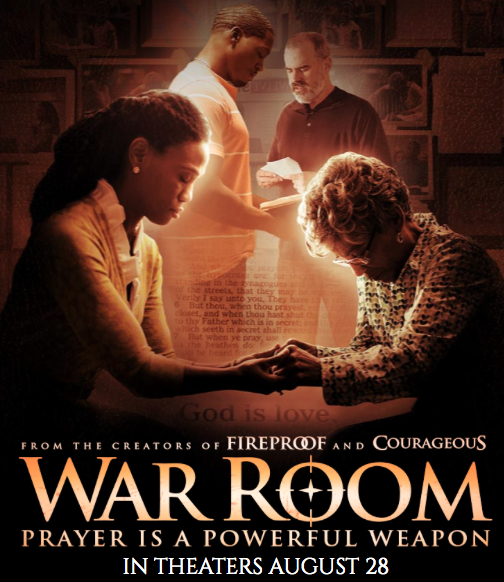
 
A "Christian" film is a movie that expresses the carefully constructed doctrine and morality of the American evangelical community.  It often promotes family and usually has an evangelistic message of some sort within it.  The latest of these is a film called War Room.  They are often promoted by churches, and some churches even have special showings for their members.  Frankly, like "Christian" music, it is a business model.

When I call something "Christian", I would like to think it reflects the tradition of 2000 years, especially the values of Jesus, like loving your enemy or forgiveness or helping the needy.  Family is okay, but Jesus also said "If you do not hate your mother and father and wife and children... you cannot be my disciple."  I'm not saying that Jesus actually meant to hate people (he didn't), but he was certainly saying that "family values" isn't the center of all that is good.  And I don't think that the evangelical church's version of Calvin-lite really expresses the values of Christianity for the majority of it's run.

Still, there are thousands of great, truly Christian films that don't fall under that American production label. So here is a list of great films that reflect the values of Jesus, and make powerful statements AND are great films. That also happen to be on Netflix Instant.  Here are a few:

Ida-- A woman about to take her monastic vows finds out that her family was killed as Jews in the Holocaust.

The Kid with a Bike-- I think the Dardanne Brothers are the greatest producers of Christian films in the world right now. This one is about a single woman who takes in a troubled kid.

Together-- Okay, this isn't a Christian film, but it is a great movie about living in community, Christian or otherwise
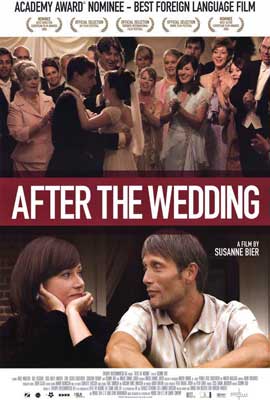
After the Wedding-- A man who dedicates himself to the poor is called home for a wedding, and he is given an offer he cannot refuse.

The Selfish Giant-- A powerful movie about what it takes to bring redemption.

Short Term 12-- A look at a private school full of special needs kids. Much better than it sounds. Really, really good.

The Overnighters-- A documentary about a pastor who lets people sleep overnight at his church.
These are among my favorite films of all time. So if you don't like them, blame me.


I'll take some time to cover some other Christian and spiritual films in the future.


Thursday, October 15, 2015

Dekalog 6: "You Shall Not Commit Adultery"

In the ten commandments, the word “adultery” is used exclusively for the breaking of a marriage covenant through unfaithfulness.  In Leviticus 18, there is a long list of other sex offenses, including incest, homosexuality and having sex with one’s wife while she is on her period (don’t ask me, I’m just letting you know).

   Interestingly enough, in Christian ethical discussions, one of the main sins that fall under “fornication” is sex before marriage.  The Bible does speak about this.  It assumes that a man would want a woman who is a virgin when they are married and if a bride deceives her husband about this fact, then she might be killed.  If a virgin is raped, then the man’s punishment is to marry her.  Let’s just say that those were different times.

The Bible doesn’t come close to speaking of the situation in this context.  Magdla (named after the “prostitute” in the Bible, Mary Magdalene, who wasn’t a prostitute at all, but possessed by seven demons), has a boyfriend or two, with whom she romps gladly in bed.  She leaves the curtains open, not only because she is on the third floor of her apartment, but because she is open and not ashamed of what she does.  Tomek (possibly named after the Bible’s doubting Thomas?) has stolen his friend’s small telescope and spies on Magdla from across the courtyard that separates their two apartment buildings.   But this peeping “Tom” is not only looking, but he enacts his obsessions with her in other strange ways.  He sends her notices, that informs her to go to the post office where he works to obtain money; when he sees that she has a lover with her, he might call the gas company to tell them her apartment has a leak; he gets hired as a milkman so he can ask her questions in the morning, allowing her to talk to her.  Frankly, he’s not healthy.

Finally, he is caught, and he confesses to her his spying.  She is offended, and then bemused.  She sees him only as a bundle of hormones, quivering with sexual tension.  He assures her that he is not, that he only wants to go out on a date.  But his humanity is blocked by her previous encounters with men, convinced that sex only has to do with a physical need and the release of tension.   There are three “loves” in this “Short Film about Love”: lust, romantic love and a third: the recognition of the person before us as an equal human being, a person of value and substance.  Magdla doesn’t experience that third love until the end of the film.

As much as this film is about love, it equally seems to be about privacy and shame.  Magdla flaunts that which most people consider to be private, and she sees herself as very open.  Tomek is full of shame and is always in a dark room, behind doors, fearful of what would happen if his secret were known.  But it turns out that his greatest fear isn’t to be found out, especially by the focus of his love, but to be spurned and mocked.  To have his most precious private thoughts cast back at him with spittle.  He is private, not just due to shame, but from protection, for if his love were laughed at, then the structure on which he has built himself would collapse.


This film is a tragedy, not unlike Romeo and Juliet, two people who are torn apart by assumption and misunderstanding.  It is a perfect film, without a single extra scene, a gem of plotting and character building. 


Monday, October 12, 2015

Dekalog 5: "You Shall Not Murder"

In the Bible, human life is connected to the likeness of God, similar to how pagan religions recognize their statues of their gods. A statue, an idol, is a representation of a god, an epiphany, a singular descent of god upon earth.  Even so, the Bible says that every single human being is an epiphany, a representation of God on earth.  Thus, to kill a human being is to wish death upon God.

 Jewish tradition states that every human being is a society, a complex nation to which there is no reaching the depth of it.  Thus, the killing of every human being is not just murder, but genocide.

But religions debate about the death penalty for murder, as well as legal systems.

Jacek is a young man, full of spite and selfish anger.  He throws rocks down onto traffic, flies in the face of other’s concerns and finally he kills a random taxi driver, for no real reason than he wanted to.  If there was anyone who was a burden on society, worthy of being extinguished, he is the man.  Mind you, the taxi driver was also a jerk, ogling young girls and not helping people clearly in need.   But should such a man be killed simply because he was a jerk?

And this is the question proposed by the film—should a selfish, hateful bastard be killed by a selfish hateful bastard, whether that killer be a random murder or the state?  It presents to us the conundrum of the death penalty—does the death penalty prevent future crime by helping people realize that there are consequences to their actions, or does it perpetuate murder by showing that killing is right in some circumstances?  Is the state a promoter of justice or a fellow murderer?

Although Piotr, the young defense attorney in this case, is clear about his proposal that the death penalty is not a part of a system of justice, I don’t believe that his complex moral arguments represent the filmmakers point of view.  Rather, his statement at the end, when we have finished viewing two deaths in detail is what perfectly presents the interpretation of the whole situation: “I abhor it!  I abhor it!”  This loathing of killing is what we are supposed to have seep into our souls.

Again, Kieslowski does not give us any answers.  The only thing we are left with is anger that killing happens at all.


A slightly longer version of this film, with better camera work, has been released as A Short Film about Killing. 

Saturday, October 10, 2015

Dekalog 4- "Honor Your Father and Mother"

As we saw earlier, the ten commandments are often used to be a “title” for a group of commands.  In the Bible, “Honor your father and mother” is just another way of saying respect or obey all authority.  The father, especially, is the backbone of patriarchal society, so if one does not obey one’s father, then all kinds of rebellion and immorality are possible.  Rebelling against and shaming one’s parents are punished severely in the Old Testament law, even to the degree of killing an older son who gets drunk a lot.

In this episode, the idea being explored is not, “isn’t there a moral way to break this command”, but rather exploring the idea of honor, and pushing the edge of the envelope.

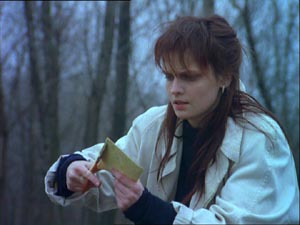
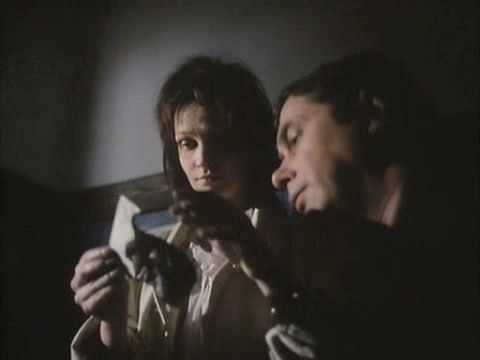
Anna has always lived with her father, Micah and has known no other parent, since her mother died just after she was born.  We see them have a fun relationship, without much discipline, but Anna is a good kid, grown now and reliable.  She is also thinking about marrying her boyfriend.  Then she finds a letter in her father’s desk which says, “To be opened after I pass away.”  Of course, curiosity gets the best of her, and she opens it only to find another envelope addressed to her from her deceased mother. 

After this is opened, the questions brought up in this film get deep and serious.  (Alert, spoilers here:) If a parent isn’t a biological parent, what are the responsibilities?  May a child then rebel?  If one finds that a parent isn’t a biological parent, what do you call the love between the parent and the child?  Could it be erotic, romantic? Does every relationship between a father and a grown daughter have an element of eroticism in it?  

These questions are so difficult, I am surprised the filmmakers were allowed to explore this direction, let alone put it on public television.  Incest, of course, is forbidden by the Bible and religions and law… but if there is no biology, then is it really incest?  Then the film brings up the next question: what if there is no evidence to say whether a parent and child are related… if sexual desire is spoken between them, what is to happen then?


Many forbidden questions here, and no answers.  This episode is equal parts frustrating and fascinating. 

Thursday, October 8, 2015

Dekalog 3- :Keep the Sabbath Holy"

As most commandments of the ten, the command of the Sabbath is not only about the seventh day of the week, but about any proper festival that requires a meaningful ritual.  In the ancient world, they took these festivals seriously.  In the Old Testament there was a time when everyone was to hold a day of celebration.  Then the law was read to them, and they were grieving with guilt.  But the crowd was told not to grieve, it‘s not the day for that.  Grieve tomorrow, they said.  The day of celebration can’t be marred with it.

In Kieslowski’s narrative, the holy day is Christmas Eve, a day of presents and celebration.  Januzs dons a Santa Claus outfit and is generous to his family.  Then Ewa, his former lover with whom he had a long standing affair, shows up at the door.  She says her husband has gone missing and she needs help finding him.  Januzs decides to help her out, lying to his wife that his car was stolen.  And off they go.

Clearly, the last thing Januzs and Ewa is doing is keeping the holy day in a holy way.  They are spending the night with their adulterous lover, lying to everyone from his spouse to the police, and in general making many people’s lives a bit more difficult.  They are no Thelma and Louise, but they aren’t bringing peace on earth that Christmas night.

Or are they?  Their intent is to find and to care for Eva’s husband, to bring him back home and to make sure he wasn’t injured.  (spoiler!) In the end, it is discovered that Ewa’s real intent was to prevent her from committing suicide, for holy-days are family days and she had no more family.  They also visited a drunk tank, where they prevented the sadistic caretaker from abusing his charges, if only for a moment. (end spoiler!)

There are different kinds of holiness.  There is a ritual holiness, like going to church.  There is a superficial holiness, like staying away from one’s lover on a night when we are supposed to be with family.  But often in the Bible holiness has to do with God’s mercy, which is unique among the living beings of the universe and those who show that mercy.  Mercy like helping your former lover who is on the brink of death instead of being with one’s family.  Mercy like supporting the drunks, objects of derision.  And if Christmas isn’t about that merciful kind of holiness, then what is?

There are a number of fascinating details in this hour of television, but I’d like to point out the names of the two main characters.  In English, we may note that Ewa’s name is “Eve”, like Christmas Eve.  But I think the name more pointedly is to the Bible’s Eve who tempted Adam to sin, even as this Ewa tempted the male protagonist to abandon his family on Christmas.  His name is Januzs, which is from the Greek mythological character Janus, who had two faces.  I believe his name was chosen because he is both looking toward his family and his ex-lover, trying to appease them both, but can’t.


One final detail (spoiler!).  The last scene shows a conversation between Januzs and his wife, where she indicates that she knows he spent the night with his former lover.  She then responds, sadly, “Does this mean you will be gone at nights?”  Her resignation of a lonely life without her husband and father of her children is heartbreaking.  His encouraging response does little to heal her continuing pain from living in a broken marriage.  A heartbreaking ten seconds. 

Friday, September 25, 2015

Dekalog 2: "Do not Take the Name of the Lord in Vain"

A woman whose husband is dying in a hospital and a doctor debate about the future.  She wants to know what will happen so she can make a fateful choice, and he tells her that it does not look good, but he doesn’t know for certain.

The ten commandments has some controversy in it.  There are different points of view as to what the ten “words” actually are, how they are divided.  The Jewish and Protestant point of view is that the second command is to not worship idols, but the Catholic interpretation has the commandment about God’s name as the second.  The Dekalog was filmed in a mostly Catholic country, so their point prevails.

There are a number of issues that come under this command.  One is that one must not swear falsely, for God’s name is tied up in one’s word and promise.  Another has to do with being a leader or a prophet and speaking for God—to speak for God casually or without regard to what God really says is a sin.  This short film deals with both aspects of this command.

The doctor is in the place of God.  Not that he is God, but he is lofty, lonely, full of knowledge and has the utmost authority.  To hear his voice is to hear the voice of God.  The woman is in the place of humanity, the typical human.  She is stressed, torn and unable to make a fateful decision.  So she becomes destructive, sometimes without her will, sometimes with it.  She destroys what is good so that she can deal with the chaos that her life has become.   She demands to know the future, so she can have less stress and stop the path of destruction she is on. When the doctor tells the truth to the woman, that he does not know what will happen to her husband, she accuses him of sin.  This is a normal relationship between a human and God. God doesn’t tell the future, and the human is angry at God for the destruction that is caused.

Of course, most of the destruction is caused by our own hands, because of our own inner needs.  God has nothing to do with it.  We blame God, because we have to blame someone.  Someone not ourselves.


Here we go into spoiler territory, now:

But the doctor uses his authority, his voice of God, to lie to her.   He does this in order to prevent her from having an abortion.  Why?  Because he lost his children in the war, and he knows that he will ruin her life if she continues to follow the path of destruction she is on.  So he lies, he takes the voice of God and uses it for an untruth, in order to create peace for another.  Is this wrong?  Did he do wrong?  He broke the command.  But he created a bond of family that wouldn’t have been there if he had told the truth.  His arrogance, his presumption, placing himself in the throne of God… is this for the good?

It is said that the writer of fiction creates questions, not answers.  Kieslowski is good at that.

There are other details that are brought up.  The observer is in the hospital, wearing an orderly’s outfit in the dying man’s room.  But he isn’t even noticed by the wife when she goes in.  Is he seeable to the human eye?  Or is she just distracted?  The leak that is right about the dying man’s bed I have a number of questions about: Is this speaking to the condition of hospitals in general?  That they don’t really notice or care about patients?  Was the leak making him worse—it certainly prevented him from resting.  And his wife notices the water on his face.  Does she see the leak?  If so, why doesn’t she say anything about it to get it stopped, or to have her husband moved to another bed?  Is this part of the path of destruction she is on, to get her husband killed? 


Finally, the image of the bug crawling out of the dirty water to live another day.  Okay, Kieslowski says that he doesn’t have allegories, that things just happen.  Right, sure.  As if the bug doesn’t represent the man getting better on his own, crawling out of the disease, despite him receiving no help from anyone.   Sure you don’t use allegory.

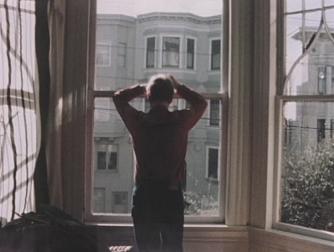
Dekalog 1: "You Shall Have No Other Gods Before Me"

The Dekalog, a Polish TV series by famous film director Krzysztof Kieslowski, is an odd duck.  It is ten hours with ten stories, focused on different characters.  But sometimes a character in one story will show up in another, and a sad-faced young man often appears throughout the series.  All ten take place in the same set of apartment buildings in Poland.  The depth of writing is a norm for Kieslowski, dealing strictly with the practical, but the stories have deep philosophical and moral questions, which are left as questions.  It is quite possibly the most significant TV series ever made.

One might think that the ten stories have to do with the ten commandments in the title, but they don’t firmly rest on one story or another.  Although they could be understood relating to a particular commandment, more often than not they question the idea of commandments with moral quandaries that don’t give us clear answers.  Yet there are such immense value in the questions, in the stories we are presented, we become richer people just by considering each item in the set.

Dekalog 1
“You shall have no other gods before me.”

We see scenes of a great dad raising his kid with the help of his sister.  The kid is borderline genius and is joyful about almost everything in his life, chess, his computer, feeding pigeons crumbs.  The only disagreement between dad and aunt is a matter of faith.  She believes in God, the soul, the church, and dad doesn’t.  But they work it out.  If Pavel wants religious education, that’s fine with dad.  When dad says something is true, aunt doesn’t disagree with him. 

Underlying all of this is the question of knowledge v. faith.  Everyone: dad, aunt, the computer all admit that there are realms in which they do not have knowledge.  The government official displays a distinct lack of knowledge about the milk he is providing free for schoolkids.  Dad’s “faith” is in knowledge, the fact that truth can be measured and determined, and if it cannot be measured, then it cannot be known or believed in. 

Yet, in the end, we are shown that no matter how careful we are in knowledge, we cannot depend on it. There is a range of knowledge, but we are limited as to how much we can trust that it is true. 

There is a place for faith.  Faith may or may not express truth, but it can help us appreciate and embrace mystery, the realm where our minds cannot go.  It creates community to help us when we cannot express our emotion.  And it helps us meet the broader universe, who is honestly concerned with our crises and tragedies.  Religion is the realm of the in-between, the unknowable but real. 

Is there a “god” replacing the real “God” in this film?  It is not the computer, whose “I am ready” communicates service, not lordship.  The computer is in the film to illustrate how difficult it is to express our thoughts to another, working with different languages or assumptions on how the world works.  The only false “god” in this film is dad’s reason, his ability to make determinations.  He seems so wise, and to Paval, he seems to know everything.  But we see his irrationality when he is stressed, his inability to draw a conclusion when it is obvious to the rest of us. 


We are weak, and we need something to fill the gaps, to help us and comfort us when we are in error.