Saturday, February 26, 2011

Summer Wars: Googles of Fun


Kenje is hired by Natsuki to be her "boyfriend" for the weekend during her grandmother's 90th birthday celebration. The bad news: the world collapses over the weekend and it's partly Kenje's fault. The good news: Natsuki's family is there to make things right!


The characters remind me of Miyazaki, especially in their friendliness and work-hard attitude, but there is little depth or real emotion going on, apart from embarrassment, especially on the part of the two in the romantic focus. The best character is the grandmother, Sakae, who is shown to be insightful, tough and imminently confident. However, the whole group is fun with all their little quirks and attitudes. The English dubs are pretty well done as well, if you are thinking about going that way.

The visuals are magnificent and detailed, especially when dealing with Oz, the internet world that everyone seems to be going on. There's a lot to see, and a number of fun little details.


The plot reminds me of .hack more than anything else. It's kind of silly, but the best part is how they integrate all the characters into this fun story. It's a perfect plot for today's gaming teens and pre-teens. It connects the gaming world with the real world and also connects family with internet. It is illustrating a chance for the isolated internet junkie to be worthwhile and connected to his or her world surrounding them.


This is probably the most fun I've had with a movie in the last year, and certainly deserving of consideration in next year's Filmspots.

Steve's rating: 4.5/5
Mercy's (my ten year old daughter's) rating: 5/5

Friday, February 25, 2011

The State of Indie


Wait, no, not THAT Indy! I'm talking about independent cinema. (Thanks to ses for the joke)

What is independent film? It is a kind of movie that is made outside of a major studio, which provides an opportunity for unique films to be made. Since Robert Redford's Sundance Festival and Soderberg's Sex, Lies and Videotape, indie films have been a force to be reckoned with, with some obtaining bigger budgets and big name stars. Indie films are simply a part of the cinema landscape now, with films like Reservoir Dogs, The Big Lebowski and Requiem for a Dream being just a few examples of independent cinema gone viral.

Just as mainstream cinema seems to be going more for the successful visual and the clever staging (like Inception and Black Swan) and even psychological drama seems to be psych-lite, independent film is focusing more on character. I want to give three examples of indie films to get an idea of where successful independent film is heading:

Please Give


This film is about a couple who has a successful business reselling retro furniture they obtain from estates. They see themselves at times as vultures, waiting for people to die off, and not more so than with their neighbor, a 91 year old who is renting a space they lease, but when she dies they expect to use her space to expand their own. Their success in this makes Kate (Cathrine Keener) neurotically guilty and want to hand out fives or twenties to people on the street. It also makes their marriage seem more like a business partnership rather than a intimate relationship.

This is a good character-driven story, and it opens up some ideas about guilt and wealth that are rarely seen in cinema. Unfortunately, the characters that the film focuses on are generally unlikable or so filled with their own self-focus that it is hard to appreciate them. The plot follows the characters well, making real people out of the sometimes eccentric personalities, but in the end, for me, these people are simply not the kind of people I want to spend time with.

Greenberg

Speaking of unlikeable characters, the title character played by Ben Stiller is immensely unlikeable. He is socially crippled, finding the wrong thing to say almost every time. I wrote a review of this film in a previous blog, so I'm not going to go in detail here. It is just enough to say that this, too, is strongly character driven. Stiller gives an amazing performance, and the plot never missteps by making a character say or do something out of what seems natural for them. But do we really want to know these people better? Greenberg is purposely unlikeable, and the only reason he is in any kind of relationship with Florence is because she is so used to acting for others, not really even knowing what she wants. But who wants to spend time with such extreme characters, who are not really likable, but simply pathetic?

The Kids Are All Right


This film is about a lesbian couple who had children through a sperm donor 18 years previous. Now the children want to meet their absent biological father. So they contact him, which causes the family's tenuous existence to topple.

This film is an example of the best of what independent film can be. Again, this is a character-led drama/comedy and there isn't a single misstep with character. At times one of the mothers, Nic is simply angry and controlling and the other mother, Jules has an affair, both of which could make these characters seem flat or unlikeable. However, the characters are so carefully written and played that we still feel connected to these people, even though they have made decisions we don't like.

We recognize these characters, not just in an abstract sense of "I know people like that", but we recognize aspects of their lives as being similar to our own. This isn't just "lesbian couple" or "organic farmer" or "children of lesbian couple" as if they were labeled in a zoo. These are people who in some ways are just like us. The emotional reactions are real for us. If we were in similar circumstances, we would react the same. The awkwardness of the first dinner with them all and the desperation to make it all right in the second dinner together is so perfect. We can feel the tension and appreciate the attempts to make relationship.

I would really like to see more films like The Kids Are All Right. Character-driven drama is important in film and we need to see well made ones-- as all three of these films are examples of-- but also we want to resonate. And to be able to resonate with characters that are so different, socially, than ourselves, is a real success.

Monday, February 21, 2011

Why Enter The Void Is the Prototypical 2010 Film

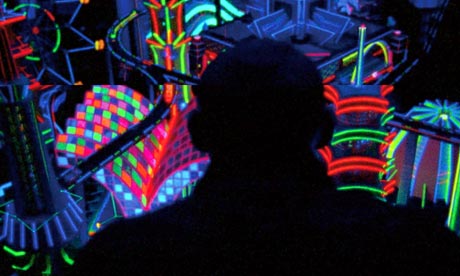
Enter The Void is a film which follows the adventures of a drug addict after he dies. We follow him as his carelessness destroys not only his life but his sister's and his friend Alex's. The film is two and a half hours in his head, one long very pretty, very depressing drug dream.


This film is like an extreme version of most of the films I watched in 2010. Some cutting-edge visuals, stylistically innovative, but ultimately lacking in substance or meaning. I'm not saying that there's no meaning, its just that the meaning is shallow compared to the effort and time used to convey the meaning.

Gasper Noe said that he created the film to show the emptiness of humanity. If that is the case, then why portray both an animal side to sexuality and a mystical side? And if death is simply a really long drug dream, then the movie isn't really about the emptiness of humanity, but the emptiness of the protagonist. If he wanted to show the emptiness of humanity, then he should have shown us a seemingly fulfilling life and how it was actually empty. Instead, he gives us a pathetic example of a human being and lets us spend two and a half hours roaming around his cranium. Thanks a lot, Noe.

However, visually the film was stunning. Very 2001-ish with a lot of neon and fractal-type images. I can't recommend it for all that, though. One other thing, if you are interested in watching the film, despite my half-heartedness, there is a lot of fairly graphic sexuality here, and at times it feels more like a porn film than mainstream. For myself, as well as for others, I would not recommend this film just because of that. 3/5

But what does all this have to do with 2010? So many of the praised films of 2010 are much like this one-- either filled with miserable lives, or full of stunning visuals but having little substance.

Black Swan-- Amazing visuals decorating a pretty simple, predictable film about psychological collapse.

Inception-- Nolan tells you exactly what will happen in the second half of the film, and fulfills his promise with amazing visuals, but is completely predictable.

The Social Network-- A bunch of miserable characters told in a very entertaining fashion.

127 Hours-- Danny Boyles style is remarkable, but it is still a story of a guy whose arm gets stuck under a rock for 127 hours. We know what's going to happen, so the rest of it is style.

I could go on, but you get the point. I'm not saying that these films aren't good-- again there are a lot of stylistic innovation and clever visuals. But that doesn't make these movies great. There simply isn't enough theme or mental stimulation to make them excellent, in my opinion. As far as I'm concerned, a great film stimulates both the mind and the senses. For the majority of films I've seen from this last year my senses have been stirred, but my mind has only been tickled, not challenged.

Tuesday, February 15, 2011

The Mobsters of 2010

For the most part, I am terribly weary of watching mob movies. I loved the Godfather films (all three) and The Wire is just fantastic, but why should I bother seeing more? Sure, I heard Sopranos was excellent, but that's a lot of Italian mafia to swallow. I saw enough of Scarface to never bother seeing the rest of it. Senseless violence, destructive personalities, assassinations, corrupt cops... it's all the same and if I want to see a half-truth, why should I see such a negative one, filled with evil people "trying" to be good or whatever?

Animal Kingdom (2010)


"Just another day of killing with the family."

See, this is what I'm talking about. Josh's mother dies and he moves in with his grandmother who's boys are all hard core criminals. Josh's narration at the beginning talks about how they all know that they are right on the edge of losing everything. So, we know how the movie's going to pan out, don't we? Pope is one of the more selfishly evil characters I've seen, and frankly, everyone else is only marginally better. No stand out performances, just a lot of senseless killing. There's a lot I might forgive of the film, but almost every character is just stupid.

However, I do think it has the best use of Air Supply of any movie. 2/5


The Prophet (2009)


"It's a lonely business, being the head of a crime syndicate."

But this French film, filled with Corsican and Arabic, reminds me of why I still occasionally watch mob films.

It is smart and mystical and powerful and sad. It is as starkly realistic and as intense as a season of The Wire (although without the award-winning dialogue).

It follows Malik into prison, his home for six years, as he is faced with a Hobson's choice from a Corsican mobster who runs the prison: kill a man or I will kill you. It could be see as a paint by the numbers rags-to-riches criminal story, but Malik remains so boyish, and his friend Ryad is so real and the ghost of his first kill haunts the screen. There is a lot in this movie, and it is worth watching.

(For those who haven't seen the film, skip this next paragraph.) One of the most fascinating aspects of the film is the mystic side of it. Malik is visited regularly by the ghost of his first kill, Reyeb, who is a criminal who will testify against his boss. I think that the development of Reyeb is fascinating, especially after he dies. He is a hash dealer who wants to trade sexual favors for drugs. After he died, he hangs around Malik, with little animosity. By the end of the film, he is giving Makik visions and encouraging him to worship God. So the ghost of Reyeb seems to be pulling Malik one direction, but his criminal reality is leading him, without pause, toward evil. This is a fascinating way to create moral tension, one which I've never seen in a mob movie before. Religion plays a role in Malik's life, but by the end of the film, he seeks out Reyeb, but Reyeb cannot be found.

Yes, it has a lot of violence, much of it seemingly senseless. But this movie is so well acted and conceived and is just original enough that it is worth whatever discomfort it might give you. 4/5

Saturday, February 12, 2011

My Toy Story Rankings (no, this isn't a brief post)

This isn't exactly a review of what some have called "the greatest trilogy in film" (those are the people who haven't seen The Colors Trilogy by Keislowski, clearly). Rather, it is a defense of why I think Toy Story 2 is the best of the trilogy. Please don't think I am putting down any of these films. They are all amazing. But only one makes my list of top 100 films. Here's why:

Toy Story


"Who is that happy child?"

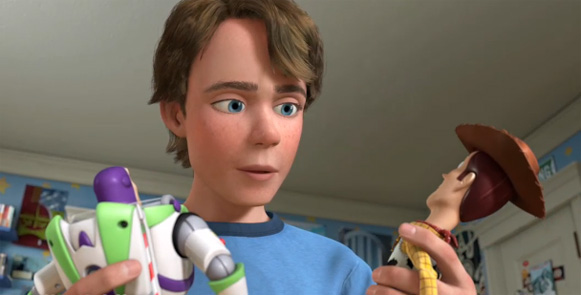
Of course, this film is great. It is what started Pixar in feature films and introduced us to Buzz, Woody, Hamm and Potato Head. It also sets up the important themes of the other movies-- double lives, friendship, mortal limitations, faithfulness, devotion. It also gives us the building blocks for the other movies-- ingenious planning, Buzz's bravery, Woody's insight but emotional instability, Rex's small intellect, as well as nuggets that become bigger in other movies-- the puppy, the Emperor Zurg, Mrs. Potato Head, Al's Toy Barn.

However, in the end, this is still a first film and it has the weaknesses of a first film. The main song is great, as well as is "Sailing No More"-- but apart from Ragtime, Randy Newman really shouldn't be writing and singing an entire score. A little more variety would have been good, as there was in the other two films. Also there are inconsistencies. Woody has brilliant planning, but just a little while before he couldn't figure out how to get out of Syd's house and then all of a sudden he knows all the ductwork? Andy hears something drop into the box next to him and suddenly W and B appear out of nowhere? They aren't even on the floor of the car?

But the biggest weakness of Toy Story, in my opinion, are the darkness of some of the characters. Woody is so blinded by jealousy that he isn't smart at all. I'm not saying that it isn't realistic, I'm saying I much, much prefer the Woody of the other two movies. Mr. Potato Head is ready to jump to severe conclusions. In the other movies, all the toys do this ("Woody, don't sell yourself!"), but it's on the normal level of the toy universe, not talk of "murder". How does one "murder" a toy by knocking him out of a window anyway? The accusation doesn't make sense. Buzz is a stellar exception. He is wonderful all throughout, even when he is fuming mad at Woody, or driven mad by his discovery that the delusions were unreal. ("The hat looks good, right? Sure, the apron is too much...").

I feel that they really understood these characters better by the second movie, and they were able to clean up the scripts to make the toy universe more consistent. Frankly, although the first movie is excellent, the second movie perfects a very good beginning.

Toy Story 3


"You have to the end of the week to decide"

The first time I saw this film it was, let's say, less than stellar conditions. A terrible noise ruined five minutes during the climax of the film and just ruined the whole thing (I never did ask the theatre for replacement tickets although I should have).

My family and I watched it again and it was just wonderful this time. Frankly, I think I would have enjoyed it better this time anyway.

The significant theme of Toy Story 3 is mortality. This comes right from the beginning when the classic Randy Newman theme ends with, "Our friendship will never die..." Even though toys don't really die, death is the major theme of Toy Story 3. When toys are no longer wanted by their owners, then their life is over. Sure, they may have some nefarious afterlife in the attic, or perhaps be resurrected by playing with the owner's kids, but in reality, their life is over. Death looms over all this film. And like Gilgamesh (the first novel ever published), the toys are desperately seeking to extend their lives. What makes a toys life meaningful? Being played with. So that's what they want to find-- a place where they will always be played with, never to be forsaken by owners. They want eternal life.

And they find it at Sunnyside Preschool. But instead of a simple paradise, it is a heaven or hell situation. It is interesting how here there is a subtle critique of monotheistic religion. Those who rule heaven are autocrats, choosing some for hell so that they can retain their paradise. And really, isn't that what most religion is about? People choosing themselves for heaven, which automatically means that some are destined for hell.

The toys, of course with Woody's help, escape hell--literal fire-- and find a completely new kind of afterlife-- reincarnation. They can be reborn with a new existence in a new owner's imagination. I really doubt that the authors had all of this religious idealism in mind (although I think they really were critiquing monotheistic afterlife), but it is interesting how this Divine Comedy plays out. They are taking some of the oldest themes of literature and playing it out in a "children's" movie.

In this way, Toy Story 3 is, in a sense, darker than the other two. The stakes are higher, the themes are deeper and the symbolism is more powerful than the other two.

Toy Story 2


When somebody loved me...

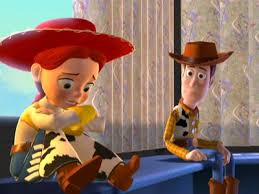
But I still think that Toy Story 2 is the best-- at least in my opinion. Perhaps Toy Story is the Illiad of the trilogy, concerning the "hubris of Woody" and TS3 is the Divine Comedy of the trilogy, exploring the different afterlifes of the toy universe. But I think that Toy Story 2 is more of a piece of art in it's own right, even without exploring deeper themes. TS2 is about loyalty. We saw loyalty in the first movie-- Slink is the personification of that. But Slink's loyalty was unfounded, untested. TS2 is about the test of loyalty-- choosing to be faithful to one's friend even when the situations are at their worst, even when you are given fame in exchange for that loyalty.

In that sense, TS2 is a great example of what Pixar itself is all about. Yes, they make films and program software, but it is not only about the work. It is about the families and the relationships and having fun as a community. The leaders of Pixar could have been controlling, like Walt Disney, or manipulating... but they chose to be about relationship instead. So TS2 talks about what is most important at Pixar-- community over success. And they obtain success anyway. Woody, as usual, remembers what is most important about being a toy-- being there for his owner-- and in that he remains true to his friends.

And TS2 reflects the themes of the others. Friendship despite conflict. Mortality. Rejection of those most important to us. But it does it in the most entertaining fashion. TS2 not only is a deep movie, but it is deeply emotional and deeply funny. It perfects the TS universe, enriches it and keeps it all entertaining, every step of the way.

TS3, I think, it the one that is the closest competition. The universe is perfect there, too, and the writing is excellent, the characters well developed without being irritating. But so much of it draws from the other two films, that it just doesn't seem original enough. And, frankly, I find TS2 more entertaining and more interesting to watch.

All are brilliant, but here is my line up:
Toy Story 2- 5/5
Toy Story 3- 4.5/5
Toy Story -3.5/5


All great, but some greater than others.

A Guy Ritchie Joint: Sherlock Holmes (2009)


'Splodies? Check. Shirtless fight sequence? Check. Burning man? Check.

I probably went in expecting too much. It starred Robert Downey Jr. and Jude Law, and it was about Sherlock Holmes. I figured the script would be smart and funny and we'd see some antics, but we'd be heading to a generally good time.

What I got was a stylized action film with House, MD and his sidekick Robert Wilson.

Sherlock Holmes isn't bookish or full of disguises in this film, he is clever, but far more smart about anatomy and how to hit his opponent than he is in solving a case. Dr. Watson is far less proper than his short story counterpart, and more likely to threaten than to heal. And their relationship is almost identical with House and his best friend in the TV show, with Sherlock being manipulative and Watson being sarcastic.

It's a good show. And Guy Ritchie is certainly in control here. The visuals are fantastic, even the final credit sequence is stunning. But I was so disappointed in what I had hoped to watch that the interesting looks couldn't sway me. Perhaps it was the obvious CGI that did me in?

If you are looking for a nineteenth century action/mystery film, with cool visuals this is for you. But if you were hoping for a funny, smart script and a new take on an old set of characters, don't bother. 3/5

Friday, February 11, 2011

Hey, I Know This Guy! Greenberg (2010)


It's unusual for me to do this, but I watched Greenberg cold. I had never seen a previous Noah Baumbach film, I didn't really have a clue as to what Greenberg was about, I had never seen a trailer or read a review. It was refreshing to come to a film so fresh. And yet, it was soooo familiar.

I would swear that Ben Stiller followed around a couple of my friends. I am a minster to the mentally ill, among others, and Stiller's character here is just like a couple people I know. So self absorbed that every difficulty is someone else's fault and every conversation is centered around him. When someone acts in a normal manner, he gets angry and would possibly walk out without warning. Greenberg (and my friends) are those who, even if not specifically diagnosed with a mental illness is so socially crippled that they don't really have friends, simply victims. Or those who try, ever so slowly, to make them into fuller human beings.


I just want to say that Greenberg is realistic, for the most part. I recognize the character of Florence and although her depth of passivity is rare, it isn't unknown. And the thought of throwing these two characters together is fascinating and it was interesting to watch.

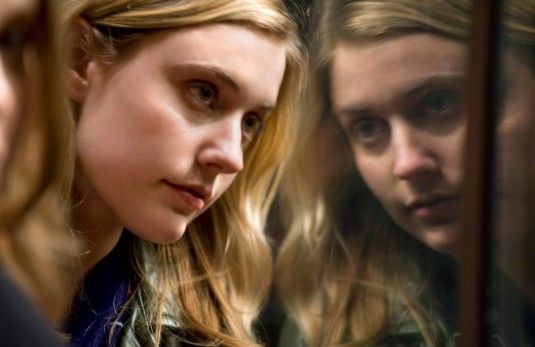
Despite, or perhaps because of, the excellent characterizations of Stiller and Gretta Gerwig, watching Greenberg was like watching a social train wreck. It is amazing, and it keeps your attention, but in the end you feel a little dirty and you wish it could have had a different ending. Tragedy is terrible, even when it is deadly quiet.