Showing posts with label F is for Fake. Show all posts

Thursday, March 15, 2012

Why Jessica Should Give Certified Copy Another Chance


My friend Jessica, aka “Lobby” of The Velvet Café and the Filmspotting Forum is a wonderful film blogger.  One of the best, actually (you can see a link to her site on the sidebar).   She has wonderful opinions of film and she expresses them in such a personal, interesting way.  However, sometimes—only occasionally, mind you—she is terribly wrong.

For instance, I would claim that 2011 has produced three masterpieces of film.  Perhaps more, after all I haven’t watched A Separation yet or This Is Not a Film.  But there are three that will be discussed and watched happily for decades to come: Tree of Life, Melancholia and Certified Copy.  Jessica didn’t really care for two of them, and hasn’t watched the third and probably is now nervous about watching the third, because I have lumped them all together.

Although I might want to defend Tree of Life, I am here to talk about Certified Copy.  Jessica said that she wasn’t really interested in a very long art discussion.  And it’s true, I wouldn’t either.  And that’s what the film begins with—a discussion about whether a piece of art is to be valued equally as it’s certified copy.  It’s an interesting notion, but one that has been discussed to death in other good films like F is for Fake, My Kid Could Paint That and Exit Through the Gift Shop. The subject has been exhausted, and I would be exhausted to watch another film about it.

But Certified Copy is not about art.  It’s about relationships.

It is using the example of a single relationship, which at times is a courtship and at times is a couple fifteen years married,  to talk about the nature of relationships in general—all of our relationships, but especially our most intimate, long-standing ones. 


There are many questions the film brings up about our relationships:

Do we change over time or are we just perceived differently by others?

Is our value intrinsically our own, or do we only have the value others give us?

Must our relationships have a goal, or is it enough that we just enjoy the experience?

Is the goal of life to produce, or to be happy?

Is it acceptable to avoid the difficult things in relationships, or should we work at “fixing” them?

I admit that the film is a difficult one to watch.  The two principles, brilliantly portrayed by Juliette Binoche and William Shimell, spend most of the film arguing, bickering.  The fact that we don’t know whether the couple are complete strangers or deeply intimate is a distraction. 

Actually, let’s talk about that—see how much of a distraction it is?  But it goes into the  theme of the film.  At the beginning of the film, it seems obvious that William and Juliette don’t know each other, that she’s attracted to him, but also extremely upset at some of his opinions.  About halfway through the film, they speak as if they have had a rocky marriage, one in which he separated himself from her and their son for most of the marriage.  They also have connection with another couple who are getting married in the same place they got married 15 years ago.  And most of the way through the film, they pass an older couple, leaning on each other in order to walk. 

I believe that all four of these portraits are of their marriage, or that they all speak to different parts of the same marriage, or all marriages.  There is the courtship, where we are getting to know each other.  Then the wedding, in which the relationship is most idealistic.  Then a number of years later when the ideals are cast aside and a choice is made to continue to live together or to separate.  And, finally, old age where the decision to remain together leads to interdependence.  

What I believe the film is saying is that all four of these stages are the same marriage.  They aren’t different relationships, but the same one.  The individuals haven’t really changed.  But each stage gives them a new opportunity to perceive each other and how we value each other differently.
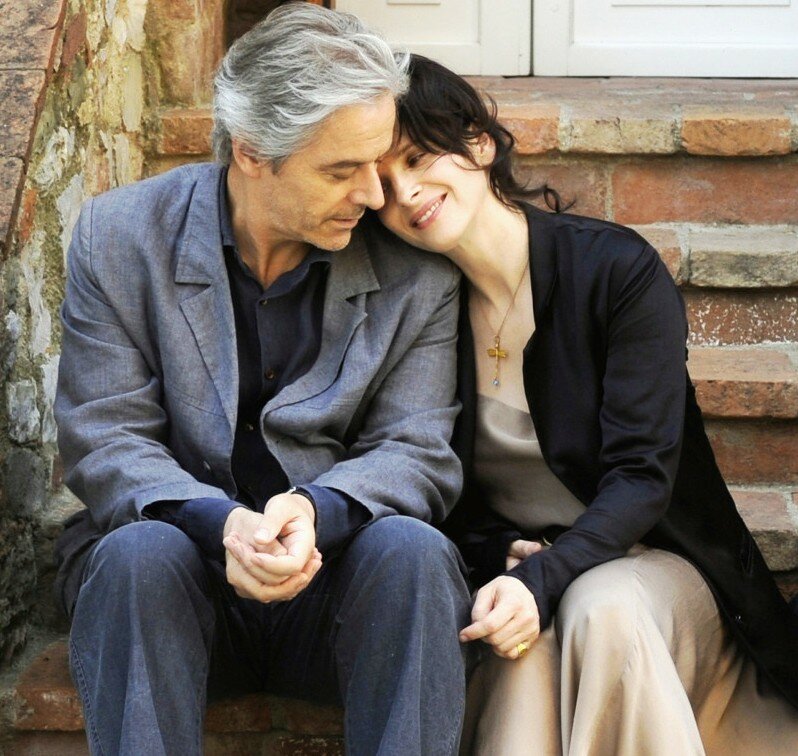
And this is why I love this film: I have never watched a film that more helps me understand the nature of long term relationships.  Mind you, I haven’t seen Scenes From a Marriage yet (although I will soon), but this film is deeper and more thoughtful about relationships than any film I have ever seen.

So, Jessica, if you are reading, I hope that give Certified Copy a chance.  Another chance.  I think there’s a lot there, more than anyone can catch in one viewing.  Really, it’s the up and coming thing.  Like indoor plumbing ;)

Thursday, September 1, 2011

F is for both Fact and False


A question was posed on the Filmspotting Forum recently about movies that claim some level of truth.  What if they don't give all the truth?  What if they change significant aspects of the story, or the history?


My friend Jessica/Lobby gave this example: In the film The Diving Bell and the Butterfly, based on the true story of Jean-Dominique Bauby, a journalist and editor who lost complete use of his body.  The film shows how his ex-wife stayed with him through thick and thin, but his girlfriend didn't show up.  However, eyewitnesses say that the truth is just the opposite-- it was the girlfriend who was by his side and the ex-wife who wasn't to be seen.  Why the change?  The ex-wife was co-producer of the film. 


Should the director or scriptwriter take some responsibility that the facts be presented correctly?  What about a portrayal that puts a real person-- perhaps a living person-- in a bad (or good) light that isn't accurate?  Should there be some baseline of truth that is required should a film claim to be based on "real events"?


In my opinion, all film is fiction.  So is almost all literature, except for the most researched, documented material.  In every film there is a kind of truth that they are trying to reach for and a kind of fiction that supports their version of the truth.   If a film states "based on real events", this only means to me that something vaguely like what occurred in the film happened.  If the real events were important to me, I'd read a journalistic, documented report of such events.


Documentaries, while using actual footage, is at best interpreted fact.  At worst, it is created from whole cloth.  This does not hinder my enjoyment of said film because I believe that all film is fiction.

Since Orson Welles' tour de force F is for Fake, many documentaries have abandoned all pretense of being journalistic or objective.  This last year we have the film Exit Through the Gift Shop, which narratively, purposefully, blurs the line between reality and fiction.  Michael Moore has facts he believes are true and presents them in an entertaining fashion, but it's only one side of the facts.  Recent documentaries such as My Kid Could Paint That and Dear Zachary allow the filmmaker to insert himself into the narrative, throwing objectivity out the window.  24 City, a Chinese documentary, uses actors to re-create interviews.  The line between truth and storytelling and just plain old fiction is often blurred without distinction.  Mind you, I love these films.  And part of what I love is the question of truth the filmmaker puts in your mind.     


I wish that the term "documentary" didn't mean, in many people's estimation, a factual account.  I wish that when anyone reads the phrase "based on real events" that they would emphasize the word "based", and recognize that there is a lot in the film that isn't fact in any way.  But people want to think that reality happens in this entertaining fashion.  So it is.

What is a director's responsibility?  Not much more than what they have done already.  I wish that every documentarian would say, "This film is more about me than my subject".  I wish that every filmmaker who creates a movie about real events would admit that they made up a lot or at least changed a lot.  But that's kind of like asking a magician to tell how they did their trick (as The Prestige would say).  Frankly, it ruins the trick for the audience.  It's like a child saying, "Let's pretend" in a Let's Pretend game.  To acknowledge the curtain is to acknowledge that you are being tricked and that ruins the real fiction: the one where the audience thinks they are being given facts instead of opinion.


So what about the girl that was falsely portrayed in The Diving Bell and the Butterfly? 


I would hope that she and her friends would know the truth.  The fact is, if the wife hadn't been a co-producer, the film possibly wouldn't have been made at all, and most of us wouldn't have known the amazing story, or seen the remarkable film.  I would wish that most people would understand that such a movie is a story and only part of the narrative is true.  Some won't.  But those of us that do will be talking about the "wife" and the "girlfriend" as portrayed in the movie, not in real life.  


As for anyone who purposefully tells a lie in order to promote themselves... I have no sympathy for them and believe that justice will be given them-- but almost certainly not in film.  Nor in the courts.

Thursday, August 25, 2011

Experience, Interpretation and Film

Please watch this video:


Most of what Paul Bloom says here is familiar to me, having read it or having been portrayed in films I have watched.  Check out F is for Fake and My Kid Could Paint That for lengthier versions of a couple of the stories.

What was striking to me was his point that what is significant in the aesthetic is what we consider to be the "essence" of the art.  Origin narratives, vision of the artist, "cooties", what have you.   And I think a number of the arguments we have between film critics as to the excellence of a film has to do with what we consider their "essence", or the significance of the film itself.

But what I note is that, in the end, the reality of "essence" does not, in fact, exist.  Sure, we can see whether a film is using certain cameras, that it has certain themes, that some actors starred in it, or had a particular director.  But these facts are simply details that we use to support our idea of it's essence.  But the essence of the idea does not exist in the film itself, nor in the director's notes of the film, but in our imagination, in our beliefs.   A film is only good to us because we believe it is good, because we see something in the film that may be there, but only we would give it that value, or something that isn't there at all, but it is significant to us, nevertheless.

Thus, to write a review is not to declare a film "good" or "bad", but is, in the end, a reflection of our belief system.  I have a friend who attempts to distill our personalities from the list of our top 100 movies.  It's a party trick, but maybe it isn't so far off from reality.  But he might also need to have our bottom 20 to get a more rounded idea of what we believe about aesthetics.  But we should also see our reviews as personal statements, like NPR's "What I Believe" rather than journalistic statements of fact.

And what does that say about ALL of our experience? A movie is a certain kind of experience, but we interpret and give value to experiences every day.  We could say that our appendicitis is "bad" because we experienced pain, but perhaps that pain also helped us see and understand a strength or a weakness in ourselves and changed our outlook, thus it could be "good".  The person cutting us could be "bad" in a street fight, but "good" in an operating room, depending on what we see the motivation of the person is.  But we don't actually know their motivation. Perhaps the one in the street fight is trying to get us out and the surgeon is a masochist.   I'm not saying that such interpretations should be normative, but that it is our belief system that determines such interpretations, not necessarily the context.

Today I watched a film called "Kill the Poor" pretty much exclusively based on its name.  It was a better film than the name would indicate (and the title had nothing to do with the film, actually).  It is the story of a number of tenants in an apartment who had excessive judgments on one tenant based on inadequate evidence.  I kept thinking, "why are you assuming that?  You don't really know that it happened that way."  But characters in movies never listen to me.  And this is what happens with many of our experiences.  We allow interpretation to color the experience rather than experience determine the interpretation.

We do that with film as well.  I expect a certain kind of film when I watch a Eric Rohmer or a Stallone pic.  Lots of people expected something when they went to see this year's Brad Pitt/Sean Penn film.   And what we expect, or what little evidence we have colors our interpretation.  And that isn't bad.  It is what it is.  But that also means that we can't give solid value judgments on film.  I don't think I'd care for The Room, but many people gain a lot of enjoyment out of it.  We could put a value judgment of "bad" or "good" on it, but that doesn't really tell the whole story does it?  Rather, a description of our experience is the only adequate description of the film.