Showing posts with label Martha Marcy May Marlene. Show all posts

Sunday, January 6, 2013

What Counts: Interpretation and Intention

I am an arrogant SOB.  At least so I have been told.  I am so convinced that I am right that I won’t listen to other points of view.  Mind you, I am perfectly willing to allow others their (wrong) point of view, but I very rarely will allow their points of view to shake my own.

This only makes sense because my opinion is distinctly my own and it doesn’t make any sense to me to adapt another person’s point of view.  That seems very invasive, to allow another’s mind to rest in my own as if it lived there.

And this goes with movies as well.  You might notice that I don’t very often post a typical “review” of a film, as if it is “good” or “bad”, enjoyable or not.  I typically am writing about movies that meant something to me and I am writing at least a part of what I understood about the film.  I am not asking others to agree with me necessarily.  But unless you give me pretty solid evidence, I won’t change my mind about what the film means to me.

In my review of Martha Marcy Mae Marline, I gave an opinion of the meaning of the last name in the film title, and a couple readers wrote in to tell me I was wrong and they gave me evidence from the film.  Well, I was wrong.  I’m disappointed I was wrong, but there it is.

Now recently I watched the film Looper, the popular time travel flick by Rian Johnson, who is a director I really enjoy.  The plot, like all good time travel stories, is complicated and intricate.  But there seemed to be a clear contradiction in the plot, involving the end which I won’t get into.  I thought it through and decided that there must have been an unexpressed, subtle twist in the film that isn’t usually seen.  I was pretty excited about it, and I was ready to share it with my film friends, to see what they thought.

Then I listened to an interview with Rian Johnson and he happened to be talking about the plot of the film and he made it clear that, as writer/director, he had no thought as to my subtle twist.  It just wasn’t there.  Which meant that the contradiction stood.  This really irritated me.  I didn’t want the film to have a logical problem with it.  Admittedly, it is difficult to have a complex time travel without a misstep, but I wanted RJ to have it right.  I like him a lot, both as a person and as a moviemaker and I wanted him to get it right.  But he just didn’t.  That sucks.

Now, I have some friends who, it might be argued, are more arrogant than I.  They would tell me, “The director cannot tell us the ‘real’ meaning of his film.  Once the film is released, it is in the public arena.  He can have his opinion of the film and you can have yours and both can stand as equals, each must stand under the scrutiny of the text of the film.” 

I can certainly see this point of view for most films.  Because most film is art created by committee.  So the director may have one intention, but the scriptwriter another, the studio another, the cinematographer another.  So while my opinion isn’t reflecting one imaginative mindset, it could represent another.  The intention of the director, or the writer or the cinematographer or lead actor is only one point of view on this art.  There are other creative people who have input into this and my point of view might be representing another equally valid point of view.

I have a harder time doing that with a writer/director like Johnson or Woody Allen or Ingmar Bergman.  These artists have more control over their work, and have a singular mindset, a point or point of view they want to express.  They are more like novelists, and when a novelist expresses an opinion about the meaning of their work, their view, while not completely authoritative, is certainly more authoritative than anyone else’s.   
I can express my point of view about Looper’s plot, and it might disagree with Rian Johnson,  and if anyone pointed out that it disagreed with the 90 percent creator, I would hang my head in shame.  I still think that I have the right to my point of view.  And it is as good as anyone else’s , unless I am proven otherwise.  But just because I like my interpretation better, the main creator of a work still gets first say.

All this is to say I wish writer/directors would just shut up about their work.  Just release the work and then let it go.  You’re stepping on my toes. L
(Just joking, Rian.  You are so cool, I like listening to you. But let us have some mystery, okay?)

Thursday, March 1, 2012

Review and Analysis of Martha Marcy May Marlene

For brevity's sake, from here on out the film, the story of a woman who escaped from a cult to live with her sister and husband in a beautiful lake house, will be called MMMM.


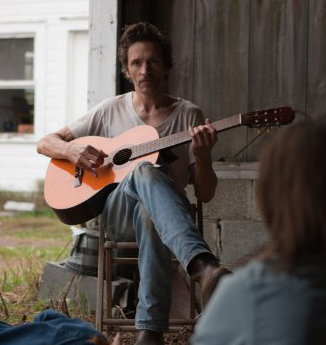
There are pieces of the film that I felt were brilliant.  I know that many people found the editing distracting, but I thought it was fantastic.  Frankly, how else could the story be told?  If it was told in a chronological fashion, it would give away too much, too soon.   The acting was fantastic, especially Elizabeth Olson, who plays the title role, and John Hawkes, who plays Patrick, the charismatic cult leader .  The fact that they make the commune a personality cult rather than a religious one, makes sense and was a smart move, because it is too easy to make a religious cult leader smarmy or crazy.  This cult was perfect as it displayed both the ideals and the weaknesses.  The sociological critique was also subtle and thoughtful.

For all the wonderful aspects of the film, it still left me a bit empty.  What is the film about, really?  Is it about the family relationships?  If so, it’s pretty depressing, because neither family really accepted MMMM for who she was.  Is it, ultimately, a thriller? If so, it may be the longest start of any thriller, and it isn’t very thrilling for most of the film.  Is the central point a subtle comparison/contrast between “normal” life and life in a radical cult?   This is the most interesting aspect of the film to me, but it seems to be undermined by the end, when the “thriller” aspect of the film takes over.   The interplay between two very different cultures displays the weaknesses of both cultures, but the end undermines the equality and gives all the serious negativity to one side alone—“Well, MMMM’s family may not be great, but at least they aren’t as bad as this.”

Personally, I think I’ll stick with the film as a critique of both society and alternative communities, and forget I ever saw the ending.


Below is the analysis of the film which definitely contains spoilers. 


Exactly what kind of critique is being offered by MMMM?  There are two worlds being presented in the film.  First is the world of the commune, an alternative community which exists on very little cash (they sell crafts in town), and have a peculiar pecking order for authority and sexual relationships.  It is an idealist society based on principles of peace and love and community.  The second world is the “normal” world of jobs and consumerism, privacy and genetic connections.   The world where you keep in touch with family,  a single family for a single home and you don’t say what you really think unless you’re really upset.

Apart from the more sinister aspects of the cult, the film offers a number of critiques of community life.  First of all, the economics of the community simply don’t work.  They are forced to steal to maintain their community of love.  The biggest critique has to be the authoritarianism that seems inherent in such community life.  Someone not only has to have a vision, but the community as a whole seems to be revolved around the Patrick's needs and quirks.  Every woman is brought into the community via a baptism of “date rape”.  The other men in the community seem to have the opportunities for sexual action after the Patrick is done with the most recent woman.   There is a highlighting of the sexual inequality, as the women only eat after the men are finished.  And there is a highly sexualized tone of the community in general, where each woman sees the Patrick as her boyfriend/husband, while the other men can be mocked or disregarded completely. 

But the film also pokes at society at large.  The demands of family seem unreasonable, and they clearly have no idea how to assist someone dealing with PTSD and depression, apart from veiled threats.  The outside world seems very uptight and narrow minded about many aspects of human life, including nudity and what is appropriate to communicate.  And the economics of capitalism, compared with community life, seems wasteful and self-centered.

But all of this critique can be taken with a grain of salt because it is made by a woman who has been clearly traumatized by her brush with community life.  As a person who lives in community, and is a leader of two different styles of alternative living (albeit distinctly Christian ones) I am disappointed that the movie seems to pull punches toward society at large.  The basic idea seems to be: “Sure, our society has weaknesses, but the alternative is worse.”   I would have preferred a stronger statement on the broader culture.

I am also a little uncomfortable at the critique of community living.  I don't think that Patrick's community is, in the film, necessarily representative of all alternative communities.  However, I think that there is a dig at all alternative communities-- while they all may not steal, they are not economically viable.  And they are too idealistic for their own good might be a critique of all communities.  Again, living in community and having visited many different kinds of communities, these critiques might sometimes be correct, but are often not. Certainly an implication of authoritarian leadership in   

One last thing I want to say, which is about the ending.  I don’t know if everyone who watched the film got this, but it seemed like a very subtle way to say that Martha ended up back in the community.  Perhaps a couple people would say, “How do you know this? The ending was pretty vague.”  Yes, visually we are left with the community approaching to attack the car carrying Martha, her sister and her brother in law.  But we are given two more pieces of information.  First of all, the final name in the title is Marlene—a name never mentioned in the film.  It implies that our protagonist is given four names, while only three were mentioned in the film.  And as the credits roll, we are given a song, sung by the cult leader, about Marlene, which means that the cult captured her, gave her another new name and then accepted her as this new person.  This leads to speculation about her family—what happened to the couple?  I can only come up with one conclusion.
Perhaps the ending was obvious to all of you who saw the film.  But while I dislike what it says about the message of the film, it was really well done and gave the final period to the statement:

 Creepiest. Cult. Ever.