Showing posts with label 2011. Show all posts

Wednesday, October 3, 2012

Does a Relationship Ever Actually Change? (Certified Copy 2010)

#90-- Certified Copy (2010)


I have been married for (carry the one, twelve minus nine) 23 years, which is half of my life.  And when my wife and I married, and for the eight years before we were married, we were completely different people than we are now.  I was more stoic and aloof.  She was more carefree and had more energy.  There is much that we haven’t changed: we both still love books (we spent half of our first three months of marriage reading), we are both still introverts, I am still ambitious and she is still anti-ambitious.  But there still seems some fundamental things that have changed.

But have they really?  Are we really all that different?  The male and female protagonists of Certified Copy (Juliette Binoche, William Shimell) seem to make a radical change toward each other in the middle of the film.  Although no time has gone by, their relationship changes from courtship to married to several years.  The heat in their relationship increases.  But the issues in their relation remains the same.  They are fundamentally still the same people, with the same opinions, with the same attraction toward each other, and with the same anger at each other’s’ idiocy.   They are different people, and yet, over the years, their relationship remains oddly similar. (There are different interpretations of the film, but this is mine and I’m sticking to it.)

What if, no matter how long we lived together, we are continually rehearsing the same relationship joys and sorrows, again and again?  Perhaps each relationship is fated to be a loop, with the highs and lows repeated, with the same arguments.  Perhaps, in the worst as well as the best times, we need to re-consider our relationships before we commit to them.  Perhaps we need to ask these questions before our marriage, before our divorce: Can I live like this the rest of my life?  Can I live without this for the rest of my life?  I know for me, despite any hardships or desperate weaknesses in our relationship, I couldn’t imagine my life without her.  I can only hope she feels the same about me. 

Fun Fact: Certified Copy is a French film with a French actress, a British actor and an Iranian writer/director, Abbas Kiarostami.  Kiarostami also directed Iranian films, such as A Taste of Cherry which won the Cannes Palme D'Or of 1997.

Sunday, July 1, 2012

The Grey: A Lesson In Survival


The Movie Bible: The Bible is a collection of ancient stories, all themed around humanity’s relationship with God and about how God wants us to live.   What would the Bible look like today if movies were collected around such themes?  I will discuss such movies, giving non-spoiler plots, discussing themes in the film and then drawing a conclusion.


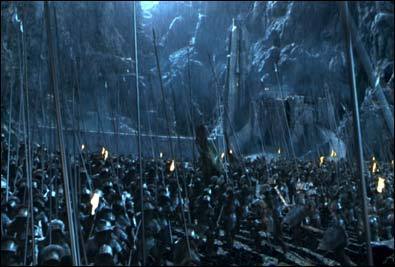
Talk about a bad day.  Liam Neeson is filled with remorse about his life, so he gets a job in the Alaskan wilderness with a whole lot of other ne’er-do-wells.  Feeling trapped and of no use to anyone, he seriously considers suicide, to the point of putting a gun in his mouth (which looks silly, no fashion sense at all).  Coming just off of that brink, he and some of his co-workers were taking a break and heading toward Anchorage.  And then the plane crashes, with only seven survivors.  Thankfully, they have Liam Neeson there to help them survive, to focus on food and warmth and a plan to get out.  And then the wolves attack.

It would be a mistake to see this film as strictly an action film.  It has a number of tense scenes (so much so that my wife laughed at me as I am jumping and whimpering in front of my laptop) and great action moments.  But if you were to see the film as action, then you would end up being disappointed.  Because in the end, this film isn’t about the intensity, but it is a parable about survival—about how we approach life in general.

We are all in the wilderness  working together to survive.  But wolves—crises, traumas and illnesses—attack us, threaten us and try to kill us.  We are all doing our best to survive, in whatever way we know how.  Some of us are better at surviving than others, perhaps because they know that life is about survival and so they have focused just on surviving.  These survivors might help us live as well, but most of us do not focus on surviving.  Some of us survive as long as we do because of the help of others.  Some of us survive because of dumb luck.  And some of us die because of that same luck. 

Some of us have faith in a higher power to save us.  Some believe that from the sky, someone will hear our cry and deliver us from our traumas and crises.  Those that do might lash out in anger because they feel that they shouldn’t have to face a crisis that is more than they can handle.  Others of faith are more accepting of their fate, welcoming crises when they happen.  Some even welcome death, recognizing that the beauty of life is more than enough to make up for one’s inevitable death.  In a sense, these people are strong because they accept death on their own terms, and so they live life on their own terms.

Most of us, though, are about survival.  Keeping alive and thriving as best we can.  We struggle, we persevere, and sometimes we make mistakes.  Our own bodily or mental weaknesses make it difficult to survive, but still we strive.  Sometimes we succeed.  Sometimes we don’t.  Sometimes we fight against our wolves, and sometimes we have no fight left to give.  [Spoiler alert—But in the end, it doesn’t matter.  None of us survive.  We all die.  Whether we die with grace, die fighting, die to stupid bad luck, die to personal weakness—in the end we are all dead.  Does it really matter how we live if we all end up the same?]

Of course it does.  Our lives are all we have,  it is our story and our story is, in the end, all we have to give to those who live after us.   Our lives matter not only for our own survival, but the survival of those around us.  And how we live makes the difference between living a good life and a poor one.

The problem with the existential parable of The Grey is that the point of view doesn’t connect to the majority of the movie-watching public.  Most of us don’t see ourselves as survivors, barely alive with wolves attacking us.  The majority of us are thrivers, propped up by a society that has more than ample resources.  The majority of the movie-watching public whine when crises come, wondering “why me” instead of accepting it as a part of life.

To find survivors, one would have to go to the homeless, the desperately poor in other nations.  They understand this film and can see themselves as one of the characters in the parable.  This parable would make sense to (and enflame the emotions of) most people in the ancient world.  But today, the existential point doesn’t make sense to most of us.  We are just disappointed that the film isn’t more of an action thriller.

But the film’s point about life is a good one.  If we don’t see the wolves as a natural part of life, we will just be taken by surprise when they do come.  And, unprepared, we will fail ourselves and those around us.   Life is about living, and living is often about survival.  We cannot survive alone, we cannot survive without hope, we cannot survive without meaning.  What can we do to help ourselves and others survive?

Movie Bible Extra:  
Be a star like Liam Neeson!  Choose mediocre or almost bad films to be a part in, that way you are always the best thing in the film.  Voila!  Instant superstar!

Thursday, March 1, 2012

Review and Analysis of Martha Marcy May Marlene

For brevity's sake, from here on out the film, the story of a woman who escaped from a cult to live with her sister and husband in a beautiful lake house, will be called MMMM.


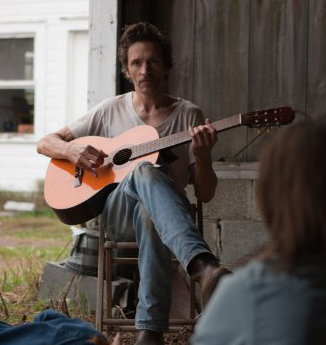
There are pieces of the film that I felt were brilliant.  I know that many people found the editing distracting, but I thought it was fantastic.  Frankly, how else could the story be told?  If it was told in a chronological fashion, it would give away too much, too soon.   The acting was fantastic, especially Elizabeth Olson, who plays the title role, and John Hawkes, who plays Patrick, the charismatic cult leader .  The fact that they make the commune a personality cult rather than a religious one, makes sense and was a smart move, because it is too easy to make a religious cult leader smarmy or crazy.  This cult was perfect as it displayed both the ideals and the weaknesses.  The sociological critique was also subtle and thoughtful.

For all the wonderful aspects of the film, it still left me a bit empty.  What is the film about, really?  Is it about the family relationships?  If so, it’s pretty depressing, because neither family really accepted MMMM for who she was.  Is it, ultimately, a thriller? If so, it may be the longest start of any thriller, and it isn’t very thrilling for most of the film.  Is the central point a subtle comparison/contrast between “normal” life and life in a radical cult?   This is the most interesting aspect of the film to me, but it seems to be undermined by the end, when the “thriller” aspect of the film takes over.   The interplay between two very different cultures displays the weaknesses of both cultures, but the end undermines the equality and gives all the serious negativity to one side alone—“Well, MMMM’s family may not be great, but at least they aren’t as bad as this.”

Personally, I think I’ll stick with the film as a critique of both society and alternative communities, and forget I ever saw the ending.


Below is the analysis of the film which definitely contains spoilers. 


Exactly what kind of critique is being offered by MMMM?  There are two worlds being presented in the film.  First is the world of the commune, an alternative community which exists on very little cash (they sell crafts in town), and have a peculiar pecking order for authority and sexual relationships.  It is an idealist society based on principles of peace and love and community.  The second world is the “normal” world of jobs and consumerism, privacy and genetic connections.   The world where you keep in touch with family,  a single family for a single home and you don’t say what you really think unless you’re really upset.

Apart from the more sinister aspects of the cult, the film offers a number of critiques of community life.  First of all, the economics of the community simply don’t work.  They are forced to steal to maintain their community of love.  The biggest critique has to be the authoritarianism that seems inherent in such community life.  Someone not only has to have a vision, but the community as a whole seems to be revolved around the Patrick's needs and quirks.  Every woman is brought into the community via a baptism of “date rape”.  The other men in the community seem to have the opportunities for sexual action after the Patrick is done with the most recent woman.   There is a highlighting of the sexual inequality, as the women only eat after the men are finished.  And there is a highly sexualized tone of the community in general, where each woman sees the Patrick as her boyfriend/husband, while the other men can be mocked or disregarded completely. 

But the film also pokes at society at large.  The demands of family seem unreasonable, and they clearly have no idea how to assist someone dealing with PTSD and depression, apart from veiled threats.  The outside world seems very uptight and narrow minded about many aspects of human life, including nudity and what is appropriate to communicate.  And the economics of capitalism, compared with community life, seems wasteful and self-centered.

But all of this critique can be taken with a grain of salt because it is made by a woman who has been clearly traumatized by her brush with community life.  As a person who lives in community, and is a leader of two different styles of alternative living (albeit distinctly Christian ones) I am disappointed that the movie seems to pull punches toward society at large.  The basic idea seems to be: “Sure, our society has weaknesses, but the alternative is worse.”   I would have preferred a stronger statement on the broader culture.

I am also a little uncomfortable at the critique of community living.  I don't think that Patrick's community is, in the film, necessarily representative of all alternative communities.  However, I think that there is a dig at all alternative communities-- while they all may not steal, they are not economically viable.  And they are too idealistic for their own good might be a critique of all communities.  Again, living in community and having visited many different kinds of communities, these critiques might sometimes be correct, but are often not. Certainly an implication of authoritarian leadership in   

One last thing I want to say, which is about the ending.  I don’t know if everyone who watched the film got this, but it seemed like a very subtle way to say that Martha ended up back in the community.  Perhaps a couple people would say, “How do you know this? The ending was pretty vague.”  Yes, visually we are left with the community approaching to attack the car carrying Martha, her sister and her brother in law.  But we are given two more pieces of information.  First of all, the final name in the title is Marlene—a name never mentioned in the film.  It implies that our protagonist is given four names, while only three were mentioned in the film.  And as the credits roll, we are given a song, sung by the cult leader, about Marlene, which means that the cult captured her, gave her another new name and then accepted her as this new person.  This leads to speculation about her family—what happened to the couple?  I can only come up with one conclusion.
Perhaps the ending was obvious to all of you who saw the film.  But while I dislike what it says about the message of the film, it was really well done and gave the final period to the statement:

 Creepiest. Cult. Ever.

Thursday, February 16, 2012

A Word From Our Sponsor: The Interrupters


I knew this was not going to be a normal filmviewing experience. 

 It’s difficult when you watch a film that relates to your own expertise or your own occupation.  At best, this leads to discomfort.  Movies are made by moviemakers, so the only details they get precisely right is when the subject is movies.  Any other occupation or subject, they can do the research and get it partly right, but not exactly.  Soldiers generally are uncomfortable with the most accurate war movies, movies about airline disasters get many details wrong and films about a historic period will often cause historians to cringe.  That’s all well and good, we know that movies can’t be perfect, unless it’s YOUR area of expertise.   Then the film is someone on the range from okay to horrible.

The Interrupters is a documentary about a bold group of lay people, called Ceasefire,  stepping in to stop the huge number of deaths among young people in Chicago.  It is a difficult task, and they get paid very little, if anything for their important, dangerous work.   They intervene in violent situations, connect with families of victims, assist the violent to be in more stable situations, and create forums to discuss issues of violence and peace.  It was directed by Steve James, who also directed the acclaimed documentary, Hoop Dreams.

You may ask how the subject of this film relates to any expertise on my part. For the last 17 years I have been involved in learning an outcast, often violent group (the homeless in Portland), being a changing presence with them and creating community.    Some call it missionary work, some call it peacemaking, some call it community work, some call it mission work.   While I am working on a religious basis, and working amidst a group that isn’t as deadly as the one Ceasefire works with,  the work is fundamentally the same.  Creating peace in the midst of violence.  Working toward changed hearts, because that is the basis of changed action.  Intervening in crisis situations.   I have called the emergency line a number of times because of bodies I have discovered.  I have stood in the middle of knife fights.  I have had the police scream at my face because I was on “the wrong” side.  I have built a network of community centers for those who have no where to go.

Enough about me.  That’s enough to give you my sense of surprise when I watched this film:  It was perfect, absolutely, spot on, perfect.

Creating peace is a different animal than keeping the peace.  It is the police’s job to keep the peace, to catch criminals and take them out of the peaceful situation.  But what if the entire community is broken?  What if there is a violent, chaotic foundation at the heart of a community?   Then peace keeping isn’t enough.  As many “bad guys” as you haul away, there will be many more to replace them.  What the Interrupters show is how a community can re-create their space into a community of peace.

The basic principles are right there in the film:
-Find those who are committed to peace in the community, for whatever reasons
-Train them in non-violent intervention and in the reasoning of peace, focusing only on violence, not other criminal activitiy
-Have them make relationships within the community, especially those at high risk of violence (youth, families of victims)
-Speak words of reason to people when they are likely to be violent, and before then
-Discuss peacemaking principles with those who are young enough to instill them in their lives

But the movie is not about the philosophy of peacemaking.  It is about the people who are involved in the everyday reality of doing it.  It is about their pasts, which caused them to see what violence can do to themselves and their community.  It is about their work on the street, both in the excitement and in the necessary hum-drum of “babysitting” a potential violent person.  It is about the successes and the failures. It is about the varied personalities that make up a successful team combating violence.

All combined with a single purpose: to stop kids getting killed. 

I was at various stages of weeping throughout the film.  Sometimes I wept for joy, sometimes for sorrow, sometimes just because I agreed so much with what they were doing.   This is the true work of God—the work of conversion, the work of creating a community of peace from a community of violence.   If you want to see some of the most important work being done in the world, I cannot more highly recommend this film.


Sunday, January 22, 2012

The Ultimate War Movie


War movies are spotty.  It seems to be their nature.  There is only one war movie I can say that I enjoyed pretty much all of it (Apocalypse Now), but most of the rest of them have aspects which are wonderful, but the film as a whole doesn’t quite work.  And war movies should work.  There is heightened drama, high stakes, danger at every turn, and lots of opportunity for powerful performances.  It seems that perhaps most war films assume that the audience is involved in the heightened drama as well, or that an excellent beginning will woo the audience into buying the rest of the film.  But it never worked that way for me.  I can be wooed by beauty, by a great performance, even by a score that is emotionally resonant, but the drama of war doesn’t do it for me itself.  It needs something else.

I’ve gone so far as to make a list of scenes that I could put together to make the greatest war movie in the world.  If we could just put them together, it’d be magnificent.  Well, maybe not, but that’s my dream. 

Here’s my ultimate war movie:

The opening dialogue from Inglourious Basterds 


Boot camp from Full Metal Jacket


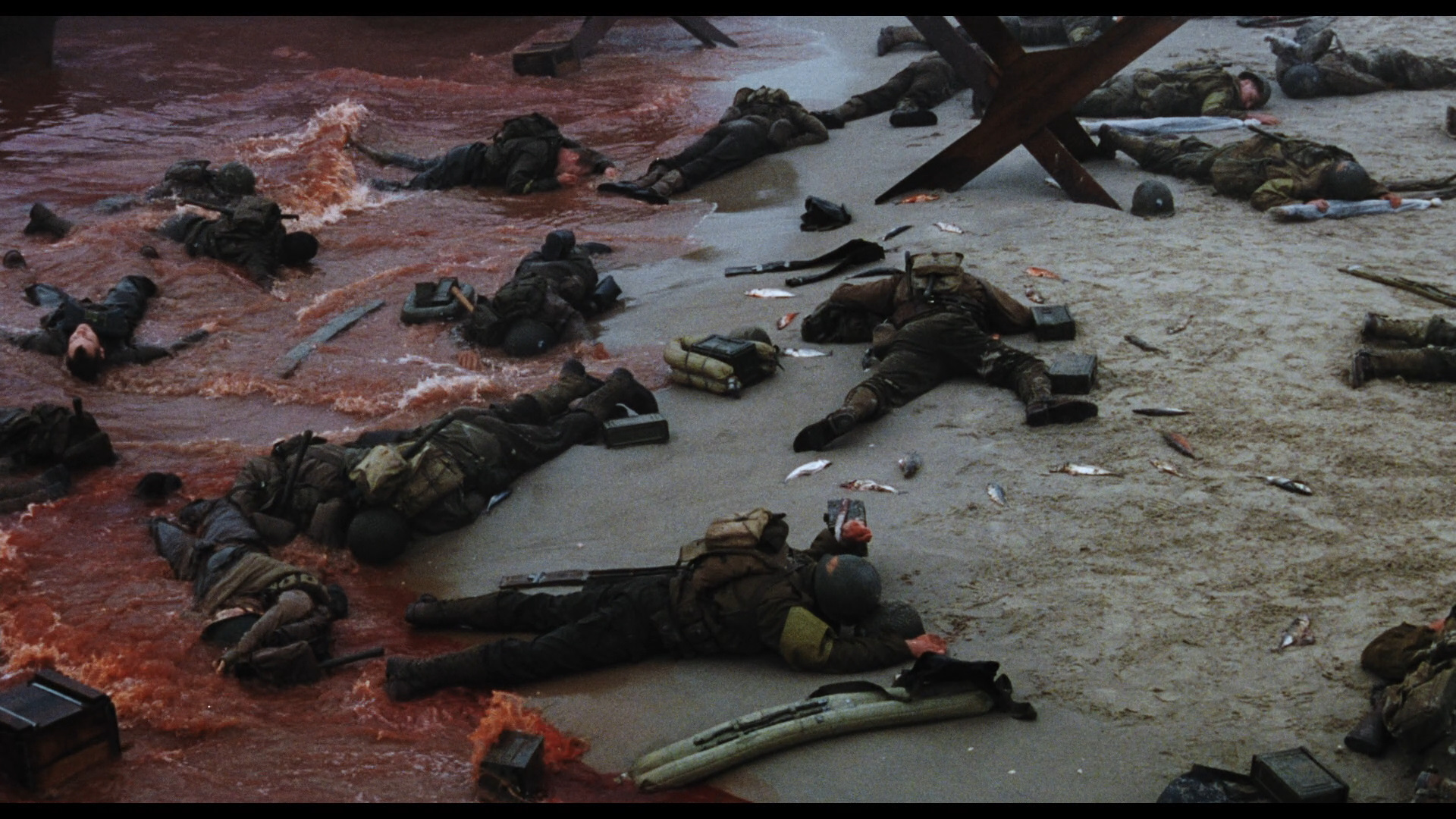
D-Day from Saving Private Ryan 


Surfing from Apocalypse Now  (can you imagine this right after the sequence of SPR?  Talk about an increase of tension)


Riding across the desert from Lawrence of Arabia (How the Arabian Desert became adjacent to Vietnam is an interesting subplot)


The President and his staff consider dropping the bomb: Combination of 13 Days and Dr. Strangelove (don’t ask me how to work that out, I’m not a screenwriter)


Capture and torture of David Bowie from Merry Christmas Mr. Lawrence (significant aspect of any war movie)


Peace and a concert between enemies from Joyeux Noel 


And finally: Ending it all with dropping the bomb from Dr. Strangelove and blowing up the world from Escape From Planet of the Apes (because I want my film to be the final word in war movies).


(In the comments, I invite you to post your favorite war scene that you’d like to see in the greatest war movie ever)

Ah, that’s a great war film.  It covers a variety of aspects of war, sees how it all works together, brings great flimmaking, deep emotional drama,  intense action, comedic elements and a bit of a dig at war all in one film.  But who could make a film like that?  Who could make it interesting?  And who would be able to keep all these different elements from contradicting one another to make a coherent film out of a mess of themes?


Of course, Stephen Spielberg.   Or at least Spielberg back in the day.  The Spielberg who made Close Encounters or Raiders of the Lost Ark, he could do it.  Saving Private Ryan had a great opening sequence, but it didn’t carry that intensity throughout the rest of the film.  But if Spielberg was at the top of his game, he could do it.

Honestly, I had thought that the best Spielberg moves were behind us.  I will always appreciate his early masterpieces, but even A.I.: Artificial Intelligence, which I love, was admittedly mixed in tone and theme.  Schindler’s List was the final great Spielberg film, and although it takes place at war time, it isn’t really a war film, but a Holocaust film, which I consider to be a different animal.  But War Horse proved all my assumptions wrong.


War Horse is that perfect war movie. It can carry different emotions and different themes because instead of telling the story of one soldier, or one troop,  or the story behind a war, it uses a horse as a means to carry us from one aspect of World War I to another.  Although I might be overly praising Spielberg in this review, at least equal credit should be given to the screenwriters, Richard Curtis and Lee Hall, who took a book and magnificently brought a complex story to the screen, so that the group of children I saw the film with were in turns enraptured and shocked, both silenced and unable to stop talking about what was happening on the screen.

Wait, did I say children?  At a war movie?  Yes, children.  There are some intense sequences in the film, and a young child wouldn’t understand what was going on, but a ten year old and up would be entranced by this marvelous film.  I brought my eleven year old daughter to it, and while she was disappointed by the absence of blood, she loved the cinematography and the story almost brought her to tears.  Almost.

I had no such option as being simply “dusty eyed”.  No, the tears rolled freely down my face as the final set of sequences occurred.  In fact, I would say that the final half hour of this film is probably the most moving cinematic experience I’ve had with a 2011 film.  No, War Horse isn’t going to be my favorite film of the year.  But if it were a less magnificent year in film, it certainly would be. 


Did I cry because it was manipulative?  Oh, yeah, it manipulated me.  In the same magical way Close Encounters does or Schindler’s List.  It wasn’t cheap sentiment.  It earned it.  It gave me time to feel for the characters, even a couple horses, and the final sequences gave me a couple surprises I didn’t expect.  My daughter said, “I knew it would end like that” and I gave her a list of the things we couldn’t expect, and she agreed.   Yes, sentiment wins the day, but why not? 

It is a rare animal (so to speak) to have a war film that determines to show the good in every man instead of the evil.  And isn’t it true that in war the altruistic and  compassion could be seen as well as the evil monster that lurks in the human breast?  I wish that we would have more films about saints and not just monsters.  Why can’t we have heroes that sacrifice themselves dramatically as well as those who blow other people up?  War Horse shows us that it is possible to have an immensely entertaining and satisfying film about persistence and charity and generosity and even friendship between enemies.  Because of the short story nature of the film, it could give more opportunity to this side of humanity than otherwise could be done.  We have a scene in no man’s land that reflects the true story behind the film Joyeux Noel, another that borrows some of the intensity of Saving Private Ryan,  camradarie between officers that reminded me strongly of another great war film, The Life and Death of Colonel Blimp.  But we also have an amazingly emotional scene having little to do with war for the first half hour of the film that is a story or rural England and daily struggle between the classes. 


What more can I say about the film? So much more.  I find, for myself, that it is the great movies I can’t stop talking about, and the poor films I have difficulty to say anything at all about.  And I could write pages about War Horse.  But it wouldn’t be fair to do an analysis of this film.  It is all there, and any child could appreciate this film.  I could write an essay on class struggle in the film, on the unique perspective of the “enemy” troops,  on the moral message.  But I couldn’t write it near as well as it is simply presented in the film.

Just go watch it.  In the theatre.  Bring your kids ten and up.  And bring a hanky. 


Sunday, January 1, 2012

Just Another Review of Winnie the Pooh


(Part of this review was posted as a comment in Bill's Movie Emporium, which you can visit if you click the link to the right)
Deep in the hundred acre woods, where Christopher Robin played/ We find the enchanted neighborhood of Christopher's childhood days. 
I don't remember watching Winnie the Pooh as a child, but I know I did-- on one of the many incarnations of the Disney television show, if nothing else.  My real introduction to the shorts came when my son was a toddler, and I was desperate for anything to make him not force me to read The Cat and the Hat again and again.  Wow, was I charmed.  The original three shorts were masterpieces.  The quiet gluttony of Pooh, the anxieties of Piglet,  the depressive Eeyore, the controlling Rabbit, and the supposedly wise Owl--  how wonderful they all were.  And the songs were both catchy and clever.  Later, Tigger was added in as the rambunctious sufferer of ADHD.  Part of what I loved about the films is that they kept all the charm and winking of the original books, added another layer with fourth wall references as well as some Disney magic.  The three original shorts didn't work as well thrown together to make  a "feature film" out of it in The Many Adventures of Winnie the Pooh.  And the fourth short, Winnie the Pooh and a Day for Eeyore lost some of the magic.  Nevertheless, the original shorts are among my favorite films of all time, individually.
There had been attempts made to bring Winnie the Pooh back to the screen.  A Disney television show was created, which was dull and simply moralistic.  From that show a couple films were released in the theatres, my favorite of which was The Tigger Movie, but all of them lacked the charm of the original, and especially the quality of the animation.
This last year, Disney tried again.  This time, they purposefully tried to re-create the magic of the first three shorts I loved so well.  The animation was very much the style of the originals, and the writers worked hard to re-establish what made the original shorts great.  They took the basic plot from an original story by A.A. Milne, they added a generous helping of sly humor, and the kept the characters to the simple stereotypes they were.  And for the most part it worked.
A mild controversy occurred about the film because of its run time.  It is only a few minutes over an hour. Even with the cute Toy Story short with it, it was a very short film.  Some said that the film wasn't long enough to pay full ticket price for.  I could understand what they meant, but in principle I agreed with my friend Bill, who said that what matters isn't length but quality.
I think if I had seen WtP in the theatres I would have been disappointed.  It isn’t that I didn’t enjoy my time with WtP, but that as much as it strove for the quality of the earlier shorts, it didn’t quite make it. For one, the songs were of lesser quality (of course, they had to be, because the Sherman Bros. weren’t writing them). But, in fact, the film was TOO long. They took a Pooh story that would have normally been told in 20-30 minutes and stretched it out to twice the time. It had all the charms of the earlier shorts, but not more than them, but added twice the time. I enjoyed the film, but I think it could have been trimmed more– if nothing else, the songs could have been shorter.
Oh well, at least we’ve got the real Pooh back again, complete with the charm, the breaking of the fourth wall, and the sly humor. How wonderful.  Thank you, Disney.  I can't wait to watch the next one. 3.5/5

Thursday, December 29, 2011

Melancholia: Review and Analysis


I haven’t watched a lot of films by Lars Von Trier.  I still haven’t seen his possibly most popular work with Bjork, Dancer in the Dark.  But in the few films I have seen by him, I know this:  Von Trier isn’t about subtlety.  He aims his 2 x 4 straight across the jaw, just to make sure you get it.  Yet this film, as opposed to many of his others, had many subtle touches and was a truly human film, filled with human touches.  The two main characters don’t represent Woman, but are characters we can recognize and appreciate, as extreme as some of their actions may seem.

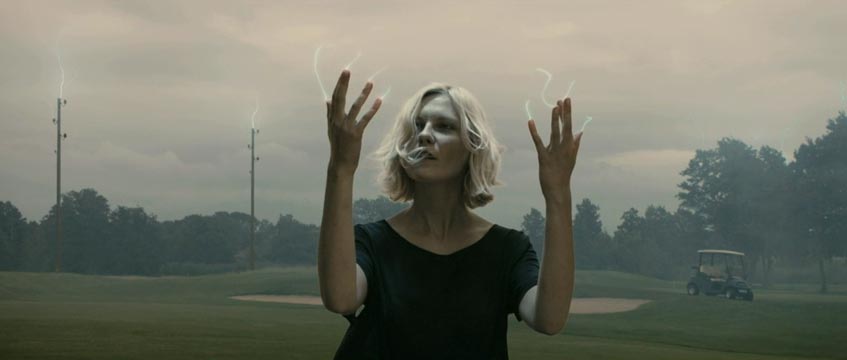
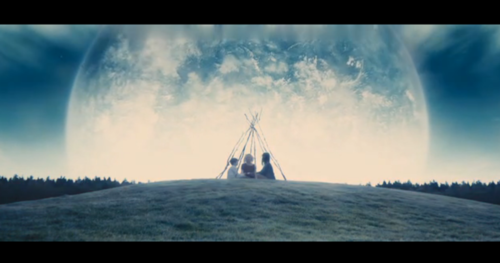
This is also possibly Von Trier’s most beautiful film.  The first five minutes of surrealistic shots, almost stills, took my breath away.   And though the film then moves quickly into narrative, it is still filled with the most gorgeous shots.  The lighting of the reception moving outside to the grass, the shot of Kirsten Dunst bathing in the light of the coming planet… all gorgeous.  And  Wagner’s score from Tristan und Isolde over it all just inhances the beauty.  Honestly, if you want me to love a film, make it surrealistic, with an amazing score and throw in beautiful images—yeah, it’ll be one of my favorites.

One of the most surprising things about this film is that though it is all about depression—we get that from the title—yet it is not depressing.  It is filled with humor, beauty, and even hope and joy.  Sure, it’s about the end of the world, but that doesn’t mean it has to be sad.  More about depression in the film in the analysis.
A much more straightforward film than Antichrist, but covers some of the same themes, about depression and nihilism.  I think this film might be the key to really “getting” Antichrist, which I will watch again to get the idea of it.  If I finally “get it” then I’ll write my findings in a new post.

Overall, Melancholia was a marvelous experience, excellently acted and brilliantly conceived.   I cannot recommend it to everyone.  If you have had no experience with depression or have never struggled with being overwhelmed by life, perhaps you wouldn’t appreciate it.  But for me, it was an amazing experience, and one I want to have again.  5/5

Below is my analysis of the film, including spoilers.  If you haven’t seen the film, I recommend not reading it until after you’ve seen the film.


As I was leaving the theatre after seeing Melancholia, I heard one woman say to her companion, “That was so stupid.”  And I could understand why.  After all, the film ends with Earth being destroyed and flames engulfing the audience, and finally, complete silence.  This isn’t subtle, nor is it an ending where you have to decide whether it is happy or unhappy.   Frankly, the film makes it clear: it just is.  This is reality.  For many people, this is simply silly.  They have never experienced the end of their world, nor dealt with the depression in which such an end is inevitable.  To end the film in this way is a slap in the face to their sensibilities, a pointless exercise in nihilism. 

But part of what the film communicates is that melancholia is a state of mind, an “illness” that cannot be gainsaid.  Either you have had this state as an experience or you haven’t.  If you haven’t, then such thinking is “stupid”, overdramatic and a rejection of reality.  But if melancholia is a part of you, then it is just how reality looks.   The end is truly nigh, and our body just is preparing for the inevitable.

What is exactly meant by melancholia?  In the ancient world, a melancholic personality is one who has too much of a certain “humor” (or fluid) in the blood.  The melancholic personality is introverted and creative, and when one develops too much of the humor that creates such a personality, then such a person becomes isolated, lack energy and depressed.  This is an early form of what today we call clinical depression.   Technically, clinical depression is usually caused by a lack of serotonin in the brain, which causes one to no longer feel pleasure in everyday experience.  This causes lethargy and a lack of energy.  Such a lack of serotonin can also cause one to be anxious, inflating little fears to inaction.   Depression is sometimes a way of the body indicating that it has had enough stimulation, and that it needs rest.  In chronic depression, the body never catches up on the “rest” it needs, and the victim can spend his or her time sleeping, staying away from people and hiding from anything that might cause stress or stimulation.

Von Trier adds one more layer to melancholia that isn’t usually found in ancient medicine or modern psychology: a philosophical side.  Attached to lack of energy, introversion, and creativity is a nihilism—a confidence that there is, in reality, no hope for life.  All life will end and there is no life or spiritual force that will replace that life when it is gone.   It is true that such hopelessness often accompanies depression, but it isn’t a necessary component of it.  However, what does accompany such depression is a satisfaction that life will end, because once life is over, then so is the stress and one can finally rest.

Obviously, Justine is the melancholic, the focus of the film—and the representative of Von Trier himself.  She has all the indicators of all the layers of melancholia, and Part I lays out exactly what such a condition is.  Justine, is in the midst of the “happiest day of her life” and it is clear that everyone expects her to—nay, demands that she— be happy.  But happiness is not in her nature, and frankly, such a social event with so much planning and detail is a clear trigger for a depressive event, demanding more energy than a melancholic has.  Everyone is disappointed with her, but she has no reserves to meet everyone’s demands.

Finally, she escapes the stress by undermining her entire life.  She publicly has sex with a visitor to the wedding, thus ending her short marriage.  She deeply and publicly insults her boss, thus ending the promotion he just gave her.  The only relationships she retains are those that give her comfort:  her father (who runs from her) and her sister.   In this way, she ends her own world, allowing the thoughts of the inevitability of such an end have their self-fulfillment.  Now she can rest.  There are no more demands.  Disaster is not something to fear, but it is to be embraced.  It is the end which is best met quickly and on one’s own terms.

In Part II, the focus changes.  Now it is about the impending disaster of the planet Melancholia coming to destroy the Earth.  For the characters, there is some ambiguity as to whether the planet will hit, but for us, who has already been given a preview of the event at the beginning of the film, there is no question, and the horses agree with us—the end is inevitable.

There are four responses to this impending doom.  The first is Justine’s.  She is not surprised by the end of all life, she not only expected it, but is content with such an end.  “The Earth is evil” she says, and so it is worthy that all life be destroyed, to be replaced with nothingness.  The funny thing is, that while pressures were being put upon Justine in the first part of the film that she couldn’t deal with, the only truly evil actions in the film are hers (except, perhaps, for John’s selfish end).  “Evil” then, must be a personal definition, not a moral one.  The Earth is evil to her because she can’t deal with it. 

Because of this attitude and approach to crisis, Justine is supremely able to deal with the ultimate crisis.  Her whole life has been in preparation for this very moment, in being able to deal with the ultimate disaster.  She creates the idea of a “magic cave” which will protect them from the coming disaster.  Of course she knows that such a protection doesn’t exist.  But she creates it to ease the anxiety of those around her.   The cave is much like the isolation that she participated in to shield herself from the end of her life.

I think that this is how Von Trier sees existentialism and probably religion.  They are necessary fictions to help the normal human deal with the inevitable, impending disaster.  This is not unlike Jean-Paul Sarte’s view of reality: Nihilism is fact, but we cannot live as if there is no hope or meaning to life.  Thus we have to create fictions, commitments to life, that we surrender ourselves to completely.  It doesn’t delay the inevitable, but it makes life easier to bear in the meantime.

The second response, which is the opposite of Justine’s, is John’s.  He is completely optimistic, he is absolutely confident that life will continue on as normal.  This crisis is simply a bump in life, one of the normal intrusions to the humdrum world that makes life interesting.  He rejoices in the planet, and takes as much pleasure as he can out of it.  Eventually, he expresses his real doubts and finally seeks out the truth of the matter.  When he discovers that Earth will actually be destroyed by the planet, he finds himself completely unprepared to deal with it, and commits suicide.  It is interesting that it is the sanguine John who commits suicide and not the depressive Justine, although in real life it is the depressive that often commits suicide.  The point is that when the world ends, it is the optimistic who can’t deal with reality, not the melancholic.

Another response is the horses.  (Not Leo.  He just follows his father’s response and then Justine’s).  They know that disaster is inevitable, and their first response is panic.  All they want to do is escape it, run away.  Augustine won’t cross the bridge because he knows what is coming there.   But after a time, they calm down.  There is no point to continue panic.  What will happen will happen.  In a sense, the horses reaction is the most logical.
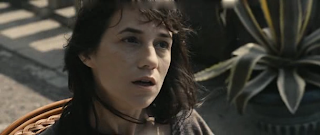
Finally, we have Claire.  In normal life, Claire is the most practical, the one that holds everything together, the one that smoothes out the rough edges, who maintain relationships, who keeps her head in all of life’s little crises.  She is the kind of person who keeps life going.   So the possibility of life abruptly ending is the worst possible outcome, and the one thing she just can’t handle.   Her response to this, appropriately, is fear.  Her husband tells her that she is just anxious, fearing for nothing.  However, we find out later, that he simply just couldn’t deal with her fear in light of his need for hope, so he just denied her the logical response.

When it is clear that the end of life is inevitable, Claire’s first response is to perpetuate life.  Just to stand on the terrace with her sister and son, to drink wine and make small talk.  Justine refuses this, recognizing that when life is ending, such a response is inadequate, and only perpetuates denial, leading possibly to a worse breakdown.  Claire finally accepts Justine’s solution of participating in the “magic cave”, but in the end, the false protection means nothing to her and she remains anxious to the end, recognizing that her worst fears have been realized.

The final question I had about the film is the allegory of the planet Melancholia itself.  Certainly it represents the end of life.  Possibly the end of one’s social life, as what Justine experienced in the first part of the film.  Or perhaps it represents a personal end to life—the inevitability of death for us all. 

But Melancholia represents more than the object which precipitates an impending disaster.   As its name indicates, it is also a representative of depression itself.   Certainly it represented the mental state of impending doom for Justine.  She refused to undress for her husband on her wedding night, nor did she even undress for the young tool she used to end her marriage with.  But for the planet of Melancholia, she completely disrobed and opened herself completely to it.  Depression itself was the joy in her life, that which she could completely surrender herself to.

But is the planet a representation of depression to everyone?  Is the greatest disaster of everyone’s life in the film not the “end of life as we know it”, but Depression itself?  Is John actually denying depression in response to crisis as an option, and when depression comes he commits suicide?  Is Claire fearful of her lack of response to life?  Is she ultimately fearful of losing control, of no longer having the energy or drive to love, to hope, to smooth things out? 

I don’t know that Von Trier intended such a deep metaphor, but it is interesting to think about. 

Thursday, December 22, 2011

Hugonic Themes

For me, Martin Scorsese has been a hit-and-miss director.  I thought Taxi Driver was brilliant, but disturbing, while Raging Bull was just disturbing and Goodfellas was unwatchable and disturbing.  I enjoyed Shutter Island and adore The Last Temptation of Christ.  But I had no questions about seeing Hugo, Scorsese's latest.  He is, at his worst, a capable director, and I enjoyed the volume it was based on, even though it wasn't that  memorable.

I found my experience with Hugo immensely enjoyable.  I laughed out loud, cried at the appropriate scenes and generally just enjoyed my time.  No, it wouldn't make my top 100 films, or 200, but there was a lot there to really appreciate.  And this without the 3D (I can't watch 3D, because it all looks fuzzy to me.  That's fine, cheaper tickets!).

So I went to my film buff friends and told the naysayers my opinion.  Everyone took it well and we had a fine conversation.  But it turns out that no one disagreed with the quality of the film.  Some took issue as to the interest it held to the viewer, and there was certainly a question as to whether Scorsese was making a children's film-- or IF he could make a children's film.  All of these questions were lesser, however.

The big disagreement was what the movie was actually about.  What is the Big Theme.

Everyone agreed there was a Big Theme, a central point to the film.  But we all thought it was something else.

The cinephiles among us saw this as an advertisement for film preservation.  Mr. Scorsese has been deeply involved in the World Cinema Foundation, and certainly a bit of propaganda for the work of finding and digitally preserving all kinds of film is found in the film.  On the other hand, this is also mentioned in the book, and it isn't a main theme, there, and the film closely follows the book.

One of the main indicators, however, that those who think old film preservation is the theme is that they are bored with the film, although they appreciate that theme.  To me, if the movie is about "one thing" and yet you think that most of the film is "nonsense" or "pointless", then perhaps, I propose, you have the wrong theme.  I think that the glory of cinema is A theme in the film, but I see no evidence that it is the central theme, or even a main one.

Another theme that is discussed is finding one's place in the world.  This aspect is certainly discussed in the film, and is important.  One critic mentioned that it is harped upon so much that she wanted to say "enough already!  I got it!"   I think that this is significant in the film, but there are different aspects that are drawn out.

First is the idea that everyone has his or her place-- that no one is left out.  Some may consider you insignificant or useless, but they are simply wrong, even foolish to believe it.  One can even say as much for the minor characters of the film.  Some characters may seem unimportant, but each one has their role to play in the overall story about Hugo-- because in the end, as the title says, the story is not about George Melise, but about the simple boy whose life is always teetering on disaster.

Secondly, the theme is emphasized that to accept that one has a place in the world on faith is not enough-- we must go out and find it.  The fact is, more often than not, our place has already been marked.  We just must accept it.  This is almost a fatalistic touch-- as if God has fashioned George Melise to be a magician with film, and it was simply George's responsibility to accept it.  Even as it is Hugo's destiny to be a boy who fixes things-- anything, even people.

Finally, having our place in the world isn't enough.  We must also have recognition of this place.  We all need a certain amount of honor, of the respect due the place we have in the world.  It would be great if it were appreciation, but at least we need to be looked at and have people say, "They belong here.  They do..." whatever it is we do.

While some might argue with the work-oriented purpose in life, in the end, recognition of one's work is something both old people and young people have in common.  The young person says, "I am working, will anyone see me as a real person because of it?"  And the old person says, "I have worked, will anyone recognize that my life has been worth something?"  Between those times, most of us are so focused on the work itself that we don't seek that place, or a recognition of that place.

But in the end, it is this whole set of themes that I loved about Hugo.  The fact is, it is a complex and compelling film.  And I think, as people look at it closer and see its greater worth than just a beautiful but pondering children's film-- because it demonstrates much more than the love of film-- rather it is the love of all people and all the work they do.  That is a wonderful message for all of us.