Showing posts with label Richard Linklater. Show all posts

Thursday, January 15, 2015

Linklater's Bullseye: Boyhood

Slacker, Linkater's first feature film
Slacker was the first Richard Linklater film I saw.  It was one of my earliest art films, and I saw it in an old theatre in Portland.  It was a strange film, and strangely opened my eyes to a new kind of art.  A number of people lecturing about freedom and alternative lifestyles, each from their own perspective.   Really, Waking Life wasn’t that different, with spooky animation and the theme being what life is all about.  But despite the different ideas floating around, they both seemed to be largely disconnected from reality.  So different from Linklater’s films School of Rock or Bernie or even Tape—those may not have been conceptual films, but they were grounded, in a narrative.  The Before movies were in between these two extremes, leaning toward the talking.  They were idea movies in a specific context.  Dazed and Confused was an event film, but leaning more toward conversation than, say, Bernie.

In Boyhood, Linklater I believe, captures the perfect balance between idea and narrative.  He draws in the nostalgia, the narrative, the real life drama, the conversation, the romance, the conceptual conversation, all in one perfect film.  Dang, I used the “p” word, didn’t I?  Let me back off from that for a moment.  What I really mean is that I feel that Linklater has been aiming at some goal all these years, experimenting and crafting amazing films which reach a balance between concept and narrative and I feel that he finally hit the bullseye.

Finally, he has truly connected with me emotionally.  Not because I recognized the scenes and cultural background of Mason’s life.  His is the generation of my children, not of me.  And I have never had to deal with all that relationship drama or dating.  The film hits the emotional target because it honestly draws me in by making these people real, and their lives real, not by hyperdramatized moments, but through visiting this family again and again over a period of years.  I just feel that I know these people.  Not just who they are in a moment, but who they became over time.  So the final scenes of Mason with each of his parents were real emotion, with real power.

The question Linklater wants to answer in Boyhood—possibly the only question he has ever asked in his films—is “what is life about?”  In the conversation, we learn that life is not about the education we receive, the jobs we get, the relationships we have, or the ideals we live by (or claim to live by).  Even though we label ourselves through these things:  we are the spouse of so and so, we “do” this job, we have this degree—that’s not what really matters.  It doesn’t even matter what we intend to do or how we spend our days.  Rather, life is about the moments, the people, the events, the dreams that capture us and drag us along with them.  

Life is the parent who is always there, always supportive, always cheering us on.  Life is not about the person we become infatuated with, but the person who “gets us” and waits for us while we learn to mature.  Life isn’t about our biggest vision, but the one that we pursue for year after year, even if we never make our money from it.  Life is not about the education we pursued for years, but about the knowledge that changes us, makes us the people we are, the people perhaps we were always meant to be.  Life isn’t about the stuff we gather, but what really is important to us, those with whom we live day in and day out, and the things we interact with that shape our being.   Sometimes the most important thing in our life is the small, offhand comment that seemed so insignificant, but it changed us in ways we never would have thought possible.  It is not just the day-to-day, it is the everyday.  It isn’t the drama, it is the small love that lasts over years that’s most important. 

I don’t feel that Linklater has been so focused on one concept Instead of trying to show big ideas compressed into a brief moment in time—a single night, a point in the history of a human life—Linklater succeeds by showing us the whole span of a family.  We cannot understand the scope of human existence until we experience that scope.  In less than three hours, Linklater gives us that span and communicates what is to be focused on. 

The film itself is full of bright cinematic spots.  For the first two thirds of the film, every time Ethan Hawke showed up, the screen lit with his energy and enthusiasm.  Even at the end, he sparkles, understanding better than anyone in the cast exactly what Linklater wants.  Both Ellar Coltrane and Patricia Arquette faltered at first, but they grew into their roles, owning them and helping us experience the growth of their characters.  Some of the scenes, like Olivia taking her children away from an abusive situation, and the self-important teacher giving an ineffectual “darkroom chat”, will remain with me forever.   But most importantly to me is the living philosophy that we had opportunity to experience, not just hear a discussion about.


I think Linklater has always tried to give us a thoughtful philosophy, to try to measure all of us and human existence in one of his films.  Finally, I believe that he succeeded.

Monday, November 4, 2013

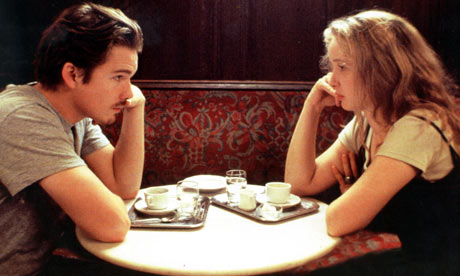
Conversationally Romantic: Linklater's "Before" Films

What I find amazing about the "Before" films by Linkater, Delpy and Hawke, is how they grow with me.  

Before Sunrise I saw many years after its release and found it the most sophmoric of efforts.  Especially I found Jessie's character unlikable, but I still found the romantic element to be full of spark and the conversation of interest. Linklater is the master of conversation films, and this one was good, if not excellent.

Before Sunrise, which takes place nine years after the first film, was a remarkable improvement for me.  The maturity of both characters was marked both emotionally and intellectually.  We were clearly seeing the same people, yet different many years apart.  As the movie grows, so does the spark we saw in the first film until it was clear that this romance was fated.  I understood this film, and it struck my soul.  This was romance as I knew it, if perhaps a bit more intellectual.  Two souls marked for life.  

Before Midnight, however, is a big question mark.  The characters have matured again, physically and emotionally, and time has worn on them.  There is sorrow over past decisions and anger over how trapped they are in the life they choose.  There is much speech about the necessity of being transitory, but still flashes of the romantic in the first two films.

This also is romance as I understand it now.  Anger, desperate decisions, insecurity, attachment worn by years. This film isn't about romance, it's about the life that grows out of romance.  It's about decisions that can't be turned back and the continuous process of creating a life together, and how difficult each decision could be. 

It reminds me strongly of Certified Copy and the themes explored in that film, which was clearly influenced by the Before films.  In Certified Copy, it explores the change and yet the sameness of a relationship over many years, almost trying to put Before Sunrise and Before Midnight in a single film. 

The strength of Before Midnight, however, is the strength of the characters the three writers created.  It is exciting to participate in the scintillating conversation between these two vibrant people.  This time, there are more characters, many as powerful as the initial two.  Especially two elderly actors, who give powerful points about the power and movement of love.  The discussion around the table is one of the most powerful scenes in the whole series, and possibly the most fascinating discussion about gender and love since Plato's Symposium.
 
Yes, it a movie full of talking.  And it is a rollercoaster of emotion and depth.  The final scene is a powerful conclusion for the trilogy, should the trio decide to retire this series.


DONT TAKE ME SERIOUSLY!  Please, Linklater and team, come back again in nine years.  I have so much to learn, and I don't want to lose these friends of mine.

***

P.S. A couple things that surprised me in the film. First is the frank talk of sex in the film.  The second is the topless Julie Delpy in the middle section of the film.  I was watching the film with my 13 year old daughter and nothing like that had been shown before.  Some frank discussion of sex, but certainly no depiction.  Now, Delpy's topless, Hawke is nuzzling her nipples... ummm... and I'm getting very uncomfy watching this with my daughter.  I purposely didn't ready anything about this third film so I could appreciate it all new and everything.  It wasn't just that she was topless, but half the conversation in that scene is just her with no top.  In a sense, it was cool.  This is how married couples converse at times.  It seemed very natural.  Except I was watching it with my young daughter.  Okay, I wish I had known that.

One other thing: Julie Delpy is such an amazing actress.  I watched her performance in Three Colors: White a couple months ago and in 2 Days in New York yesterday.  She can do anything, and she seems to have fun with whatever she plays.  In Before Midnight I wish she could get an Academy.  It's such a powerful role.

Tuesday, May 15, 2012

Scenes from Scenes From a Marriage


Alexander was bored too

Scene 1: Seed of Hatred

I knew I was caught by the time Ullmann started rejecting Josephson’s  sexual advances.  The characters added another layer, right there.  Although it was suspected that they were lying to their friends, it is at this moment that we know that they are lying to themselves, deluded that they are in a happy marriage, when their real desires in a relationship are openly uncommunicated.

How different from other Bergman films I experienced.  I saw my first Ingmar Bergman film in high school with Fanny and Alexander in a theatre.  I was supposed to like it, so I said it was good, but I didn’t really get it.  It wasn’t until my second viewing of the film that I realized I didn’t have a clue what Bergman was doing or saying here. 

I looked forward to The Seventh Seal, for it was about death (I love the metaphysical) and was an “important” film.  It left me cold (like death, get it?).  It was then I realized that Bergman may not be for me.
Then Through a Glass Darkly, then Winter’s Light (half of it).  I understood what was being communicated,  it just wasn’t compelling to me.  Bergman, although he is loved by many, just wasn’t for me.

My distaste had run its course
Scene 2: Deliverance
I didn’t give up on Bergman, though.  Why?  Because my fellow film lovers insisted that I just needed to keep trying.  Honestly, I wasn’t looking forward to another dull, mystifying journey.

It wasn’t until Wild Strawberries that I finally gained a spark of interest for Bergman’s films.  Spark?  I loved this film of a man reflecting back on a life of distance and wondering what he was leaving behind.  I had been impressed with other performances (Harriet Andersson in Through a Glass Darkly especially), but Wild Strawberries was just stunning.

But was Wild Strawberries just a fluke?  Clearly Scenes From a Marriage indicates not.

Talk, talk, talk
Scene 3: Dialogue Reigns
The structure of Marriage is in six “scenes”,  each revealing (to us and themselves) a different aspect of the central couple’s relationship, and thus changing the relationship.  The method is dialogue, which has always been a favorite method of communicating ideas for me.

Dialogue has been around for as long as there has been stage plays, some three thousand years.  Some of my favorite dialogues were written by Plato and Sophocles, written in ancient Greece.  And some of my favorite filmmakers use dialogue as the central method of communicating: Linklater and Rohmer are two of my favorites and some of my favorite movie scenes are the simple but intense dialogue by Tarantino.
Scenes from a Marriage, after the first scene, are just dialogues between the central couple, Johan and Marianne, even as the films Before Sunrise and Before Sunset and the recent film Certified Copy are dialogues between one couple.   

I wonder if we realize how much of the drama of our lives—and the pleasure and the comfort—takes place in simple conversation, especially with those we love and respect?  Conversation changes us and so changes the reality we live in.  Our whole world can powerfully shift because of a sentence.  A well-placed word can cause us to spiral into depression or to dance with joy.  To converse is to be surrounded with life.

Making it up
Scene 4: Making a Marriage

To converse is to relate.  And the most intimate, the most vulnerable, the most mystifying relationship is that of a marriage.  Most people marry.  There are billions of marriages.  Yet every marriage is mostly a mystery.  Each is unique.  As humans we are clearly driven to marry—it crosses all religions and almost all cultures.  But since every human is a complex of personalities and drives and contradictory emotions, each marriage is as much a collision of two societies as it is the joining of two people. 

And so it is quite possible—even likely—that a couple, married for ten years, still are confused and bumbling about their relationship.   In this unification of souls, the souls in question shift and morph.  If the souls change, can the marriage remain the same?  Of course not.  One soul is changed by close proximity to another, and so the very relationship between the souls shift and so both souls change again.

So marriage cannot be seen as an entity as much as a shape-shifting organism, forced to be completely different or to die.  And this is not the story of a relationship that can change.  It does change, but only through internal struggle and brokenness.

Scene 5: Partner in the Dance

(Warning: This section has spoilers)
The marriage is broken upon two solid features of the soul’s personalities: Marianne’s need to please others and Johan’s need/desire for more sex than Marianne is comfortable to give.  In their marriage they only drop hints as to the need to change and when it finally is communicated, it is too late for the marriage.  The marriage unravels, dissolves, almost in a single night. 

And the film insists that it must be so, for while they were in that marriage they could not change or become the different people they need to be to make the marriage work.  Only when they are out of the marriage, married to others, have they grown enough to be the people that they needed and deserves.

And by this time are they addicted to adultery?  Do they see each other, their former partnership, as a release from their current bonds, or do they see each other as the match they should have had from the start?  The violence and expression of hatred in the penultimate scene seemed insignificant compared to their need of each other in the final scene.   How can anyone love after such a scene?  Is it love for each other that blinds them to that night, or simple, driving need?  Or is it that they are the true couple, the eternal couple that will not ever completely be apart because they were joined by a purpose that cannot be gainsaid by human will?

These questions are not answered in the film, and it is in the questions that the film remains so true.  Because every enduring erotic relationship truly is a mystery.  I would love to have every new couple watch this film.  Not to tell them that their relationship is pointless, surely to end in agony.  Actually, my wife and I have been married for 23 years and we are content with each other.  If there is one secret to our marriage, it is because we chose to make every life change together.  The changes always came, but we are committed to face change by each of us changing, so changing our relationship.

No, I would want newlyweds to see this film to tell them that they need to communicate.  That they need to navigate the waters together as a school of fish, each swimming individually in unison.  That they need to see their spouse not as the answer to their needs, nor as the canvas for their imagination, but as a partner in the freestyle dance we call life.  That the partnership only ends when one or both decides that it does.  And even then, like many dances, the partnership is never truly dissolved.  The intimate touch of another’s soul never goes away.