Showing posts with label A Dark and Stormy Night. Show all posts

Tuesday, October 4, 2011

A Dark and Stormy Night, #3: Favorites


Here are some favorite thrillers of mine, as defined in the previous post.  No spoilers are included.  I hope I can encourage you to watch some or all of these classics.

Dial “M” for Murder
A cuckolded husband plots to rid his wife (who had an affair with a mystery writer) and obtain her fortune with the help of a college “friend”.  I recently watched this Hitchcock-directed classic, and it is an excellent example of a traditional formula of the thriller genre.   The husband is so smooth and conniving, Grace Kelly so beautiful and helpless, and the detective smart and manipulative.  It all takes place in a single apartment, there are five characters, a murder in the first act and new twists in the second act.  There is nothing exceptional about Hitchcock’s directing, and there is little innovative in the story itself.  But as an introduction to the genre, it is pitch perfect. 3.5/5


Deathtrap
Two playwrights of thrillers, two women (one a psychic) and a lawyer plot and scheme for fame and fortune in a house full of weapons. One of the greatest things about Deathtrap is that it teaches us about the genre itself.  It stars Michael Caine and Christopher Reeve as writers whose plots become horrifyingly real.  This is probably the cleverest of scripts in the genre, written by Ira Levin who wrote the original novels of The Stepford Wives and Rosemary’s Baby.  The movie is so self-referential it twists upon itself and mocks itself at every turn.  Such wonderful fun. 4.5/5

Sleuth
A cuckolded mystery novelist plots to get rid of his wife… by having his replacement steal his precious jewels?  This last week I watched Sleuth, which inspired me to write this series on thrillers.  It is an excellent thriller about a plot to steal, or to murder, or to humiliate… what actually occurs is hard to determine.  What is clear, however, is that Laurence Olivier and a young Michael Caine are at their best in acting.  They both ham it up, but neither at the cost of the other—rather they play off of each other so well that it is clear this film was a joy for them to work together. 4/5

A note: Sleuth is difficult to find, as it has not been released on DVD.  However, it is available, as a whole, on YouTube: 


My favorite thriller is:
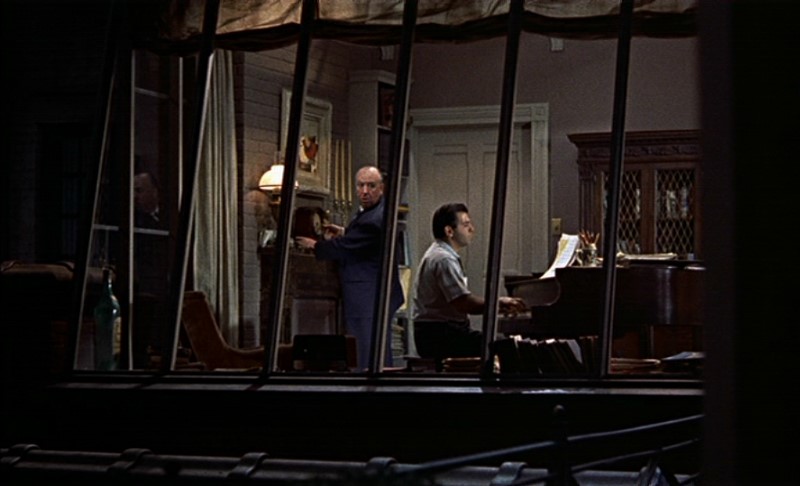

Rear Window
A journalist is stuck in a wheelchair in his apartment (and Grace Kelly) with nothing to do but peep into his neighbors windows—but he suspects one neighbor of murder!  It could be questioned as to whether Rear Window even follows the formula.  But I think it does as long as you don’t mind bending a couple rules.  The two acts aren’t so clear, and most of the action doesn’t take place in the apartment our hero is trapped in.  Yet this is the least intellectual, most psychological of thrillers.  What happens in the bottom apartment is simply one act in a whole human menagerie, where a whole host of stories take place.  If the various apartments are red herrings, they are the most fulfilling of them.  And what happens to our three “heroes” becomes important to us.  I believe that Rear Window is the most perfect thriller ever made, and it gives me great pleasure to watch each and every time.  5/5

A Dark And Stormy Night, #2: Thriller


Despite this horrific experience, and the tremendous risk to my psyche, I watched other thrillers of this genre over the years and found I enjoy them immensely.  They are highly intellectual and rarely do they contain superior acting, for rarely is the actor called upon to display more subtlety than badly hidden jealousy.

One cannot make such carefully plotted dramas out of thin air. There are rules to these thrillers.  First of all, the space must be limited.  At first it was because most of the thrillers were originally performed in the theatre, but  later it was a standard of itself.   The space could be a single room, like the Spider’s Web, an apartment or a house,  or perhaps a manor, but one cannot just be wandering about the countryside namby-pamby like that Mr. Holmes.  The cast is also limited.  No more than eight members, and it could possibly be limited to two.  It has been mentioned that the classic number is five. 


Of course, there must be a murder, or at least the plotting or suspicion of a murder.  And there must be detection.  The putting together of the pieces is traditionally done by a detective, whether of the police or private.  Sometimes the plot is puzzled together by another party, but it is done through many twists, some surprises and multiple red herrings.

One more rule: there must be two acts.  Again, this is a device borrowed from theatre, but it gives some structure.  In the first act, the murder is committed and the basic plot is revealed.  In the second act, the original act comes to fruition, twists multiply, and, in the best thrillers,  the plot goes in directions we never would have suspected.

The thriller might seem stilted to some with so many rules.  But the best writers can make the tightest sonnet seem free of all restrictions.  Even so with the best thrillers.  In my next post, I will give spoiler-free descriptions of my favorites of the genre.

A Dark and Stormy Night, #1: Horror


The house was comfortable even for the family of five who lived in it.  It had four bedrooms, two bathrooms, a living room with a stereo system, a rarely used dining room and a family room with the central appliance: a television.  That was the object of my downfall, the focus of my destruction.

It was 1983 and cable television was still a nifty idea.  I had just graduated from high school and I had some time before I entered college, so I spent it watching television, for the most part, my favorite pastime.  I was a little addicted to television.  If it was on in the room, my eyes were glued to it, no matter how dull the video display was.  When the TV Guide appeared in our mailbox every Friday, I memorized its contents for every channel from 3pm to 11pm for the next week.  In this way, the rest of my family never had to consult the reference.  They just consulted me.  This was not a problem, or at least not yet.  Rather, this only led to the fateful evening.

Mysteries weren’t my favorite genre.  I preferred animation and comedy: Looney Tunes and MASH.  I did a lot of reading of Science Fiction, and mysteries entered my interest through the back door of Isaac Asimov.  Agatha Christie wasn’t unknown to me, but I’d not read a single one of her books.  In our new version of TV Guide I noted that on one of the newer channels we’d just obtained called Home Box Office there was a showing of an Agatha Christie play, The Spider’s Web.   I shrugged and  decided to try it out.


It was a locked room mystery.  Seven people could have committed the murder, and they all had excellent motives.  One by one they are accused and they all deny.  Their alibies are studied and found wanting.  I am the detective, and in my mind I play with different theories.  One is found wanting, so I  develop another.  The show is about to end, and the murder is soon to be revealed.  I lean forward to see if my final theory, the gem I had been polishing for the last twenty minutes, is as priceless as I consider it to be.

And then the screen turns to snow.  The cable had cut out.

The calm house is torn by a bloodcurdling screen as I rush the set.  I switch channels, frantically, seeking life.  
No good.  Every channel had shut down.  And the television remained inert, frozen for a whole hour.  

Meanwhile, I sat there, stunned, staring at the white and black pattern, near comatose.