Showing posts with label Loony Toons. Show all posts

Sunday, March 12, 2017

Loony Tunes Classics, 1936-1938

All of these cartoons can be Googled and found intact on Daily Motion.
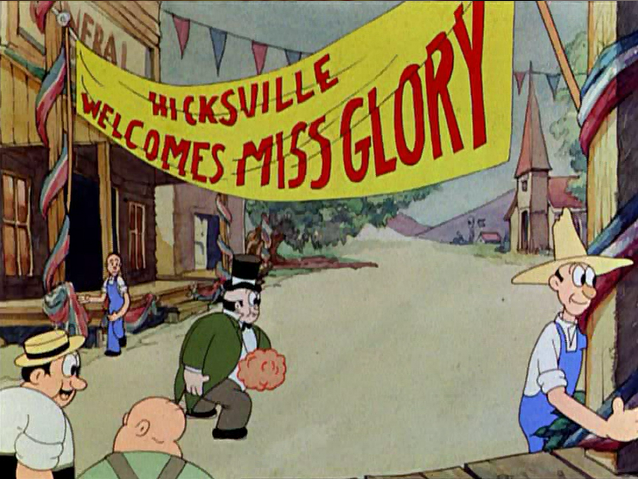
Page Miss Glory
This first Warner Bros cartoon takes its name from a movie released the previous year about a country woman who dreams about becoming a starlet, and gets her chance to play a starlet, which becomes real.  In this cartoon, we see a page dreaming of serving a starlet in a fancy hotel, although he is in a small town.  It is interesting that there are a lot of references to alcohol here, as prohibition just ended a few years before, so people are pretty giddy at the opportunity to partake openly. 

As an early cartoon, it isn’t bad, but it doesn’t have lasting power.  I also don’t think it was intended to.  Warner Bros. cartoons were more successful when they tapped into a lasting myth (e.g. the rabbit and the hunter reversing roles), but many of the cartoons were simply reflections of the culture at the time of the cartoon.  That works for newsreels, but not necessarily for later generations.

I Love to Singa
This cartoon is based on the Warner Bros. movie, The Singing Kid, starring Al Jolson, which has the song “I Love to Singa”, played three times in the film.  The tune is repeated a number of times in the cartoon as well.  The main characters are owls so they can have the joke, “Owl Jolson”.  Note that Chuck Jones is a main animator here.


I remember seeing this one as a kid on television.  It is more successful than Paging Miss Glory because it reflects the trope of the child who is naturally opposite to his parents.  At this point the trope is overused, but the cartoon still has it’s fans.  I love the reference to Jack Benny (a bunny) and the old amateur hours that was similar to American Idol today. An interesting point is that Mel Blanc was on the old Jack Benny radio show, as well as the Warner Bros. cartoons.    This is as much about radio as it is a movie, and the popularity of it.  Overall, fun.

Wholly Smoke
Porky Pig was introduced in cartoons in 1935 in the film “I Haven’t Got a Hat”.  He was originally voiced by Joe Dougherty, who had a severe stutter.  In fact, the stutter was so severe that production costs were too high to keep him as the voice, so Mel Blanc took over as the voice of the popular Porky Pig in 1937.

There are a couple places that seem influential on Disney—the position and look of the “bad kid” on Lampwick in Pinocchio, and the chaotic end of the dream sequence on Dumbo.  The original was black and white, but it was colorized later on.  The song “Little Boys Shouldn’t Smoke” is based on the song “Mysterious Mose”, which was used to better effect in a Betty Boop cartoon in 1930.

I like a good sermon, but this one just seems dumb—a repetition of “children shouldn’t smoke” and a weird dream sequence.  The cameos work better—the Three Stooges, Bing Crosby and many puns based on different cigars/cigarettes.

Okay, but I’m not impressed.  
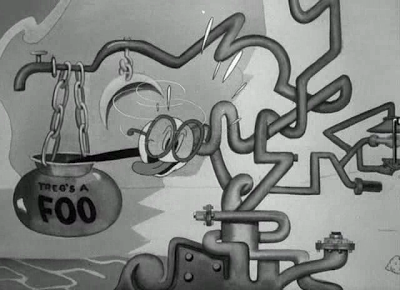
Porky in Wackyland
I remember much of this, but I wonder if I didn’t see a colorized version of this film called Dough for the Do-Do from 1948, which cut some of the scenes, added a couple others and tried to avoid most of the racial stereotypes by giving the “African” characters skin of primary colors.

Honestly, I think that the imagination and animation quality are excellent here.  The Dali/Seussian landscapes and the number of unique creatures are fascinating and fun.  This is basically a “hunt daffy duck” cartoon, but the insanity of those early cartoons really work with the unique insanity of this one.  It also has a great punchline at the end.

It isn’t laugh out loud funny, but there’s a lot to see and be interested in, even today.  Quite surrealistic and fun.   

The animation is really smooth, unlike most of the cartoons at this time.  It doesn’t have any fuzzy edges but is perfectly clear.  Even Porky Pig’s voice is clearer.  They worked hard at this one and it shows.

Porky in Egypt
The introduction of “Egypt” containing not only Arabic, but black and East Indian stereotypes is pathetic, but expected.  The film really gets on when Porky and his camel  Humpty Dumpy goes into the desert.

My favorite part is the camel’s speech about “desert madness”.  It must be based on some speech, but I can’t find out what.  Very well done.  The depiction of madness devolves into the desert mirage joke and Daffy Duck imitations, but there are some good sections here.


Still, I probably wouldn’t recommend it apart from the middle section with the sun hammering down and Humpty going crazy.  

Friday, April 6, 2012

Classic Cartoons of 1957

You may find that I am posting more about movies of 1957, like Paths of Glory in the last post.  The reason for this is because my movie comrades and I on the Filmspotting Forum are participating in Retrospots, where we grant awards for film of years gone by.  For our first round of Retrospots, we have chosen the year 1957.  This is a year of truly great film, like 12 Angry Men, The Sweet Smell of Success and Witness for the Prosecution and many others.

It was also a pretty good year for cartoons.  Yes, cartoons.

I like cartoons.  I grew up watching repeats of classic Popeye, Loony Toons, Woody Woodpecker, Droopy, Hanna Barbera, Japanese anime, and even Super Chicken.  And so, to provide a *ahem* service for the Filmspotting community, I watched a whole bundle of cartoons from 1957 and reviewed them.  For your reading pleasure, I share them with you, along with my rating out of five stars.  If you'd like to watch any of them, they are all available on YouTube under the name given.


The Candlemaker
A pretty standard Christian moral tale with a conclusion of working hard.  Occasionally the animation is interesting, but nothing exceptional here.  2.5/5


Ali Baba Bunny
A Bugs Bunny/Daffy Duck classic.  Some good laughs.  The tension the duck causes and the brains of the bunny are always enjoyable, and it’s a standard good time.  Hassan chop!  4/5


Piker’s Peak
The Bunny and Yosemite Sam, climbing the “Shmaterhorn”.   Sam is just sad.  3/5

Hooky Spooky
Casper the friendly ghost.  It started out so well, with a “night school” for ghosts, but as soon as Spooky wants to go to the zoo instead, the imagination ends. 3.5/5


The Story of Anyburg, USA
A Disney moral tale of who is responsible for good driving.  It’s not funny, and the point is pretty dumb, actually.  2/5

The Truth about Mother Goose
A history lesson on the background of three nursery rhymes by Disney.   Disney proves once again that they know how to educate better than anyone and that they really don’t know solid history.  Still, it was fascinating to watch. 4/5

Bedeviled Rabbit
Taz v. the Bunny.  Taz is smarter than he is in other cartoon, and it is better for it, although it really only makes him a substitute for Elmer.  Amusing.  3/5

Red Riding Hoodlums
A Woody Woodpecker knock off with his niece and nephew.  They try so hard and are occasionally funny, but they are just stealing jokes from Warner Bros, and the animation isn’t near as well done. 3/5

Byl Sobie Raz (Once Upon A Time)
A first effort by Polish/French director Borowczyk.  It’s got a lot of imagination put into it, but in the end it is simply too basic.  Not enough to keep ones interest even for its eight minute run. 

What’s Opera Doc?
Well, this is the star of the year, and no wonder.  It isn’t really funny, but it draws in a lot of elements—from Fantasia, Wagner and the basic plot from Bugs and Elmer—and it is dark.  Really dark.  It is the most different of any of the Warner Bros. cartoons, and the animation is truly artistic.  If you haven’t seen this since you were a kid, try it out.  (I still prefer Duck Amuck)   Kill the rabbit! 4/5

Romeo Rabbit
Elmer has to babysit a romantic (enormous) rabbit for his uncle who promises him 500 dollars to do the job.   Frankly, Elmer deserves every penny.  He forces Bugs to help him out, and Bugs at first is no match for the duo.  Of course,  he wins in the end.  A couple surprises, but a lesser Bugs. 3/5

Steal Wool
One of my favorite WB series is the Sam the Sheepdog and Ralph the Wolf (who is just Wile E Coyote behind a red nose).  These are just two working stiffs, doing their jobs, one to protect and the other to steal sheep.   The action between the bookends is pretty typical Road Runner stuff, except that Sam is almost miraculous in getting out of Ralph’s traps.  The ending of this one is one of my favorites. "Morning Sam."  "Morning Ralph."  4.5/5

Mucho Mouse
Time for a Tom and Jerry mini marathon.  Jerry is a Spanish mouse, who can never lose.  Tom is the champion mouse-catcher from the States.  Tom is too outmatched, it isn’t really fair and all the characters speak, which to me is breaking the rules.  I had no idea the series was created by Hanna Barbera, but this cartoon certainly has the look of later H/B series.  3/5

Tom’s Photo Finish
Spike is framed by Tom for eating the chicken, but Jerry has it all on film, and he begins placing copies of the photo all over the house where the masters will see them.  This is classic T & J.  And Tom doesn’t get beat up too badly.  4/5

Feedin’ the Kiddie
Jerry has a nephew visit for Thanksgiving, who is so focused on food that he doesn’t pay attention to the trouble he gets into with Tom.  I prefer the ones where Jerry actually has a challenge—he’s more fun on the defense than the offense.   3/5

Timid Tabby
Tom has his cousin George visiting, who is scared of mice.  Jerry thinks he can use this to his advantage, but because he can’t tell the difference between Tom and George, he is fooled.  Nice to see Jerry on the taking side for a change.  3.5/5

Tops With Pops
Tom and Jerry and Spike with his son Tyke.  Jerry hides with Tyke, whom Spike loves and protects from Tom.  Some good laughs here, although Jerry is infernally smug.  4/5

Give and Tyke
An unnamed dog is stealing Spike and Tyke’s dog collar so he doesn’t get taken into the pound.  While Spike’s voice is an imitation of Jimmy Durante, the unnamed dog is exactly like Yogi Bear.  However, Yogi Bear doesn’t appear until 1958, when Hanna Barbera open their own studio.  So this cartoon must be part of the vocal development of that most famous character.   There’s a lot of give and take here, but little decent comedy.  Still, this is historic, showing the development of MGM Hanna Barbera to their own studio work.  3/5

Scat Cats
Spike and Tyke have to keep a group of alley cats from getting into the masters’ house when they are away.  Another historic document.  Not only does the voice of Yogi return, but the alley cats clearly precede the series Top Cat, which began in 1961.  Some good laughs in this one.  3.5/5