Thursday, March 21, 2013

When Leadership Reflects Societies Values (Being There 1979)

77. Being There (1979)


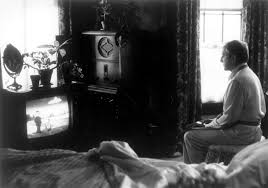
Chauncey Gardner is an up and coming politician.  He has got the support of movers and shakers.  He is becoming a powerful beacon of hope with his analogies of growing gardens and spring.

And he is a complete idiot.

Not in a bad way, mind you.  He is one of the nicest, most polite people you will ever meet (and the most rounded character Peter Sellers ever created).  But he doesn’t know about analogies, economics, politics, or votes.  He has a charming charisma, one that makes you want to think that he is saying more than he is.  He is frankly not suited to rule a household, let alone a country, as wonderful as it is to spend time with him. 
What he really likes to do is watch.  Watch TV.  His whole mindset is passive, allowing the world to pass over him, making no decisions except for the smallest changes that effects his garden, which is his sole responsibility.

And yet as a society it is frequent that we want a charming person to lead us, rather than the smart one.  It is amazing that Being There was release in 1979, a year before Reagan was elected president, who was the most charming affable person anyone could meet, but perhaps not the smartest person to run a country.  I have nothing wrong with the man, but his cabinet was full of people who took advantage of their positions for selfish gain, and caused one difficulty after another.  Both Bill Clinton and George W. Bush followed in this model.  Pleasant people, wonderful with a crowd, but not necessary the brilliant leaders the country needed to rule the world.   Who trusted untrustworthy people.  Whose leadership was so weak that almost nothing got done.  Who made deep mistakes and still cannot see what was wrong with them.

Obama, for all his moral problems, at least is a smart, capable politician, a trend away from Chauncey Gardener.   But the trend is set.  Soon we will have another Chauncey Gardner, an incapable leader who is capable at sound bites, broad ideas, and repeating what he’s heard.

What makes Being There so great is that it doesn't smash you over the head like I just did with a political message.  It is clearly a comedy, and while it is not subtle, it doesn't talk about political problems, it just shows them.  And it is truly funny.  It allows the context just soak in, while it puts our affable Chauncey into one outlandish situation after another.  

Being There wouldn't have been made except for Peter Sellers.  He wanted this film made, and he wanted to play the lead.  So it got done, no matter how many strings he had to pull. 


What Connects Revolution and Mental Breakdown? (Fight Club)


78. Fight Club (1999)

Spoilers here.  If you haven’t seen the film, don’t read this analysis.  Instead, go out and see it.

Edward Norton (nameless in the film) has unwittingly got caught up in a club of revolution.  They use creatively destructive means of communicating the degradation of consumerist society.   They are a militia, and they are about to embark on pulling the rug out from under the entire system by erasing the evidence of all financial records, allowing everyone a financial reboot.  This will both be destructive to society and cause a great opportunity for the unprivileged.  This is deeply disturbing to Edward, because he is the IKEA man, who has a love/hate relationship with consumerism, and because his good friend and roommate, Tyler Durdan is the mastermind of this militia.

What is more disturbing, of course, is when Edward finds out that Tyler is actually one of his own personalities and that he, himself, is the mastermind.  His love/hate relationship with consumer society is what is causing the revolution.  And the fact that is mind is malleable enough to create two separate personalities is what caused this destruction.

But isn’t that the case of revolution in general?  To cause the destruction of all we knew, doesn’t it take personalities that are twisted in a certain way to destroy what others hold dear?  It is one thing to talk about revolution in a general sense, but to actually purchase the guns and to enforce one’s vision of society on everyone else, isn’t that at least megalomania, if not psychopathology?  In the movie Carlos, about the real life revolutionary Carlos “the Jackel” it displays him as being on the outside, even within his own movement and less effective as he went on. 

Of course, we have brilliant people at the head of revolutions as well: George Washington, Che Guevara, Simon Bolivar, Vladimir Lenin.  The fact is, if there is a successful revolution, not only does it require megalomania on the part of a revolutionary, but also a deep societal illness that keeps people degraded and crushed, and piles guilt and punishment on the innocent.   When a revolutionary looks sane, like the best solution to societal ills, then the breakdown of society is complete.

Which is scary when Tyler Durdan or V (as in Vendetta) look more and more reasonable. 

Sunday, March 17, 2013

Five Meditations: Vagabond (1985)


       1. A piece of life
Agnes Varda finds in film a playground of life.  She seems to have ADHD, unable to focus on anything, insisting upon total freedom of mind and thought.  But she knows what she wants to say and continually returns to the themes she is considering, making a whole.  Her narrative might be difficult to follow, but patience gives one the depth that is found in her films.

At one point a character in her film Vagabond (1985) has a near-death experience and she exclaims, “It is true!  As you are dying you see flashes of your life!”  In a sense, this is exactly what the film Vagabond is: flashes of a life in the midst of death, shown right at the beginning of the film.

It is amazing how much of a single life can be contained in just a two hour period:

Judgment and sympathy
Work and irresponsibility
Love and lust and sex and rape
Fear and comfort
Relating and separtation
Connection and misunderstanding
Pogniancy and laughter
And, of course, sorrow and regret.

In the end, it is very disappointing that all life ends in death.  An anticlimax, really.
The memories we have left in the minds of others is all that is left.

2. Double Helix
Freedom and faithfulness seem to never be found at the same place and time.
We all desire freedom:
Freedom from bosses, from lovers, from commitments, from boredom, from demands
Yet we also need security:
Houses, warmth, peace, safety, regular meals, people we trust

In order to reach a balance of freedom and security, we must have faithfulness:
The keeping of promises
Unspoken agreements
Work for each other
Unbroken trust

Those who deny this balance, who insist on either complete freedom or complete security, are both the object of envy and scorn.

3. Trust
Means being taken advantage of
Means hoping instead of requiring
Means walking away when you want to control
Means allowing another to grow at their own speed
Means relying on God, less so on others

4. Speedy Compassion
“I’m too busy to be compassionate”
Compassion requires less time than consideration
The thought to pick up socks for the needy when buying clothes
The thought to keep breakfast bars in one’s car
The thought to give away clothes instead of throwing
The thought to speak a kind word instead of harsh
The thought to step toward instead of away
The thought to smile and listen instead of turn away and ignore

But speedy compassion changes no one
It is only love in the short term
Opportunity for change only occurs in long words:
Patience
Endurance
Longsuffering
(Long in time, not letters)

Opportunity is found in creating new contexts
in which another might thrive.
Opportunity is found in seeing the positive change
  (and diminishing the enduring negatives)
Opportunity is found in the trusting, sacrificial welcome

5.  Lost Hope
There were two characters who could have changed the end of Mona, wanderer, without roof, without law.
One is the Tunisian who truly loved Mona, and gently prodded her to a secure life of work and care.  But his concern about the opinion of others was stronger than his love of this woman.  The shot of his face, deep with regret brought a tear to my eye.

The second is the arborist, the professor, who truly appreciated Mona’s company.  After spending two days with her, appreciating each other’s company, enjoying each other’s vibrancy, the professor dropped Mona off, away from her home.  She could appreciate, but she could not trust.  She also regretted her action, realizing at the end of her life, that this relationship was essential, not passing.

Without trust there is no community.  Without community, there is no life.


If you would like to find out more about Steve's community of the homeless and the mentally ill, check out Nowhere To Lay His Head, the website of Anawim located in Portland, Oregon, USA.

Sunday, March 3, 2013

Christian Endurance: Hunger (2008)

(This is a review/sermon from 2010, reposted from another of my blogs, Steve Kimes, Anawim, esq.)

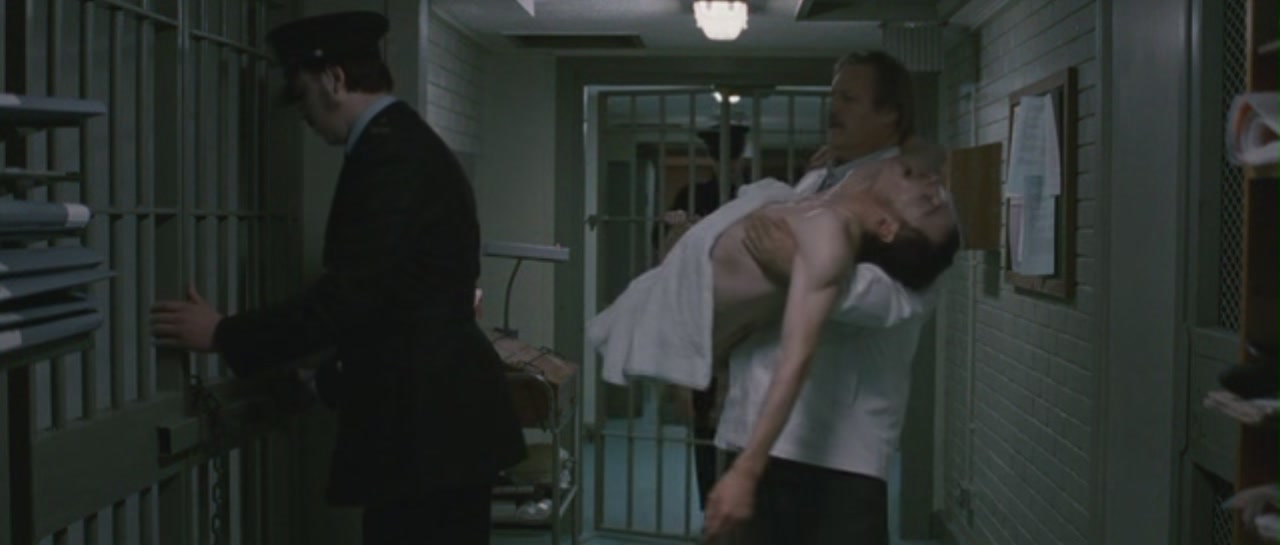
Hunger is the story of Bobby Sands, an Irish Republican put in prison for political violence against the British. While in prison, he leads protests, demanding to be treated as political prisoners—POWs— instead of just criminals. As the British refuse, he and his co-prisoners suffer the filthiest existence at their own hands. And then they endure forced bathings and the most inhumane searches. Finally, Bobby Sands decides on a hunger strike, for him and his comrades. And the horror of that fast is depicted gruesomely.

Obviously, this is not a movie for everyone. By the end of this film I began to wonder why I was putting myself through this torturous movie. Then I wondered why the director put in all of this amazing effort, with some of the greatest filmmaking talent ever, to put us through this experience with Bobby. It seems that Bobby is going through some of the most terrible self-torture, and for what? Political recognition? For the recognition of human rights, most of which were in their grasp at any point? To make some petty point?

But I realized that this was not a political film. The director depicts the suffering of the guards as well as the prisoners. The fact how everyone’s life involved was simply miserable because of this system, because of the determination of these men.

Finally, I realized what the movie is about. Endurance. It doesn’t matter what Bobby Sands was fighting for, or what methods he used. The point is simple—he was willing to go to whatever extent to obtain his goals. He had the steadfastness to put his body through any degradation, to suffer whatever the cost, to go through any pain or mutilation in order to achieve his goals. The ethic nature of the goals weren’t significant. But his determination was.

And, honestly, that’s what makes any cause great. Not the rightness of the cause, but the stark determination of the promoters of the cause. This is what made the civil rights movement great, as well as the Indian freedom protests—they were willing to suffer all, while not causing the suffering of anyone. This is what made the early Anabaptists great, the early Franciscans, the first century church. They all promoted their cause to the death, while never harming another.

I am ashamed of our modern day church. How little determination we have. How we speak so much about “balance” and “cycles”, as if the main text of Scripture we should be living out is not the Sermon on the Mount, but Ecclesiastes 3. We speak of the “discipline” of rest, but the fact is our lives are full of rest and we do little work for those who honestly need it. Pastors are the ultimate compromisers, seeking salaries and retirements and office hours, instead of trusting and giving. 

I know true endurance. I once lived it. For fifteen years, I worked hard for the people on the street until my body, slowly but decidedly gave up on me—until my stress levels exploded. Surely, people would say, that is the need for balance. And I will say, no one’s body is meant to endure terrible stress for twelve or fifteen years. We just can’t keep doing it. Even Jesus only dealt with daily suffering for three years or so. 

And this kind of endurance isn’t for everyone. It is a saintly life to support the spiritual athletes and soldiers—those who lay down their lives for the cause. But, honestly, we are in a time of the church where those who are willing to lay their lives down for the gospel are few. Very few. 

What is the task? To love others, even if it means our own death.
What is the cost? Our lives, our sanity, our family, our “balance.
Who is willing to endure?

Who is willing to endure?

Sunday, February 17, 2013

What is Love? The Deep Blue Sea and Amour


Rachel Weisz (in a marvelous performance) is in deep trouble.  She has left her husband, who loves her for her passion, a younger man who does not love her.  Her despair in this triangle leads her to attempt suicide.  And this is just the first ten minutes of The Deep Blue Sea

The theme of the film is passion, and the consequences of giving in to our passions.  Passion is gorgeous, but dangerous; it is powerful and destructive.  Certainly it is shown in this film to be a double-edged sword, ending in destruction. 

Passion is often confused with love, especially among the young.  This is not to say that passion isn’t an important aspect of love.  Were it not for passion, would our rational minds ever get married, get pregnant, go through birth, raise children?  Passion gives us the energy and drive to accomplish that which our species most needs.  It is the engine that drives our survival.

But is that all of love, or even the foundation of love?  Perhaps it is the engine, but what is the hull, the keel, the sail?  Passion drives love, makes it do amazing stunts, but what keeps love afloat?  If passion were all that love was made of, love would look like a hyperactive boy, flitting this way and that, always attached to a shiny object, running over whatever or whoever is in his way.   Although drawn out, this is exactly what we see in The Deep Blue Sea—the destructiveness of passion, and the ultimate loneliness of it.

It is interesting that within The Deep Blue Sea is embedded the theme of a more recent film, Amour: “A lot of rubbish is talked about love.  You know what real love is?  It’s wiping someone’s ass or changing the sheets when they’ve wet themselves.  And letting them keep their dignity so you can both go on.”

Amour is about the slow demise of a wife and the faithful service to do whatever was needed by her husband.  She has a quiet stroke, almost unnoticeable.  Then another, which leaves her half-paralyzed.  She speaks of ending her life, but her husband convinces her not to, that she is not a burden to him.  As the movie wears on, she becomes more and more of a burden as she regresses to an infant state.  The performance by Emmanuelle Riva is easily the bravest acting I have ever seen, allowing her to be put in the most humiliating positions ever. 

Just by its title, Amour asks “Where is love in this couple?”  Love isn’t found primarily in the ending of the film, as some would say.  Love is found in the day-to-day faithfulness, awareness of the other’s need, and spending oneself to meet that need.  As is often true, we can see love in contrast to those who do not display it: the daughter who wants to push her own will because of her own emotional needs, the nurse who has a program and will follow it no matter what the cost to her patient.

Love is the dance of a couple moving to help her sit in a chair.  

Love is spoon feeding a spouse when she doesn't want to eat, and learning to give up.  

Love is giving her privacy so she doesn't have to inflict her misery upon others. 

Love is a wife who is unable to communicate anything but “Hurts… hurts…hurts…hurts… hurts” for hours, and a husband who stokes her hand, tells her a story, sings old songs, until she quiets and is at peace.

Both films speak of the limits of love as well.  The Deep Blue Sea displays passion as having a limited life, quick to begin and quick to end.  The true love of Amour also has a limit: the emotional demands of love takes an emotional toll and it eventually breaks into rash anger.  But the best love recognizes that limitation and prepares for it, even apologizes for the limitations. 

I wish I could recommend Amour as an example for all to observe.   But it is such a difficult film, like almost all of Michael Haneke’s films, that I cannot recommend it to everyone.  My parents are so close to this situation, that the example would only hurt them emotionally.  Others are so young and passionate that Amour would just seem dull and pointless.   But for those who are ready for it, Amour is the glory of love in its most raw display.   The Deep Blue Sea is more beautiful, and has wonderful performances we can relate to.  Amour takes us to the next level of teaching us depth and maturity.

Redeeming Violence: Tarantino's Revenge Philosophy


Quentin Tarantino’s fantasy revenge films are all the rage.  Django Unchained just passed Inglourious Basterds in the worldwide box office, raking in more than 350 million dollars in a couple months.   Revenge seems such a basic theme, and pulp revenge films have always had a low-brow charm, but Tarantino has now brought that lower class entertainment to allocates (and controversies) by granting it a wider audience, especially among cinephiles.

The four (or five) revenge films I count as these:  Kill Bill, where The Bride takes revenge against her co-assassins for killing herself and her unborn child; Deathproof, where a group of women attack a woman-killing stunt driver; Inglourious Basterds, where Jews kill Nazis with glee, even burning Hitler in a movie theatre; and Django Unchained where a former slave kills slave-owners and traders.

Revenge seems such a basic motive and it touches many people.  Let’s use QT’s films as a way to look at this fantasy and what it promotes.  There are four basic principles of QT’s revenge fantasies:

1.       Oppressors and killers are dispatched violently
This is the basis of all revenge: Lex Talionis.  Whatever violence one does, it will be done to them.  We see this perfectly in Deathproof, where Stunt Man Mike is destroyed by a car, even as he killed women with cars.  An oppressor is seen as one with power, but uses that power to harm those with less power, and so that power is used against them.  From Disney films to art films to novels to ancient literature, this is a basic theme of humanity.  It is also the foundational principle of religion, that each person will obtain, eventually, exactly what they deserve.

2.       The oppressed take their revenge in their own hands
This is a theme that QT emphasizes.  Each group takes their own vengeance.  So it is women who kill Stunt Man Mike, Jews that kill Nazis and a black man who kills white slavers.  This is opposed to most forms of Lex Talionis, where the oppressed are powerless and they hand the power of vengeance to someone else, whether that be the police, the military, God, or Prince Charming.  As Django learns, to get justice, you have to get your hands dirty: which means, you have to kill people.

3.       Those who allow or appreciate such oppression to continue are also dispatched
In a turn we haven’t seen since ancient times, QT also kills those who support or approve of oppression. So the sister of Candee who took advantage of the slavery system is gleefully killed.  Any Nazi soldier is killed as an act of justice, no matter what their participation in violence.   It doesn’t matter what level of participation they have, any is enough to be killed as punishment.

           4.   Movie audiences are seen as equal oppressors
In a fascinating move in Inglourious Basterds,  after the Nazis gleefully applaud and cheer after their enemies are destroyed on screen,  when the Nazis receive the same fate, the American audiences are encouraged to applaud and cheer the Nazi deaths.  QT is in equal parts condemning the approval of oppression and death, even of one’s enemies.  The audience cheering his film is made out to be the equals of Nazis.  In Django Unchained, whites are separated from blacks and all the whites are killed.  Even so, QT separates the whites from blacks in his audience, dispatching all the whites.  In Deathproof,  all men who do any kind of harm to women, including humiliation, is implicated.  Nor does QT exempt himself—not only is he implicated in his own films, being male and white—but he has himself killed in Django.  Support of oppression goes to the extent of cheering and glorifying oppression.

What is the end?
What happens to these heroes, the destroyers of oppressors?  Although QT often has his heroes have an uneasy victory at the end of his films, he is fully aware of the end of his destroyers of oppression: like Christoph Waltz in Django, they are killed as killers.  Dr. Schulz receives a similar end as John Brown, one of QT’s historic heroes.  John Brown, who gathered a band of vigilantes to kill slavers throughout Kansas and was later hung as a terrorist and murderer.   This is the end of Django, the Jews in Basterds, and the women in Deathproof—some sort of death penalty.  As for the Bride in Kill Bill, even QT says that if he made a third one it would be about the children of those the Bride killed, coming back for vengeance against her.  Because in QT’s philosophy, everyone should have their day of vengeance.  The world gone blind, indeed, or, in QT’s universe, at the end of a samurai sword.

If QT were to continue this series of films, what would be the next one?  Perhaps a vengeance film against oppressive governments?  Oh, no we have V for Vendetta for that.  What about a group of vigilantes taking vengeance against the rich for their oppressions?  It seems that the new film The East will fit that bill.  

Perhaps QT should do a film about an oppressed third world country,  taking glorious vengeance against the nations that warred against it, and against the nations that financed it?  Of course, we saw that movie play out in real life on September 11, 2001.  From the point of view of Al Qeada and their people, they are freedom fighters against Israel and the “Crusading” western nations that attacked the Palestinians and who refuse to recognize their legally voted in government.   

The Kansas Massacre and the Twin Towers burning: that is what QT’s revenge philosophy looks like in real life.  
Saturday, February 16, 2013

Jiro Dreams of Sushi and I Wish

My family's fascination with Japanese culture probably originates with our joy in watching the films of Miyazaki.  The foreignness of the fantasy is not only because of the fantasy worlds themselves, or the unique beings, but from the deep culture of Japan that infuses them.  Now that my daughters are interested in Japanese anime and one daughter is taking Japanese in school, that fascination has only deepened.

For myself, I am usually spending time in an older Japan, the time of the samurais with Kurosawa (Seven Samurai, Ran), or a spiritual Japan with Miyazaki (Spirited Away, My Neighbor Totoro). Also a Japan of the 50's with Ozu (Floating Weeds). Recently, however, I spent a day in modern Japan, with two films from the last year that opens up many insights of what Japan is now. 

In I Wish, Goichi and Ryu are brothers in grade school who now live quite a distance from each other after their parents split up. Giochi lives with his mother and grandparents in a town underneath a constantly smoking volcano, while Ryu lives with his father, who has a casual life in music.  Goichi hears that if you stand at the place where the bullet trains pass each other, the energy created from the passing allows one to make a wish.  Goichi insists that he and Ryu must meet at the passing and wish for their family to come together again.  Kind of like The Parent Trap with magic. 

Of course, there is a lot of planning and difficulties along the way, growth and wonder and friendship and mentors. It is an utterly charming and joyful balance between dreams and reality.  It should be watched if only for the wonderful performance of Oshiro Maeda, (Ryu) who made me smile every time he came on screen. 

What surprised me in this film is just how similar the children's lives were to the children I knew, or my own childhood.  The friendships, the elaborate but childish plans, wise children and foolish adults, as well as the other way around.  In many films around Japanese children, they are always studying or working (when they aren't having amazing adventures), but these children are playing as often as anything else.  They don't take their schoolwork anymore seriously than American children, and they are just as picky about their food.  On the other hand, they aren't playing video games as often as Americans.  The adults aren't really very different, either.  There is less rigor or work ethic than I would have expected.  And grandparents are the same the world over.

I Wish seems to be a bridge between cultures, pointing out the similarities we all have, especially as children.

Jiro Dreams of Sushi has another fish to fry, so to speak.  It is a documentary of the greatest sushi chef in Tokyo, possibly the world.  Despite having no bathrooms or other amenities  Jiro's restaurant has received three stars (the highest mark) from the Michelin Guide for years.  This happens because of Jiro's tireless discipline, which he keeps for himself and for his assistants, including his 50 year old son.

One of the most remarkable things about the film is the mixture of cinematography and music.  This film has some of the best montages I've ever seen and the greatest I've ever seen in a documentary.  Even as the sushi is a piece of art, so is this film, a prime example in the art of documentary making.  

Jiro is about a continuous vision made reality through perseverance and hard work. His wisdom and his son's wisdom come through in this film, and the contentment with a life they have made their own through difficulty and strength.  The Japan that is presented in this film is a more traditional view: discipline, work, tradition, honor.  

Yet in the end, I suspect that these films are only two snapshots of a more complex and diverse Japan than could ever be imagined.  Much like the film Yi Yi expresses, both the frustration and the joys of living modern life.  How can I but touch the surface of such a complex culture through film?

I Wish 4/5
Jiro Dreams of Sushi 4/5