Sunday, October 27, 2013

A Meta-Horror Triple Feature

This month, for Shocktober, I watched three horror movies referring to past horror movies to make them something more, something special.  I almost wish I had watched them all in a single day, because they work together in a way that separately are dull.  Here's my reviews of each, with the final review wrapping things up.


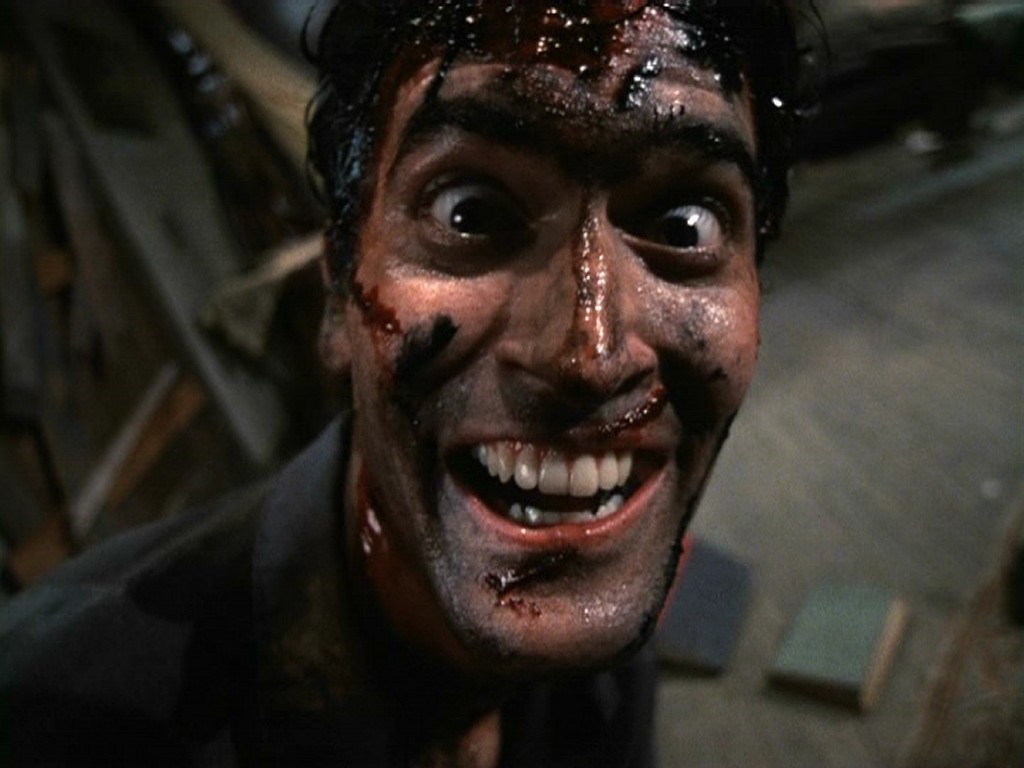
Evil Dead II
This film is the King of Camp, this film spurred many comments from my daughter and I while watching:

"Epic shovel. Keep that with you."

"Some guys like it when their girls bite. I guess he doesn't."

Amazing car! It's faster than evil!"

"You can hide from evil, but not the camera."

"Favorite character: the Hand. Miracle fingernails!"

"Pretty red. Quite cinematic."

"If it weren't for stupid people, there'd be no horror movies. But honestly, I'm surprised he made it for a full hour and a half."

"Exploding puddles!"

Comments like these is what makes movies like Evil Dead II worth watching.

Viewers tip:  You don't have to watch the first Evil Dead to appreciate this follow up as it is not a sequel, but a mock remake. 

Scream
A beautiful meta-horror film filled with references to horror films of the past.

Just to give you an idea, here are the three rules to not getting killed in a slasher movie:
1. Don't have sex (only a virgin can defeat the bad guy)
2. Don't drink/have drugs (that's just an extension of #1)
3. Don't ever say "I'll be back." (because the irony is too much to deny)

Of course, as this is said, a couple is having sex, a group of teens are drinking and a person leaves, saying, "I'll be back." Obvious, but still delightful.

By the way, I'd hate to be the serial killer in this film. He gets so beat up and punished throughout the film. I think I'd give up the serial killing business if I were in Scream.

It is interesting to compare this to the meta-horror film Cabin in the Woods. It is just as referencing past horror films and creating principles of horror, but Cabin feels less like a lecture on horror tropes and plays with them more.

Still, any movie that purposes to point out then reverse tropes is okay in my book, and entertains me.

Viewers Tip: Get with friends and have a drinking game for every time they reference another film.  Certain to give you a bloated bladder. 

Cabin in the Woods
The first time I watched this film last year, I felt that it wasn't all that I thought it should be. First of all, it was only occasionally. Secondly, it wasn't that scary. Yet somehow, I thought that it was a horror film I could show my teenage daughters, and they would enjoy it. Since last year I watched Scream and Evil Dead II, and the light turned on and I now know why this film is great.

Cabin is the ultimate expression of what Scream and EDII tried to capture-- the meta-horror movie. All three films attempt to explain the mythic core of horror stories and what makes them both successful and powerful. There is a basic moral story that communicate to us, especially young people, some basic sins that the universe demands must be punished, even if we, as humans, might wink at.

Cabin is the best of these three because it makes the meta story not only explicit, but integral to the plot. There is a double story-- the familiar one of the group of teens getting a taste of freedom without any authority, and the story of a secret government agency tracking their movements for some hidden, dark purpose.

Cabin is the best of the three because Scream references and summarizes all slasher films, Evil Dead 2 takes the plot a step far beyond the cabin story (poking tender fun at the genre), but Cabin speaks of not only the purpose of the genre, but the horrible end to it. It goes to the ultimate finale of the myth, which is satisfying in its own right.

Oh, and it truly has funny moment and is highly entertaining, like the other two. What a great triple feature, to watch all three, as I did this Shocktober.

Viewers Tip: Watch it again.  It's good that way 

The Emperor's New Groove: It's just Funny, Okay?

There are many who were disappointed in this film before they even saw it.  It was to be called The Kingdom of the Sun and was to be the follow up to the dramatic and powerful Lion King.  Then someone *cough*MichaelEisner*cough* took the film away from Roger Allens and gave it to the comedic director Marc Dindal, reduced the budget and took away almost all the songs written by Sting for the original production.

Others don't care for this film because it's simply too light.  There is no dramatic tension, pretty much no sympathetic characters, and the moral is as obvious as the nose on a llama's face.

Nevertheless, for my money, this is the most entertaining of Disney (non-Pixar) animated films.

I grew up on Loony Toons, watching Bugs Bunny and Wile E. Coyote almost every day of my young life.  This film has the zaniness and the non-sequitur humor of those old films.  It also has a few times when the most awkward of adult conversations are placed in, just for fun. (An adopted son speaking to his mother about her much younger boyfriend: "So... he seems nice."  "Oh, he is.").  It pokes fun at every aspect of real life, from the self-importance of those who have always gotten what they wanted to brilliant ideas that occur to us in the middle of the night to the desperate importance of a minor talent of ours ("And I never liked your spinach puffs."  "Oh, she's going down").

Perhaps the voice-over narration is irritating, but if we get into the film, the irritating nature of David Spade is part of the fun, and how David Spade's character gets irritated at the David Spade narrator, tells him to "go away" and the narrator is silent throughout the rest of the film is not only brilliant, but a revenge on voice-over narration in all films.

How I love this film!  I count them by quotes that my family throw at each other almost every day:

"Uh huh, uh huh, uh huh."
"Point three: Look what I can do." "What does that have to do with..." "No, wait, he's got a point."
"Why do we even HAVE that lever?"
"Bring it on."
"No touchy"
"It's not the first time I've been thrown out of a window, and it won't be the last."
"Oh.  I feel it."
"Is that MY voice?"

Okay, I won't bore you with the silly quotes.  Enough to say that this movie works for us.  Yes, it's only entertainment.  It entertains us.  And that's what a movie is really all about, right?

Saturday, October 12, 2013

Gravity: Glorious Spectacle

I checked to see a 2D version of this film on the internet and went to my local theatre, who charged me extra and gave me the glasses.  "This is a 3D showing?" The cashier nodded.  "Dang, I really can't see 3D. It's all fuzzy to me."  He said, "I'll tell you what.  If it's a problem, come to me early in the film and I'll give you your money back."  That's fair.

The trailers didn't seem too fuzzy, but they weren't inspired, either.  The extra dimension seemed attached to the screen, unrealistic, pointless.  Then the feature film began.

Spectacle, glorious spectacle.  This is what I saw when I first saw Star Wars in 1977, opening my eyes to the cinema experience.  It is what I hoped to see when I saw Avatar a few years ago when my 3D vision was all fuzzy.  From the very first shot of the three astronauts in a space walk outside the ship Explorer, I am stunned.  And rather than get bored of the vision of the massive Earth as a wall portrait, I am never comfortable, never apart from the awe of this vision.  This isn't due to the 3D, although it didn't hurt it, either.

The story is pretty basic.  There's no deep characterization, the symbols used are pretty basic.  But what does it matter? The characters are so basic that the film suffered no impediments.  This was an uncomplicated odyssey through the most dangerous nature humanity has ever explored.  The majority of time in the film was spent in the harshest environment possible, and it was not just the confident Clooney or the trembling Bullock who had to face this sparser-than-the-arctic enemy, but I.  It was me, floating above the earth, trying to remember that I would not fall, at least not yet.  I suffered vertigo throughout the film.   I had to remember to breathe.

This film is also a disaster film, where the human mechanism, needed to survive, failed in a big way.    And it isn't just a one-time disaster, but one that visits again and again, pouring tragedy upon our lives in a cycle of fire and doom.  The space ships are islands of humanity, but they are not places of hope, reminding one of home, but pockets of emptiness and chaos.  The film is relentless, pounding, increasing it's intensity at every moment, without respite.

No, there's nothing deep. But the experience is unforgettable and immense. 


I think that 2013 will, for me, be the year of science fiction.  My three favorite movies (so far) were all wonderful explorations of the genre: Upstream Color, The World's End and Gravity.  They are all unique and powerful versions of SF storytelling.

***
Minor spoilers below.

I am fascinated by a theory about Gravity that has been bouncing around.  That the whole of the film was symbolic, that it is Bullock's state of grief after her child died.  That she is weightless, drifting without purpose or meaning in life, and that Clooney's character is her guide to get past grief and back to Earth (real life). 

There is also the womb symbols that are used, with the water at the end being her rebirth into life.

I think that these ideas are interesting, but they don't add much to the film for me.  Still, the first theory I might find interesting next time I watch it. 

Sunday, September 22, 2013

The Human Condition: A Personal Perspective

***Mild spoilers below***

The Human Condition is the story of Kaji, a leader in fascist Japan with a heart of compassion.  He travels all over occupied Manchuria from 1943-1945 and leads a bold but quiet fight against the heartless nature of the military machine.  He is a labor organizer, a soldier, a lead private, a refugee, a POW and a homeless beggar. 

It is a nine hour film and it is not for the faint of heart.  It is divided into six equal measures of an hour and a half, and it was meant to be watched over a period of time,  not one day.  But it doesn't feel long for all that. This film is also one of the most powerful experiences of my life.  

This is the most personal film I’ve ever experienced. I feel like I’ve lost my best friend and my very self to despair and madness.  To say this film is “depressing” doesn’t get to it.  I am devastated, in mourning, in almost physical pain.  And yet I would watch this film again, right now.  All nine hours. There is so much I missed and I want to experience it all.  And I don’t want to lose my relationship with Kaji, the man who is in every scene of the film. He is my friend, my counterpart, even in his lowest points.  He sees the world as I see it, with all the naiveté and sorrow and struggle that accompany such a vision.

Ever since I spent months in India decades ago, observing desperate poverty and experiencing a mild form of it myself, I see the world as a battle between peace and collapse.  Peace, as I understand it, is wholeness.  A self wholly at peace, a community united, a nation set on providing needs, a religion of love and compassion for all people. 

That’s a big order, really.  Especially in a world that is filled with powers attempting to break that shalom.  There are billions of hungry, wars in many nations, violence on almost every major street, the chronically ill in every family.  And there are those who, just in the normal course of things, require more attention: children, those nearing the end of their lives, the infirm, the very poor, the mentally ill.  To battle this requires stamina, focus, strength and resources.

That’s how I see the world.  It’s how I’ve seen the world since I visited India in 1985 and saw real poverty and suffering and my own complacent reaction to it. From the beginning of 1986 I determined that I would do all I could to combat it, with whatever I had.  If that is taking my paltry life in its fragile eggshell and throwing it against the stone wall, so be it.

The film The Human Condition comes from a similar viewpoint.  Although locked into a very specific cultural construct—Manchuria from 1943-1945 from the viewpoint of the Japanese invaders—it introduces the idea of the poor and the lowly again and again.  Draftees in boot camp, forced workers, POWs, refugees, women forced to trade sex for survival, some lost in the wilderness, the homeless, the despairing, the lost.  Each of these are given their fair time and a voice in this film.  They are able to express their anguish and the corner that they are put in.  This movie is, more than anything, about the plight of the lowly, and how they suffer not only their everyday sorrow, but beating, raping, insults, forced hunger, unpaid labor, and more leveled on them.
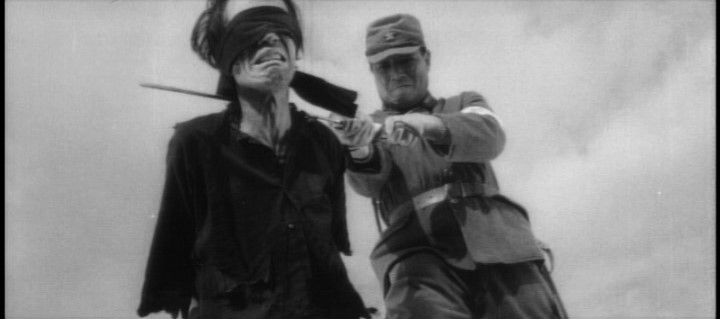
Why do the lowly suffer this way?  Because some have power over them.  The power forces the lowly into their place of suffering and the lowly must, in their way, support the system that causes their suffering. These powerful are not only the thumbs of the system, but they also heap on additional abuse onto the lowly that isn’t required or even legal by the system they represent.  Why should they do this?     It isn’t just their power, but their assumption of superiority that makes them so deadly.  They “deserve” the better treatment as opposed to the lowly, and the lowly “deserve” the additional abuse heaped on them.   Their petty complaints are really more important than the survival of the lowly. It’s as if some people think that being homeless isn’t enough, they also must be criminalized and harmed to teach them that being homeless is a bad idea.  Who would do that?  Oh yeah… we do.

Kaji is our protagonist, he is the mediator between the outcast and the powerful.  He has charismatic power that gives him authority even when the system hasn’t given him that authority.  He is like Joseph in the Hebrew Bible—no matter how low he lands, he still rises to the top of the heap.  He is smart and courageous and strong and determined.  He is also compassionate for the plight of the lowly, but that compassion isn’t all.  It is that he stands up for better treatment for the lowly, so that they may thrive, or at least survive.  He is the persistent voice of justice for the outcast.  He is sometimes listened to, always reluctantly.  More often than not, he is mocked and derided.

Kaji attacked by both sides.  By the powerful because he is seen as subversive, by the lowly because he is seen as an oppressor.  What is funny is that he is not subversive at all.  He gathers what resources he must to allow the lowly to survive and thrive.  Nor is he oppressive.  He is in the place of power so that he might cushion the attack against the lowly, but the lowly only feel the attack, they don't see the softening of it.

I understand Kaji, better than many, if I may be so bold.  I just read some critics wondering if Kaji is a realistic character, standing with compassion when the rule of the day was prejudice.  I have been given the opportunity to be a pastor of the homeless and the mentally ill in a United States that thinks the poor are lazy and unworthy of compassion.  The treatment of the homeless and the mentally ill by the police here in Portland and its suburbs is comparable to the treatment of the POWs after WWII or the Chinese by fascist Japan.  Their possessions are stolen from them or destroyed by local government forces.  Even as some of us attempt to assist these very poor, we are hindered by others.  The local housed people consider themselves superior to the homeless and consider the homeless worthy of being punished just because they are homeless.  The neighbors of our church and the local government wants to stop us from providing showers or overnight shelter on the coldest nights because they have fears or policies.  Me and my kind have stood up, attempting to help the community see the homeless as human beings, worthy of respect as anyone else, local citizens and not criminals unless they have actually done criminal activity.  And for this work, we have been insulted by the neighbors, threatened, yelled at by the police, knives drawn on us, and kicked out of our homes. 

Because of this background, I truly appreciate Kaji.  I haven’t been through all he has, but I understand his perspective and I can appreciate his suffering, even if I haven’t been through it all. Kaji represents my heart, and when he speaks I can see myself speaking the words, even if I am at times uncomfortable with them.  At this point, I am older than Kaji ever got, and sometimes I think of him as a younger version of myself and I’d love to give him some counsel.

When Kaji is naïve, in the first film, I understand, for I was once naïve and considered that I could change the world myself.  I want to sit down with Kaji and explain to him that his difficulties came from thinking that the uncompassionate, oppressive world would just see the justice of his position and agree to it.  He is so humble that he fails to see the assuredness of the oppressors superiority.  The lowly aren’t just lowly because of some twist of fate but because they “deserve” their position in some karmic insanity.  And their suffering is “good” for them in some twisted logic.  Kaji can’t understand this logic so he keeps speaking the language of compassion, of empathy with the lowly, which the powerful cannot understand.  So Kaji is alone and persecuted.

Kaji is also like Jesus.  Not in some false Christ-type many movies attempt to throw in.  In many scenes, however, he is willing to suffer and take on the beatings and tortures that would have gone to the lowly.  He
accepted it so they wouldn’t have to.  Perhaps that was his own hubris, that he could handle the suffering better than they.  But in a way this was true.  Because he was taking on suffering out of nobility, not out of some false sense of justice.  No one who punished him considered him worthy of punishment.  Rather they punished him because they had to release their own wickedness in some way.  Kaji accepted it so others would not.

Eventually that suffering broke him down.  He is only human.  In the second film, Kaji becomes angry, sometimes irrationally so, lashing out at his persecutors and I wanted to have another session with him.  I understand why he is angry.  He is angry because his body cannot endure such suffering anymore.  He is angry because he cannot endure the irrational punishment any more.  But I’d like to remind him of the result of his anger. His anger wouldn’t create compassion for the lowly, nor would it force the oppressor’s hand.  In fact, he is undermining his own compassion, for he fails to see that the oppressors are enslaved by their own actions and that they need deliverance as much as the lowly do.  Perhaps he can’t help it, but if he can, he should control it, for other’s sake.

In the third film, Kaji cannot forgive himself for his own acts of oppression.  Again, I understand, as I too have oppressed and beat myself with guilt.  What I wanted to comfort him with was that the system of power makes it all too easy to oppress those who are weak.  We can oppress with a word, with a glance, or by simply ignoring the lowly.  We must resist those impulses, but we will slip into them.  When we do, we cannot beat ourselves up because of our failings in a system of destruction, but resolve never to do it again.  We must remain strong so as to both help the needy and fight the system of injustice.  And it is easy to fall into the trap of weakening ourselves with shame or a too-quick-surrender.

Finally, Kaji snaps and takes his vengeance out on one who caused the death of the lowly. Again, I wish I could have spoken to him, even yelled at him.  Take your vengeance out by changing the world!  See your ideal flourish!  Look at the long view-- he isn't the problem, and you can't take vengeance out on a system.  You are just participating in the system by being the criminal against it.  You are fitting into their idea of you!  I don't know that he would listen to me, though. 

What kept Kaji going, waking up each day, was the thought of going home to his wife.  My home is even more distant than his: I see a world of justice, a world where the poor aren’t oppressed, a world where governments and religions are organized around compassion instead of a false sense of justice.  My home is where the poorest of the poor have a home and a comfort and can contribute creatively to society. 

Now I’m going to get all religious on you, that the film never went.  In this view of the world, Kaji had to go mad.  His hope was pointless.  In fact, in the third film there are hints that his wife was probably raped, beaten, starved or sold her virtue for food, possibly dead.  The home that Kaji longed for probably wasn’t there. 

In Christianity, we are told that we will get to the end of our lives and not find this home we seek, a world of justice and hope for the lowly.  The next world is where we will find it, and those who gave mercy and suffered for would get a second chance at life, successfully creating a just world that could not be done in this life.

And I’ll be honest.  I am often stumbling in the snow, wondering if my hope is in vain.  The way I figure it, Kaji, is that even if there is no home to come to, I have done what little I can to make the world a place where others can have home.  Perhaps this world wasn’t meant for us, Kaji.  Perhaps we were never meant to find home.  But isn’t it enough to know that we offered comfort to others?  Isn’t it enough that our lives were lived for the ease and survival of others?  We may not have done much.  Helped a few hundred people.  But isn’t that enough to keep living for?  Even if that means we go to Siberia, isn’t that enough? Certainly better than dying of frostbite, longing for a home we’ll never have.


Isn’t it?

Friday, September 13, 2013

A Life With A Clockwork Orange

I was an older teen when I first watched A Clockwork Orange.  That isn’t a surprise, since it seems many people watch this controversial film at about that age.  The age when we are old enough to watch a movie on our own without our parent’s supervision.  A Clockwork Orange seems to be one of the first go-to films for kids of that age.  We hear rumors of the violence, the graphic nature of it, and it’s classic status.

I know that some, when they catch up with it, find it a moving experience, important.  For me, frankly, I found it disturbing and… well… I don’t know.  It is memorable, that’s for certain.  But what is it about this film that makes so many people find it significant?  I just don’t know.  I couldn’t decide about it.  And that’s where I left it for 27 years or so.

This week I decided to revisit the film.  My wife deeply questions my wisdom about that.  But I was missing something.  As I explained to her, I was so young when I saw it that I can’t really rate it fairly.  (Her response, “And that’s good enough reason to watch it?”  “Of course,” I replied.  A film buff cannot be denied a rating.) But more than that, it’s an important film experience for many people, but I can barely remember a thing.  I wanted to participate in the event with my film buff community.

So I watched it and it was as disturbing as I remembered it.  The violence, the dehumanization of women, the sociopathic activity, it was all very distressing.  It made as if to titillate with the sex and violence, but all it did was offend, which I suppose is part of the point.  I certainly did not enjoy the film in any way whatsoever.  It was clearly satiric.  Frankly, it felt like one Monty Python sketch after another, each one more over the top than the one before, but not a one was even remotely funny.  There were times I felt sick to my stomach.

And as my memories came rolling back from almost 30 years ago, I realize that I must have had some level of the same reaction back then, but to a less degree.  The one scene that I remember most clearly from my previous viewing is the scene in the bar where the plastic woman’s nipples are used as a faucet to pour the patron’s drink.  It disgusted me then and disgusts me today.  Frankly, the whole thing does.  This is similar to the film Brazil, when it communicates just how bad society has gone and seems to go too far… but at least Brazil had some laughs to break the oppression on one’s soul.  A Clockwork Orange never does.

The mocking of society is penetrating and somewhat remarkable in its insight.  Over the last 40 years since it was made, society has off and on again embraced pornography as an everyday experience, as a regular part of everyday existence.  And the result of this almost always is the objectification of women, especially young women, to just be seen as objects of lust.  Right now, pornography is as popular as ever, but it is kept private, and women are more and more regarded as equal humans. 

Another pointed jab is how we allow ourselves to be led by sociopaths.  Those who are willing to use violence or dehumanization to bully and force their way through both small groups and society at large is still a fact of life.  It is interesting that often today we see the conservatives, who demand an “eye for an eye” to be the bullies, but in this film it is the liberals, those who want to rehabilitate rather than just punish criminals, who are guilty of the greatest depth of dehumanization—by denying freedom altogether.  Not only the freedom to commit crimes, but the freedom to appreciate art as well.  In the end, our “hero” is granted an opportunity to partner with the government.  It looks like he will go far, because he is of the same type.

Our society reflects the world of A Clockwork Orange in the lack of ethical thinking.  What is essential is the outcome, not the process.  As long as all the policies are followed, and the outcome is what is accepted, then all is well, and we can enact crimes to produce that outcome.  It is fascinating to me that there are only two ethical thinkers in the film: The Chief Guard and the new roommate.  While they seem cruel at points, at least they had an ethical theory.  

One of my issues of the film is that it, like many satires, can point out the wrong in thinking, but can it determine the right?  Simple “eye for eye” punishment isn’t exactly a well-thought out ethical theory as well. 
But in the end, considering all these things, I realize that when I watched this film when I was young, the plot didn’t stick, nor did many of the scenes.  But what did stick with me was the disgust at the misogyny and the violence.  I couldn’t determine my reaction to the film because the primary emotional response was revulsion, and while I knew there was something else going on there, I couldn’t process what it was.


Now I can.  And I think that disgust and unfunny satire isn’t enough to base a great movie on, at least for me.  I nod at the bold moviemaking.  And I am glad to have had the experience of revulsion at the dehumanization of women when I was young.  But I cannot recommend this film, as noble as its intentions may seem.

Tuesday, September 3, 2013

What is Truth? A Meditation on Stories We Tell

In the ancient world, two or three witnesses proved an event.  This proved problematic when there was a conspiracy, such as the ancient book of Susanna showed.

But what if every person speaking intends to tell the truth, but you still have different stories, different perspectives?  You get real life.  But do you get anything close to truth?

I suppose it depends on what truth you are seeking.  Are you seeking the truth of what happened?  Emotional truth?  Relational truth?  Or, if given an introspective mindset, can we discover something about the nature of truth itself?  That it is dependent on perspective, on relationship, on context, on narrative arc?  That multiple truths can exist in the same story, in the same overall truth and still have meaning?

It is fascinating to me how certain decades of nations have types of movies that characterize them.  Korea is the "genre-bending" nation.  France is the "personal narrative art" nation.  Finland is the "dry humor" nation.  Canada used to be known as the "bad movie" nation.  But then Guy Madden and some quiet classics were created.  It makes me think that perhaps Canada is the "personal perspective" nation.  Stories are told from a strictly personal point of view that would look different if someone else was telling it, and they glory in that unique point of view.

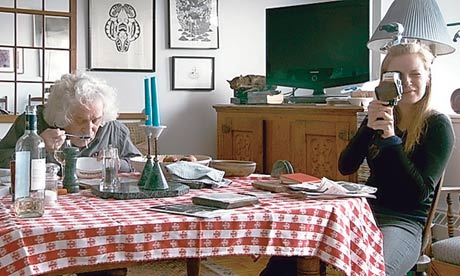
This movie could only be told by Sarah Polley.  It is the perspective of the daughter with a lost mother and two fathers, one unknown.  If someone else told this tale, it would look vastly different.  Someone else wants "facts", another one wants comedy, another one wants it to be more touching or more objective.  But this is Sarah's story and only hers.  It is her life.  And she chooses to tell this story by multiple perspectives, all given equal weight.  And that is as it should be.

It still mystifies me that people think that documentaries are truth.  They are, of course.  But they are no more truthful or of a different sort of truth than a fictional film.  They tell us narratives that increase our experience and, at their best, cause us to look at our lives differently.  This story is telling, for when the narrative was made know three women divorced their husbands.  The most amazing moment for me is when the adult director is speaking with her "mother." It shows to what extent a director is willing to bend the truth to present truth.

For me, the truth is, that truth is found in the differing perspectives.  The way of telling is the truth that lies behind the facts.

Friday, August 30, 2013

To The Wonder: Review and Meditation

There is a wildness to the work by Malick.  It is this intimate conversation between concept and emotion, almost thrown together in a passionate fury.  When I watch his films, I am in an hypnotic trance, deep in thought yet caught up in the intense emotional contours of the characters.

When it was clear the direction To the Wonder was going to go, an intense love and a equally intense breakup, I said to my wife, "This one is going to break me."  At the end, I said, "It wasn't as bad as I thought it was going to be."  But secretly, I wanted it to be that bad.  I wanted to be so caught up in the passions that I was in anguish.  I was slightly disappointed.

Still, it is an amazing film.  It follows a narrative arc better than many Malick films.  And it follows the emotional tides of the characters well.  It is a perfect romance, both between the characters and with the viewers.

*  *  *

Love is a cycle, a process that includes hate or at least disinterest.   Love isn’t all about passion and emotion.  Love encompasses all life, the ups and downs, the strengths and weaknesses, the deaths and new lives.  Love embraces it all, celebrating it all.  But love isn’t only about celebration.  It is about weeping, about comforting, about giving space, about ignoring, about fighting, about erring, about forgiving, about persevering and about collapsing.  Love must meet all of our failures and all of our ignorance, all of our hatreds and all of our violence and say, “Yes.”  “Yes, I see that, I feel that, I embrace that in order to make all love.”

Love is not all.  Love is the transformation of all to benefit.  Even that which is far short of love.

There is a pinnacle of love.  A height it can reach, a point of tremendous joy and power in which, in seems, the entire world can be changed.  It is the Wonder, the glory of human life:  that which all beauty and awe points to.  When we sit despairing and lonely, it is that which our hearts reach for, that which we seek.  When we achieve it, we feel nothing can compare.  And when it is completely absent from our lives, we know that life is no longer worth living.

But this is not love.

Love is not the pinnacle.  The pinnacle is our reward for love, it is that which drives us when we are completely ignorant of love.  The Wonder is sometimes the motor of love, which keeps us moving when nothing else will.  But this is not where love is found.

Love is found when you pour out your heart and soul into another and they say, “That’s simply not good enough,” yet you pour yourself out again.

Love is there when you feed and care for one and they turn your back on you when you are hungry and ill, but you still pronounce your blessing on them.

Love is there when you surrender your heart for another and they reject you in little ways daily but you are still there for them.

Love is giving hope in the midst of despair.

Love is seeking the triumph in the midst of loss.

Love is being there, no matter what they have done to you.

Some claim that love is weakness.  But love is stronger than hate, crushing apathy and can conquer death.  It just does it quietly, as a child might play by herself, creating worlds no one else sees. It is a strength that transforms everything, but few can see it.

For this reason, love is difficult to share.  When love is shared, at the same time, the pinnacle is reached.  But true love is found when one experiences the love and the other is lost in death or despair or need.  But how then can true love truly be shared?  It happens when the love creates the transformation.  When it takes the old and recreates it into something unimagined.  Sometimes the transformation isn’t even recognized when it happens.  It might take days or years when someone says, “Something happened.  You aren’t the same person.”


Love happened. Don’t deny it, don’t mistake it.  Because every single wonderful transformation happened only because of love.  Changes happen for many reasons.  But the best ones only happen through the love that perseveres through death.