Showing posts with label 2000s. Show all posts

Sunday, February 5, 2017

Mulholland Drive: Deadly Desire

The vision opens with a group of kids, circa 1950s, energetically dancing the Jitterbug. The sashaying and twirling is hypnotic until the dance is interrupted by a girl with short blonde hair laughing with her companions.  And then the story begins.

A car with two men up front and a glamorous woman in back stops.  She says, “This isn’t where we are supposed to stop,” and the man in the passenger seat pulls out a gun and commands her to get out.  Just as the tensions run high, two group of kids in impossibly speeding vehicles crash into their car.  The glamorous woman crawls out of the wreckage and collapses.  Then she gets up, confused, walks off of Mulholland Drive, wanders over to Sunset Blvd and then to a high-end apartment building in L.A.

The streets remind us of other movies that take place in a secret Hollywood, the Hollywood-behind-Hollywood in which violence and sex rules the lives of the stars, directors and producers of the films we all clamor to see.  Young actors are desperate for attention, and famous actors bask in their decadence and power over others.  How much of this is real is almost impossible to say, as the gossip about Hollywood is as creative as the on-screen entertainments.  But it is in the netherworld of speculation and desire that Mullholland Dr. takes place.

The filmmaking is almost perfect.  We enter quickly into the story of Betty and her companion “Rita” who has forgotten her identity.  The acting is odd, at a distance from reality, but Naomi Watts and her co-stars are so larger than life, so melodramatic that we aren’t concerned at all.

As the story moves on, we become more confused. What causes the run of horrendous luck of the director, Adam?  Why does Adam’s wife, when caught in bed with the pool man, say, “Now you’ve done it.”  Why can Betty and “Rita” so easily enter an apartment, although it is overseen by the police and a neighbor?  Why is there a full ashtray when no one is smoking? On the surface, we might think of these as simple contradictions—not like we haven’t seen such obvious errors before in film.  But this isn’t your average filmmaker.  This is David Lynch, who eats a few contradictions for breakfast, before spitting out an analogy that clarifies them into a paradox.  

More than a plot that becomes more confusing as the film goes on, this film is almost perfect cinematically.  Every shot is distinctive, having their own flavor, as if we were if a buffet of cinematic eras.  I finish the film and want to watch it again, not just to try to grasp some of what I didn’t understand, but to simply watch the colors and textures.  To hear the sounds and to glory in the latter insanity.  This is Lynch’s mysterious masterpiece, having hints of Blue Velvet and Eraserhead, but beautifully vanquishing both.

*** Spoilers Ahead***

The biggest question we are left with after the film is: WTF?  What was that all about?  And we scan the internet to see if we can find any clues.  It turns out that David Lynch himself, explaining nothing, has given us some details to explore, which might, he suggests, explain the film:

Pay particular attention in the beginning of the film: At least two clues are revealed before the credits.
Notice appearances of the red lampshade.
Can you hear the title of the film that Adam Kesher is auditioning actresses for? Is it mentioned again?
An accident is a terrible event—notice the location of the accident.
Who gives a key, and why?
Notice the robe, the ashtray, the coffee cup.
What is felt, realized and gathered at the Club Silencio?
Did talent alone help Camilla?
Note the occurrences surrounding the man behind Winkie's.
Where is Aunt Ruth?

Perhaps these are clues, but they are as Lynchian as anything in Eraserhead.  Not much help for those of us without a clue, although on my next viewing I might hold these clues before me and try to answer all of these questions.

I believe that a key to the film is found in a quote from Laura Harding’s attempt to grasp at the straws: “Who we are does not count for much—what matters instead is what we are about to do, what we want to do.”

I hold that the basic meaning of the film…or at least the meaning that means the most to me now… has to do with desire.  There are two Hollywoods in the film, and both are the Hollywood of imagination.  The first is the Hollywood of dreams, where a young girl gets ahead on talent alone.  The second Hollywood is that of gossip, where everyone famous is corrupt and takes advantage of the power they have.  Although the one we see dreaming is Rita, they are both fantasies of Diane.  The first is the dream of her desire, the second is the fantasy Diane thinks she lives in.

Betty is who Diane wishes she could be, innocent, professional, seeking after her ideals, letting nothing stand in her way.   Rita is who Diane wishes Camila would be, helpless, needing to be guided, ready to be loved.  Camila, meanwhile, is a separate character, who gets the role Diane wants because of a mob producer’s threats.  Adam, meanwhile, is remarkably consistent in the two distinct Hollywoods, although in the first he his hapless and punished, while in the second he is overjoyed at the same events of his life.

There are so many other themes: that of identity, that of illusion (and disillusionment), that of power and the cost of revenge.  All of it makes sense though, when we see the film through the haze of Diane’s desire and how she reacts when her desires cannot be met. 

Personally, her response reminds me of men’s rights activists, who look at women as objects of desire both in sex and in power.  When women will not submit to their desires, then they embark in a moral fantasy, creating “musts” for women that have no resemblance of who women are or should be.  At times, this fantasy becomes so pervasive that they must shatter reality in order to conform it to their desires.


But I think the point of the film is to talk about the power of desire and how broken we are when we are disillusioned. In the end, when Diane realizes that she is no Betty and Camila no Rita and that she is actually the evil one in the Hollywood she created, she kills herself, freeing her of both fantasies—the one she is forced to live and the one she only dreams about. 


Friday, December 9, 2016

Joy in the Struggle: The Gleaners and I

If the ultimate purpose of directors is to guide the tone of a film, then Agnes Verda is the most successful of all directors.  Even in the darkest of her films, she finds a way to infuse a lighthearted joy, allowing us to smile in surprising moments in her protagonist’s struggles.  This is a collection of real people, including the director herself, gathering up the discarded elements of our society and find it useful and even necessary.  We see a number of people on the edge of survival, and yet they matter-of-factly, even happily, pursue their lives, whether chosen or not.  

In the struggle there is joy, there is joy in the struggle. We might feel defeated, but we still must struggle, not just for ourselves, but for those around us.  And in that struggle, we need to laugh and make light of ourselves.  We need to feel the joy of love.  And in the midst of our joy, we need to recognize that it is also hard work, to keep afloat in a world with so much opposition, with so much difficulty.  Along with the joy, we can feel a pride in the work of love and compassion we participate in. 

Also watch: In America, 7th Heaven, Tideland

Keep reading our blog series, The Way Forward

Tuesday, December 6, 2016

Cycles Return: Spring, Summer, Fall, Winter... and Spring

Despite the title, this film is not about a year, but about a lifetime that takes place at a hermitage on a beautiful tiny island/dock in the middle of a lake.  A young boy is raised by a monk and goes through struggles, rebellion, despair, and eventually returns to take the place of the monk.  The protagonist must make changes in his own attitudes and how he sees the world in order to fit where he belonged in the first place.  

Spring, Summer, Fall, Winter... and Spring reminds us that no matter what struggle or difficulty we find ourselves in, no matter how the world seems to encroach on our freedoms and our abilities to do what we must, in the end, our lives are a cycle, the world is a part of a larger cycle, and all things come back to where they should me, if we would but endure.  At times, being who we should be then patiently enduring in that being is the best we can do, and we can watch the world return to where it should be.

Also watch: Wild Strawberries, Ikiru, Temple Grandin, Boyhood

Keep reading other posts in the series: The Way Forward


Sunday, August 7, 2016

Paprika

When I first saw Paprika, I immediately placed it in my top 100.  It has many elements that I dearly love.  A surrealism that reflects its dream-like narrative that leads to many surprising moments, especially in the introductory section.  A double character whose real life persona is melancholic but smart, and her dream counterpart who is cheery and cheeky.  Then there is the foundational dream, supposedly created from an egotistical maniac, which is used to invade other’s dream-states and trap them in it.  All of this is simple genius and still deeply impresses me.

But in my re-watch, I realize that there is a bit too much time spent on simple nonsense, the placement of words together that is not supposed to make any sense, and of repeated images that are there simply to startle.  The central dream sequence begins as nonsense, but as it becomes more elaborate, the combination of seemingly random details become a unique art form, powerful and hypnotic. 

I’ve been reflecting on my long-held love of Alice in Wonderland.  I deeply appreciate Martin Gardener’s notes in The Annotated Alice, for it takes a book of nonsense, and claims that there is meaning and intent behind the crazy images.  It is a fine attempt, but in the end, even should many of the claims be true, isn’t it still a collection of nonsense?  Does it really have any meaning as a whole?

Paprika certainly has a meaning, the narrative of mutual appreciation, even love; the rejection of fantasy for the sake of power; the discovery of oneself in the subconscious.  But these meanings seem shallow compared to the surreal and nonsense that Paprika presents.  Like Alice, it works as an act of imagination.  But as a work that provides meaning to our everyday lives, less so.


Sunday, May 29, 2016

Personal Reflection on After the Wedding

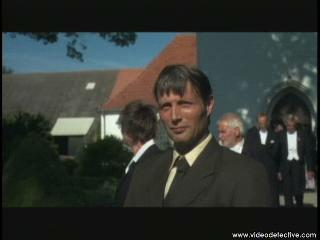
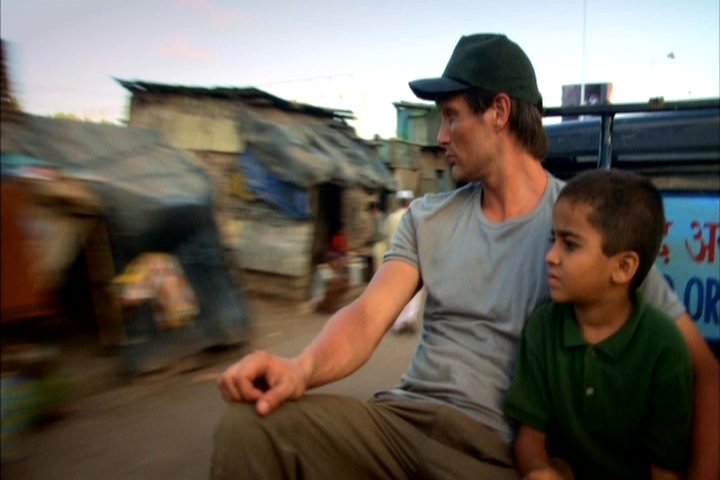
Jacob runs a struggling orphanage in India, but he is no distant administrator.  Rather, he is personally involved with the children, loving them with all his heart.  He is committed to the cause of poverty and he had dedicated his whole life to doing his part.  He visits his origin hometown in Denmark, to attend a wedding.  After the wedding he is made an offer: never go back to India and a very wealthy supporter will give enough money so that the orphanage might be established firmly for decades to come.

I just love how awkward he looks
I could see myself being places in that same vice.  I run a church for the homeless, and we provide services for hundreds of economic refugees in Portland Oregon and its neighbor Gresham.   I’ve been doing this work for twenty years and it has grown as homelessness itself has grown.  We monthly struggle financially, and given that we have very limited political support in city or church, we regularly face extinction.

What if someone gave me the opportunity to make sure that all of my people were cared for, at least as well as I could or better, but I would never see them again, I would not even be able to say goodbye.  Not only could I get a break, but I could do what I have been longing to do for more than a decade: give the work over to someone who isn't exhausted and overworked every day.  However, I would belie one of the principles that I base my work on.  That this work for the poor wouldn't be clinical or two dimensional, but would be personal, based on true friendship and care. To trade my relationships for what fundamentally is a sum of cash changes the very structure of the work I have established, transforms it possibly into a monster, a facade into which a stranger would insert their own motivations and principles.  It is not just my own retirement, a breaking of deep relationship, but turning my back on everything I've created.  I think of this, deeply consider this, on a regular basis, without the sum of money (the possibility, say, of housing half my folks) because I am that exhausted and I often look for an escape route.  But the cost is the trust that I have built.

All this to say that After the Wedding isn't a thought experiment for me.  Well, I suppose it is.  I created and maintain my work with no one but those I serve wanting to continue it, so no one is offering me a sum of money for the name and shell of my work. In the last month I have been rejected from two opportunities to work with the main cities I work with, because my answers are too radical, too insistent that the homeless are equal citizens of anyone else in the city and so worthy of equal rights.  I enact illegal actions, again and again, in order to save lives the city find inconvenient.   I suppose they find my solutions inelegant, or impolitic.  My point is this: there is no one who has a sum of money who would like to infuse it into the structure I created.  I can't get grants, I can't gain support from other churches, I can't even get food from the local food bank.  My work is formed out of a twenty year growing emergency, that the powers that be finally recognize, but they don't want me or my work on the team to create solutions.

After the Wedding threw this moral dilemma in my face, and I "knew" what Jacob should do.  But do I now choose a different option for myself?  Am I a hypocrite because I choose a path for a fictional character, but in my life I would chose the opposite direction?  Pramod, the orphan in India who does not stay with Jacob because he denies his own principles, would he look at me and gently accuse me? 


All this to say that a powerful movie like this causes us to question our whole lives, to re-examine our motivations and hopes.  This one just shaves a bit too close.  It is one of the great films, especially for me, but damn.  


Wednesday, May 25, 2016

The Coen Religion in O Brother Where Art Thou

"O Brother Where Art Thou?" is the title of the movie that was going to be made in the film Sullivan's Travels, a film about the depression, poverty and reality.  Well, it's close.  I am watching the film for the third time, but each time that I watch it, I gain insight.

The Coens' claimed that they were deeply influenced by Homer's Odyssey in the writing of this film, although they had never read the poem fully.  I'm sure they read a summary.  But deeper than this, they were interested in placing their own philosophy of life in the film.

Homer's Odyssey:
Our Ulysses is on the run from the law, just as Odysseus was running from Poseidon.   Like the epic poem, the gods of O Brother are capricious and fickle-- we have the governor of Mississippi, his opponent in the coming election and the representative of unmerciful justice.  There is a debate in the film as to whether there is another, all-powerful god over all these other human.  The power of these gods are not magic, but music, which can stir the hearts of humans and create powerful actions to occur.  Ulysses is fated to the poorest luck possible, just as his epic counterpart.  He and his travelling companions are beaten, tricked, betrayed, and run into the worst of characters-- one-eyed monsters, women intent on their destruction, and chased by powers of destruction.  Finally, they find that they have their own music that can guide their own fate, which leads Ulysses to his true treasure-- his family and his wife who is being wooed by another man. Through the power of a merciful god?  Or fate? Or luck? Ulysses achieves his goal-- home and hearth and family.   Perhaps.

Coens' philosophy:
The Coens' philosophy begins with a universe that cannot be determined.  Is it God?  It is fate?  Is it luck?  Whatever the case, for the most part we are all a sad sack, trapped in a cycle of bad luck.  The way to move ahead is to grasp onto our fate, to take action in every moment that it presents itself. That action might be theft, it might be earning money, it might be working with people who are perhaps unsavory.  But we will never achieve the next step we need in life unless we keep moving.  Death is stillness, passivity, inaction.  Only when we keep acting do we know who we are.  And when we keep making those steps, we find that the universe isn't opposed to us, but in the end it fits together, for the best.  And the best for us is home, hearth and family.


Besides the themes of this film, the music is marvelous.  This is one of my favorite soundtracks of all time, brilliantly produced by T Bone Burnett.  I listen to the music all the time so it is so wonderfully familiar when it appears between the cracks or in the forefront of the film.  Each song is the magic of the film: not just the tone, but the power of each scene, the sound of the god or monster shaking the universe, all attempting to fruitlessly force their own will upon humanity.


Thursday, February 11, 2016

A Deadly Lust: Two films by Claire Denis

For Claire Denis, sex is a hazardous decision.  Gone is the thought that one might casually, flippantly hold the attitude of Marline Dietrich, “It’s just sex.”  Sex is a life-and-death compulsion, it drives and destroys in equal measures, it is a deadly lust.  Dare anyone call these films “erotic”?  They do not titillate, but rather warn.  And we wince.

The title “Bastards” really says it all.  Men manipulating, forcing themselves upon women, using them and casting them aside as an old sex doll.  Men, all men it seems, are so goal-oriented that nothing will stand in their way, but their goal is never relationship, but relationship is used as a means to their ends.  A female human being is simply a hurdle, a means, but never the end in and of themselves.  One man might be considered a good father, another might be a good uncle, but they are never, nor do they have the capacity to be, a caring husband, a stirring lover.  The good male companion is a fantasy, never to be fully fleshed out because they never give more than a cursory glance at their partner.

In “Trouble Every Day” lust is a drive to consume.  Perhaps we have experienced this—our love of a child might cause us to pinch them, to claim, “I could just eat you up!”  But in this film the compulsion for sex is always accompanied with the drive to devour flesh.  This leads to a couple of the most disturbing sex scenes possibly every put upon screen—revolting, disgusting.  And yet, and yet…  Perhaps Denis is speaking about addictive personalities, perhaps she is opening up the fetish can of worms in which lust occasionally leads down darker paths.  Or perhaps she is revealing something about all of us, that in the end our lust is about our appetite, and no matter how we try in the end our compulsion will drive us and destroy others.  Maybe we just can’t help it.


My friends who have seen more of Clair Denis will tell me that these films are different for  her.  Perhaps so, but this is a side of her that must be recognized.  The driven darkness of us all are explored and exposed and there is a time that we must look right in the mirror of cinema and confess, “That is me.”

Thursday, June 25, 2015

Hunger: Who is Willing to Endure?

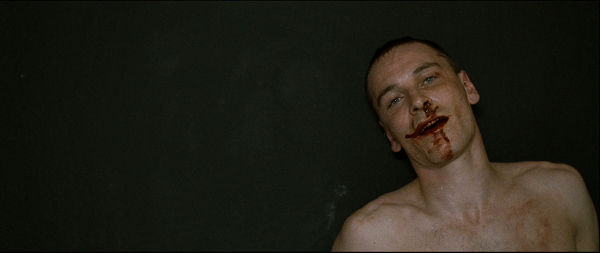
Hunger is the story of Bobby Sands, an Irish Republican put in prison for political violence against the British.  While in prison, he leads protests, demanding to be treated as political prisoners—POWs— instead of just criminals.  As the British refuse, he and his co-prisoners suffer the filthiest existence at their own hands.  And then they endure forced bathings and the most inhumane searches.  Finally, Bobby Sands decides on a hunger strike, for him and his comrades.  And the horror of that fast is depicted gruesomely.

Obviously, this is not a movie for everyone.  By the end of this film I began to wonder why I was putting myself through this torturous movie.  Then I wondered why the director put in all of this amazing effort, with some of the greatest filmmaking talent ever, to put us through this experience with Bobby.  It seems that Bobby is going through some of the most terrible self-torture, and for what?  Political recognition?  For the recognition of human rights, most of which were in their grasp at any point?  To make some petty point?

But I realized that this was not a political film.  The director depicts the suffering of the guards as well as the prisoners.  The fact how everyone’s life involved was simply miserable because of this system, because of the determination of these men.

Finally, I realized what the movie is about.  Endurance.  It doesn’t matter what Bobby Sands was fighting for, or what methods he used.  The point is simple—he was willing to go to whatever extent to obtain his goals.  He had the steadfastness to put his body through any degradation, to suffer whatever the cost, to go through any pain or mutilation in order to achieve his goals.  The ethic nature of the goals weren’t significant.  But his determination was.

And, honestly, that’s what makes any cause great.  Not the rightness of the cause, but the stark determination of the promoters of the cause.  This is what made the civil rights movement great, as well as the Indian freedom protests—they were willing to suffer all, while not causing the suffering of anyone.  This is what made the early Anabaptists great, the early Franciscans, the first century church.  They all promoted their cause to the death, while never harming another.

I am ashamed of our modern day church.  How little determination we have.  How we speak so much about “balance” and “cycles”, as if the main text of Scripture we should be living out is not the Sermon on the Mount, but Ecclesiastes 3.  We speak of the “discipline” of rest, but the fact is our lives are full of rest and we do little work for those who honestly need it.  Pastors are the ultimate compromisers, seeking salaries and retirements and office hours, instead of trusting and giving. 

I know true endurance.  I once lived it.  For fifteen years, I worked hard for the people on the street until my body, slowly but decidedly gave up on me—until my stress levels exploded.  Surely, people would say, that is the need for balance.  And I will say, no one’s body is meant to endure terrible stress for twelve or fifteen years.  We just can’t keep doing it.  Even Jesus only dealt with daily suffering for three years or so. 

And this kind of endurance isn’t for everyone.  It is a saintly life to support the spiritual athletes and soldiers—those who lay down their lives for the cause.  But, honestly, we are in a time of the church where those who are willing to lay their lives down for the gospel are few.  Very few. 

What is the task?  To love others, even if it means our own death.
What is the cost?  Our lives, our sanity, our family, our “balance.
Who is willing to endure?


Who is willing to endure?

Thursday, May 21, 2015

3-Iron

Silent as the grave, Tae-suk places advertisements on different homes, over their door knobs.  Later that evening, he returns to check if an advertisement remained, and if so he would pick the lock, check the answering machine to see if the owners had left a message saying they would be going out of town, and if they did, he would settle in.  Eat their food, take a bath, wash any dirty clothes the owners had left and sleep in their bed.  He leaves the residence in a better state than he came to it, and he steals nothing but some food.

By accident, he runs into a companion, who wants to live this free life of silence and mystery.  All of that is fine until they get caught.

* * *

A ghost story without ghosts.

Taoism teaches us the way of the small, the insignificant. It demonstrates that true power rests in the slow, quiet movement, in that which cannot be observed easily. Leaders try to make a "moment" a powerful drama to change society with . Taoism says that this is not the correct way to lead. True leadership comes in the releasing, the movement behind the scenes.


So what if in our lives everything on the surface looked the same, or even better, but in the background, in the really-real of all things, everything was different? Is love in the foreground, the power, the elaborate gift, or is love really found in the quiet, the silent, the unseen?

Monday, October 20, 2014

Struggling with the Void: The Hours

The Hours is a film of three stories about three women all living a form of the life of Mrs. Dalloway, the lauded novel by Virginia Woolf.  The first story is that of the author herself played by a gaunt, frail Nichole Kidman.  She uses the novel to struggle with her inner demons, to which she eventually subcumbs (as we see in the first scene of the film).

Then there is Mrs. Brown, a housewife in the 50s, masterfully played by Julianne Moore. She has the perfect life, the perfect husband, the perfect, beautiful son, yet she is inadequate for this very life she is living.  The third woman is Clarissa, played by Meryl Streep, a book editor who struggles to keep her dear friend, poet and ex-lover involved as he struggles with AIDS.

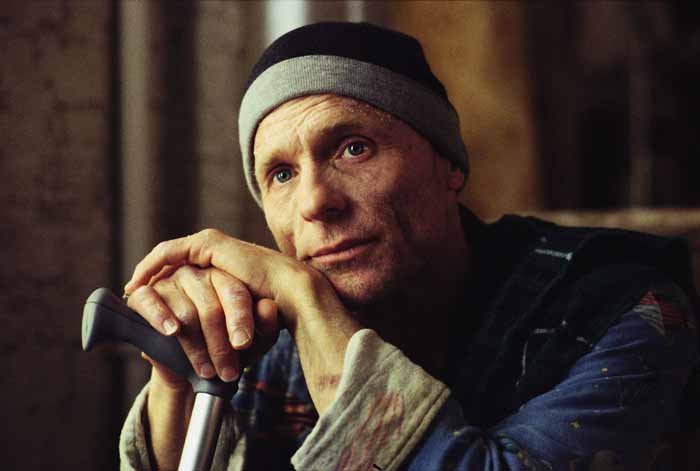
The brilliance of this film is the weaving of these three stories into one coherent whole about life and happiness and relationship.  This is cinematic literature, depth in film at its finest, even if it wears its literariness on its sleeve.  The film is held strong by its amazing cast, including John C Riley and Ed Harris, who take the great ideas and encapsulates them into a reality that touches us and breathes.  Even the editing is top-notch, clearly spelling out a narrative that could easily be confusing for frustrating, but never is.

One of the greatest aspects of the film are the touchstones of themes in the story.  There is a desperate kiss in each story, each protagonist collects flowers to maintain a semblance of normalcy, and they all have an individual that keeps them alive and breathing, often out of duty.  The deeper we look into this film, the richer we find it.

*  *  *

Is the purpose of life happiness?

Happiness is so fleeting and life continues long after happiness has passed.  A life might be spent pursuing happiness, but that goal might be too lofty to be achieved, yet does that make the life any less meaningful?  Certainly life must have a certain level of contentment, a low level of happiness, a sense that "yes, this is the direction things should be going in."  We must have a satisfaction with who we are, what we do, lest we perpetually be in transition.  At the very least, we must hope that who we are will eventually be enough to satisfy ourselves.

But what if we have obtained happiness, all the things that we have reached for we finally achieve, all the hope realized and then, mysteriously, we are still not content? Some might say we are ungrateful, but the inner emptiness has noting to do with appreciation.  We can be amazed and thankful of how far we have come, but it simply isn't enough.  Perhaps the goals we achieved were wrong headed to begin with, or perhaps our emptiness will never be filled.  We don't know.  And the ache becomes more and more unbearable.

To obtain contentment, we must have peace both in our environment and in our hearts.  To claim that one or the other kind of peace is all that is necessary leads to despair, causing one to fall in the personal void of discontent.

Struggling with this void comes naturally to those who have no control over their own life decisions. Their lives are taken out of their hands and their happiness and contentment is determined by those who only see a shadow of their deeper selves.  There may be fleeting glimpses of bliss, or the opportunity to build the life of another, but this is inadequate to avoid despair over the long haul. When we have no say in our own lives, the natural result of this is discontentment.  The vulnerable life is the despairing one.

Perhaps contentment is essential, but if we see the basis of life as our own personal happiness, that would deepen the discontentment, because it can never be ultimately achieved.  But what else is there?  Compassion?  Building society through family or other means?  This is the core of our being, and we must discover it for ourselves.  In the end, the determination of what gives our life purpose is a solitary determination.

Saturday, August 30, 2014

John Donne Meets the Tortures of Cancer: Wit (2001)

Christian theology screws a lot of people up. At this point, this is a truism, but it is partly true because people do not understand the basic, everyday terms of the original idea. Take "salvation" for instance. The original idea of "salvation" isn't spiritual or other-worldly at all, but it means moving from a state of need to a state of the satisfaction of need, from starvation to being filled, from neglect to honor, from sickness to a state of wellness. When we spiritualize the simple, then we complicate that which is very basic, and turn what we understood at our mother's knee into a state of confusion and anxiety.

Poor John Donne. When observing the sufferings of Professor Vivian Bearing, the "treatment" which is no such thing, we observe the flayings of Donne upon his soul who wishes to be forgotten by God, because he cannot bear under the sight of a God whose vision is so cruel as to judge that which cannot change.

If lecherous goats, if serpents envious
Cannot be damn'd, alas, why should I be?

This is not unlike the sufferings of Vivian, but while Donne spiritualized his sufferings, imagining the loving Mother who seeks him no matter how much he might hide as a horrible abusive monster, even so Vivian doubts that compassion and touch and a simple act of kindness could be a greater balm than the deepest understanding of the medical profession. How we complicate that which is quite simple, really, and then find ourselves of need to walk through a morass of maze-like corridors to come back to that which we learned at our mother's knee.


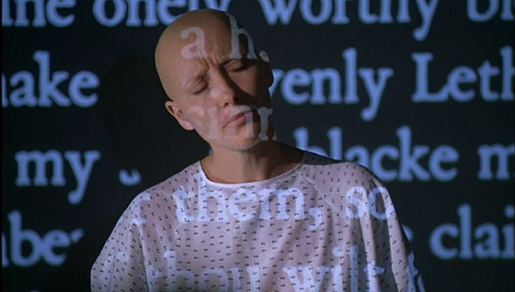
But that doesn't speak to Emma Thompson at all. Suffice it to say, I could listen to her speak all day. The fact that she is reading some of the greatest lines ever written, just causes me to close my eyes and bask in the delightful lyrics. But only briefly, because she is like Dryer's Joan of Arc (The Passion of Joan of Arc), beautifully deformed by her anguish.


Monday, June 30, 2014

Noriko's Dinner Table

This is not the best made film. It feels like a pulp film, inexpensively put together with questionable acting skills. The cinematography wasn’t excellent and even when the shots were carefully thought out, no magic displayed itself. But it was one of those rare films that, after it was finished, made me sit and think about the themes of the film. No matter what the technical problems of the film, the plot, themes and development weren’t among them.

This film acts as a companion to Suicide Club, which I have never seen, but the events of that film are referred to in this prequel. Can it really be called a prequel, since it shows event both before and after the previously made film?

Anyway, we’ve got Noriko, who is unhappy at home. She feels that she could find happiness on the internet and then she thinks she can find happiness living in Tokyo with her internet companions. But her friend, Ueno Station 54, AKA Kumiko, isn’t interested in helping Noriko find happiness, but to change society.

After Noriko runs away, her sister Yuka, puzzles out her own unhappiness and eventually pursues Noriko to Tokyo, only to find that she is no longer Noriko, but Mitsuko, an actress paid to act like missing family members to those who could pay for the service.

A heavy curtain of mystery weighs over the film, especially over the first two thirds. What is the real purpose of this group? Is there a Suicide Club or not? If not, why the mass suicides? What is Kumiko’s real purpose? There are answers to these questions, but not without our effort to piece them together along with Tetsuzo, N and Y’s father.

This is a more than worthy movie, with equal parts pulp and social commentary. 

Sunday, May 11, 2014

Love and Dogs: Amores Perros

Three intense stories about love and dogs. A young man in love (lust?) with his brothers wife, uses his brother's dog in fights to raise money to steal her away. A just-discovered model gets in a car accident and begins losing her grip on reality. A down-and-out assassin does one more job while pining for his lost daughter. Any one of these stories is enough to fill a film, but together, it makes for an intense two and a half hours.

Director Inaritu keeps it all cinematic, even though the plot could lose that focus. He mixes up the stories and pumps up the intensity and gives us a variety of music that highlights both the similarities and differences in the stories.


In the end, it all seems to be about humans fruitlessly fighting against fate. But that sounds so depressing and dull and the movie is not really that. Because our protagonists are complicated, we both love and hate them, and we wonder if their futures are better or worse for having gone through the drama of these stories.

Sunday, March 16, 2014

Departures: Gorgeous Introduction to the Art of Encoffining

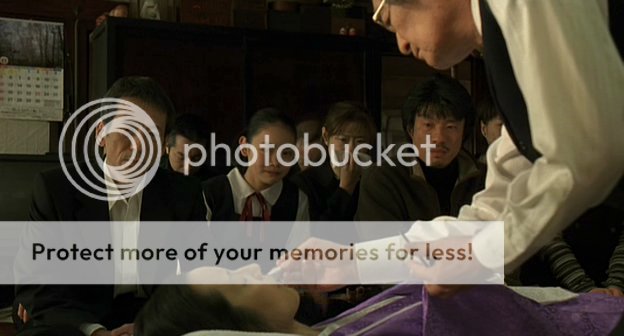
As sentimental as a Hallmark film and yet it is as elegant as the art of encoffining that it depicts. When the ceremony is presented again at the end of the film, I couldn't help but stare at the dance above, upon and around the corpse. When some in the film are disgusted at the procedure, I am stunned, because I am one of those few who have seen it at it's best, while they have not. Once seen, the respect and power of the profession cannot be denied.

And the parallels to music just add a layer to the art. Encoffining, preparing a corpse for coffin placement, has as little to do with western embalming as the work of a conductor has to do with a construction crew. The conductor is all about expressing life and respect for music through his movements, while a crew is all about the fast-and-dirty business of meeting the goal as cheaply and efficiently as possible.


As a movie, it is shallow and sentimental. As an introduction to an amazing art, it is perfect.

Ratatouille and the Pixar Magic

There are no spoilers in this analysis of an aspect of Ratatouille, but I’m assuming if you're interested in reading this, you’ve seen the film.

Ratatouille isn’t standard children’s fare, but it is a child’s fantasy: suppose a rat was a foodie, a natural chef, and suppose he could control a human well enough without speech to cook food on the very highest level.  Not very believable, but fine for a kid’s film.  Then, the final test comes, Anton Ego, the most pompous critic in town, arrives to review this restaurant he’s heard so much about.
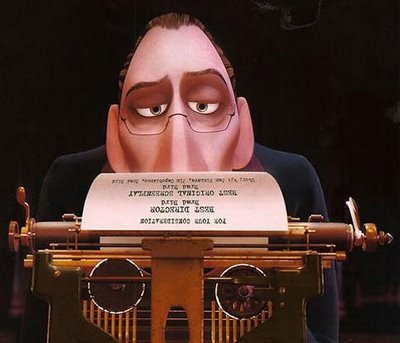
Until this point, Ego is a stereotype, the shell of a human being, the negative critic who could be expected to sniff at the food.  Of course, Ego could be expected to exclaim his loud praise and run into the streets demanding people come in to eat this food.  That would suit the character of the film, but not the film's character.  At this moment Ego is fleshed out and we see who he really is: a particular man, an introvert who has high expectations, but when those expectations are met or exceeded, then he does not yell, but his emotion is just intense. 

And just as personal.  His response is not only about food, but about his childhood experiences.  He knows that his reaction is subjective, but he can't help it.  He has experienced art in the deepest, most intimate level, and this experience changes his life.  This is really about the response every artist dreams about-- the inner touch that only that one lover, the loving mother, the life-long friend can have.  An artist only has a moment, perhaps a matter of hours, to touch a human being so deeply that they will never forget it, and it changes how they see the world around them.  Suddenly, the world is brighter, clearer, closer.  This is the true moment of every artist who has ever lived.

Ego is suddenly packed with humanity and life.  It isn't enough to say that Bird gives critics a good shot while others' dismiss critics.  Some films skewer critics, while others literally have them killed (in the film, of course).  Bird makes his critic not only his eloquent spokesperson, but a genius who perfectly combines opinion and word to elevate everyone's perception of a particular piece of art.  Ego is the personification of the power of criticism, an artist in his own right.  Some claim that critics are leeches, at times borrowing, at times darkening the shining glory that is art.  But in Brad Bird's world, the critic is the artist who can empower art to be art, or to dissolve the work of the faux artist.   Perhaps Bird has such a good opinion of critics because even when his work was less than very successful (Iron Giant), the critics sang his praises, saw his art for what it really was.


Bird gives the power to critics that they sometimes deserve.  And in turning shallow creatures (Linguini, Ego, and to a lesser extent, Colette) into full characters in the final act, he also enriches the film to be a fuller film.  It is no longer about childish fantasy, but about a unique perspective on adult realities.

Pixar magic, when they take the time to use it, is not just about excellent storytelling, but also about taking the time to make characters more than a millimeter deep.  Ego could have been just a throwaway one-note character, but instead they take the time to give us a background and a more complex motivation.

They do this a lot with supporting characters-- Jesse the cowgirl in Toy Story 2, Doc Hudson in Cars, Mirage in The Incredibles, Gil in Finding Nemo.  How many animated films take the take to make real people out of side characters.  But it is this that makes many Pixar films full worlds and not just fluff.