Showing posts with label Japanese. Show all posts

Monday, February 8, 2016

After Life (1998)

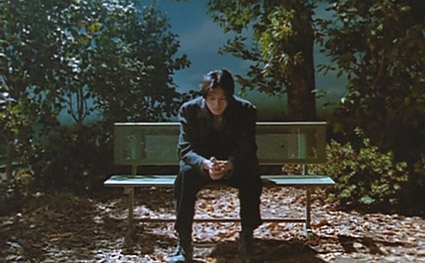
Okay, so you’re dead. Sorry, but you knew it had to happen eventually. For some, it happens young, but most of us when we are older and worn. Rather than a bright light, you end up in a low budget college with a dorm and a staff. Their purpose is singular: to help you choose the one memory that you will spend eternity with. It’s a tough choice because eternity is a long time and out of all the beats in your life you only get to choose one.

Think about it for a second. Your whole life, one memory is all you will get. Your whole life will be boiled down to this one moment. Nothing else will count. Will you chose a happy memory? A poignant one that perhaps represents your whole life? A lesson you learned? A person you spent your life with… or a person you wanted to spend your life with. It’s a tough decision. But don’t worry, you’ve got a few days to figure it out.

I love the conceptual seed of the film, but also the rough, almost gritty feel of it, just the opposite of most presentations of the afterlife. There’s no mystic light, no robes, no courtroom feel. Just a group of social workers, there to bring you to your inevitable conclusions, who, of course, have their own issues. The interviews are also quite realistic, documentary-like, and rightly so, as some of the people are not actors, but just people who they are asking this singular question to.


So you might ask, what is my choice? After spending two plus hours thinking on the question and asking my family about it, I think that a scene that is interpreted various ways would be best for me. If I’m going to spend eternity watching a short about my life, I’d like it to be provocative, with different answers. Because I will be many people, thinking different things throughout eternity and I’d rather have a scene that could be interpreted various ways. Or I could just have a recording of Jesus Christ Superstar. Or maybe a poem by John Donne. Something like that.

Friday, January 29, 2016

Ringu

Years ago, I watched The Ring, which was an effective, scary horror film, even if the premise is a little silly. I mean, a cursed videotape, which kills everyone who watches it? Even though an explanation is given, it doesn’t make it any less ridiculous.

I find Ringu, the original Japanese film, based on a popular Japanese novel of the same name, to be more thoughtful and interesting. I guess I’m not alone in that. Most people who have seen both films prefer the original.

For me, the original is better because it seems to have two themes weaving throughout the film. The first is obvious—fear of technology. All the most frightening images have to do with the technology that we fill our lives with—videos, phones, pictures. These are manipulated to turn against their users, to stir fear and ultimately death.

But the second half of the film seems to go deeper than this. We delve into a story of a woman who is accused of lying and is so shamed by her society that she commits suicide. Her daughter is later buried alive by her own father for being a “monster”. And we might also note the tragedy of the main character, a reporter who was abandoned by her husband, left to raise their son on her own. He is a main character in the film, and he is often dismissing her suggestions, rejecting her participation and telling her to remember their child. Ultimately, this film isn’t really about technology at all, but about the use and abuse of women. It is the act of a woman, a mother, who brings deliverance to all.


Why then is the very end of the film about sharing the David Lynch-esque video? Of course, to avoid death. But why would the ghost want this done? First of all, I think that the death of Ryuji is simply to get back at his abuse of his wife. But it seems that the deaths end because of the spreading of the video? Probably, like David Lynch, the author of the video is an artist and she thinks that she is really communicating something about abuse and suffering through her video and so wants it shared with everyone. Of course, it took the whole length of the film to find out what the video meant, but artists don’t always get that.

Monday, June 30, 2014

Noriko's Dinner Table

This is not the best made film. It feels like a pulp film, inexpensively put together with questionable acting skills. The cinematography wasn’t excellent and even when the shots were carefully thought out, no magic displayed itself. But it was one of those rare films that, after it was finished, made me sit and think about the themes of the film. No matter what the technical problems of the film, the plot, themes and development weren’t among them.

This film acts as a companion to Suicide Club, which I have never seen, but the events of that film are referred to in this prequel. Can it really be called a prequel, since it shows event both before and after the previously made film?

Anyway, we’ve got Noriko, who is unhappy at home. She feels that she could find happiness on the internet and then she thinks she can find happiness living in Tokyo with her internet companions. But her friend, Ueno Station 54, AKA Kumiko, isn’t interested in helping Noriko find happiness, but to change society.

After Noriko runs away, her sister Yuka, puzzles out her own unhappiness and eventually pursues Noriko to Tokyo, only to find that she is no longer Noriko, but Mitsuko, an actress paid to act like missing family members to those who could pay for the service.

A heavy curtain of mystery weighs over the film, especially over the first two thirds. What is the real purpose of this group? Is there a Suicide Club or not? If not, why the mass suicides? What is Kumiko’s real purpose? There are answers to these questions, but not without our effort to piece them together along with Tetsuzo, N and Y’s father.

This is a more than worthy movie, with equal parts pulp and social commentary. 

Sunday, March 16, 2014

Departures: Gorgeous Introduction to the Art of Encoffining

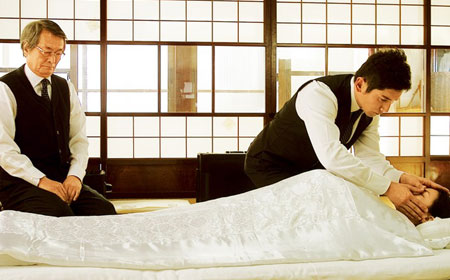
As sentimental as a Hallmark film and yet it is as elegant as the art of encoffining that it depicts. When the ceremony is presented again at the end of the film, I couldn't help but stare at the dance above, upon and around the corpse. When some in the film are disgusted at the procedure, I am stunned, because I am one of those few who have seen it at it's best, while they have not. Once seen, the respect and power of the profession cannot be denied.

And the parallels to music just add a layer to the art. Encoffining, preparing a corpse for coffin placement, has as little to do with western embalming as the work of a conductor has to do with a construction crew. The conductor is all about expressing life and respect for music through his movements, while a crew is all about the fast-and-dirty business of meeting the goal as cheaply and efficiently as possible.


As a movie, it is shallow and sentimental. As an introduction to an amazing art, it is perfect.

Sunday, September 22, 2013

The Human Condition: A Personal Perspective

***Mild spoilers below***

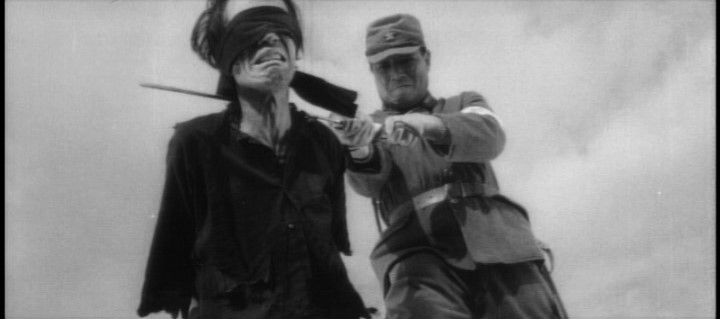
The Human Condition is the story of Kaji, a leader in fascist Japan with a heart of compassion.  He travels all over occupied Manchuria from 1943-1945 and leads a bold but quiet fight against the heartless nature of the military machine.  He is a labor organizer, a soldier, a lead private, a refugee, a POW and a homeless beggar. 

It is a nine hour film and it is not for the faint of heart.  It is divided into six equal measures of an hour and a half, and it was meant to be watched over a period of time,  not one day.  But it doesn't feel long for all that. This film is also one of the most powerful experiences of my life.  

This is the most personal film I’ve ever experienced. I feel like I’ve lost my best friend and my very self to despair and madness.  To say this film is “depressing” doesn’t get to it.  I am devastated, in mourning, in almost physical pain.  And yet I would watch this film again, right now.  All nine hours. There is so much I missed and I want to experience it all.  And I don’t want to lose my relationship with Kaji, the man who is in every scene of the film. He is my friend, my counterpart, even in his lowest points.  He sees the world as I see it, with all the naiveté and sorrow and struggle that accompany such a vision.

Ever since I spent months in India decades ago, observing desperate poverty and experiencing a mild form of it myself, I see the world as a battle between peace and collapse.  Peace, as I understand it, is wholeness.  A self wholly at peace, a community united, a nation set on providing needs, a religion of love and compassion for all people. 

That’s a big order, really.  Especially in a world that is filled with powers attempting to break that shalom.  There are billions of hungry, wars in many nations, violence on almost every major street, the chronically ill in every family.  And there are those who, just in the normal course of things, require more attention: children, those nearing the end of their lives, the infirm, the very poor, the mentally ill.  To battle this requires stamina, focus, strength and resources.

That’s how I see the world.  It’s how I’ve seen the world since I visited India in 1985 and saw real poverty and suffering and my own complacent reaction to it. From the beginning of 1986 I determined that I would do all I could to combat it, with whatever I had.  If that is taking my paltry life in its fragile eggshell and throwing it against the stone wall, so be it.

The film The Human Condition comes from a similar viewpoint.  Although locked into a very specific cultural construct—Manchuria from 1943-1945 from the viewpoint of the Japanese invaders—it introduces the idea of the poor and the lowly again and again.  Draftees in boot camp, forced workers, POWs, refugees, women forced to trade sex for survival, some lost in the wilderness, the homeless, the despairing, the lost.  Each of these are given their fair time and a voice in this film.  They are able to express their anguish and the corner that they are put in.  This movie is, more than anything, about the plight of the lowly, and how they suffer not only their everyday sorrow, but beating, raping, insults, forced hunger, unpaid labor, and more leveled on them.

Why do the lowly suffer this way?  Because some have power over them.  The power forces the lowly into their place of suffering and the lowly must, in their way, support the system that causes their suffering. These powerful are not only the thumbs of the system, but they also heap on additional abuse onto the lowly that isn’t required or even legal by the system they represent.  Why should they do this?     It isn’t just their power, but their assumption of superiority that makes them so deadly.  They “deserve” the better treatment as opposed to the lowly, and the lowly “deserve” the additional abuse heaped on them.   Their petty complaints are really more important than the survival of the lowly. It’s as if some people think that being homeless isn’t enough, they also must be criminalized and harmed to teach them that being homeless is a bad idea.  Who would do that?  Oh yeah… we do.

Kaji is our protagonist, he is the mediator between the outcast and the powerful.  He has charismatic power that gives him authority even when the system hasn’t given him that authority.  He is like Joseph in the Hebrew Bible—no matter how low he lands, he still rises to the top of the heap.  He is smart and courageous and strong and determined.  He is also compassionate for the plight of the lowly, but that compassion isn’t all.  It is that he stands up for better treatment for the lowly, so that they may thrive, or at least survive.  He is the persistent voice of justice for the outcast.  He is sometimes listened to, always reluctantly.  More often than not, he is mocked and derided.

Kaji attacked by both sides.  By the powerful because he is seen as subversive, by the lowly because he is seen as an oppressor.  What is funny is that he is not subversive at all.  He gathers what resources he must to allow the lowly to survive and thrive.  Nor is he oppressive.  He is in the place of power so that he might cushion the attack against the lowly, but the lowly only feel the attack, they don't see the softening of it.

I understand Kaji, better than many, if I may be so bold.  I just read some critics wondering if Kaji is a realistic character, standing with compassion when the rule of the day was prejudice.  I have been given the opportunity to be a pastor of the homeless and the mentally ill in a United States that thinks the poor are lazy and unworthy of compassion.  The treatment of the homeless and the mentally ill by the police here in Portland and its suburbs is comparable to the treatment of the POWs after WWII or the Chinese by fascist Japan.  Their possessions are stolen from them or destroyed by local government forces.  Even as some of us attempt to assist these very poor, we are hindered by others.  The local housed people consider themselves superior to the homeless and consider the homeless worthy of being punished just because they are homeless.  The neighbors of our church and the local government wants to stop us from providing showers or overnight shelter on the coldest nights because they have fears or policies.  Me and my kind have stood up, attempting to help the community see the homeless as human beings, worthy of respect as anyone else, local citizens and not criminals unless they have actually done criminal activity.  And for this work, we have been insulted by the neighbors, threatened, yelled at by the police, knives drawn on us, and kicked out of our homes. 

Because of this background, I truly appreciate Kaji.  I haven’t been through all he has, but I understand his perspective and I can appreciate his suffering, even if I haven’t been through it all. Kaji represents my heart, and when he speaks I can see myself speaking the words, even if I am at times uncomfortable with them.  At this point, I am older than Kaji ever got, and sometimes I think of him as a younger version of myself and I’d love to give him some counsel.

When Kaji is naïve, in the first film, I understand, for I was once naïve and considered that I could change the world myself.  I want to sit down with Kaji and explain to him that his difficulties came from thinking that the uncompassionate, oppressive world would just see the justice of his position and agree to it.  He is so humble that he fails to see the assuredness of the oppressors superiority.  The lowly aren’t just lowly because of some twist of fate but because they “deserve” their position in some karmic insanity.  And their suffering is “good” for them in some twisted logic.  Kaji can’t understand this logic so he keeps speaking the language of compassion, of empathy with the lowly, which the powerful cannot understand.  So Kaji is alone and persecuted.

Kaji is also like Jesus.  Not in some false Christ-type many movies attempt to throw in.  In many scenes, however, he is willing to suffer and take on the beatings and tortures that would have gone to the lowly.  He
accepted it so they wouldn’t have to.  Perhaps that was his own hubris, that he could handle the suffering better than they.  But in a way this was true.  Because he was taking on suffering out of nobility, not out of some false sense of justice.  No one who punished him considered him worthy of punishment.  Rather they punished him because they had to release their own wickedness in some way.  Kaji accepted it so others would not.

Eventually that suffering broke him down.  He is only human.  In the second film, Kaji becomes angry, sometimes irrationally so, lashing out at his persecutors and I wanted to have another session with him.  I understand why he is angry.  He is angry because his body cannot endure such suffering anymore.  He is angry because he cannot endure the irrational punishment any more.  But I’d like to remind him of the result of his anger. His anger wouldn’t create compassion for the lowly, nor would it force the oppressor’s hand.  In fact, he is undermining his own compassion, for he fails to see that the oppressors are enslaved by their own actions and that they need deliverance as much as the lowly do.  Perhaps he can’t help it, but if he can, he should control it, for other’s sake.

In the third film, Kaji cannot forgive himself for his own acts of oppression.  Again, I understand, as I too have oppressed and beat myself with guilt.  What I wanted to comfort him with was that the system of power makes it all too easy to oppress those who are weak.  We can oppress with a word, with a glance, or by simply ignoring the lowly.  We must resist those impulses, but we will slip into them.  When we do, we cannot beat ourselves up because of our failings in a system of destruction, but resolve never to do it again.  We must remain strong so as to both help the needy and fight the system of injustice.  And it is easy to fall into the trap of weakening ourselves with shame or a too-quick-surrender.

Finally, Kaji snaps and takes his vengeance out on one who caused the death of the lowly. Again, I wish I could have spoken to him, even yelled at him.  Take your vengeance out by changing the world!  See your ideal flourish!  Look at the long view-- he isn't the problem, and you can't take vengeance out on a system.  You are just participating in the system by being the criminal against it.  You are fitting into their idea of you!  I don't know that he would listen to me, though. 

What kept Kaji going, waking up each day, was the thought of going home to his wife.  My home is even more distant than his: I see a world of justice, a world where the poor aren’t oppressed, a world where governments and religions are organized around compassion instead of a false sense of justice.  My home is where the poorest of the poor have a home and a comfort and can contribute creatively to society. 

Now I’m going to get all religious on you, that the film never went.  In this view of the world, Kaji had to go mad.  His hope was pointless.  In fact, in the third film there are hints that his wife was probably raped, beaten, starved or sold her virtue for food, possibly dead.  The home that Kaji longed for probably wasn’t there. 

In Christianity, we are told that we will get to the end of our lives and not find this home we seek, a world of justice and hope for the lowly.  The next world is where we will find it, and those who gave mercy and suffered for would get a second chance at life, successfully creating a just world that could not be done in this life.

And I’ll be honest.  I am often stumbling in the snow, wondering if my hope is in vain.  The way I figure it, Kaji, is that even if there is no home to come to, I have done what little I can to make the world a place where others can have home.  Perhaps this world wasn’t meant for us, Kaji.  Perhaps we were never meant to find home.  But isn’t it enough to know that we offered comfort to others?  Isn’t it enough that our lives were lived for the ease and survival of others?  We may not have done much.  Helped a few hundred people.  But isn’t that enough to keep living for?  Even if that means we go to Siberia, isn’t that enough? Certainly better than dying of frostbite, longing for a home we’ll never have.


Isn’t it?

Monday, August 26, 2013

Spirited Away: A Guide to the Perplexed

I have been shocked at how many of my friends have called my favorite movie of all time “incomprehensible” or “really weird.”   Well, let’s get this part out of the way: Yes, Spirited Away is my favorite movie.  The top of all my Top 100 Movies lists.  In a range from 1 to 10, I give it an 11. I honestly have a hard time imagining that another movie would ever beat it, but it’s possible.  And Hayao Miyazaki is my favorite director.  I have four of his films in my top 100.

Now, back to my friends.  It stuns me how many people watch Spirited Away for the first time and just don’t get it.  It’s too confusing, too gross, too weird.  But I’ve never felt that.  Sure, there have always been details I never got, but the heart of the film always made sense to me. 

So I write this guide to assist those who don’t understand the film.  Partly because I want you to love it as much as I, but mostly because I at least want the film to have a chance.  If it’s just one weird image after another, that’s no fun.  And Spirited Away IS fun.  I just watched it again last night and I had a big silly grin on my face all throughout the film.  Okay, let’s try to stick to the facts.  I’ll try to calm my uber-geek down.

What is this world?
So Chihiro (the girl) and her parents wander into an abandoned theme park where there seem to be ghosts and weird creatures.  And Chihiro runs into a large, beautiful building, which we are told is a “bathhouse for the spirits”, but what does that even mean?  What is this place, anyway?

This is where your Religion 101 comes in handy...  What?  You never took a Religion 101?  You were drunk when you went to Sunday School? Okay, let’s start from the beginning.

The basis of almost every religion is that there is an alternative world that we will conveniently call “the spirit world.”  It occupies the same space that we do, but we cannot see it or feel it.  Occasionally the spirits of this alternative world (which we can call “ghosts” or “demons” or “angels” depending on your spin) make small changes in our human world, but mostly they leave our world alone.  They have their place, and we have ours.  Oh, and they can see our world, but we can’t see theirs.  That sucks, huh?

Hayao Miyazaki’s universe (an alternative universe to our own, which all his films are in) is deeply influenced by Shintoism, an organized folk religion in Japan.  In fact, Miyazaki’s film My Neighbor Totoro is an excellent introduction to Shintoism.  Like many other religions, every place, every body of water, every forest and desert has their own spirit.  Totoro is a forest spirit, and the two girls are learning the way to respect and live comfortably with their local spirits, which summarizes what Shintoism is about.

What happens to Chihiro and her parents is they wander into a place where the spirit world and the human world intersect.  You can read about these places in the Bible, too—ever hear of Jacob’s Ladder?  That’s what happened to that lying thief when he stumbled across a cross point between the spirit world and the human world.  Spirited Away is about Chihiro’s adventures in one of those crossover places.

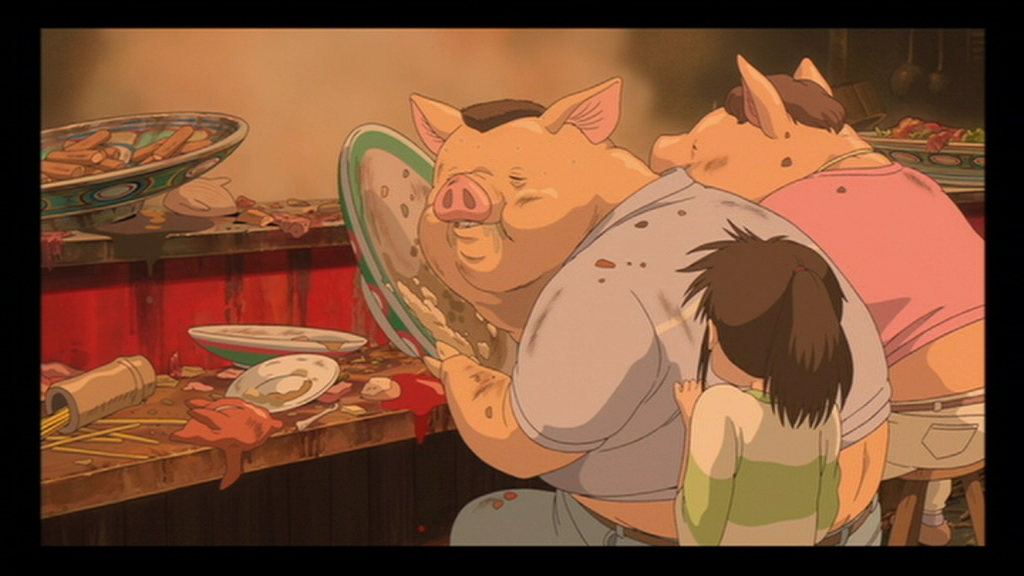
Why do Chihiro’s parents turn into pigs?
When you have crossed over to the spirit world, one of two things happen.  The first is you disappear.  That’s because humans don’t belong in the spirit world, so they wouldn’t exist there.  Haku has Chihiro eat a bit of the spirit world’s food, which gives her a place in the world.

Second, in the spirit world, you look like who you really are.  So the beautiful cheerleader who teased you in high school?  In the spirit would she’d be as ugly as her inner person was.  Even so, Chihiro’s parents showed themselves to be gluttons, so they turned into pigs.  The fact that Chihiro remained herself, shows how strong her character was.

Why does Haku help Chihiro?
Haku from the very first is concerned about Chihiro and her well-being.  But why?  As we find out more about him, we know that he isn’t a tenderhearted guy.  Everyone talks about him as the kind of person who would see a baby on the ground, crocs coming to eat him and he’d cross over on the other side of the road.  And maybe kick the baby a little closer to the crocs, just for fun.  But he goes out of his way, even to get himself in trouble, to help Chihiro.

And that’s because, we find out later in the film, Haku is a slave to Yubaba.  He’s stuck and he doesn’t know who he is, or where he came from.  And his only clue is that he recognized Chihiro.   You can see it as soon as he glances at her.  So Chihiro is his only way to escape the slavery.  Somehow, she is a clue to his identity, which he can use to escape Yubaba’s clutches.  So he has to care for her until he is able to figure out how he can use her for his own escape plan.

So why is he so mean to her in the elevator?  Because as long as he is in the bathhouse, under Yubaba’s influence, he has to be 100 percent henchman.  If she suspects that he has some connection to Chihiro, his plan is lost.  So this means that all those girls fantasizing about a romantic relationship between Haku and Chihiro… nope.  He’s not interested.  Besides, he’s a spirit—they aren’t even of the same species.

Why does Yubaba take Chihiro’s name and give her the name Sen?
Yubaba is the spirit/witch who runs the bathhouse with authority and a business-like charm.  Her character is based on the Slavic folk story Baba Yaga, who was an old witch who lived in a house with chicken legs, who was sometimes mean and sometimes very helpful.  Possibly Yubaba’s sister Zeniba is supposed to be the nice side of Yubaba?  She just gets cranky around thieves.

In the ancient world, to have another’s name is to have power over them.  So Yubaba has her workers sign away their names, so that she might obtain power.  Not just the power of them forgetting who they are, but she can use the name to put curses or other magic on people through the use of their name.  It’s interesting that Yubaba lifts most of Chihiro’s name off of the paper, leaving only the word “Sen” (because the writing style they were using is pictorial, not phonetic).   This also means that everyone’s real name in the bath house is different from what they are called.  And everyone in the bath house is desperate for money—is this so they can buy back their names and escape slavery?

What’s going on with Stinky?
Yubaba claims that a stink spirit” is coming to the bath house and everyone does their best to dissuade him away, but it’s no use.  He comes in, smells up the place like a porta-potty that no one has ever drained, and he takes his bath with Sen helping.  Sen then finds a “thorn”, which Yubaba figures out, and after Lynn ties a rope onto the thorn, everyone in the bath house has to pull it out, which is a bunch of garbage.  Yubaba then declares that it is a river spirit, and he provides everyone with wealth.  Okay, what?

So a river spirit would be a spirit that lives in a river, but is also identified with the river.  So whatever happens to the river, happens to the spirit.  The river was polluted severely to such a degree that it smelled to high heaven.  He came to the bath house to get the human debris cleaned out of him.

The great thing is how everyone works together here.  Sen had the compassion to see that something was wrong.  Yubaba had the experience and smarts to put the pieces together.  And it took Lynn and the rest of the bath house to clean the river and send him on his way.  In this movie, the little girl doesn’t do all the saving herself—she is simply the key through which saving can be started.  But it takes a community to make peace.  Or to clean up a stinky river.  Pretty clever parable, there, huh?

What’s the deal with No Face?
Although it’s kind of a side story, the plot surrounding No Face takes up the center of the film and it is arguably some of the most dramatic parts of the film.  And it is a key to the main theme of the movie.  Besides, much of what happens with No Face is simply gross, and why is Miyazaki putting us through all that?

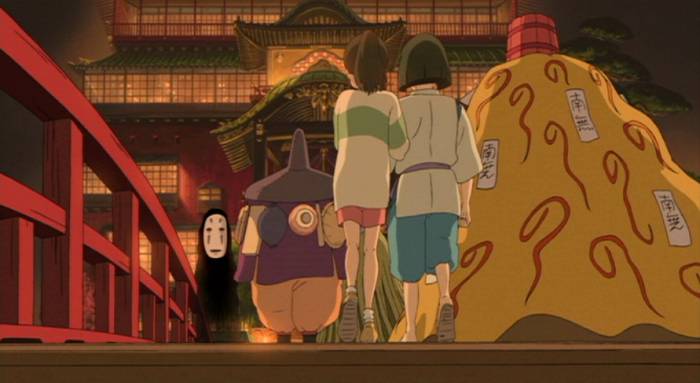
No Face first appears on the bridge as Chihiro is trying to get across. He notices her immediately.  Later, Sen invites him into the bath house from a side window (oops, broke a rule there).  In response to her kindness, he tries to help her out—stealing bath tokens, for example.  He wanders about for a while, swallows a talking frog, offers some gold and demands food.  A lot of it.  All the food in the house, practically. All the while throwing gold about for everyone to get rich, while he turns into a huge, hideous monster.  Sen stumbles across him, and he offers her a huge pile of gold, which she wasn’t interested in.  Gold had nothing to do with helping Haku or her parents, so she didn’t care.  No Face then goes in a rampage, swallowing other attendants and demanding Sen.  Yubaba tries to help, but to no avail.  Finally Sen comes in, tells him he has to leave, and gives him a piece of medicine.  No Face starts vomiting all over the bath house, all the attendants and froggy comes out fine, and then he throws himself in the river, where he follows Sen to go to Zeniba’s house.

What is this insanity?

First, about No Face—he is a spirit without a center, without a base character.  He, like Haku, notices her immediately, but not because he remembers her.  He notices her because she has such a strong center.  Chihiro/Sen, from the time she enters the spirit world is determined to save.  She needs to save her parents, and then she needs to save Haku, and later she needs to save No Face.  Her center is her compassion or “love” for all of these people.  It is her determination to love that is her center throughout the film.  No Face, being an empty, lonely spirit, recognizes this immediately and is drawn to her. 

But once he gets in the bath house, he is turned away from Sen by the powerful center of the bath house itself, which is greed.  Everyone in the bath house is infected by Yubaba’s greed.  Some have the greed for gold that she does, but others have a greed for freedom, a greed for food (mmmm, roasted newt!), a greed for whatever they don’t have.  Caught up by this gluttony and avarice, he (literally) ingests it, and demands more and more, using his magic to make dirt look like gold, and an orgy of greed ensues.

But what No Face really wants is a true friend, someone who really cares about him.  So when Sen refuses his trade of gold-for-relationship (if only he had listened to the Beatles!), No Face is confused and goes on a rampage.  Realizing that Sen is the only one in the bathhouse that will give him the love he needs, he demands her like a crying toddler after his mommy.  Sen finally meets with him and realizes that he is sick, just as sick that Haku was with the paper wounds.  So she offers him the medicine, and he begins vomiting out the illness—the greed.  Only after the greed was completely expelled was he empty enough to accept the subtle but caring touches Sen offered him.

This greed v. love theme is the center of the film.  Haku got trapped in a cycle of greed when he came to the bathhouse, coming to steal magic and becoming a slave to Yubaba’s greed instead.  But he is set free from her curse by Sen’s love and compassion for him.  The parents are trapped because of their gluttony to eat that which did not belong to them, assuming that their money would buy anything.  Sen’s love and determination frees them.

Greed is a slavery that love delivers us from.  Do you hear that, capitalist pigs?

What is Spirited Away about, anyway?
Ultimately, Spirited Away is a coming of age movie, not too unlike Miyazaki’s film Kiki’s Delivery Service.  Like that movie, Spirited Away shows a girl who’s determination and hard work causes her to mature. 
But Spirited Away goes further.  At the beginning Chihiro was a normal pre-teen girl—grumpy, anxious, full of irrational complaints  (apologies to my pre-teen daughter).  The only thing that saved her in the movie was her determination to save others.  Only when she realized that her parents, Haku, No Face and others depended on her to deliver them, did she have the power to grow up.  Hard work is a factor, like all Miyazaki movies, but the hard work that makes changes in the world is the effort of compassion. That’s what makes the world better.  That’s what makes US better people.  Some people are lazy gluttons (the parents), and some people are hard working for their gold (bathhouse attendants), but to grow up, we have to determine to work for others.
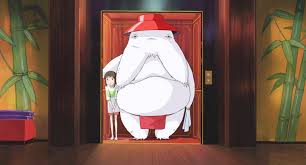

I love this movie because I love watching the imagination just go crazy.  I love watching the fanciful characters, and the adorable characters like the soot creatures, Kamaji the boilerman, and the Radish Spirit.  Yes, the Radish Spirit.  Love that guy. 


 But mostly I love this movie because I get to see Chihiro grow up.  She becomes a confident young woman, ready to face the world.  No longer naïve, but really understanding the power of compassion and how it changes people.  So awesome. 

Sunday, July 7, 2013

Japanese Civil War: The Last Samurai, Samurai Assassin and When the Last Sword is Drawn

In the 1860's, Japan's economy took a major turn, depending more on foreign trade than ever before.  This led to a conflict between the Emperor, who, by the end of the 1860's was under the thumb of the foreigners, and the Shogun, who wanted to retain power for his military class, the samurai. This eventually lead to some skirmishes and also to all out war between the forces of the Shogun and the Emperor in 1868, where the Shogun was defeated in Edo and the Shogunate was dissolved.

This era of Japan was made into many films in Japanese theaters and television.  It is a dramatic time and the stories from this time heighten the tension and the challenge to samurai at the time.  Although it can be questioned as to the nobility of the samurai at the time, yet most films display the samurai as noble and loyal to a fault, which is seen as a great ideal to follow.  Here are some words on a few of the films on this era, two Japanese and one American.
Samurai Assassin (1965)

This film takes place in 1860 at the beginning of the tension between the Shogunate and the Emperor. It is showing dissent amidst the ranks of samurai, all trying to respond to the coming of the West in force to Japan.

The clan of Mito determines that the Elder of Il must be killed, for the sake of the strength of the Shogun, and they collect a variety of samurai, including ronin (master-less samurai) to accomplish this task, but there is a traitor in their midst.

Of course, one of the ronin samurai is Mifune, who plays Niiro Tsurichyio, son of a concubine who's father is unknown. He is trained as a samurai, but his temper gets the best of him. Of course, he is the most skilled of samurai, and somewhat of a rogue. But this is only because his ronin class left him in poverty and disgrace, not even able to obtain a wife, let alone the woman he truly wants.

The first half of the film is dull, with much explaining, political discussions, and narrative-based action. But it is all giving the necessary background for the second half, where the truth is opened up.

Although much is spoken of honor and principle, it all descends into savagery and the worst of violence. It is a good reminder to us that we can get so caught up in secondary issues that we lose sight of the important issues of honor and morality. It reminds me of a modern political thriller, where corruption rules the day, even by those who seem so noble on the surface.

By the end, it is horribly wonderful.


When the Last Sword is Drawn (2003)

This film takes place throughout the era, ending just after the defeat of the Shogunate.  It is a biography about Yoshimura Kanichiro, who was, in history, in service to the Shogun and was eventually defeated by the emperor's forces.

The film depicts him as much misunderstood because of his complete humility. He did all his strange (for a samurai) actions for the sake of duty to his family and to his lord.

I am amazed that this film won so many Japanese awards. It is unfortunate that this good story was told so poorly. Every emotional scene felt so manipulative, not because we shouldn't feel emotion, but for some reason it seems adequate to lengthen a scene and have characters repeat each other's names for emotional resonance. The final half hour of the movie could have been presented in five minutes-- Boredom is an unfortunate way to end a film. And instead of emphasizing our hero's nobility of duty despite opposition and mockery, it emphasizes dying in battle as a noble honor.

I'll give it a passable 3 out of 5, only because the heart of the film has a good depiction of a controversial figure.


The Last Samurai (2003)

The Last Samurai famously stars Tom Cruise who arrives in Japan just after the Shogunate is defeated and is asked to help dispatch some of the rebellious samurai forces that still exist. 

As an American epic, it has some eye-rolling cliches that took me out of the film. As a samurai movie, it cannot compare to the classics of that genre, but like those films, it discusses the matter of honor with some subtlety and interest.  The action was, in a sense, less realistic but more effective than most samurai films. As a movie that explores the connection between the East and West, it completely fails, but I"m not sure how much it was attempting to explore cultural connections.  But in the end, it is not a bad film, if not a great one.

What is this?  Like Avatar and Dances with Wolves this is a movie about an American teaching an indigenous tribe to fight for themselves.  Because an American has to do this, they wouldn't figure it out on their own.

Frankly, I still think Avatar is the better movie, not only because it's prettier, but because it is not a "movie about Japan" or a "movie about Indians", it is rather a movie about all subdued, oppressed cultures and so can represent all of them.  I wish it weren't necessary for an American to be the hero.  Why can't an aborigine travel abroad and become the hero for their own people.  I understand the cross-cultural element is necessary, but why always make the American the hero?


Nevertheless, I have to give The Last Samurai some kudos.  Tom Cruise played his role with tact and, at times, humility.  When he gave the honor to others, it brought tears to my eyes.  I don't care what nationality it is-- American, Japanese, or Na'vi-- when a man of pride and arrogance surrenders himself for another person or nation, it is of the greatest honor.

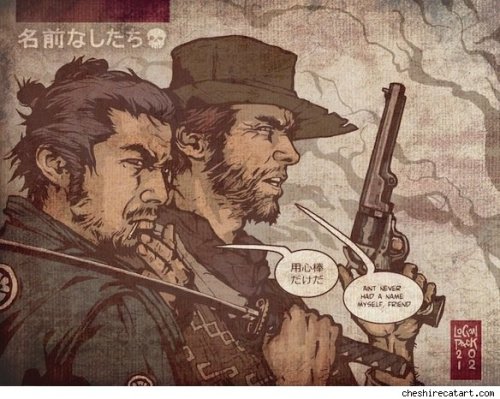
Sanjuro and the Man With No Name

The "Man With No Name" Series, a.k.a. the "Dollars" films:
Yojimbo (1961, Kurosawa)
Sanjuro (1962, Kurosawa)
A Fistful of Dollars (1964, Leone)
For a Few Dollars More (1965, Leone)
The Good, the Bad and the Ugly (1966, Leone)

Many people know that A Fistful of Dollars was a remake of Kurosawa's Yojimbo.  The plot goes pretty much scene for scene from the original, although Eastwood plays a slightly different hero than does Mifune. For a Few Dollars More may have borrowed some elements from the Japanese sequel, Sanjuro, but it is quite different.  For a Few Dollars more takes the character of the Man with No Name in a certain direction-- he has a sense of humor, but Eastwood is certainly for sale. By the time that trilogy ends, his morality is determined by the Almighty Dollar.

In Sanjuro, the character becomes more moral, taking on the cause of the underdog, even offering to sacrifice himself and proves himself wise in the arena of politics with a military twist. As per usual, the Man with No Name (who names himself "30-year Camellia" on a lark) arrives in a town split by violent factions. In this case, one faction is behind truth and justice and the other is not. As usual, our anti-hero gets involved, and his methods are... unusual. At the very least, unexpected. The "good" faction are often fighting about whether to listen to the man.

What is most unique in this film is the insertion of a female, even gentle, point of view. Recognizing Mifune as a "glinting sword" an older woman recommends that he would be better off as "a sword in a sheath." We find our anti hero questioning himself, even making errors, because of his excessive violence and self-assurance.

I love Mifune's take of this character, at one point lazy, another yelling, another deeply considering as he rubs his face.  So full of life and joy.  I am really beginning to appreciate the appearances of Tatsuya Nakadai, here as Mifune's counterpart on the corrupt side of the equation.  This is the one place where I can see a similarity between Sanjuro and For a Few Dollars More-- in the uncomfortable camaraderie of equals.  That aspect truly enriches both films, although it is minor in Sanjuro.

One of the fascinating aspects of Sanjuro, which is also played with in Harakiri, is the facade of dishonor, even betrayal, for the sake of loyalty and honor.  The nine young samurai are often discussing whether Mifune is simply unorthodox in his approach to nobility, or is actually ignoble. This aspect makes this film more true to real life, for there are many people in which the appearance of disloyalty is the same as disloyalty, as if a criticism of a nation is equal to a lack of patriotism.  "The proof is in the pudding", so to speak.


Should actually be titled
"The Bad, the Bad and the Bad"
Although out of the whole series, I find For a Few Dollars More the more entertaining ride, I find Sanjuro to be both funny and introspective, both filled with action and a call to gentleness. If Tarantino would ever get off of his revenge kick, I'd love to see him do a remake of this classic film.

For the record, I consider The Good, the Bad and the Ugly the worst of the five films. I dislike the depths of selfishness the Eastwood character goes to and the development of that character as a money-grubbing criminal.  Obviously I don't have a problem with immoral characters (see my review of Sword of Doom), but I find that the Man With No Name isn't very smart in this last film.  Sigh.  Oh well. 

Wednesday, July 3, 2013

The Cost of Defanging Selfishness: Castle In the Sky

#68—Castle in the Sky (Laputa)

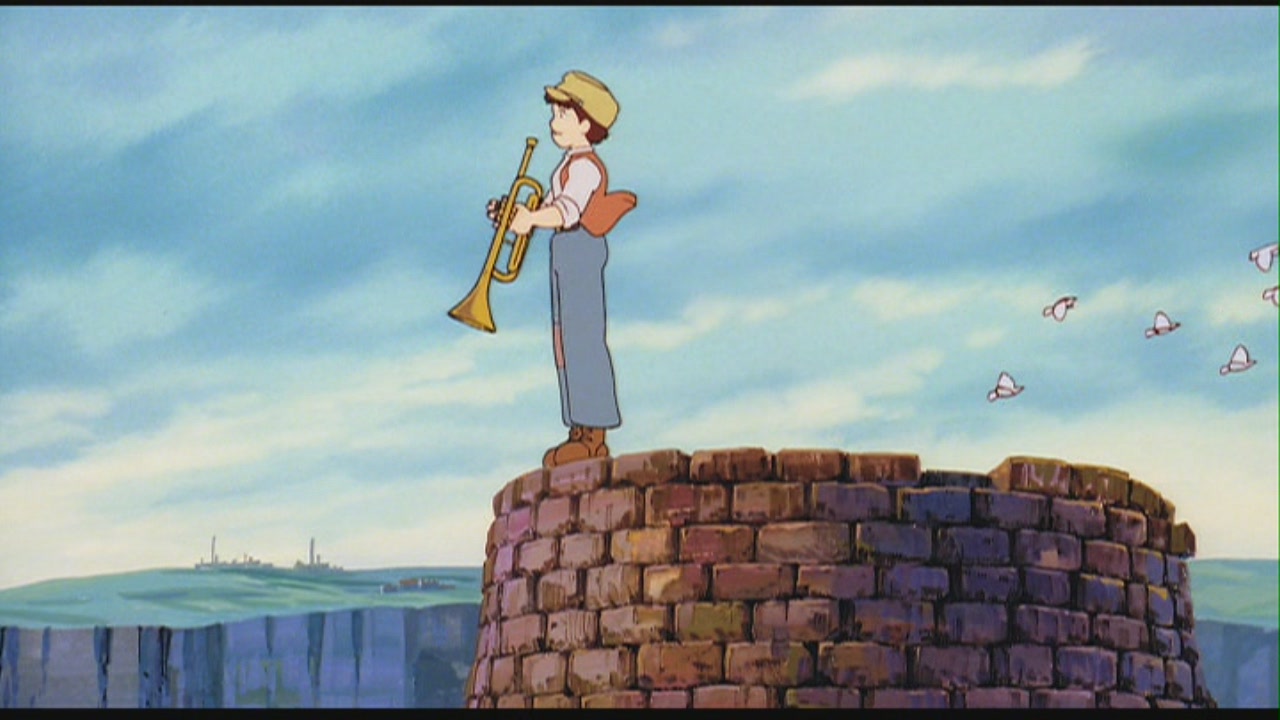
It is a small mining town in Great Britain, around the time of World War I.    Air power is just coming into its own and in Europe the great air power is Germany, with it’s magnificent floating military fortress, Goliath.  There are also air pirates to take advantage of the governments like the Dola Gang, a group of pirates under the head of their mother.  But there are also rumors and hints of an even greater power: an ancient floating city, Laputa.  Some say they have seen it, but no one is certain.  One pre-teen girl named Sheeta, however, holds the key: an amulet made of volucite (or “aetherium” in the Disney dubs) that is said to hold the key to Laputa and all its power.

This is the context of this Raiders-esque romp through a mining town and the skies above it.  It is one long chase scene, but what an exciting chase it is!  Air wars, floating girls, train chases (borrowing a bit from Keaton’s The General), a Babylonian city, secret ancient science, caves, robots (did The Iron Giant borrow from these?), military encampments—it just never stops!  The pirate boys are always around to drop a good laugh now and then, and we see the whole thing through the eyes of the ball of energy, Pazu.  Did I mention, best Pirate Mom ever?  What about awesome proto-Iron Giant robots?

The fact is, I think this film out-Raiders Indiana Jones.  It is more fun, and the heroes are real heroes and the (real) bad guys are smart and more sinister. 

Now that I’ve told you about this film, I want to give you my latest theory about Miyazaki.


No matter what kind of film he’s making, there seems to be a focused vice.  It is often repeated a number of times through each film.  In Nausicaa, it is fear—all the terrible events come about through fear of others, fear of nature, fear of what might happen.  In Princess Mononoke, it is hatred—the hatred one has of the enemy that is preventing you from living life as you think you ought to have.  In Spirited Away, it is greed—whether gluttony, greed for money or greed for love—that causes all the problems in that film. 

In Castle in the Sky, it is selfishness.  Greed is a factor, but ultimately all of the events play out because a nation and an individual wants to see reality changed from their own perspective, without regard to others.  This selfishness is caused by insulation from others and from the earth itself, to consider oneself above all others and all the earth, to see all others as simply tools for one’s own ideals.

The solution to this, as to all the vices in all Miyazaki’s films is a single solution labeled a number of different ways, even within Castle In The Sky.  It is called compassion, love, connection.  In summary, it could be called community living.  In each of the films we’ve seen in the marathon there is some kind of idyllic community used as an example.  The Valley of the Wind, the village of Prince Ashitaka are both examples of how humans can live with nature in harmony, and how people work hard for each other to create a good life for all. 

In Castle in the Sky, the idyllic community is not actually seen.  It is the community that young Sheeta was kidnapped from.  (What is it about the theme of kidnapped princesses?  Anyway…)  This is the community the Laputans formed when they determined that living in their city was too separatist, and that they needed to return to the earth, to live with nature and to the people whom they once ruled over. 

The ideal is not simply a virtue that one can live on one’s own.  There is no single hero that shines through any Miyazaki movie that solves all the problems.  Rather, solutions are determined by both heroes, leaders and community.  It is a way of life they decide to live out together.  It is a life of compassion, of concern for others, of hard work and of communion with nature.  Yes, each film has its hero, who through deep personal sacrifice, brave deeds, mediation and virtuous determination creates the opportunity for peace.  But ultimately they only point the way.  It is when the community decides to take this upon themselves that the hero’s brave deeds are fulfilled.

And in some films, such an idyllic state is never reached.  Perhaps the vice of a certain person is thwarted, but the future is still uneasy. 

With this moral basis throughout all Miyazaki films, it is no wonder that they are considered children’s films, even though Nausicaa and Princess Mononoke and Porco Rosso aren’t really for kids.  The moralism is a bit heavy handed.  Nevertheless, with all this high-mindedness, Miyazaki gives us amazing sights to see and adventures to live out in our minds.  And this is why I consider Miyazaki my favorite writer/director.  He offers us a unique and beautiful moral vision, and makes it completely entertaining.

Even with all this “made for children” action and moralizing, there is a very real point that is not for children—the position of Princess Sheeta.  In the end, she realizes that she has part control over a monstrous power to destroy whole cities.  And the other person who has control over this power is a madman, willing to not only threaten, but use this power at will.  What does she do? 

Of course, her position is the same as our own.  Some of our leaders have the power to destroy large populations with little effort.  We share in that power.  The answer in Castle in the Sky is to, of course, be rid of such weapons, at whatever cost.  The fate of innocent people is nothing compared to power, a paradise, and even our own lives.  It is worthwhile to make deep personal sacrifices for the sake of the world. 


Funny that our present world hasn’t made this decision.  I guess we don’t have the same ideals as Miyazaki.  What a shock.


Ambition and Sustainability: Princess Mononoke

#29—Princess Mononoke

Princess Mononoke is the most male-oriented of Miyazaki's films.  It has a lot of action, and although there is a love story, it isn't a significant part of the plot.  It is seen through the eyes of a young man, and it certainly is more gruesome than other Miyazaki. 

Alongside of Spirited Away, this is Miyazaki's most visually stunning films.  Every frame has so much to see and as ugly as some of the action sequences get, so many of the forest scenes are gorgeous.  Every movement is perfect, every background communicates as much as the foreground focus.  You could just turn the sound off with no subtitles and it is amazing to watch.

The setting is ancient Japan, just at the beginning of industrialization.  Gods roam the countryside, and every healthy tree has a spirit living with it.  The plot is focused around the wanderings of Prince Ashitaka, who is forced out of his idyllic home because he was cursed by a demonized boar-god. He gets involved in the ongoing battles of the up and coming industrial Iron Town and the gods of the nearby forest.  Ashitaka tries to remain neutral, but finds it difficult after seeing the desires to thrive on both sides of the war, and he is torn by the hatred on both sides.  And there are, of course, complications.  For one, he has fallen in love with a human on the forest side, San, who grew up with the wolf god.  And the Emperor, seeking the key to living forever, has sent a monk to retrieve the head of the forest spirit, which has the power of life.

For many of Miyazaki's movies, I think of them in pairs.  The partner to this one is Nausicaa.  They both deal with wars between communities and the connection between nature and humanity.  The great evil of Nausicaa is fear, while in Mononoke it is hatred.  At one point Ashitaka breaks up a fight between San and Lady Eboshi, saying, "You both have the same spirit," meaning hatred.  It is hatred that causes a god to become a demon and hatred that causes a human to become a monster, even if their appearance does not change. 

The point of the movie, as with Nausicaa, is that nature and humanity should be working together for the benefit of all, rather than battling each other for limited resources.  Ashitaka yells out at one point, "Why can't humans and the forest live together?"  Ashitaka is seen with distrust from all sides because he won't take a side.  But in the end, at least Lady Eboshi considers rebuilding Iron Town in a way that would not harm the forest.

Although Nausicaa takes place long after Mononoke, I think it is better to see Nausicaa before Mononoke, because the potentially idyllic relationship between humanity and nature is more clearly seen there, and the tradgedy of Mononoke can be better seen in this light. 

A question one might come from the film: "Why is it called Princess Mononoke?  She seems more like a supporting character."  I think the key is in the term.  "Mononoke" is not a name, but a word that means "spirit" or, more tellingly, "monster".  The title obviously applies to San, being as much wolf as human and siding with the spirits in the battle.  But the term also applies to Lady Eboshi, who is a marvelous ruler of her town, but when she is ruled by hatred then she is monstrous, horrific.  They are both a "princess mononoke" and it gets to the heart of the film.  For the true monster is the one who is filled with hatred for either humanity or nature-- the one who is controlled by hatred and pours it out on one's enemy. 

Because of this, I think that Lady Eboshi is the moral heart of the film, the driving force.  At first she truly does seem like a monster because from the perspective of the forest, she is ambitious, and doesn’t care what she harms in order to meet her goals.  But she is not a monster, rather she sees the needs of her people, and is just seeking peace and sustainability for them, not knowing that there is another equally sentient people that she is harming.  She and Sen despise each other and each other’s people’s because they see their opponent’s people as less than sentient, less than “human”, less than fully moral.  They hate because they do not recognize the other as an equal.  By the end of the film, Lady Eboshi especially realizes that both peoples are equally “human” and that her ambitions for sustainability can also embrace the forest.

It is easy to say that Miyazaki’s ideal is to have town and forest live together in harmony (which I just did up above).  But more than this is the ideal that the inhabitants of town and forest are equally deserving of peaceful life, and that any ideal of sustainability has to include all inhabitants of the land, not just the humans.

When I first saw Princess Mononoke almost ten years ago, I didn't find it that great.  The themes were beyond me, I think, and I couldn't grasp whether the movie was ugly or beautiful.  After seeing so many other Miyazaki, however, I can understand it better and appreciate it much more.  It still has weaknesses: I think that the motivations of the characters, especially Ashitaka, are unclear, and I spend part of the film in confusion. 

Nevertheless, I can now see that it belongs with the top Miyazaki films.  It enriches Miyazaki themes, and displays the power of animation in ways that few films can.