Showing posts with label 2012. Show all posts

Sunday, December 22, 2013

Judgment Rising: The Hunt

Last week, I had a friend of mine tell me that I lived a double-standard.  That wouldn't have been so bad by itself, but she based it on a statement that she remembered me making that I had never made, nor implied. And no matter how much I clarified my point of view, it did not change her judgment of me.

I was watching a fantastic episode of the West Wing ("Isaac and Ishmael") in which an Arab American was accused of being a terrorist, and every time that he was previously falsely accused of this before was being brought up against him as proof of his guilt in this circumstance.

It is a commonplace that we live in a world of pain and that the hardest story must be the truest one.  "You may not like it, but it's true."  But in reality, this assumption that the most difficult must be true leads us to false judgments.  The Passion of the Christ is brutal... in reality TOO brutal.  Historically, it is inaccurate because there are too many beatings and too much blood.

When we take this point of view to our lives, we find that we think the worst about people because it is the "harsh reality" we believe in, not because there is any real evidence of the fact.

The Hunt gives us the harsh reality that reality is more harsh when we assume the worst.  The worst criminal activity happens when people assume someone is a criminal, with or without evidence.  Our fears create more harm against the innocent than they protect the innocent.

The Hunt deals with judgmentalism and forgiveness by just telling the story of an individual that applies to everyday situations, much as the Dardenne brothers do.  Each performance is remarkable in the everyday quality of the reactions, despite the unique circumstances. By the end of the film, I was telling characters what to do or not do at the top of my voice.  I apologize to my wife.  She told me that I shouldn't watch it.

Despite my wife's objections, I highly recommend the film to those who prefer their morality dramas to be fully human and complex.

Thanks to Jessica for turning me onto this film.

Sunday, February 17, 2013

What is Love? The Deep Blue Sea and Amour


Rachel Weisz (in a marvelous performance) is in deep trouble.  She has left her husband, who loves her for her passion, a younger man who does not love her.  Her despair in this triangle leads her to attempt suicide.  And this is just the first ten minutes of The Deep Blue Sea

The theme of the film is passion, and the consequences of giving in to our passions.  Passion is gorgeous, but dangerous; it is powerful and destructive.  Certainly it is shown in this film to be a double-edged sword, ending in destruction. 

Passion is often confused with love, especially among the young.  This is not to say that passion isn’t an important aspect of love.  Were it not for passion, would our rational minds ever get married, get pregnant, go through birth, raise children?  Passion gives us the energy and drive to accomplish that which our species most needs.  It is the engine that drives our survival.

But is that all of love, or even the foundation of love?  Perhaps it is the engine, but what is the hull, the keel, the sail?  Passion drives love, makes it do amazing stunts, but what keeps love afloat?  If passion were all that love was made of, love would look like a hyperactive boy, flitting this way and that, always attached to a shiny object, running over whatever or whoever is in his way.   Although drawn out, this is exactly what we see in The Deep Blue Sea—the destructiveness of passion, and the ultimate loneliness of it.

It is interesting that within The Deep Blue Sea is embedded the theme of a more recent film, Amour: “A lot of rubbish is talked about love.  You know what real love is?  It’s wiping someone’s ass or changing the sheets when they’ve wet themselves.  And letting them keep their dignity so you can both go on.”

Amour is about the slow demise of a wife and the faithful service to do whatever was needed by her husband.  She has a quiet stroke, almost unnoticeable.  Then another, which leaves her half-paralyzed.  She speaks of ending her life, but her husband convinces her not to, that she is not a burden to him.  As the movie wears on, she becomes more and more of a burden as she regresses to an infant state.  The performance by Emmanuelle Riva is easily the bravest acting I have ever seen, allowing her to be put in the most humiliating positions ever. 

Just by its title, Amour asks “Where is love in this couple?”  Love isn’t found primarily in the ending of the film, as some would say.  Love is found in the day-to-day faithfulness, awareness of the other’s need, and spending oneself to meet that need.  As is often true, we can see love in contrast to those who do not display it: the daughter who wants to push her own will because of her own emotional needs, the nurse who has a program and will follow it no matter what the cost to her patient.

Love is the dance of a couple moving to help her sit in a chair.  

Love is spoon feeding a spouse when she doesn't want to eat, and learning to give up.  

Love is giving her privacy so she doesn't have to inflict her misery upon others. 

Love is a wife who is unable to communicate anything but “Hurts… hurts…hurts…hurts… hurts” for hours, and a husband who stokes her hand, tells her a story, sings old songs, until she quiets and is at peace.

Both films speak of the limits of love as well.  The Deep Blue Sea displays passion as having a limited life, quick to begin and quick to end.  The true love of Amour also has a limit: the emotional demands of love takes an emotional toll and it eventually breaks into rash anger.  But the best love recognizes that limitation and prepares for it, even apologizes for the limitations. 

I wish I could recommend Amour as an example for all to observe.   But it is such a difficult film, like almost all of Michael Haneke’s films, that I cannot recommend it to everyone.  My parents are so close to this situation, that the example would only hurt them emotionally.  Others are so young and passionate that Amour would just seem dull and pointless.   But for those who are ready for it, Amour is the glory of love in its most raw display.   The Deep Blue Sea is more beautiful, and has wonderful performances we can relate to.  Amour takes us to the next level of teaching us depth and maturity.

Sunday, January 20, 2013

A New Kind of War Film: Zero Dark Thirty


I had tears in my eyes throughout most of Zero Dark Thirty.

Mind you, I’m ill (keeping away from everyone, though), and so I might be a little more prone to emotionalism.  And I left the film utterly exhausted because of that.  But the film as a whole pained me to no end.

This is less the fault of the film as it is the fault of the ideology I bring to the film.  I am a pacifist, and I am opposed to revenge and this film is, no matter what else it is, certainly a film about revenge.  So to spend two and a half hours seeing a Federal assassin track down her victim—even if the victim is Osama Bin Laden—is painful for me to watch.

I recognize that most others will watch this film with different eyes, and that is how it should be.  Because this is a film that will feed almost any ideology.  What you get from the film is what you came in with.  This doesn’t mean we won’t learn something about how spying works today or about war in a post-9-11 era.  But if we are opposed to torture, we can see that in this film.  If we think that any amount of cost is worth such a lofty goal, there is evidence for that in this film.

A new era of war requires a new kind of film to describe that war.  In the 40’s, war films were mostly propaganda, with the rare film showing the subtleties of personalities (Colonel Blimp).  Some aspects of war were criticized in film in the 50’s, but there is always a noble soldier for us to identify with (Paths of Glory).  In the 60’s there was quite a bit of discomfort after the Cuban Missile Crisis (Dr. Strangelove), but war was still often glorified in film (The Green Berets).   It wasn’t until the 70’s that film turned firmly against war, deconstructing the whole war film, showing it to be destructive to the soldiers and to the nation (Platoon, Apocalypse Now). 

After 9-11, though, war changed.  It is no longer nation against nation, but one nation in opposition to small enclaves of well-funded, well-organized enemies.  It requires subtlety, and the moral ground is different than it used to be.   Terrorists are horrible, but they are human beings as well, and they might even have a point.  The new war film is less ideology-heavy and more documentary style, allowing the viewer to be on the ground, seeing what we could never possibly see, giving us the experience of warfare, not an entertainment.
This was first done in a famous, amazing scene in Saving Private Ryan.   We had the opportunity to experience D-Day as it has never been seen before.  We were an allied soldier, hearing—even feeling!—the mass of bullets missile past us, seeing our comrades fall, the gore, and we feel the difficult courage it takes to keep moving up that deadly beach.  However, that scene was surrounded by a film deep in the old ideological presentation of war.

Paul Greengrass is the one who really introduces this new perspective on terrorism and war in two films: Bloody Sunday and United 93.  They are objective, documentary-style and while they give a very particular point of view, we have a sense of objectivity that we have never experienced before.  We were there, we are not just viewing the tragedies so much as experiencing them as they unfold in time, seeing people’s reactions as they happen.  Yes, it is a movie trick, but it works.  We are involved in these experiences like we have never seen.  This continues with Steve McQueen’s Hunger and with Kathryn Bigalow’s  The Hurt Locker.  Yes, they are told from a certain perspective, but we are on the ground with the characters, able to judge or to applaud them as we felt.

Most of all, these films didn’t tell us how to feel, but they opened discussion.  They gave us facts, and ideas and powerful experiences that we could look at and draw our own conclusions.

In Zero Dark Thirty, Bigalow continues this, showing us not only a documentary-like view of Bin Laden’s discovery, but also showing us the heart of the United State’s war on terror.  The new war, the new spying, is less about capturing cities, but about discovering who we are at war against.  Names and locations are hidden, and even with massive amounts of technology at one’s disposal, they are almost impossible to find.  Politics also gets involved and public opinion can cut funding even in an essential operation.  Researching and the military go hand-in-hand, but it feels like the scalpel is replaced with a sledgehammer—the two approaches make for strange bedfellows.

Nevertheless, the new war has heroes.  Tenacity and courage is still what wins the day, whether a soldier or an analyst.  No matter how we feel about the proceedings, we still see Maya as a powerful person, one we admire, a force of nature.  But we see the other side as smart, and those being tortured as very human.

Despite all the torture, the bombings, the threats, the shootings, the killing of parents in front of children—we are not told how to feel about all of this.  Yes, this is a film about revenge, but not like Inglorius Basterds, where we cheer the brutal killing of Nazis and then we are slapped on the wrist for being like them.  Again, we are given a difficult, even brutal, experience, and we are emotionally impacted, but not told what to think.

At the end of the film, Maya cries.  This isn’t a spoiler, really, although it is an amazing ending of the film.  But why does she cry?  Does she cry for her colleagues who suffered so much to get to this place? Does she cry for relief because it is done?  Does she cry because the tortures and deaths were too high a cost?  Does she cry because she doesn’t know what to do with her life now?  We don’t know.  We might guess, but that is putting our experience on Chastain’s marvelous performance. 

The new kind of war film is objective, but not emotionless.  Zero Dark Thirty made me feel, in turns, frustrated, laughing, angry, excited, relieved, and outraged.  But we know the difference in this: the new war film doesn’t leave the audience clapping.  They walk out in silence, both deeply considering and deeply stunned by what they have witnessed.

Wednesday, January 16, 2013

Wisdom of a Child: Beasts of the Southern Wild


Empowerment is a central focus of American society.  It is the heart of our discussion about freedom.  We want to be free to be who we are, to do what we want to do (so long as we hurt no one else),  and one of the main keys to this in American society is the power to tell people stopping us from wanting to do our own thing, “Leave us alone!”  This is a power that people in the past didn’t have.  We don’t have to go far back in history to find large masses of people being arrested, imprisoned, tortured and killed because they were living their lives the way they wanted to live them.  Most Americans are offended by the idea of persecuting or prosecuting people because they are black, gay, atheist, or a child.  The American answer to all these cases is to empower the people to refute persecution with law.

However, there are still masses of people who are not given such empowerment.  One type of community that is still vulnerable to persecution is presented in Beasts of the Southern Wild.  The residents of The Bathtub, an island on the “wrong” side of a levy, are a truly wild people.  They make their own homes, determine their own work, create their own lifestyles, without regard to law or “normal” culture.  The way they raise their children, what they teach in schools, how they associate with one another is completely without regard to societal norms, and that’s the way they like it.  The scariest thing for them is to be institutionalized, to be forced to live according to someone else’s rules.  There are pockets of this feral community throughout the United States: you can find them in homeless camps and in outback rural areas.   And they frighten the majority of mainstream cultures.  Feral communities are depicted as dangerous in such films as Deliverance, The Wicker Man and in recent films like Winter’s Bone.

Beasts of the Southern Wild, however, takes a very different view of feral communities.  The Bathtub is a joyful, if not especially bright, community, full of innovation and support and love.  Even though many of them barely survive, they are still vibrant.   Although floods come to devastate their community, this isn’t a story of desperation and rescue.  In fact, salvation from the outside is the enemy.  While most of us would be on our roofs, waving to the helicopters, they crawl in drying hovels, hoping the helicopters would go away.  Because for the feral community, empowerment is separation from government, separation from laws and the police and from anyone who wants to “save” them.  Even when their land becomes unlivable.

This film is not about the community, as fascinating as I find it.  It is a movie about the empowerment of one person—Hushpuppy a very young girl tossed to and fro by circumstances.  In the mainstream community, we see such a child as necessary to be protected, because she is so frail, so vulnerable.   But is she really?  Does she have resources that we know nothing about?  Absolutely. 

Where the Wild Things Are, Tideland, Spirited Away and Pan’s Labyrinth are three films on my top 100 movies of all time.  The Spirit of the Beehive and the Iranian film The Mirror also are powerful films. And they all deal with a child’s resilience in the face of tremendous crises.  The Mirror is the most simple one, displaying a child lost in the midst of a huge city, but using her own independence and determination to make it home.  Pan’s Labyrinth and Beehive has a child in the midst of fascist oppression, undermining it through powerful determination.   Spirited Away has a child in a spirit world with rules she doesn’t really understand but her hard work and innate talents shine in the midst of crisis.  Tideland is perhaps the hardest of these films to watch, with a young girl becoming orphaned in a dangerous wilderness.  Where the Wild Things are has a child facing down the toughest opponent of all: his own lack of control and anger.

A child, along with the developmentally disabled and mentally ill, is the one who has the least ability to be empowered.   Yet all of these films give the main tools for empowerment for the most helpless and vulnerable.  It is not law, for law requires some legal standing and experience.  It is not governmental authority, because adults do not really understand the perspective and need of the child (or mentally ill).  How can a hopeless, helpless child be empowered?

For a change, movies give us a key.  All of these films, including Beasts of the Southern Wild, give us the key: determination and imagination. 

It is the imaginative who are empowered, because even if they cannot understand the complexities and massive scale of the trouble they are in, they can use their imagination to grasp it in a way they can grasp.  The solutions may be beyond their ability to intellectually fine, but they can use their imagination to find a path that will lead to survival.  As adults, we might dismiss imagination as being something less than reality.  But imagination can stand in place of reality, giving us empowerment in situations that we cannot live with otherwise.  This is the wisdom of the child.

It is the determined who are empowered, even if they have no other sword to wield.  Only the determined will see through their survival and safety to the end.  The determined can not only deliver themselves, but others as well.   The determined remains on the path to their goal, no matter what obstacles, no matter how wayward the path, no matter any naysayer.  Only the determined have the faith necessary to reach safety.  This is the wisdom of the child.

Although children, and others in powerless situations, may lack in traditional intelligence or resources that normally means survival, if they (or we) have that imaginative determination we can and will survive.  Perhaps these are qualities we should encourage.  For these are the true leaders of our society.

Sunday, January 6, 2013

The Theology of Life of Pi


The most recent Ang Lee film, Life of Pi, is easily the most beautiful film of 2012.  I really enjoyed my time with it, as did my two daughters who watched it with me (since you asked, 12 and 16).  It is a simple tale, but wonderfully told and engaging.  I encourage you to see it.  4/5


There.  Now the review portion of this post is done.


But I have been asked a few times concerning my opinion about the religious themes of the film.  This makes sense, since the point of the film is a religious one and I am a pastor.  So I ought to have an opinion, right?  Well, I do.  I’ll try to be unpastorlike and keep it brief.

I have found five theological statements this movie makes.  Let me summarize them:
1. God, as a powerful being, exists
2. God has something to say
3. God speaks through stories
4. God speaks through a variety of stories, sometimes contradictory
5. God is less concerned about truth than communication

The first three points are in full agreement with Christianity, as well as Judaism, Islam and Hinduism.  Other religions, such as Buddhism, thinks that what a god might say isn’t as important as enlightened humans.  But few religious people should have a problem with these first three.

The fourth principle is a problem with certain orthodox believers and certainly fundamentalists.  They hold that God is completely contradiction-free and there is a logic and consistency in God’s communication.  If God gives us a narrative, it a cohesive narrative.  And if there is contradiction, it must mean that part of the narrative is not of God. 

The final principle speaks directly against the fundamentalist point of view, because that point is all about the one truth.

What I want to point out is that the movie doesn’t disagree that there could very well be one truth.  What it actually questions is whether the direct communication of that truth is the best way to create a world.  People don't always handle truth well.  Jesus spoke truth, and it wasn’t received well at all, and so he spoke in parables which were not understood, but people then just scratched their heads or came to Jesus and asked.  Indirect truth seems to have done work equally well.

If God’s perspective is to bring people to a certain place—let’s say to train people to love, or to prepare them for eternal life—and truth isn’t the best way to bring people to that place, would God be so restrictive as to not give a narrative that might be more flexible with statistics?  Must every jot and tittle be historically, scientifically, measurably accurate?  Or can the details be fudged in order to bring people to the place where He wants them to be?

I am not saying God has done that.  Nor is the film.  It is just a question, a thought, to put us in the mindset of God and to possibly not be so narrow minded about our “truths” we hold dear.  After all, it could be that we have a stranglehold on a “truth” that has been colored, let’s say.  And that would be very embarrassing when we found out the real truth.

For me, it is more important to find out the direction God wants us to move than to find out the details of all that He has done in the past.  The stories are clues and the principles we are given are directions.  But it is up to our relationship with God here and now to determine what it means.


Important visual commentary by Kilgore and his daughters:


Sunday, December 9, 2012

Lincoln: A Review and Political Rant


Steven Spielberg is not only one of the great makers of blockbusters, he is also a great history teacher.
I know, your history teacher was better.  At least more accurate.  Less subjective.

C’mon, who’s kidding who?  History is about story and the best history teachers are storytellers- every one with   Some might help us better remember facts and figures better.  Some might better cause us to remember the flow or themes of history.  But almost no one is a better storyteller than Spielberg.  And what other history teacher has a multi-million dollar budget?

Spielberg has now got a number of historical films under his belt: Empire of the Sun, Saving Private Ryan, Schindler’s List, Amistad, Munich, War Horse and now Lincoln.  While others may have taken place in the past (e.g. 1941, Catch Me If You Can), there is less a sense of communicating anything about history.  There is just a setting that the story takes place.  All these films can best be called historic fiction, although there are parts of all these films that give us a sense of placing us in that historic setting and giving us a greater knowledge of what it meant to live in that time and place.

Like a good history teacher, it is not enough for us to just know the facts of the event, but to give us an interpretation of what the facts mean.  In this way, we not only have a starting point for our own interpretation, but we will remember the facts better than if they are given to us in an Edward Murrow presentation.

As a presentation of history, I think that Lincoln is next to Schindler’s List in its greatness and moral complexity.

 Certainly there are some stunning performances here. Tommy Lee Jones gives one of his best performances here (in my opinion, second only to No Country for Old Men).   He balances the humor and power of the role of the radical Thaddeus Stevens perfectly.   The whole ensemble was fantastic.

But this is the film in which I must declare that I have decided that Daniel Day Lewis is the best actor of our generation.  Yes, I have seen him before and I’ve been impressed, but this performance is stunning.  It isn’t an imitation, but a full embrace of a historic personage to such a degree that I suppose that I will never think about Lincoln without this performance again.   DDL’s Lincoln isn’t the image of Lincoln I had in the past, who I considered brooding unless he was before an audience.   DDL’s Lincoln is an image of perfectly controlled anger.  He is furious at injustice, furious at his wife’s instability, at his son’s insistence to join the army, at his opposition’s unfairness—yet he knows that raging and yelling only increases his impotence.   As a man sold out to create justice, he does only what is necessary to form a better family, a better government, a better nation.

Without spoilers, I just want to say one thing about the three climaxes of the film: the vote, the scene in Thaddeus Steven’s bedroom and the theatre.  All three of these amazing scenes were done without the central character in sight.  This is a brilliant choice to show us the impact of Lincoln’s work, because it is about what he did for others, no matter what the cost for himself.  

Yes, there’s a lot of talking here.  But it’s surrounded by great cinematography and imbued with one of the greatest dramas of American history.   I will never forget it.  5/5


* * *

Meditation on the Politics of Lincoln
This meditation is necessarily full of spoilers of the film.  You are warned.

I haven’t done reading on the historical accuracy of the film Lincoln.  I know that it is based on a work of history, Team of Rivals, but I am not so naïve to think that the film does more than give generalities of the arguments and ideas and people involved. 

Nevertheless, with what reading I have done, I find that the historic attitudes and the means and ways of politics in the film to be accurate, even if many of the specifics aren’t. (Again, I don’t know  how accurate they are, they may very well be.)

Lincoln was an idealist placed in the middle of a political catfight.  But he knew that there is no straight line in politics.  To accomplish his goals he needed to hide them.  To create justice, he had to remain “neutral” between injustice and justice. 

Personally, I am much more attuned to Thaddeus Stevens, both in attitude and in approach.  He is portrayed as a simple, moral man, angry and ideological, but he could destroy the whole process by his refusal to compromise.  He stands with justice without compromise, without retreat and hopes that his constant harping on the truth might bring change. 

Democracy must put aside such passion.  Democracy demands that all sides make compromise with each other for the greater good.  Lincoln understood this, and lived to push for justice in the midst of this system.  A political saint who tells stories, worked for positive compromise, started a war for the greater good.  A politician of the best kind—full of the lies and the egomania that all the best politicians have. Yet would slavery have been abolished without this man?  He was a unique man, a “pure” man—but why should a nation be dependent on the unique powerful individual to create morality?  Without the unique moral individual who is willing to take the compromise, democracy cannot work.

What kind of a system that demands moral compromises, even outright lies, in order to accomplish the moral good?  I cannot accomplish a politics that requires me to surrender what I know to be good for that which is significantly less than good.  I cannot abide a government that insists on liars in order to achieve truth.  Nor can I believe in a system that demands the innocent be unwillingly sacrificed for the sake of peace and unity.
In the end, the amendment was passed because of the compromise of good people and the corruption of weak people.  

And Lincoln, in the end, says that democracy requires people to stick with it. The fact is, with the rare exception, democracy is fighting against-- and just as often fighting for-- a rising tide of injustice.   For every moral position, two immoral positions arise.  For every "pure" man, fifty arise to take power.  Yes, the pure politicians (as few of these that there are) can make some progress, but the impure at the same time provide distractions and drawbacks, and even more. If this is democracy, give me anarchy, or monarchy.


Friday, November 30, 2012

Ruby Sparks: A Review and Reflection


Just to let you know, up front, I might gush a bit at the film Ruby Sparks.  But it’s not really my fault.  I love magical realism and movies about writing and touching romances.  It just gets me right here, you know?  The two films Ruby Sparks is just like are probably Stranger Than Fiction about a man whose life is being determined by a novelist he’s never met and (500) Days of Summer, a quirky, funny movie about a breakup.

Like (500)… this tells the story of a romance from a male point of view, and how screwed up he is in it.  It is clever and wonderful and heartfelt and it makes you really sympathize with the screwed up, selfish, sometimes abusive guy.  In the end he sees how screwed up he is, so that’s okay, right?

Like Stranger, this film speaks of the magic of creation through writing.  It really is magic, but it is fascinating because we also recognize it as real.  To write a character, or at least to do so well, is to create a new person that people—perhaps yourself—can appreciate, argue with, explore, discover life with, and even love or hate.  To write or read a character is to bring a new person into your life.  We recognize that when, at the end of a marvelous book, we are saddened by the fact that we won’t be with this person, or these people… perhaps ever again.  No wonder Kathy Bates got so upset.  Really, wouldn’t any of us?

At this point, I’m not going to go into the details of the plot of Ruby Sparks.  It explores an idea with some cool characters and if what I haven’t written above doesn’t encourage you to see it, then I won’t be able to write more to do so.  Perhaps it is enough to say I loved it. 

Below is a reflection on the film.  Although much of it is tangential to the film, I highly recommend not reading it unless you have seen it.

* * *

Relationships are difficult. 

Your significant other has habits you hate, says inappropriate things, misrepresents you as a couple, complains about your normal behavior, and embarrasses you.  Why do we remain in such a relationship, with so much baggage?  Because, of course, there are things you love about the other person, but most of all you are IN LOVE with the other.  You are no longer you yourself, but you are a part of them and they are a part of you.

And that’s the problem.  Because all of these unacceptable behaviors are not just a part of the other person, but a part of “us” and “us” is a part of you.  This is where controlling behavior in a relationship begins.  We control our significant other in the same way we control any irritating, immoral, unacceptable behavior in ourselves, because the other is now a part of ourselves.

Once a relationship matures, there are three people: “you”, “I” and “us” and the “you” behavior can be separated from the “us”, but at first it is difficult to measure that out.  Some people never grow in this way.

The difficulty for Ruby is that she has no real backbone, no real “self” except that was created by Calvin (a very deterministic name, to be sure).  There is a “you” in Ruby, but a very weak one, one that is dependent completely on Calvin.  Ruby is little more than a sim, and Calvin is her god.  She can leave her god, but in the end he is in control.

One of the reasons a human being finds it difficult to be God, or even a god, is because we are so filled with ambitions and hopes and desperate desires that must be fulfilled, that we cannot leave free will alone.  If we had complete control over our significant other, which of us would set that aside, completely, to allow them to be their own person.  Eventually, all of us, convincing ourselves that we were doing it for “their own good” would use the power to control in order to make “the relationship better.”  In other words, we would control the other in order to fulfill our own desires.

Relationships are tough.  And that’s the way it’s meant to be.

If one person in a relationship controlled all aspects of the relationship, then there is no growth.  Sure, there could be growth of each individual person in other aspects of their lives, but not in the relationship.  If a relationship is seen as a perfect, unchanging entity, then it is, by definition, incomplete, imperfect.

We are meant to be in relationship, because we need to grow.  And growth only comes from conflict with one whom one must remain attached.  The struggle between the attraction and the unacceptable, both within the same person, is how we grow.  We learn to compromise, to mediate, to surrender, to convince, to seduce, to minimize, to forgive.  We learn to love.

Because love isn’t just the overwhelming feeling of desire or connection.  That’s just the first step.  Love is learning to live with the other that is so vastly different than the self.   Love is the blending of the self with the other, while never actually erasing the other or the self.   Neither control nor complete surrender has any part in love.

I just want to say one more thing about the film that I hope the writer and female star of the film never reads. (Zoe, if you do read this, I am sure you deeply disagree with me on this, but it’s just the funny way I see these things, okay? I really loved the movie, so just remember that.

The movie is about Calvin who controls his relationship with his girlfriend, and how he learns not to be so controlling.  But in reality, not the film, it is Zoe, who plays Ruby and who wrote the screenplay, who is in control.  And Paul Dano, who plays Calvin is her boyfriend.  So in reality, while the film might be about men controlling women, it is actually about a woman finally getting control over her real life relationship, making her boyfriend grow up by her own literal script.
 
Control goes two ways.  It always does.

Friday, November 9, 2012

The Master: Review and Analysis


PT Anderson has created what is, in some ways, the inverse of one of the greatest movies ever made. 

His last film was There Will Be Blood, and, like The Master, it deals with the drama in a single relationship.  The central relationship also has a charismatic, skilled leader, used to directing and controlling situations with his charisma, and a weak, almost pathetic individual who is trying to succeed and finds he is unable to achieve his goals.  In both films, the relationship changes each of the men, directing their future in a way that would unforeseeable.

In the film There Will Be Blood, the central relationship is an enmity that increases envy, greed, power plays and violence.  In The Master, the central relationship is a friendship that increases each man’s ability to function in the world.

Joaquin Phoenix plays Freddy, a sea man who was in the navy and worked other vessels after that.   He is sexually deviant, but we later discover that he doesn’t just take opportunities for sex—what he really wants is relationship but he cannot control his desires or anger.  Due to his drunkenness, he loses many jobs and then stows away on a ship borrowed by Lancaster Dodd, the head of a new mystical cult. 

Lancaster is also in a bit of a bind.  He is in financial difficulties, and his wife says that he finds himself obsessed with his enemies who attack him and his methods.  When the clearly drunk, hopeless, pathetic Freddy comes on board, they have an immediate attraction for each other.  They truly enjoy each other’s company and appreciate each other in a way that others’ do not.  Freddy has never had anyone who accepted him, but also wanted him to grow.  Lancaster was inspired by Freddy, seeing him as a pallet to create new theories and to inspire new ways of healing the weak.

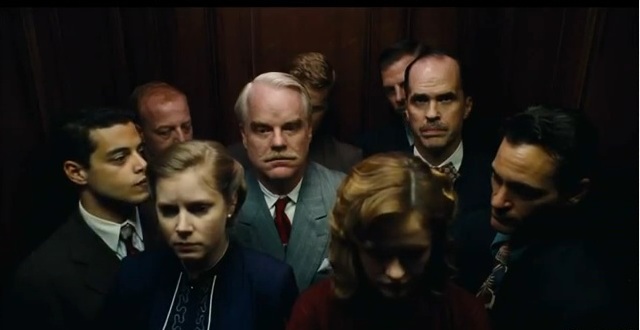
Paul Thomas Anderson is a great director.  He knows how to pull in varying elements to make a fascinating, cohesive whole.  His writing has gotten much better over the years and he pulls in some remarkable talents in cinematography and music. But his most remarkable gift is that of pulling out some of the best performances by very talented actors.  In years past, he directed Burt Lancaster and Tom Cruise into possibly their best performances.  There Will Be Blood has arguably the best performance by one of the best actors on screen, Daniel Day Lewis.  In The Master, Joaquin Phoenix certainly gives his best performance on screen, and Amy Adams, Phillip Seymour Hoffman and others give their strongest, most memorable characters.  Whether one appreciates PTA’s stories or conclusions, his films are requirements to be seen for the performances.

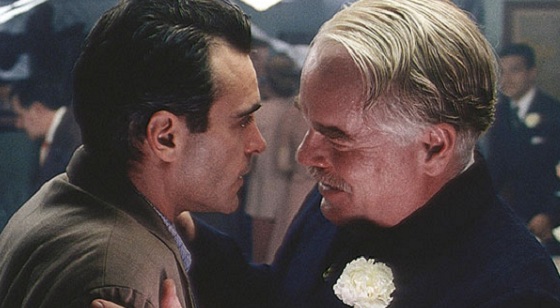
Although I’ve heard otherwise, I think that The Master is one of Anderson’s best films, second only to There Will Be Blood.  It stands as a great film about relationship and deep human connection.  It has some of the best performances you will see this year.  It is a remarkable work and will not get the praise it deserves. 4.5/5

***
(Spoilers below)

It would be easy to focus on the cult, called The Cause, in this film.  When you hear about the studies of Scientology and L. Ron Hubbard PTA did to work on this film, we might think, as the rumors have said, that this would be a film about Scientology.  But The Cause isn’t the central player, and how the cult grew and expanded isn’t the focus of the film.  This is only tangentially about a cult or religion.  It is instead about human connection.

Everything that happens is about the central relationship between Freddy and Lancaster. And all the side stories are about where the two men came from and how this one central relationship shaped their lives.  Freddy wasn’t, we find, completely pathetic.  He was in line to marry a young beauty in his home town.  But he needed work to establish himself financially, so he took on a position on a boat that took him far from home for many years.  And that proved to be too much for him, causing him to despair about his life and to drink severely.  In the end, what Freddy really wanted was not alcohol or sex, but a deep, lasting relationship, and he felt that he had lost his opportunity.

Lancaster had a successful cult, but it was limited in scope and easily mocked.  He wanted not just to help old women discover new things about themselves, he wanted to find out how to improve the human condition, to heal and to teach others how to heal.  His relationship with Freddy helped him achieve these goals.  He was able to gently experiment on Freddy, using what relational powers he had to bring Freddy to a new level.  In the end, he felt that he had learned much, even if Freddy never accepted the teachings of Lancaster, and his findings were posted in a new book.

Freddy didn’t learn about methods to make him successful, and he was never truly accepted by the cult, the way he was by Lancaster.  Despite his relationship with Lancaster, Freddy continued to be a drunk and despite Lancaster’s protests, Freddy continued to have violent rages.  But Freddy picked up on what he needed in life from Lancaster’s friendship that he couldn’t find in Lancaster’s teaching.  He learned about loyalty, about faithfulness, about connecting with others, about self-discipline, about taking joy in others.  Finally, he was able to take what he learned and face the world.

Although his relationship with Doris, his intended, was long past recovery, he could use his new social skills to meet new people, and to find a deeper level with a woman than just sex.  He went into life ready to relate, ready, for the first time in his life, to really love.

Only relationship can train us to relate.  Joy in friendship helps us to find the wonderful things that others have to provide.  The discipline of keeping friendship helps us to be disciplined in other areas.  Only love can teach us how to love.  And to find that relationship of love is almost happenstance, and it is certainly odd.  Love makes for strange bedfellows, both literally and figuratively.  A cult leader and a drunken sailor best friends?  What do they have in common?  In a friendship, what we have in common is our mutual need for each other.  Maybe this need isn’t a deeper relationship, maybe the need is more course.  But that need is what initiates, and sometimes drives, the love.  But that need causes us to grow and to deepen, to become richer human beings in ways we never would have seen.

Every intimate relationship, in its own way, makes us a new person.  And even when the relationship ends, whether for good or for ill, we can look back and say, “If it were not for this person, I would not be who I am today.”