Showing posts with label Michael Haneke. Show all posts

Sunday, February 17, 2013

What is Love? The Deep Blue Sea and Amour


Rachel Weisz (in a marvelous performance) is in deep trouble.  She has left her husband, who loves her for her passion, a younger man who does not love her.  Her despair in this triangle leads her to attempt suicide.  And this is just the first ten minutes of The Deep Blue Sea

The theme of the film is passion, and the consequences of giving in to our passions.  Passion is gorgeous, but dangerous; it is powerful and destructive.  Certainly it is shown in this film to be a double-edged sword, ending in destruction. 

Passion is often confused with love, especially among the young.  This is not to say that passion isn’t an important aspect of love.  Were it not for passion, would our rational minds ever get married, get pregnant, go through birth, raise children?  Passion gives us the energy and drive to accomplish that which our species most needs.  It is the engine that drives our survival.

But is that all of love, or even the foundation of love?  Perhaps it is the engine, but what is the hull, the keel, the sail?  Passion drives love, makes it do amazing stunts, but what keeps love afloat?  If passion were all that love was made of, love would look like a hyperactive boy, flitting this way and that, always attached to a shiny object, running over whatever or whoever is in his way.   Although drawn out, this is exactly what we see in The Deep Blue Sea—the destructiveness of passion, and the ultimate loneliness of it.

It is interesting that within The Deep Blue Sea is embedded the theme of a more recent film, Amour: “A lot of rubbish is talked about love.  You know what real love is?  It’s wiping someone’s ass or changing the sheets when they’ve wet themselves.  And letting them keep their dignity so you can both go on.”

Amour is about the slow demise of a wife and the faithful service to do whatever was needed by her husband.  She has a quiet stroke, almost unnoticeable.  Then another, which leaves her half-paralyzed.  She speaks of ending her life, but her husband convinces her not to, that she is not a burden to him.  As the movie wears on, she becomes more and more of a burden as she regresses to an infant state.  The performance by Emmanuelle Riva is easily the bravest acting I have ever seen, allowing her to be put in the most humiliating positions ever. 

Just by its title, Amour asks “Where is love in this couple?”  Love isn’t found primarily in the ending of the film, as some would say.  Love is found in the day-to-day faithfulness, awareness of the other’s need, and spending oneself to meet that need.  As is often true, we can see love in contrast to those who do not display it: the daughter who wants to push her own will because of her own emotional needs, the nurse who has a program and will follow it no matter what the cost to her patient.

Love is the dance of a couple moving to help her sit in a chair.  

Love is spoon feeding a spouse when she doesn't want to eat, and learning to give up.  

Love is giving her privacy so she doesn't have to inflict her misery upon others. 

Love is a wife who is unable to communicate anything but “Hurts… hurts…hurts…hurts… hurts” for hours, and a husband who stokes her hand, tells her a story, sings old songs, until she quiets and is at peace.

Both films speak of the limits of love as well.  The Deep Blue Sea displays passion as having a limited life, quick to begin and quick to end.  The true love of Amour also has a limit: the emotional demands of love takes an emotional toll and it eventually breaks into rash anger.  But the best love recognizes that limitation and prepares for it, even apologizes for the limitations. 

I wish I could recommend Amour as an example for all to observe.   But it is such a difficult film, like almost all of Michael Haneke’s films, that I cannot recommend it to everyone.  My parents are so close to this situation, that the example would only hurt them emotionally.  Others are so young and passionate that Amour would just seem dull and pointless.   But for those who are ready for it, Amour is the glory of love in its most raw display.   The Deep Blue Sea is more beautiful, and has wonderful performances we can relate to.  Amour takes us to the next level of teaching us depth and maturity.

Wednesday, June 20, 2012

What Does a Great Director Look Like?


Stanley Kubrick on a good day
What exactly does a director do?  A film can be a massively complex jigsaw puzzle.  There are actors, writers, producers, studio execs, cinematographers, special effects: both physical and digital, sound, music, props, make up, clothing, editing, lighting, catering, cameras, location, assistants, and more and more and more.  The director takes all of these details and works them all toward a (hopefully) coherent whole.   This is an amazing job, one that makes me wonder if it is humanly possible.  Obviously it is, with a lot of help.   What really amazes me are the directors who can produce one (or more!) films a year.  Woody Allen is a workhorse.  Johnny To is a madman.

So being a director is a difficult job, no matter whether you produce an art film, a blockbuster or something in between.   I think to call any director a “hack” isn’t fair.  Every director has a difficult job.  Some are just studio directors, producing whatever the studio told them to make—but even a studio director could be Victor Fleming who directed both The Wizard of Oz and Gone with the Wind the same year.  I don’t think any director is really lazy.  Kevin Smith might come close, but he’s such a good writer that we forgive him.  And besides, Red State wasn’t lazy directing at all.

But what makes a great film director?  What makes a director stand out from the pack?  We know a great director when we see their body of work, but what exactly does a great director do that others do not?  Below are a list of characteristics that I think great directors have:

1. Unique vision
It's a Wonderful Life
First of all a great director has a vision with the film he is creating.  Sometimes the same vision extends to different films, and sometimes a director has a different vision for each film.  Most importantly, each film has something that makes it special, that causes it to stand apart from all other films, and to be a glorious example of filmcraft.  Constantly working directors sometimes have a vision that is clearer in one film than another (everyone has a bad year), but still, a great director’s work stands out.   Frank Capra had a unique vision: that of the everyman changing the world despite opposition, and it made his films stand out in the midst of hordes of everyday films being produced in his time.

2. Theme
Three Colors: Blue
A great director isn’t just telling a fairy tale with a simple plot and a straightforward telling, but she or he has a theme or themes that run throughout the film, adding depth and power to the plot or characters.  Krystof Kieslowski often had simple plots with deep themes that ran through the visuals, the music, the characters and the sometimes odd events that occurred in his films.


3. Communication
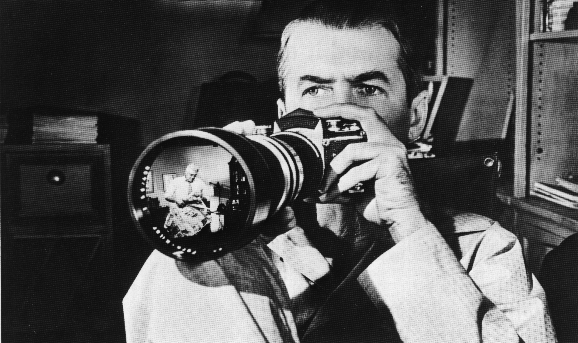
Rear Window
A good director often has themes and a unique vision, but he or she might have difficulty communicating this to his audience.  Part of this is knowing who your audience is, but a larger part is using all the complex pieces to make a coherent, never-before-seen whole that makes sense to the audience.  Hitchcock was brilliant at communicating his themes in often unique ways, using details to sometimes obviously and sometimes obliquely communicate his vision and themes.

4. Connection
The Godfather
The final aspect I want to emphasize is that a great director knows how to take all of these film pieces and to connect to his audience.  Not just that he touched them emotionally—a cat video could do that.  Rather, she or he gives his audience a memorable experience.  This director’s film isn’t just communication, it is magic.  He or she can take their work and make it a part of their audience’s life.  Their work becomes a reference point for other experiences, and the film is now a part of real life.  Even though a Mafia family is leagues away from most of our experience, the Corleone family is a part of our cultural heritage, and their unique morals and habits are a part of everyday conversation, to make us understand the rest of our world better.  “Corleone” is even in my Google spell check, for which I am very grateful.

Let's look at some directors who, I believe, are at the top of their game right now:

Howl's Moving Castle
Hayao Miyazaki—Some may say that an animator has less details to worry about.  However, those who understand animation knows that the director’s job is just as difficult to do well.  Miyazaki is a master of writing and direction. Even in his mediocre works (Lupin III; Kiki’s Delivery Service), his approach is fresh and fun.  In his masterpieces (Mononoke, Spirited Away) he is unlike any other director, yet a compelling storyteller.  At times, Miyazaki doesn’t communicate well because his stories are so foreign to us non-Asians.  Nevertheless, he wins most of us over in time because his very unique vision and compelling themes, as well as his characters that we enjoy spending time with.

Barton Fink
The Coen Brothers—I don’t appreciate some of their classic works as much as some (The Big L, Miller’s Crossing), but it doesn’t matter.  The Coens have a unique approach to storytelling, as well as unusual morals.  I have my favorites (A Serious Man, O Brother Where Art Thou, Barton Fink)… but so does everyone, and everyone’s favorites are different.  That’s a great director. Because they are both unique, but they communicate something to (almost) everyone.

Days of Heaven
Terrence Malick—Malick is a great director not just because of his message,  which is interesting, or the manner of his communication, which is unique (although sometimes hard work), but his method of creating film.  He, more than any other, takes the editing stage of filmmaking as a creative process, and by the end of his editing he may have a completely different film than the plan before the editing.  All the filming and the music are less communicating a narrative, but a concept and the film and even the plot are just resources for  him to use as toward the finished product, which isn’t realized until long after filming.  Again, that is a powerful director.

Wendy and Lucy
Kelly Reichardt—I think that Reichardt has the most unique vision of the current group of independent makers of low budget films (Miranda July might come close to that).  The stories are small and quiet, but the emotional resonance is deep and powerful.  She wants you to walk with her characters, to live their lives for a few days, even the silences and the confusion.  In this way, she hopes to teach us compassion and perspective.  I think this is powerful communication that is more than just telling a narrative.  It is throwing us in the deep end and hoping we will learn to swim.


Vera Drake
Mike Leigh—I have spent time with more real people through Mike Leigh than any other filmmaker.  Like Kelly R, Leigh throws us in the deep end of a community’s life and asks us to swim.  But the swimming isn’t deep, and often very pleasant, with only the occasional shark to gnaw on our legs.  He is a powerful filmmaker, the Michael Powell of our generation, always giving us what we don’t expect.  I can’t wait to see another film by him, which is as high a praise a director could get, I suppose.

Cache
Michael Haneke—Finally, the man who makes dramas that feel like horror films. He has a singular vision, and he seems to be determined to dismantle society bit by bit.  Everyone seems so normal, so typical, so pleasant until they are not and the underbelly of proper society is revealed.  But he also throws a generous helping of Hitchcock, presenting us with a puzzle or two that we might not ever solve.  Nor do we necessarily have to.  And if we did, we think we might exhaust ourselves.  So Heneke, for his singular vision and disturbing experiences goes on the list.