Showing posts with label John Huston. Show all posts

Tuesday, July 28, 2015

The Dead by James Joyce and John Huston

Timing may not be everything, but it can change how we see the world.

In my second year of college I read The Dead by James Joyce, beside the woman who would later be my wife.  We both agreed that it was probably the most dull text we had ever read in the arena of fiction.  I cannot deny that Joyce is a genius of the highest caliber, but that couldn't keep me from sleeping again and again through the story which seemed to be about nothing.  A party full of non-events to non-people.  Our teacher, when we dragged into class to discuss the story, said that boredom was the point.  That these people were not actually living, but they were, in fact, more dead alive than the memories of their dead.  Because of this horrid experience, I avoided the film.  Even though the film took only as long as it did to read the story, I didn't want to experience that "hour that felt like five" again.

But my film friends prevail, in time, and today I watched the film.  I had received it last week, before my good friend fell upon his bed without spirit and the paramedics struggled to return to him his breath and a self-perpetuating heart, to no avail.  That was before I sat at the bedside in a hospital with another friend, dying of liver cancer, unconscious but comfortable.  Before he passed yesterday afternoon, with his final words being three days previous.   That was before I could no longer control my tears, not at the death of my friends, which was good for them, but for my own loss of their souls, gone until I see them again.

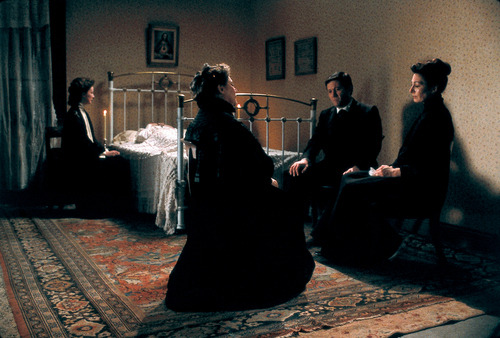
Unlike the story, this film is bright with characters and the language, cloth and candles of the best costume dramas.  The script is about everyday people, but unlike the story, they shine in their mediocrity, representing Salieri's final cry in Amadeus in praise of the mediocre than J.K. Rowlings demand that our talent be worth more than "good job."  It is a celebration, not of Epiphany, but of lives half lived, and the dead who burned out in glorious moments.

Why are the dead so celebrated while the living so depreciated?  Because of the dead we recall an edited life.  I remember my friend's smile, his soft but wise words, his work in the church kitchen for his friends.  Over time, I will almost certainly forget his days, sometimes weeks of being so dizzy he could barely get up, watching movie after movie because he could do nothing else.  I will remember his small cardboard sign "One Coin Helps", begging for a few dollars to buy his Mountain Dew and his weed.  I won't remember the times I saw him drunk.  I will remember how he accepted abuse from his friend when he didn't deserve it.  I won't remember his anger against his other friend who disappeared and didn't call for a year and so ended up never talking to him again.  I will remember him noble, gently strong, loving, big-bearded, a pillar of strength amidst weakness.

Who can compete with memories of a noble man?  Who can compare?  No living person can ever be as good as the dead.  We honor the dead because they are no longer alive and, should they happen to die at the right time in their lives, we will never remember their weaknesses, only their strengths.  And so it should be, if we can.  If we have done more good than abuse, if we have saved the lives of those who are grateful.  A luck of the draw, perhaps, between saint and sinner.

I will never forget this film.  Not because of it's qualities, although they are many.  But because I watched it now, today.  This film will always be connected to this time, and like the dead, I will only remember the powerful emotions it pulled out of me.

Friday, December 21, 2012

Wise Blood and Redemption


I have not read the novel on which this film was based, but I have read enough Flannery O’Connor to know that it represents her literature well.

The film is about religion.  Not about spirituality, but religion—with its contradictions, misunderstandings and rough-and-tumble viewpoint.  It is about the South.  The small town, the small city, the polite veneer, the prejudices mixed with pride. 

It is about simple people.  Not one-note characters, but people who struggle with life because they haven’t thought everything through, because they haven’t got enough control over themselves to really assist others.   You have our main character, Hazel, whose anger against God and demands that he be redeemed warp his sense of reality.  You have the blind preacher who isn’t really blind and doesn’t really believe in the tracts he hands out.  You have his daughter who knows she needs a man to survive and only knows one way to get him.  You have the landlady whose greatest desire is to help someone in need, which becomes her desperate need.  And you have the huckster, who knows a good con when he sees one, even if the one perpetuating it is desperately sincere.

And finally, there is the ugly aspects of Flannery O’Connor’s works.  In an essay I read of hers, she speaks of the Southern “necessity” of their literature being “gruesome”.   It is interesting that John Huston has the ugly plot points, but he doesn’t make them visually ugly.  He is not even leading us to imagine the ugly scenes which he has off screen.  It would be a very Christian film, if it were not the fact that the religious themes were so difficult to determine.

Hazel is a man in desperate need of redemption, and he not only rejects Christ, but also the need of redemption itself.  We need not repent, we need no blood, we need no two-thousand year old death to save us, because, Hazel preaches, we need no salvation.  We are complete, we are fit, we are sufficient in and of ourselves.   However, the entire film, ever character, every event shows the lie of this message.

Every person in this film is religious, almost all claim Christ in some way.  Even Hazel, who denies the effectiveness of Christ is haunted by him, sees him in the very fabric of life.  And even though he denies the fact of redemption, he cannot stop thinking about it, talking about it, like an atheist who cannot stop speaking about the existence of God.  It is clear that religion is doing none of these people good.  It is as much a block between them and healing as their own desperate clutching of their needs.

Spoilers below

There are two questions that stay with me at the end of this film.  The first is: given the need of redemption, did anyone find it?  Clearly Hazel goes through a remarkable character arc, in which he learns about his own need, but did his solution, his repentance really cause his redemption?  Or was his self-mutilation and self-denial just another way of taking advantage of others?  

The other question is one that Huston and the writers struggled with: Does Christ win, in the end?  The screenwriters opined that he did, but it isn’t clear that Huston agreed.  Perhaps Christ won in the sense that Hazel, and most of the rest of the characters, recognized the need for redemption by the end of the film.  But if Christ is about redeeming people, not just making them want redemption, then not a single soul was saved in this film.  All are left in as much agony as they began—some more so.

I’d say that Christ, just like everyone else in this film, lost.

However, to see this struggle, to pose questions that otherwise could not be posed, to open our eyes to the struggle of redemption that is happening all around us—for these reasons and more I’d say that this film is more than worthwhile watching.