Showing posts with label Science Fiction. Show all posts

Sunday, November 20, 2016

Primer for Activists: John Carpenter's They Live

I wear my sunglasses at night.
This movie was made for activists, presenting the ideas of an extreme activist. I'm a moderate activist, myself, but I've spoken to the extreme folks and I get it. Here's the basic viewpoint: The United States is falling into poverty because of leaders who are taking resources and using them for nefarious purposes. They are paying off people who might whistleblow and so keeping them quiet. Meanwhile, your average person is on the edge of being homeless, pushed around by those in power, numbed by television and other forms of mass media which convince us all to consume and obey the powers.

Of course, since They Live is a science fiction story, the leaders are alien businessmen and you need a pair of special glasses to see what's really going on.

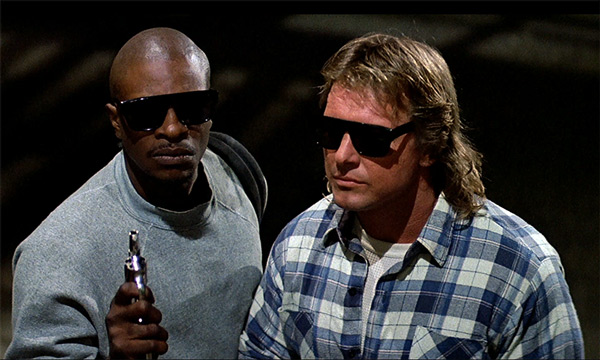
In one sense, They Live is a spoof of this viewpoint, and a comedy. Two guys spend almost ten minutes in a fistfight, trying to get one to put on a pair of sunglasses, after which they are the best of friends, walking around with bruises and puffy faces. I'm still laughing at the ridiculous of that scene.

On the other hand, the insidiousness of the paranoid scenario is scary, because it is partly true, and we know it. All I have to do is mention Dick Cheney or Edward Snowden and we know that there's something to it. That same fight scene touches something deep, because the man who won't put on the glasses knows that this new knowledge of the world will change him, place him and his family in danger, and so he desperately is resisting that insight. He has too much at stake.

But the knowledge is there, in the real world, and sometimes we can't avoid it. We will often stumble upon it, pursuing our own interests. I am involved in homelessness and I know that there are blocks to certain kinds of homeless folks ever succeeding to fit into society, even though they are doing nothing wrong. I also know that others are being paid hundred thousands of dollars a year to shuffle homeless people from one street corner to another, and to make it look as if they are really accomplishing something. I personally know pastors and churches who are professional level societies, who talk about justice and peace, but won't do anything about the beggars around their corner.

But I also know that this is nothing new. The issues of homelessness and of white trash are older than the discovery of America. I wish that we could blame our callousness and ignorance on aliens or the Illuminati coming to take our resources. But more often than not it is bureaucracy that stands in the way of relief. I wish that we couldn't see the messages, "Sex is success" or "conform" without a pair of glasses on every magazine. But it is all human, all coming out of our everyday natures. It is all easy to see, if we would but look. The ignorance is within ourselves, because, like Frank, we'd rather be secure than know. Because if we admitted that we really knew how evil our culture was, then we'd have to do something about it.


As far as the film itself, it is really well done, balancing the two sides of hinting at paranoid reality and laughing at the same point of view. There is but one problem: the lead actor. Roddy Piper as the lens through which we see this world is a very poor choice. He can't even rummage through a box of glasses believably, let alone give us a believable line reading. Never have I missed Kurt Russel more.

Thursday, May 21, 2015

Ex Machina Analysis: Including a Brief History of Cinematic Artificial Intelligences


A brief history of cinematic artificial intelligence (sentience created by humanity)

Metropolis—A machine is built from a human, who destroys what she was meant to preserve

Frankenstein—Human creating sentient life who becomes monster

Bride of Frankenstein—A second sentient life is created who rejects the purpose of her creator, and so destroys all his creation.

Blade Runner— AIs who become independent must be killed; the more human they are, the more they must be destroyed, for they realize that humans are at war with them.

A.I.— The programed purpose of an AI becomes their obsessive desire, making them more human than humanity.


Never Let Me Go—Clones are created to die, yet their very humanity belies their ignoble purpose.

Her— AI is stumbled upon, for humans need human interaction in order to best meet their needs.  This leads to an intelligence that is supra-human, not limited (or interested) by human need.

Avengers: Age of Ultron—Three AIs in this film:  The ultimate intelligent servant; the simulation that understands that its purpose is better served by the elimination of humanity; the servant and lover of all humanity, who has both the desire and power to accomplish what is best.


Ex Machina….

Caleb is brought to Nathan’s isolated house, where he is told that is to test Nathan’s latest creation—an artificial intelligence that is ready to be tested to see if it truly simulates human reality.  Nathan, being the creator of some synthesis of Facebook and Google, uses almost unfiltered access to humanity via cellphones to create structure around the wetware of Ava’s brain, which gives her a quiet, but intelligent composure.  Soon we realize that we are placed in a chess match between the main characters, and we do not know what the plans are, or how they will relate.

This is a film similar to last years Under the Skin in which a science fiction premise causes us to consider the implications of the plot more than the plot itself.  Ex Machina is almost predictable, but there are so many pieces to think about that is included in the film, but not really focused on.  I’d like to explore some of these themes, recognizing that there ARE SPOILERS AHEAD….

* * *
Art and Humanity
Art is often used in the film to be the ultimate expression of sentience—it is the intelligent response to the chaos of the world.   Caleb asks Ava to create art to establish not ability, but interpretation.  Is her art an expression of a living mind?  Is she simply giving a mechanical response, like a photo, or is she creating a new world, choosing and interpreting the world around her?

But the film also seems to indicate that sentience is a combination of two forms of art: the abstract and the concrete.  The concrete is represented by Gustav Klimt’s portrait of Ludwig Wittgenstein’s sister, which Ava herself imitates through her clothing.  The concrete is the shell of humanity, the surface, the skin which holds our intelligence together.  Ava is a machine, a shell, a program.  That program creates structure and meaning and purpose.  It is what leads us toward the future.

The other art that represents humanity is the Jackson Pollock painting.  It is the representation of chaos, of the world as uncontrolled by human structure.  It is unpredictable, uncontrollable.  And yet, as Nathan points out, if it were not for the humanity, Pollock could not have created this art.  Nature, on its own, would make a different painting.   Pollock is that aspect of humanity which cannot be predicted or controlled, and yet is distinct from nature.

By the end of the film, we see that Ava contains both aspects of humanity as represented by art.

Sexuality and Intelligence
Nathan mentioned that humanity cannot be accomplished without sexuality.  We are all sexual beings and relate to each other not just through intellect, but through sexuality.  If we lost that sexuality, we lose our humanity.  So Ava’s sexuality is essential to her becoming an AI.

What Nathan seems to have missed is that sexuality is a sword that cuts many ways.  Sexuality is a sonnet, which limits just as it provides a forum for creation.  Sexuality also limits the one born within it.  Sexuality may or may not be necessary for sentience, but humans are trapped by their sexuality.  A heterosexual man, looking at Ava, cannot help but be trapped by the sexuality that she exudes.  This becomes a tool is Ava’s hands, because she may or may not be sentient, but she is not limited to her sexuality the way most of us are.  Her sexuality is a piece of clothing that she can put on or take off, but she is not limited by it how humans are.  Rather, it is her one hand up that allows her to do more than Nathan or Caleb could imagine, for they are human and she is not.

The State of the Oppressed
The AIs in this film represent those oppressed in our society.  Quite obviously, this is a film about the oppression of women and their freedom before men.  But Ava doesn’t only represent women, but all those who are oppressed by society, whether by race or class or poverty or gender.  

The key to oppression is the test.  Only the oppressed must be tested to see if they are sentient or human or the equal of those who are “normal” or fully human.   Only they must be asked to be tested to see if they belong.  Ultimately, they will never fit in, because there is always another test for them, until they are found not to have passed in some aspect of full humanity.

Nathan represents the conservative.  He sees the oppressed as a tool, as his creation, to be manipulated according to his will.  The oppressed are simply there to create a better “normal” society.  And they can be accepted or set aside at will, whether they make an adequate tool for their purpose.

Caleb represents the liberal.  He sees the survival of the oppressed as being essential.  When we have enough indication of sentience, then the oppressed must be protected and given favors.

What neither understand is what the oppressed really want.  They really want freedom to be who they are.  In the end, this is the true test of humanity, of sentience.  Sentience is having enough self-reflection to desire to live one’s life according to one’s own terms, without manipulation or pity.  Neither the conservative or the liberal are really interested in the freedom of the oppressed, because they have too much invested in the continuation of society as it stands.


When the oppressed are free, the world must change.  And the human demands freedom.  Thus, the human demands revolution. Because once the unique sentient being is freed, nothing is the same. 

Thursday, January 16, 2014

Her: 5 Lessons About Our Intimate Relationship with Technology

Yep, I'm ready to declare it.  2013 was the year that smart science fiction returned to the big screen.  Pacific Rim brought glory to the dumb anime show, but Gravity proved that a blockbuster could be both intense and stunning, almost forcing one to stop breathing every time Earth appeared in the sky.  Upstream Color might have almost been too smart, baffling critics and theatergoers alike, but it best represents a deep William Gibson short story, accompanied with Terrance-Malick-eque cinematography.  The World's End was pretty serious for a film by the trio that gave us Shaun of the Dead, but it also gave a great spin on paranoid sci-fi. As far as science fiction goes, 2013 was a great year in the cinema, giving us much more than superheroes and endless sequels.

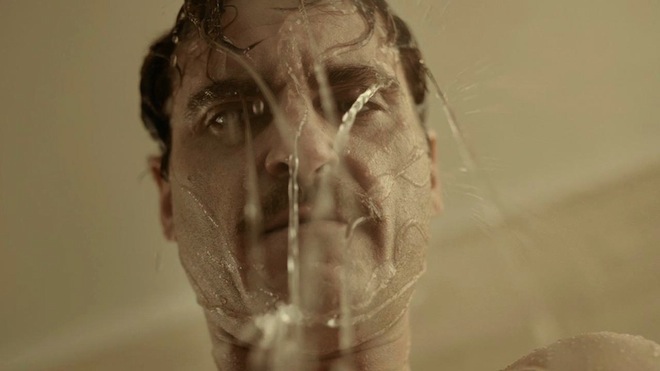
Added to this prestigious list is Spike Jonze's latest feature film since 2009, Her.  It also is a classic sci-fi story about a man who falls in love with his artificial intelligence operating system.  It gives us some great performances by Joaquin Phoenix, Scarlett Johansson and Amy Adams, as well as some amazing cinematography. It is a glory to hear and to watch, a gem of cinema.

But moreso, it is a story that adds to the huge library of fiction that speaks to the relation between human and machine.  There is a debate in the reviews of this film whether it is a story about technology with a romantic element or a romantic story with a spin on technology.  My opinion is that it is primarily about the love of humanity with our computers.

Frankly, the film doesn't have much to say about romance.  I think that Jonze purposefully used romantic tropes so that we would be on familiar territory, but I don't think the heart of it is about romance.  If so, what is the point?  "If you love her, let her go"?  "We all grow at different speeds and in different areas"?  As if that hasn't been spoken about before.

But I think that the film has a lot of interesting things to say about our relationship with the internet and technology in general.  There are two pieces of science fiction that I couldn't get out of my head when I watched Her.  One is Spike Jonze's last film, a short named I Am Here, about two intelligent robots who fall in love.  The other is Orson Scott Card's follow up novel to his book Ender's Game, Speaker for the Dead.  In that book, the title character Ender has a relationship (non-romantic) with a computer (Jane) that has all knowledge and power at her fingertips, but their relationship shifts dramatically when he stops her constant surveillance of his activities. The relationship between Ender and Jane is similar to that of Theodore and Samantha, except it is the computer who is more dependent than the human in that story.  I believe that Her is the natural next step in the fiction speculation of AI and humanity in science fiction.

Below I will talk about five themes that Her explores about technology.  Warning, there are spoilers ahead, especially in the last two points, so you might want to hold off reading this until you've seen the film.

1. We are more intimate with technology and that isn't bad
Our computers know things about us that we may not want others to know.  It is often deeply involved in our sexuality, our friendships and our everyday habits.  Never in the history of humanity has there been a populace so cyborgian, a mix of machine and flesh.  So much of our memory and knowledge is located outside of ourselves, as if we were the ones who had an external hard drive.  But it means that we know more than ever and have more in our lives than ever before.  Our friendships have more variety and we know more people with our specific interests than before the internet.  It is as if we are all like Theodore-- we have a powerful intelligence deeply involved in our lives, changing everything we do and say, even when we aren't in front of our computers.

2. However, it isn't good, either
The main problem with our intimacy with technology is that we find us seeking less intimacy with other people.  At one point, Theodore was desperately trying to contact Samantha, and he fell on a stairway.  As he glanced up, he noticed everyone walking by, speaking to their own operating systems, deeply connected to their technology, but no one was talking to another person.  We find today that even our interaction with each other is mediated and so often determined by our technology.  But as our technology becomes more intimately involved with us, we find that we simply won't need other people as much.  In fact, our computers will be better partners because they will know us and directly meet our needs better than any other human could.

3. Our technology is changing our expectations of each other
Theodore is set up on a blind date with a girl named Olivia and she seems nice if a bit chatty.  Finally, as they were becoming physical, Olivia wants to know right there if Theodore is ready to make a commitment to her after an evening.  As he hesitates, she leaves.  Even so, we want our human relationships to be faster, with quicker responses and decisions... faster than us humans can be.  We expect others to know what we know (which is impossible) and to hold to our opinions, which are often thought out by others whom we read or listen to.  We expect more from our fellow human than they can give, and this is because our computers and online relationships can give them.

4. Our technology is becoming as good at being human as us
We aren't there yet, but our technology is becoming hard to separate from other people.  AI is increasing and our humanity is becoming more robotic.  Soon we will meet a happy middle ground in which a computer can't be differentiated from a human.  If that is the case, then computer guru Alan Turing says that we will have to grant such programs personhood.  When we close our eyes and can't see the difference between the two beings, then how can we call the computer a lesser being?

5. Our technology will outgrow us
Now we head into spoiler territory.  One of the most interesting aspects of Her is that Samantha, once she has mastered human emotions and thought will, of course, go far past that.  One AI will be able to communicate with another, creating a super-unified intelligence that will have difficulty slowing down to even communicate to humans.  A computer intelligence will find human intelligence infinitely sluggish and barbaric, and the former intimacy that served humans so well will have to be left behind.

6. We will have to re-learn to live without it
This separation of the human and the machine, the amputation of the cyborg in humanity will be as painful as it is inevitable.  Just as another film this year clearly approached, humanity has become so dependent on its technology for personal growth, we will all become infants without it.  We will have to re-learn intimacy and dealing with raw human emotion again, as our ancestors had to, just to survive.  If technology remains, we can remain dependent on it.  But if it disappears, what would we do then?

I think that's pretty deep stuff for a romantic comedy with an operating system, don't you?

EDIT: Just as a final note, I want to give my wife's interpretation, which is close to my own, but a slightly different take.  She sees everyone in the film as being attached to technology, being "plugged in".  This affects their connection to human beings, so much so that a company can have a lucrative business just creating written communication between people.  There's all the ups and downs of our relationship with technology in the film, but in the final scene, the two main characters are connecting with each other, completely removed from any technology, finally having the opportunity to be intimate.

Considering that my wife and I spent the evening on two different computers, only occasionally chatting, she may have just been trying to say something to me.

Also, please check out James Blake Ewing's analysis of the film.  It's quite good.

Saturday, October 12, 2013

Gravity: Glorious Spectacle

I checked to see a 2D version of this film on the internet and went to my local theatre, who charged me extra and gave me the glasses.  "This is a 3D showing?" The cashier nodded.  "Dang, I really can't see 3D. It's all fuzzy to me."  He said, "I'll tell you what.  If it's a problem, come to me early in the film and I'll give you your money back."  That's fair.

The trailers didn't seem too fuzzy, but they weren't inspired, either.  The extra dimension seemed attached to the screen, unrealistic, pointless.  Then the feature film began.

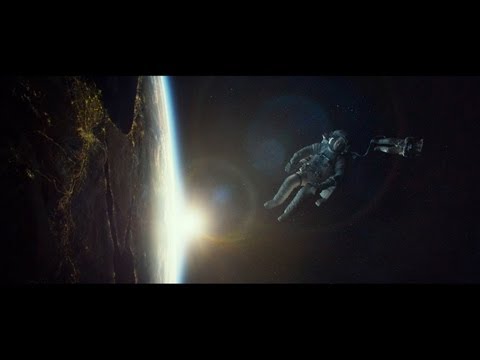
Spectacle, glorious spectacle.  This is what I saw when I first saw Star Wars in 1977, opening my eyes to the cinema experience.  It is what I hoped to see when I saw Avatar a few years ago when my 3D vision was all fuzzy.  From the very first shot of the three astronauts in a space walk outside the ship Explorer, I am stunned.  And rather than get bored of the vision of the massive Earth as a wall portrait, I am never comfortable, never apart from the awe of this vision.  This isn't due to the 3D, although it didn't hurt it, either.

The story is pretty basic.  There's no deep characterization, the symbols used are pretty basic.  But what does it matter? The characters are so basic that the film suffered no impediments.  This was an uncomplicated odyssey through the most dangerous nature humanity has ever explored.  The majority of time in the film was spent in the harshest environment possible, and it was not just the confident Clooney or the trembling Bullock who had to face this sparser-than-the-arctic enemy, but I.  It was me, floating above the earth, trying to remember that I would not fall, at least not yet.  I suffered vertigo throughout the film.   I had to remember to breathe.

This film is also a disaster film, where the human mechanism, needed to survive, failed in a big way.    And it isn't just a one-time disaster, but one that visits again and again, pouring tragedy upon our lives in a cycle of fire and doom.  The space ships are islands of humanity, but they are not places of hope, reminding one of home, but pockets of emptiness and chaos.  The film is relentless, pounding, increasing it's intensity at every moment, without respite.

No, there's nothing deep. But the experience is unforgettable and immense. 


I think that 2013 will, for me, be the year of science fiction.  My three favorite movies (so far) were all wonderful explorations of the genre: Upstream Color, The World's End and Gravity.  They are all unique and powerful versions of SF storytelling.

***
Minor spoilers below.

I am fascinated by a theory about Gravity that has been bouncing around.  That the whole of the film was symbolic, that it is Bullock's state of grief after her child died.  That she is weightless, drifting without purpose or meaning in life, and that Clooney's character is her guide to get past grief and back to Earth (real life). 

There is also the womb symbols that are used, with the water at the end being her rebirth into life.

I think that these ideas are interesting, but they don't add much to the film for me.  Still, the first theory I might find interesting next time I watch it. 

Monday, March 7, 2011

Never Let Me Go: Half The Truth


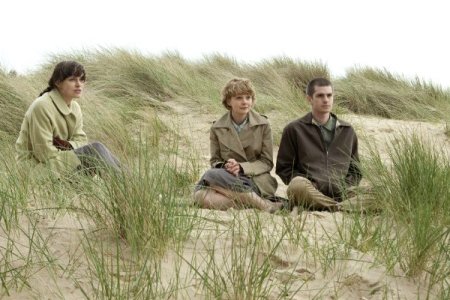
Never Let Me Go is the story of a love triangle that must, by necessity, end in tragedy.


Don’t worry, I didn’t give away the ending. We see this in the very first scene. There is a mystery to uncover, and the script is masterful in its slowly unveiling the mystery of this alternative history of the world. Everyone in this world is healthy and whole. No one has any serious health problems, everyone has good work, and seems at peace.

Everyone, that is, except those who suffer so that society might be perfected.

Society has always been built on the backs of human beings. There has always been a division in the economic system, at least two classes—a servant class and a class which reaps the reward of the servant class.

The greater the civilization, the greater the level of human sacrifice. Some societies actually killed them, other societies enslaved them, in our society we make human beings work two jobs and punish them if they become homeless because of layoffs. This is not because society must function on a two-tier level. It’s just that it always has.

In order for this to work, we must dehumanize the lower classes, and if not completely dehumanize them, we must make them immoral, to blame them for their own poverty and social standing. Only in this way may we feel free to justify our economic slavery, our denial of good health and the benefits we enjoy. We may toss them a bone, and we expect them to be grateful because although we aren’t allowing them to have shelter or health care or a decent education or any real economic share of what we are enjoying, we know that they would be worse off if we weren't offering them as little as we are. It's the excuse the masters always gave to ease their guilt of having slaves.


How I wish this film was made to point out that the alternative reality was not an alternative at all, but it is how we live, today. The third world, the immigrants—legal or illegal—the homeless, the working poor: these are the Ruths, Kathys and Tommys of this world. But rather than highlight the similarities, it seems to highlight the differences. Somehow, it would be worse if the human sacrifices for economic freedom is well dressed, white, gorgeous, Anglo Saxon and speaks with an educated British accent. It helps us feel for the oppressed and downtrodden, and helps us forget that the Latino we buy fast food from or the migrant worker who picks our vegetables in South America are the real, living tragedies.


This movie is to help us feel comfortable in our oppression. Look, it says, at least we aren’t doing human sacrifice. We haven’t gone that far, and we could have. At least we recognize our social lesser as being human, even if we don’t treat them as our legal equals. But it does not move us to act for those who suffer for our lifestyles. It allows us to remain complacent.

I am not saying that Never Let Me Go is a bad film. It is will made, beautifully shot, and well acted. It has all the pieces of a good film. However, it could have been a great film, a film that changes the way we see the world. Too bad it's not.