Showing posts with label Stanley Kubrick. Show all posts

Monday, March 23, 2015

2001: A Spacey Analysis

I just had a marvelous experience.  

A local theatre just set up a restored 70mm projector and the first film they showed was 2001: A Space Odyssey.  The last time I watched this film was as a teen, thirty years ago, on a small television screen, with me sitting across the room, the volume not too loud so as not to disturb others who lived in the house.  My experience last night was right in front of a huge screen, in front of a speaker, with my twentysomething son and a friend.  

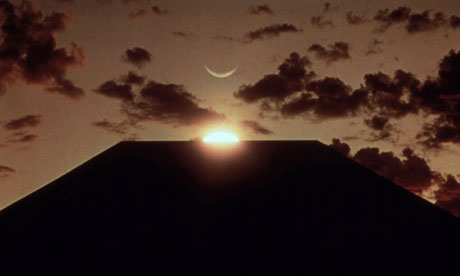
Truly unforgettable.   I could imagine being a film viewer in 1968, when the lights dimmed and the 50’s sci fi music mystically settled the audience down, then the room goes black, deadly black, we are in emptiness, the blankness of space and then we see the sunlight display the outline of the earth and the sunrise gives way to moonrise and all three orbs are gloriously magnificent in the midst of space and Zarathustra stirs our soul, in preparation to an epic spectacle.  

I may have seen greater films that have been made since this tremendous visual circus, but almost every epic since 1968 has been influenced for the better by this one.  Its greatness cannot be questioned, and it cannot be forgotten.
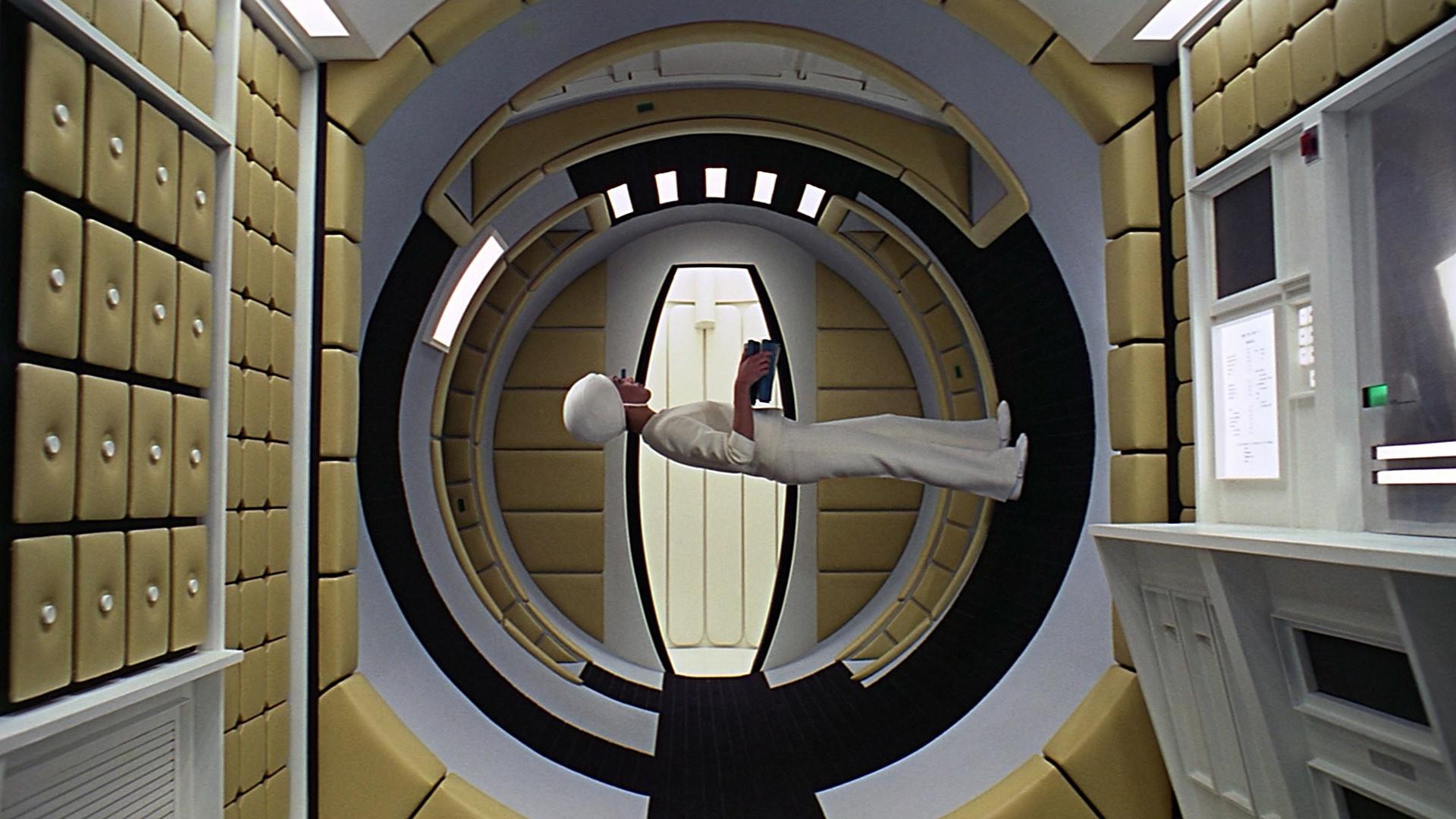

For all of its importance and power, yet 2001 is a strange duck.  For a long epic film, the narrative is minimal at best and incomprehensible at worst.  Perhaps this is because Stanley Kubrick wanted his viewers to work for the plot, to remain so dazzled that they will examine the film and so piece together the story over time.  But I suspect that isn’t the case.

Kubrick wrote the story and screenplay with Arthur C. Clarke, one of the greatest science fiction writers of the twentieth century.  They based the story on Clarke’s novella, The Sentinel, but they worked so closely on this project that while Kubrick was creating the film, Clarke was writing the novel, and the two works of art really should be seen as two aspects of a single work, different mediums working together, where one isn’t complete without the other.   Only the film’s outline is comprehensible without the novel, and the power of the story is lost without the film’s visuals and music.
This is an unusual relationship between a novel and film.  Perhaps only George Lucas’ original Star Wars film and book has anything similar, in which the novel fills out the film and the film empowers the novel.  I have deep questions that one was ever supposed to understand the meaning of the film without the novel.  Although my son, in his first viewing of the film, was able to glean the basic outline of the meaning of the film, only aided by hundreds of movies, tv shows, video games and novels that have been influenced by this work of art. 

Yet there are many who are baffled by this film.  And who wants to read the sci fi novel?  So I will give you the basic elements of the film, and in about 15 minutes you can sound as good as anyone else who has guesses as to what the film is about.  It’s been about 25 years since I read 2001 and about that long since I read the first sequel, 2010, but I remember it well enough to have a coherent idea of the film.  I will present the basic foundation of the film, the purpose of many scenes and some guesses of my own. As usual, I am open to any comments or corrections of my analysis.


Main plot
Incredibly advanced aliens direct the evolution of humanity, from the dawn of man to humanity’s next step, the Star Child.

Main subplot
Humans and their tools battle for rule of the solar system.
The primary cycle
Humanity is in a restless peace.  Humanity is always seeking more power, more security, more of the universe they can see and comprehend, but they are at their limit. The elegance and peace of humanity is represented by Johann Strauss’ Blue Danube.   A black monolith appears, and the voices of Requiem by  Gyorgy Ligeti,  call humanity, disturbing the peace with a mystical communication of knowledge that will take them to the next level.  A human touches the monolith, to the theme of Thus Spake Zarathustra and the communication is completed—humanity then has knowledge of the path of the next level they must pursue.  They will achieve the next level of evolution only through power and domination, as Friedrich Nietzsche stated (who inspired the piece Zarathustra).

Introduction I
With the theme of Zarathustra playing, we are introduced to the line of communication from the heavens, including the sun, the moon, to the earth.
The Dawn of Man
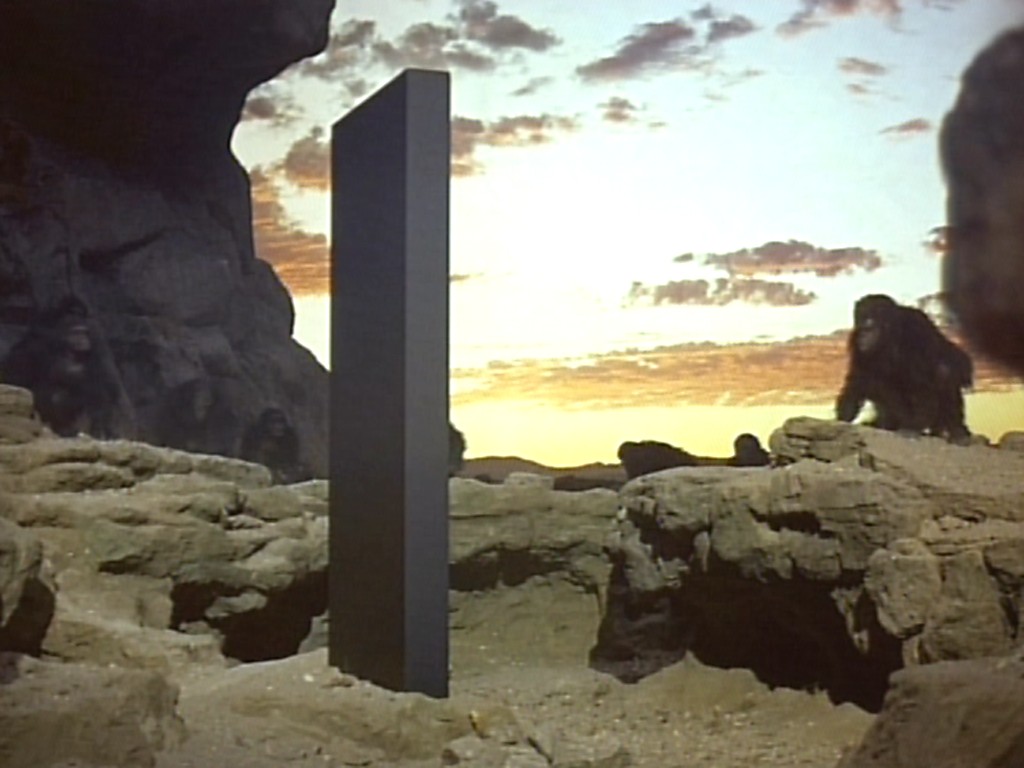
Proto-humans live peacefully with warthogs, in fear of violent large cats and against other tribes over a muddy watering hole.  A monolith appears, granting a single tribe the knowledge of using tools, which they use for violence, both against the warthogs for food and against other tribes in the first war for power over the watering hole. 

 Introduction II
The tool of a bone shifts to the tool of a space-plane in 2001, where tools now are so complex and huge that they encompass humanity.  This harmony between tools and humanity are highlighted by elegant flight and the elegant Blue Danube.   Heywood Floyd travels to the moon to examine a monolith uncovered 40 feet beneath the surface, buried 4 million years previous.  This is clear evidence of alien life.  After Dr. Floyd touches it, a signal is sent to Jupiter, communicating to the aliens, and directing humanity to Jupiter to receive their next communication.
Journey to Jupiter
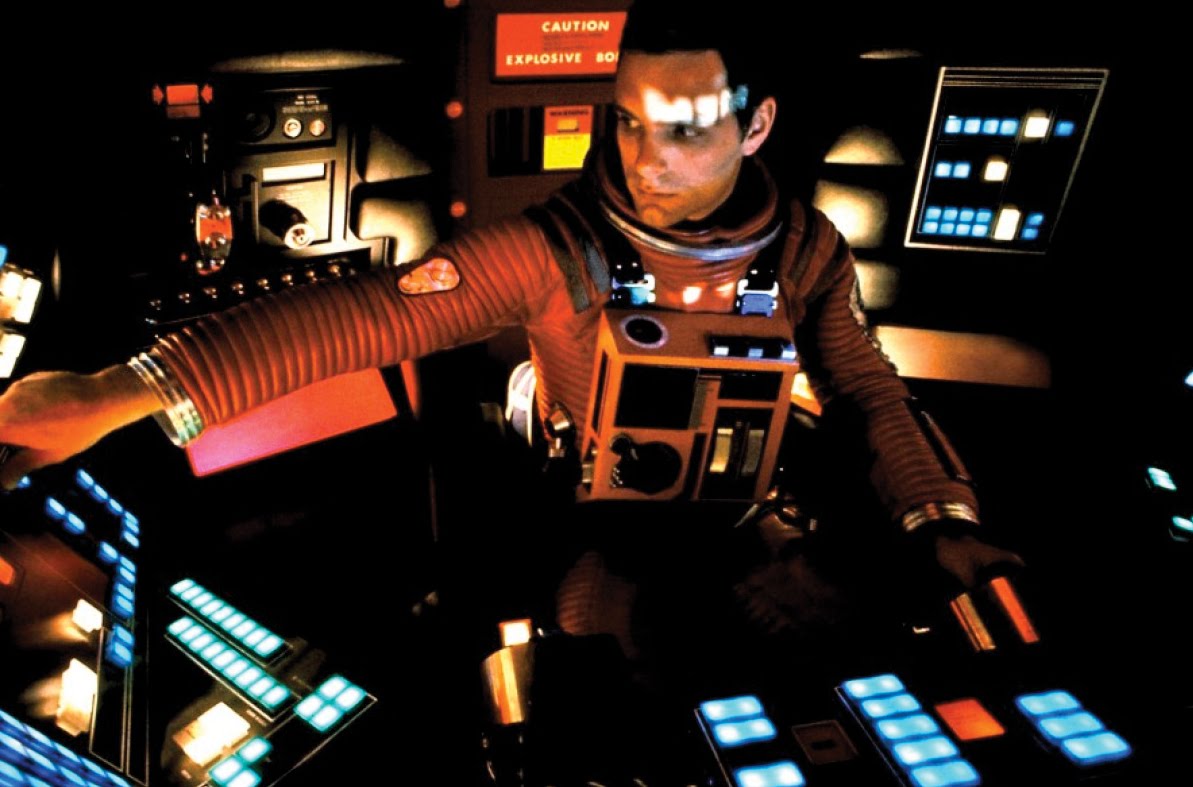
As we are introduced to the crew members, we notice that one of humanity’s tools, HAL 9000 is treated as an equal member of humanity.  HAL is uncomfortably human and the pilots are uncomfortably sub-human, with each of them meeting in the center of a humanity shaped by tools and tools becoming more human.  HAL is infinitely smarter than any single human, with greater logic and able to run the ship to such a degree that the pilots are dependent on him.


HAL, while on the trip, comprehends the true purpose of the mission, that aliens will confer on humanity the next evolutionary step.  HAL, perhaps considering humanity inferior to their tools, plots to kill the humans and to take the step himself.  HAL kills off Frank and the rest of the crew in stasis, and then isolates Dave Bowman in space.  Dave, using the mechanical system on the ship, not connected to HAL, is able to enter the ship at great risk. Although HAL has greater logic than any human, he underestimates human determination to survive, even to take on a huge risk.  Dave takes HAL’s chips out, causing him to regress to his birth.   This is the final war of humanity, the battle of whether humanity or their tools will take the next evolutionary step. 

Jupiter and Infinity
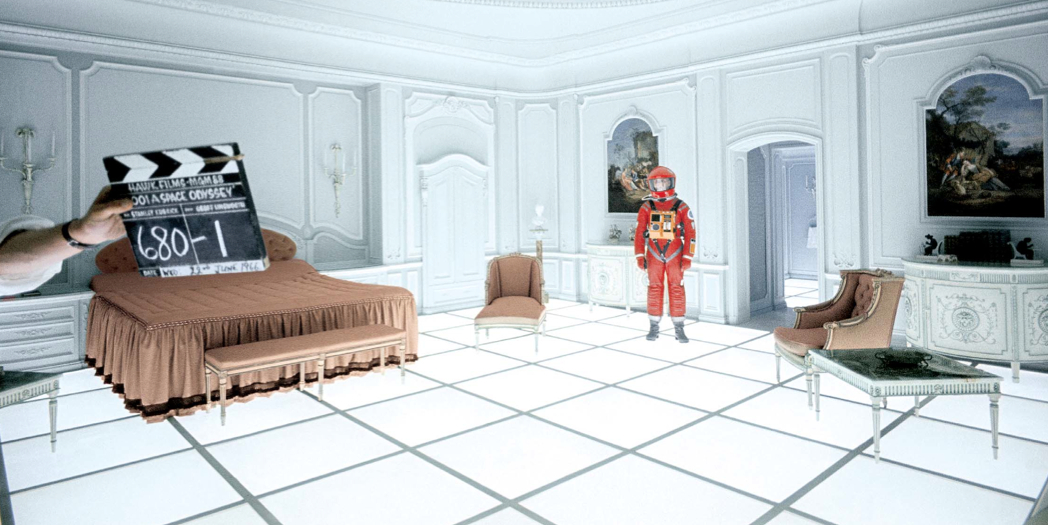
David Bowman leaves his ship behind, travels to a monolith, just beyond a moon of Jupiter.  He travels through a wormhole, into a room in which he quickly lives out the rest of his life.  At the moment of his death, he reaches out to a monolith, which transforms him into the Star Child, the mediator between humanity and the aliens, the dominating force of our solar system.

60’s Mindset
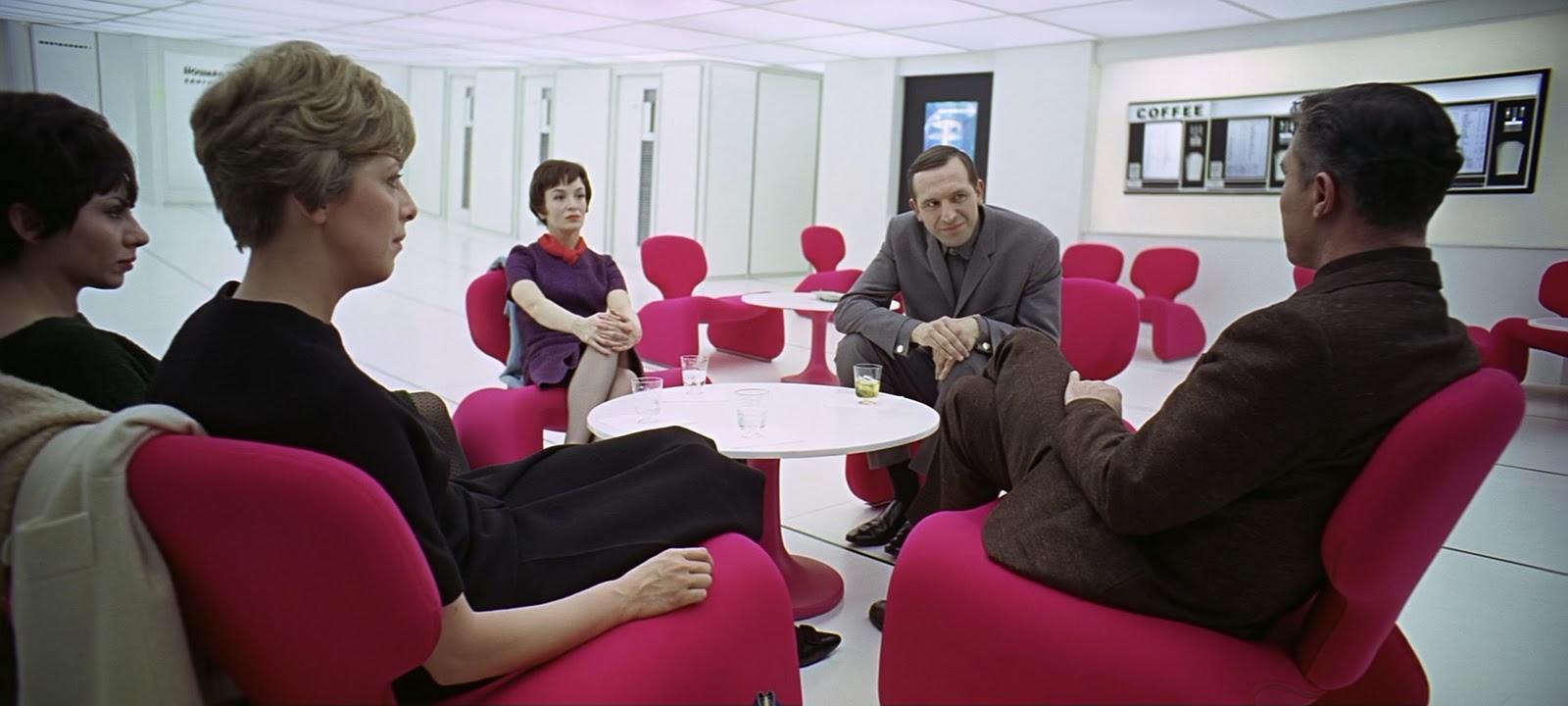
The pace is slower than any other Kubrick film, except perhaps The Shining, but why is this necessary?  It only offers to confuse and bore the audience.  I think it has to do with that the film is supposed to focus on visual spectacle, minimizing narrative—a huge picture book for the novel, or the visual outline the written novel is supposed to explain.  The slowest aspects of the film are dull to our modern eyes, but we could understand that Kubrick wanted to showcase the models of the complicated spaceships and the camera tricks that display weightlessness.  While these visual effects are commonplace today, they are unique pieces of art that Kubrick thought would keep the audience’s attention.

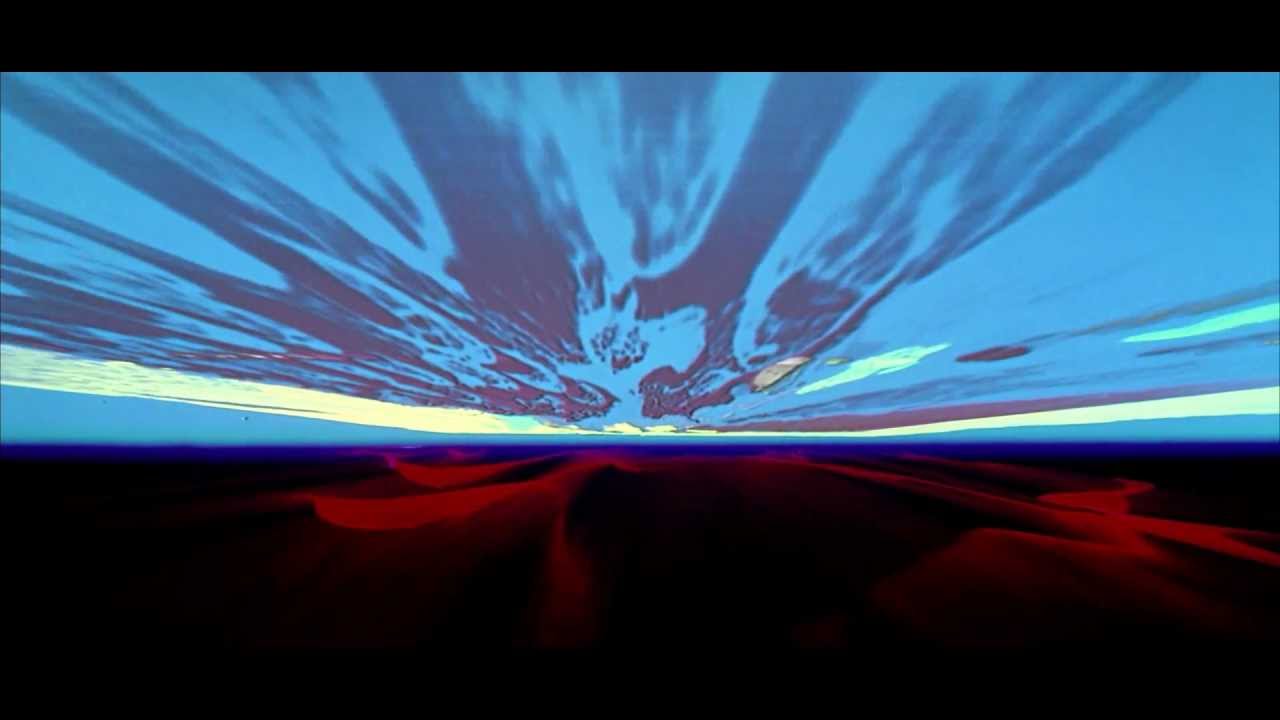
This film is very much caught in its timeframe, reminding us again and again that it is a film of the 60’s, with a 60’s vision of the future, as all visions of the future are ultimately reflections of their own time.  While the male doctors are given the title “Doctor” the female doctors are called “ladies”, and servants are all women.   The fashion is just a step beyond the time-restricted 60’s fashion, whether furniture or clothing.  The final “mind blowing” acid trip of a wormhole is little more than dye on glass, color filters and colored pen on film , and weak compared to some of the spectacle we have seen in more recent years.  As forward-thinking as the film is, it remains an obviously 60’s vision, which takes away the timelessness of most great films.

The greatest restriction of the film is the fact that it has influenced so many films after it, from Solaris to Star Wars to Tree of Life to Gravity.  There is little in the film we haven’t seen before.  Yet it is still an amazing film, worth seeing in all its 70mm glory.  The ideas might be overused by others, but its greatness shouldn’t be lost on audiences for all time. 


Friday, September 13, 2013

A Life With A Clockwork Orange

I was an older teen when I first watched A Clockwork Orange.  That isn’t a surprise, since it seems many people watch this controversial film at about that age.  The age when we are old enough to watch a movie on our own without our parent’s supervision.  A Clockwork Orange seems to be one of the first go-to films for kids of that age.  We hear rumors of the violence, the graphic nature of it, and it’s classic status.

I know that some, when they catch up with it, find it a moving experience, important.  For me, frankly, I found it disturbing and… well… I don’t know.  It is memorable, that’s for certain.  But what is it about this film that makes so many people find it significant?  I just don’t know.  I couldn’t decide about it.  And that’s where I left it for 27 years or so.

This week I decided to revisit the film.  My wife deeply questions my wisdom about that.  But I was missing something.  As I explained to her, I was so young when I saw it that I can’t really rate it fairly.  (Her response, “And that’s good enough reason to watch it?”  “Of course,” I replied.  A film buff cannot be denied a rating.) But more than that, it’s an important film experience for many people, but I can barely remember a thing.  I wanted to participate in the event with my film buff community.

So I watched it and it was as disturbing as I remembered it.  The violence, the dehumanization of women, the sociopathic activity, it was all very distressing.  It made as if to titillate with the sex and violence, but all it did was offend, which I suppose is part of the point.  I certainly did not enjoy the film in any way whatsoever.  It was clearly satiric.  Frankly, it felt like one Monty Python sketch after another, each one more over the top than the one before, but not a one was even remotely funny.  There were times I felt sick to my stomach.

And as my memories came rolling back from almost 30 years ago, I realize that I must have had some level of the same reaction back then, but to a less degree.  The one scene that I remember most clearly from my previous viewing is the scene in the bar where the plastic woman’s nipples are used as a faucet to pour the patron’s drink.  It disgusted me then and disgusts me today.  Frankly, the whole thing does.  This is similar to the film Brazil, when it communicates just how bad society has gone and seems to go too far… but at least Brazil had some laughs to break the oppression on one’s soul.  A Clockwork Orange never does.

The mocking of society is penetrating and somewhat remarkable in its insight.  Over the last 40 years since it was made, society has off and on again embraced pornography as an everyday experience, as a regular part of everyday existence.  And the result of this almost always is the objectification of women, especially young women, to just be seen as objects of lust.  Right now, pornography is as popular as ever, but it is kept private, and women are more and more regarded as equal humans. 

Another pointed jab is how we allow ourselves to be led by sociopaths.  Those who are willing to use violence or dehumanization to bully and force their way through both small groups and society at large is still a fact of life.  It is interesting that often today we see the conservatives, who demand an “eye for an eye” to be the bullies, but in this film it is the liberals, those who want to rehabilitate rather than just punish criminals, who are guilty of the greatest depth of dehumanization—by denying freedom altogether.  Not only the freedom to commit crimes, but the freedom to appreciate art as well.  In the end, our “hero” is granted an opportunity to partner with the government.  It looks like he will go far, because he is of the same type.

Our society reflects the world of A Clockwork Orange in the lack of ethical thinking.  What is essential is the outcome, not the process.  As long as all the policies are followed, and the outcome is what is accepted, then all is well, and we can enact crimes to produce that outcome.  It is fascinating to me that there are only two ethical thinkers in the film: The Chief Guard and the new roommate.  While they seem cruel at points, at least they had an ethical theory.  

One of my issues of the film is that it, like many satires, can point out the wrong in thinking, but can it determine the right?  Simple “eye for eye” punishment isn’t exactly a well-thought out ethical theory as well. 
But in the end, considering all these things, I realize that when I watched this film when I was young, the plot didn’t stick, nor did many of the scenes.  But what did stick with me was the disgust at the misogyny and the violence.  I couldn’t determine my reaction to the film because the primary emotional response was revulsion, and while I knew there was something else going on there, I couldn’t process what it was.


Now I can.  And I think that disgust and unfunny satire isn’t enough to base a great movie on, at least for me.  I nod at the bold moviemaking.  And I am glad to have had the experience of revulsion at the dehumanization of women when I was young.  But I cannot recommend this film, as noble as its intentions may seem.

Sunday, July 28, 2013

Just Another Analysis of The Shining

A family travels to paradise.  Paradise, in the ancient world, was a garden, a huge, never ending garden that had everything the family needed.  They would never have lack.

In every garden there is a temptation, a manifestation of evil that tempts them to harm and destruction.  For the man, the temptation was his entitlement, his sense that the world revolved around him and that anything that deviated from his orbit was in opposition to him.  For the woman, the temptation was her fear—partly her fear of the man, but also her fear of her inadequacy to be a good mother, to care for her child.

For the child, the temptation was Room 237.  The Hotel Overlook was the tempter, the snake, causing them all to give into their temptations, to destroy each other. 

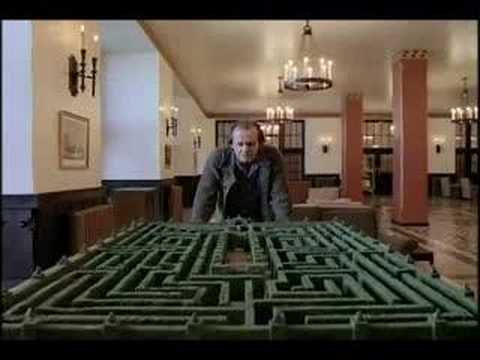
The Shining is a film that encourages thinking, and, as we see in the documentary Room 237, overthinking.  There is so much detail, so much complexity in a relatively simple story that we want to assume that it is more than it is.  And the movie is slow enough, constantly taking us through labyrinthine halls and mazes that never end, giving us ample room for our interpretations to hang themselves. 


It is this that makes the Shining a work of art.  And it is The Shining’s weakness.   Is it possible for a work of art to be full of so much detail that no real interpretation is likely?   Is the real maze not in front of the Overlook Hotel, but in our minds, and Kubrick has given us just enough to allow our own subconscious to be the true director?

How many interpretations are possible?

Thursday, May 16, 2013

The Tale of a Man: Barry Lyndon


Stanley Kubrick is the master of the hypnotic film.  I didn't really know what to expect into his excursion across the classes of the 18th century, but like The Shining and 2001 and Eyes Wide Open, his set pieces and long takes and paced action by worn people can't be set aside easily.  They lull you into a trance, so that the whole experience just washes over you until it's done and you say, "What was that about?"

One of the great aspects of this film that is different than others is his beautiful, natural scenes capped with gorgeous architecture.  So many scenes open with a picture that is a piece of art.  That only preps us for the orderly, mannered society that we are to enter into.  Mind you, the world is terribly violent, immoral and, at times horrifying, but it is all done in a stately manner, paced, even and polite.

What is the film about?  Honestly, I think I'd have to watch it again to give a semi-complete response.  But, as the title suggests, it is about a man-- and, in a sense, all men.  We see the rash nature of a young man both at the beginning and the end, implying that this is a cycle that is repeated in many men-- perhaps all men.

We begin our manhood in youth as rash, bold creatures, not really knowing what we want or what our lives are going to be about, but we are ready to commit our lives and make any sacrifice (even others' sacrifice) for our whims.  When we fail, as we inevitably do, we seek stability, but by our own terms, no matter how unwise we are.  If we are uncomfortable, we rush to the next opportunity.  Soon, we seek ambition.  This ambition might be power or lust or wealth or notoriety, but we claw for it, and hurt others to obtain our ultimate desire.

Finally, after some ambition has been reached, we might give in to our most hidden fantasies, but then we will seek to establish the stability we sought for all along.  We might be harsh in this action, and we might whittle away what good will and resources we have in this endeavor, but the long term goals will be reached by hook or by crook.

Some men actually achieve their long term goals, the stability they have worked so hard toward.  But many men only obtain the wisdom gained through the attempt.  The wisdom that to create something long lasting in the world, the main tool we must hone first is ourselves.  Because without that disciplined, forged and sometimes tarnished tool, made to build others, not ourselves, then we will ultimately fail.

The amazing thing to me is that every step of Redman Barry's story is not just foreshadowed, but foretold, but this practice did not hamper the tale at all.  The voiceover narrative was soothing yet sobering, even as the rest of the story was.  This is master storytelling.  A tale-weaver who is so confident at his skill, that he can break one rule after another and yet still succeed.  This is easily one of Kubrick's best, if not his very best.

This film has been seen by far too few people.  I hope that will change as time goes on.

Thursday, April 5, 2012

Paths of Glory: System of Leadership


The court martial movie is a well-trodden path.  And no wonder: it has the semblance of rebelling against authority, while supporting the system of authority.  It provides an opportunity for true actors to really shine in highly dramatic roles.  It has the best of both stage-- a presentation before a limited audience-- and the movies, providing context and drama outside the courtroom.  Some of the greatest movies have been court martial films: Mutiny on the Bounty, The Caine Mutiny, Breaker Morant, and A Few Good Men are among them.

Paths of Glory is certainly among them.  It stars Kirk Douglas as a Colonel in World War I, who is first ordered into a dubious battle and then forced to defend his men from accusations of cowardice.  Beside being a marvelous court martial movie, it  has one outstanding characteristic above the other films: it has amazingly good war scenes as well.  It isn't focused on the court, although it's focus is upon justice and the misuse of authority.  The most dramatic scenes are on the field.  Like another great war movie, The Life and Death of Colonel Blimp, PoG allows us to see inside the whole war machine, from those who command generals to the lowliest private.

The amazing thing about this film is that it doesn't just target a single bad commander.  Rather, it shows how the system as a whole is built to create those commanders to make decisions that unnecessarily costs lives.   How both a general and a sergeant are supported in evil decisions in order to cover their butt or to obtain a little more glory at the cost of many lives.  And it also shows how such a corrupt system cannot abide by integrity, nor even understand it.

And this makes Paths of Glory unique.  It isn't exactly an anti-war film, because Kirk Douglas, our hero and man of integrity, begins and ends a soldier.  And it doesn't just decry the misuse of authority.  Rather, it says that there is a systemic problem in all military leadership.  That is a remarkably bold statement.  Especially for a film made in the mid-50s.

I do wish that more of the supporting cast had been as stellar as some of the lead roles.  But the sound and cinematography are worthy of Academy Awards-- although the Academy didn't even give it a single nomination. The central battle scene is amazing and it seems to have influenced at least Spielberg, as I can see Saving Private Ryan and War Horse borrow aspects of it.   While not a perfect film, it's a keeper and worthy of the Kubrick label.

Oh, did I fail to mention that it was directed by Stanley Kubrick?