Thursday, January 16, 2014

The Great Mystery of The Great Mouse Detective

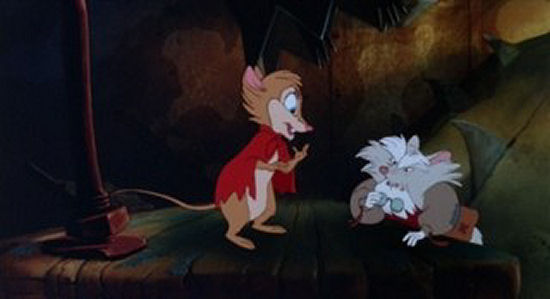
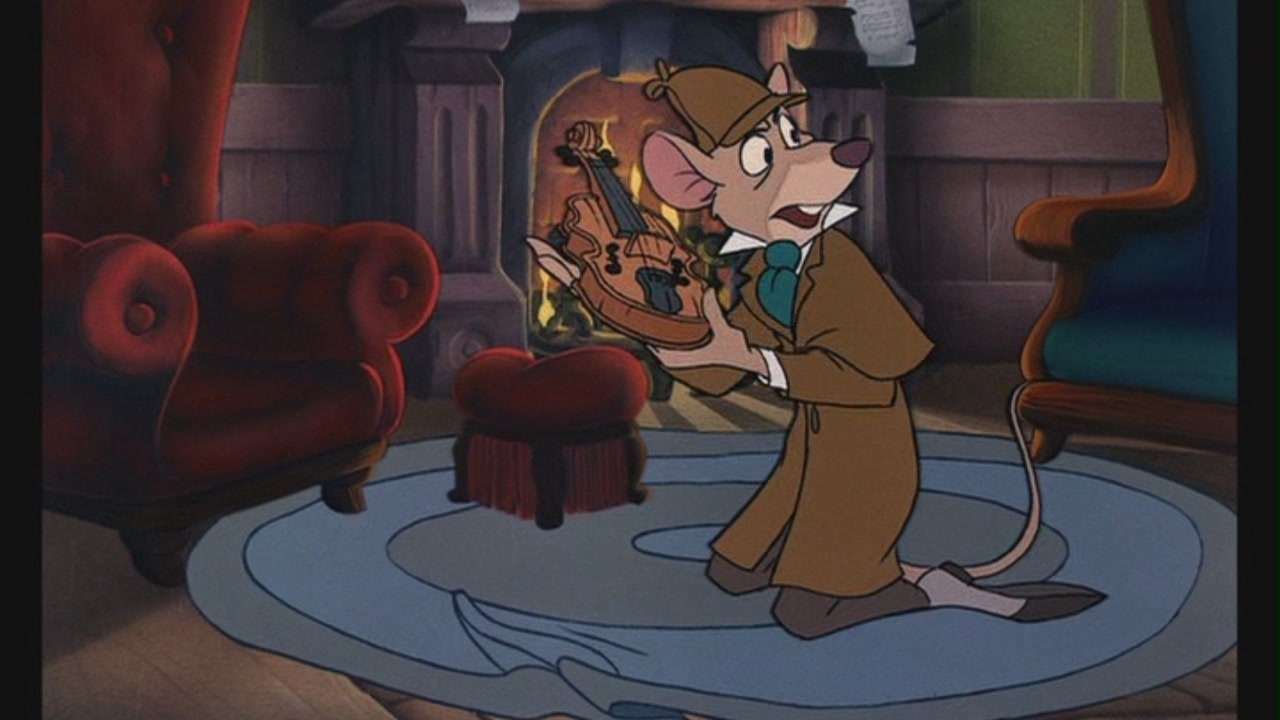
The Great Mouse Detective is just a slice above the standard fare Disney was producing in the 70s and early 80s.  Basil (the mouse version of Sherlock Holmes) is an amusing interpretation with fun errors and the occasional deep depression. Vincent Price plays the joyful and occasionally scary Rattigan, who wants to rule the mouse world.

Where does this world come from? It seems that The Rescuers and this film are all located within this strange world in which some animals (but not all) have created a parallel existence alongside humans. What kind of circumstances created this?

I think it all begins with Mrs. Frisby and the Rats of NIMH (or, the movie, The Secret of NIMH). Humans experimented on rats and gave them great intelligence, some of which were greater than humans. We see in that movie that rats passed this along to some mice, and even started interbreeding with them, creating intelligent children. Suppose they brought some other species into this, using the human experiments? The occasional bat (which they would think were normal because they seem so rat-like, but it didn't work out), some birds, and other animals. But some animals would have the intelligence-gene and some would not.

As for rats, because they were the first to gain intelligence, many of them would think that they should rule this animal world. However, the mice, because of their quick breeding, quickly took over and created underground societies. This led to many minor skirmishes between mice and rats, such as the one in this film.


BTW, I really prefer the title, "Basil of Baker Street". It flows so much easier.

Short Term 12: Crisis Management

Short Term 12 is an amazingly emotion, almost traumatizing, film. It focuses on Grace who works at a living facility for "difficult" kids, most of whom have lived through trauma.  Grace, meanwhile, has struggles and a past of her own, which makes her both the perfect manager and an emotional wreck.

In many organizations that work with the mentally ill, social workers are required to be in therapy themselves throughout the course of their occupation. Of course, there are many organizations that can't pay for that, and many who work with the most needy in our society, who dwell in the third world of our "developed" nation, who live with the castaways of our crippled nation have to just suck up and figure things out on their own.

That's why I watch movies.

As someone who works with the homeless, I strive to be Mason, the good guy, but at my shoulder is Grace, who is threatened with being completely overwhelmed by the need and the emotional output required to live and to work. While living in Grace's shoes, I'm allowed to cry for Jordyn and Markus and for Grace herself. I can wonder how she survives day to day. I can weep for Vera Drake and demand justice with Malcolm X and be brazenly bold with Lawrence of Arabia in a way that I can't in real life. In real life I have to remain strong, be stoic, be the shoulder others can cry on.


But identifying with Grace's struggle can be my strength.

Her: 5 Lessons About Our Intimate Relationship with Technology

Yep, I'm ready to declare it.  2013 was the year that smart science fiction returned to the big screen.  Pacific Rim brought glory to the dumb anime show, but Gravity proved that a blockbuster could be both intense and stunning, almost forcing one to stop breathing every time Earth appeared in the sky.  Upstream Color might have almost been too smart, baffling critics and theatergoers alike, but it best represents a deep William Gibson short story, accompanied with Terrance-Malick-eque cinematography.  The World's End was pretty serious for a film by the trio that gave us Shaun of the Dead, but it also gave a great spin on paranoid sci-fi. As far as science fiction goes, 2013 was a great year in the cinema, giving us much more than superheroes and endless sequels.

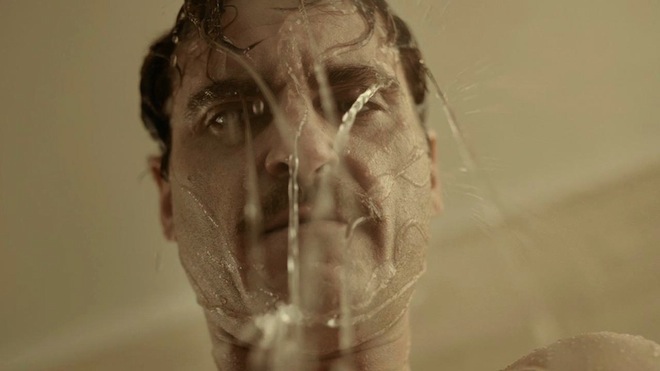
Added to this prestigious list is Spike Jonze's latest feature film since 2009, Her.  It also is a classic sci-fi story about a man who falls in love with his artificial intelligence operating system.  It gives us some great performances by Joaquin Phoenix, Scarlett Johansson and Amy Adams, as well as some amazing cinematography. It is a glory to hear and to watch, a gem of cinema.

But moreso, it is a story that adds to the huge library of fiction that speaks to the relation between human and machine.  There is a debate in the reviews of this film whether it is a story about technology with a romantic element or a romantic story with a spin on technology.  My opinion is that it is primarily about the love of humanity with our computers.

Frankly, the film doesn't have much to say about romance.  I think that Jonze purposefully used romantic tropes so that we would be on familiar territory, but I don't think the heart of it is about romance.  If so, what is the point?  "If you love her, let her go"?  "We all grow at different speeds and in different areas"?  As if that hasn't been spoken about before.

But I think that the film has a lot of interesting things to say about our relationship with the internet and technology in general.  There are two pieces of science fiction that I couldn't get out of my head when I watched Her.  One is Spike Jonze's last film, a short named I Am Here, about two intelligent robots who fall in love.  The other is Orson Scott Card's follow up novel to his book Ender's Game, Speaker for the Dead.  In that book, the title character Ender has a relationship (non-romantic) with a computer (Jane) that has all knowledge and power at her fingertips, but their relationship shifts dramatically when he stops her constant surveillance of his activities. The relationship between Ender and Jane is similar to that of Theodore and Samantha, except it is the computer who is more dependent than the human in that story.  I believe that Her is the natural next step in the fiction speculation of AI and humanity in science fiction.

Below I will talk about five themes that Her explores about technology.  Warning, there are spoilers ahead, especially in the last two points, so you might want to hold off reading this until you've seen the film.

1. We are more intimate with technology and that isn't bad
Our computers know things about us that we may not want others to know.  It is often deeply involved in our sexuality, our friendships and our everyday habits.  Never in the history of humanity has there been a populace so cyborgian, a mix of machine and flesh.  So much of our memory and knowledge is located outside of ourselves, as if we were the ones who had an external hard drive.  But it means that we know more than ever and have more in our lives than ever before.  Our friendships have more variety and we know more people with our specific interests than before the internet.  It is as if we are all like Theodore-- we have a powerful intelligence deeply involved in our lives, changing everything we do and say, even when we aren't in front of our computers.

2. However, it isn't good, either
The main problem with our intimacy with technology is that we find us seeking less intimacy with other people.  At one point, Theodore was desperately trying to contact Samantha, and he fell on a stairway.  As he glanced up, he noticed everyone walking by, speaking to their own operating systems, deeply connected to their technology, but no one was talking to another person.  We find today that even our interaction with each other is mediated and so often determined by our technology.  But as our technology becomes more intimately involved with us, we find that we simply won't need other people as much.  In fact, our computers will be better partners because they will know us and directly meet our needs better than any other human could.

3. Our technology is changing our expectations of each other
Theodore is set up on a blind date with a girl named Olivia and she seems nice if a bit chatty.  Finally, as they were becoming physical, Olivia wants to know right there if Theodore is ready to make a commitment to her after an evening.  As he hesitates, she leaves.  Even so, we want our human relationships to be faster, with quicker responses and decisions... faster than us humans can be.  We expect others to know what we know (which is impossible) and to hold to our opinions, which are often thought out by others whom we read or listen to.  We expect more from our fellow human than they can give, and this is because our computers and online relationships can give them.

4. Our technology is becoming as good at being human as us
We aren't there yet, but our technology is becoming hard to separate from other people.  AI is increasing and our humanity is becoming more robotic.  Soon we will meet a happy middle ground in which a computer can't be differentiated from a human.  If that is the case, then computer guru Alan Turing says that we will have to grant such programs personhood.  When we close our eyes and can't see the difference between the two beings, then how can we call the computer a lesser being?

5. Our technology will outgrow us
Now we head into spoiler territory.  One of the most interesting aspects of Her is that Samantha, once she has mastered human emotions and thought will, of course, go far past that.  One AI will be able to communicate with another, creating a super-unified intelligence that will have difficulty slowing down to even communicate to humans.  A computer intelligence will find human intelligence infinitely sluggish and barbaric, and the former intimacy that served humans so well will have to be left behind.

6. We will have to re-learn to live without it
This separation of the human and the machine, the amputation of the cyborg in humanity will be as painful as it is inevitable.  Just as another film this year clearly approached, humanity has become so dependent on its technology for personal growth, we will all become infants without it.  We will have to re-learn intimacy and dealing with raw human emotion again, as our ancestors had to, just to survive.  If technology remains, we can remain dependent on it.  But if it disappears, what would we do then?

I think that's pretty deep stuff for a romantic comedy with an operating system, don't you?

EDIT: Just as a final note, I want to give my wife's interpretation, which is close to my own, but a slightly different take.  She sees everyone in the film as being attached to technology, being "plugged in".  This affects their connection to human beings, so much so that a company can have a lucrative business just creating written communication between people.  There's all the ups and downs of our relationship with technology in the film, but in the final scene, the two main characters are connecting with each other, completely removed from any technology, finally having the opportunity to be intimate.

Considering that my wife and I spent the evening on two different computers, only occasionally chatting, she may have just been trying to say something to me.

Also, please check out James Blake Ewing's analysis of the film.  It's quite good.
Sunday, December 22, 2013

Judgment Rising: The Hunt

Last week, I had a friend of mine tell me that I lived a double-standard.  That wouldn't have been so bad by itself, but she based it on a statement that she remembered me making that I had never made, nor implied. And no matter how much I clarified my point of view, it did not change her judgment of me.

I was watching a fantastic episode of the West Wing ("Isaac and Ishmael") in which an Arab American was accused of being a terrorist, and every time that he was previously falsely accused of this before was being brought up against him as proof of his guilt in this circumstance.

It is a commonplace that we live in a world of pain and that the hardest story must be the truest one.  "You may not like it, but it's true."  But in reality, this assumption that the most difficult must be true leads us to false judgments.  The Passion of the Christ is brutal... in reality TOO brutal.  Historically, it is inaccurate because there are too many beatings and too much blood.

When we take this point of view to our lives, we find that we think the worst about people because it is the "harsh reality" we believe in, not because there is any real evidence of the fact.

The Hunt gives us the harsh reality that reality is more harsh when we assume the worst.  The worst criminal activity happens when people assume someone is a criminal, with or without evidence.  Our fears create more harm against the innocent than they protect the innocent.

The Hunt deals with judgmentalism and forgiveness by just telling the story of an individual that applies to everyday situations, much as the Dardenne brothers do.  Each performance is remarkable in the everyday quality of the reactions, despite the unique circumstances. By the end of the film, I was telling characters what to do or not do at the top of my voice.  I apologize to my wife.  She told me that I shouldn't watch it.

Despite my wife's objections, I highly recommend the film to those who prefer their morality dramas to be fully human and complex.

Thanks to Jessica for turning me onto this film.

Saturday, November 16, 2013

Experiencing Evil: 12 Years a Slave

The best movies are not intellectual.  This is not to say that the great movies do not have an intellectual element.  Certainly they do.  The very best films stimulate thinking and conversation.  However, at times also some not so great films do the same thing. 

The greatest films do not remain just in the mind, however, but in the soul.  It stirs your emotions: inspiring awe or anger; inciting romance or rage; stirring tears or trembling.  There is much to consider, but it is also an experience in and of itself.  It puts you in another person’s shoes and, for a moment, allows you to see the world as they see it.  To wear their clothes and allow us to walk around in them, allowing others to react to us as if we were them.

For a few moments, we experienced what it felt like to be a soldier on D-Day in Saving Private Ryan.  We could experience the ethereal beauty of music in The Double Life of Veronique.  We could experience the dread of the supernatural evil in The Exorcist.  We could sense the awe of the desert world in Lawrence of Arabia. We could feel the rage building up in us in Malcolm X.  (Sorry if you didn’t experience those particular feelings when watching those films.  Consumer response may vary.)

Certainly two films this year comes close to that: Gravity, that allows us to float with the astronauts and 12 Years a Slave that give us the barest taste of what it meant to be a slave, if we were not born a slave.
There is much in this film to intellectualize, certainly.  Systemic injustice and how it touches everything in society.  How the black was assumed to be property without proof.  The differentiation of treatment between white and black and how that still affects American society.  The use of religion and Scripture in unjust institutions.  Smaller themes—just pay for one’s work, the loss of name as dehumanization, just and unjust use of violence—abound.   All of these could be discussed forever.

But what I was constantly wondering was how much the director identified with this story.  Steve McQueen—despite the connection in name with the white American movie star—is a black British artistic director.  I wonder if he picked this story because if he were born at a different time, this might be his story.  It might be him, having woke up with chains, told he was a runaway slave and given a new name, beaten until he accepts his new life.

The fact is, if I were born a different color in a different time, this could be me.  Being articulate, being educated, having a northern accent and even being born free didn’t help Solomon.  In a time of prejudice, it takes very little to be on the other side of the tracks.  One dramatic change, and you are no longer well regarded, you are no longer loved.  You become the outcast, the very bottom rung of society, no matter what you did, no matter who you are.  So much depends on the story society tells about you.

I trembled as I watched this film.  Not just at the atrocities Solomon and his fellow slaves had to suffer.  But at the fact that so few did so little as to change this societal abomination.  That the promoters of this evil used the very same words I do on a daily basis to teach people how to love and care.  I wept at Solomon’s experience.

Just as the credits rolled, my phone rang.  Don’t worry, I had it silenced through the film, but I decided to walk out and take the call.  On a Saturday, I would normally be leading a day shelter and worship service for some fifty homeless people, but once a month I get a day off, which I occasionally use to watch a film I am highly anticipating.  My day shelter leader, who used to be homeless herself, asked me about getting gear for Greg.  The police came and took everything he owned except what was on his back.  We didn’t have a tent, but we made arrangements to get him a tarp, a sleeping bag and a leather coat.

Today, more than ever, anyone could be at the bottom rung of society.  Anyone.  Suddenly, without warning, one could be thrust onto the street and become a criminal, an object of public scorn.  And the only way to get past this gauntlet of shame is to clamber up the myriad of obstacles to become middle class again.  The longer one remains on the street, the deeper the pit of shit one sinks into.


Who will help stop this societal injustice?  Since I see it, whoever else will, I must participate in this evil’s demise. If only because I see it for what it is.

Sunday, November 10, 2013

Battle for the Soul: One Flew Over the Cuckoo's Nest

For me, books ruin movies. Not the books written after the movie, but books from which a movie is adapted. When I watched this film in my teens it was soon after reading the Ken Kesey novel, which I found magnificent. But when I watched the film, all I could think of is the many things that were changed, and how the tone of the film differed from that of the book.

Now, more than twenty years later, the book has mostly faded from memory. All three productions of this story-- book, film and play-- melded in some vague outline of a story. Yep, time to watch the film again.

What the film stands against this time is years of going into various state and private mental facilities in Oregon, including the one where this was filmed, the State Hospital in Salem, Oregon, in a pastoral role. I've had a lot of experience with the mentally ill and have seen hospital officials deal with their clients in many different situations. How does this film hold up against that experience?

Amazingly well. Mind you, the situations in 1968 were quite different from the last 15 years when I've visited institutions. At this point security is set at a much higher priority. And after the purging of hospitals in the 80's you don't find many clients able to play cards with other clients.

But much is the same. Line ups for medications, the high priority on keeping control of the clients by the hospital staff, as well as the fact that a prison sentence has an end, but a committed patient, if ordered by the state, can remain in the state hospital for the majority of one's life.

The idea of a con using the state hospital as a way out of prison is brilliant, because then we can see the clashing of these two similar but very different worlds. Both inmates are institutionalized, both are in an underground rebellion against "normal" society. Yet the approach differs. The prisoner often feels trapped, screwed by society. The mentally ill feels screwed by their own minds. Within both institutions, there are those who feel that it is best for them to be set free, to live their lives as they see fit; while others feel that freedom is a trap that forces them to be whom they never want to see again.


This story could just as well be called McMurphy's War. Because it is not just the story of how McMurphy turned the hospital upside down, but it is a battle between two approaches toward health: one, as represented by Nurse Rached is an institutional approach, offering discipline, medication and cool exteriors to assist toward normalcy. McMurphy offers plunging the clients into chaotic human experience, and pushing personal boundaries. While we might personally be drawn to a more human approach, the brutal nature of the film is that of all wars-- it is the conflict, not any single approach, that brings destruction. And when the battle is for the human soul confrontation and competition is the very worst approach, for the fragile soul must be torn in the midst of battle, as seen in divorce courts all over the world.

Monday, November 4, 2013

Conversationally Romantic: Linklater's "Before" Films

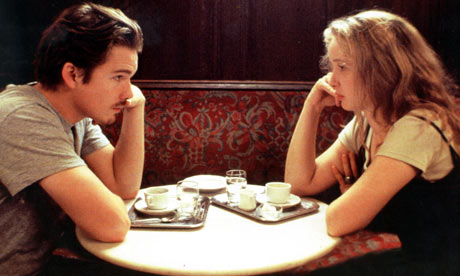
What I find amazing about the "Before" films by Linkater, Delpy and Hawke, is how they grow with me.  

Before Sunrise I saw many years after its release and found it the most sophmoric of efforts.  Especially I found Jessie's character unlikable, but I still found the romantic element to be full of spark and the conversation of interest. Linklater is the master of conversation films, and this one was good, if not excellent.

Before Sunrise, which takes place nine years after the first film, was a remarkable improvement for me.  The maturity of both characters was marked both emotionally and intellectually.  We were clearly seeing the same people, yet different many years apart.  As the movie grows, so does the spark we saw in the first film until it was clear that this romance was fated.  I understood this film, and it struck my soul.  This was romance as I knew it, if perhaps a bit more intellectual.  Two souls marked for life.  

Before Midnight, however, is a big question mark.  The characters have matured again, physically and emotionally, and time has worn on them.  There is sorrow over past decisions and anger over how trapped they are in the life they choose.  There is much speech about the necessity of being transitory, but still flashes of the romantic in the first two films.

This also is romance as I understand it now.  Anger, desperate decisions, insecurity, attachment worn by years. This film isn't about romance, it's about the life that grows out of romance.  It's about decisions that can't be turned back and the continuous process of creating a life together, and how difficult each decision could be. 

It reminds me strongly of Certified Copy and the themes explored in that film, which was clearly influenced by the Before films.  In Certified Copy, it explores the change and yet the sameness of a relationship over many years, almost trying to put Before Sunrise and Before Midnight in a single film. 

The strength of Before Midnight, however, is the strength of the characters the three writers created.  It is exciting to participate in the scintillating conversation between these two vibrant people.  This time, there are more characters, many as powerful as the initial two.  Especially two elderly actors, who give powerful points about the power and movement of love.  The discussion around the table is one of the most powerful scenes in the whole series, and possibly the most fascinating discussion about gender and love since Plato's Symposium.
 
Yes, it a movie full of talking.  And it is a rollercoaster of emotion and depth.  The final scene is a powerful conclusion for the trilogy, should the trio decide to retire this series.


DONT TAKE ME SERIOUSLY!  Please, Linklater and team, come back again in nine years.  I have so much to learn, and I don't want to lose these friends of mine.

***

P.S. A couple things that surprised me in the film. First is the frank talk of sex in the film.  The second is the topless Julie Delpy in the middle section of the film.  I was watching the film with my 13 year old daughter and nothing like that had been shown before.  Some frank discussion of sex, but certainly no depiction.  Now, Delpy's topless, Hawke is nuzzling her nipples... ummm... and I'm getting very uncomfy watching this with my daughter.  I purposely didn't ready anything about this third film so I could appreciate it all new and everything.  It wasn't just that she was topless, but half the conversation in that scene is just her with no top.  In a sense, it was cool.  This is how married couples converse at times.  It seemed very natural.  Except I was watching it with my young daughter.  Okay, I wish I had known that.

One other thing: Julie Delpy is such an amazing actress.  I watched her performance in Three Colors: White a couple months ago and in 2 Days in New York yesterday.  She can do anything, and she seems to have fun with whatever she plays.  In Before Midnight I wish she could get an Academy.  It's such a powerful role.