Showing posts with label Top 100 Movies 2012. Show all posts

Sunday, October 27, 2013

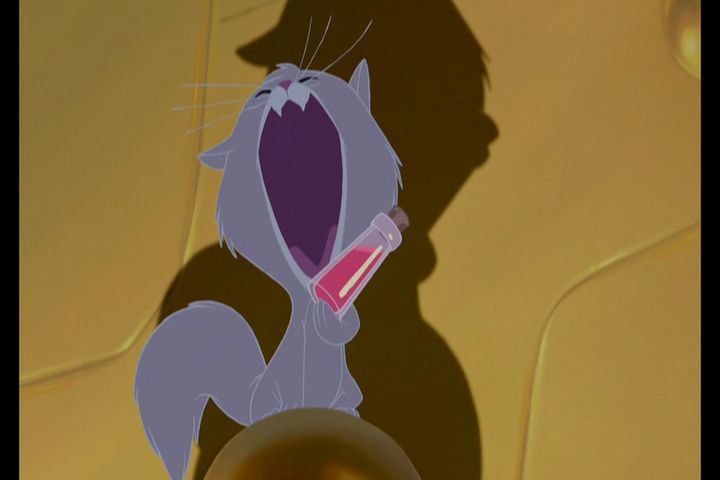
The Emperor's New Groove: It's just Funny, Okay?

There are many who were disappointed in this film before they even saw it.  It was to be called The Kingdom of the Sun and was to be the follow up to the dramatic and powerful Lion King.  Then someone *cough*MichaelEisner*cough* took the film away from Roger Allens and gave it to the comedic director Marc Dindal, reduced the budget and took away almost all the songs written by Sting for the original production.

Others don't care for this film because it's simply too light.  There is no dramatic tension, pretty much no sympathetic characters, and the moral is as obvious as the nose on a llama's face.

Nevertheless, for my money, this is the most entertaining of Disney (non-Pixar) animated films.

I grew up on Loony Toons, watching Bugs Bunny and Wile E. Coyote almost every day of my young life.  This film has the zaniness and the non-sequitur humor of those old films.  It also has a few times when the most awkward of adult conversations are placed in, just for fun. (An adopted son speaking to his mother about her much younger boyfriend: "So... he seems nice."  "Oh, he is.").  It pokes fun at every aspect of real life, from the self-importance of those who have always gotten what they wanted to brilliant ideas that occur to us in the middle of the night to the desperate importance of a minor talent of ours ("And I never liked your spinach puffs."  "Oh, she's going down").

Perhaps the voice-over narration is irritating, but if we get into the film, the irritating nature of David Spade is part of the fun, and how David Spade's character gets irritated at the David Spade narrator, tells him to "go away" and the narrator is silent throughout the rest of the film is not only brilliant, but a revenge on voice-over narration in all films.

How I love this film!  I count them by quotes that my family throw at each other almost every day:

"Uh huh, uh huh, uh huh."
"Point three: Look what I can do." "What does that have to do with..." "No, wait, he's got a point."
"Why do we even HAVE that lever?"
"Bring it on."
"No touchy"
"It's not the first time I've been thrown out of a window, and it won't be the last."
"Oh.  I feel it."
"Is that MY voice?"

Okay, I won't bore you with the silly quotes.  Enough to say that this movie works for us.  Yes, it's only entertainment.  It entertains us.  And that's what a movie is really all about, right?

Monday, August 26, 2013

Spirited Away: A Guide to the Perplexed

I have been shocked at how many of my friends have called my favorite movie of all time “incomprehensible” or “really weird.”   Well, let’s get this part out of the way: Yes, Spirited Away is my favorite movie.  The top of all my Top 100 Movies lists.  In a range from 1 to 10, I give it an 11. I honestly have a hard time imagining that another movie would ever beat it, but it’s possible.  And Hayao Miyazaki is my favorite director.  I have four of his films in my top 100.

Now, back to my friends.  It stuns me how many people watch Spirited Away for the first time and just don’t get it.  It’s too confusing, too gross, too weird.  But I’ve never felt that.  Sure, there have always been details I never got, but the heart of the film always made sense to me. 

So I write this guide to assist those who don’t understand the film.  Partly because I want you to love it as much as I, but mostly because I at least want the film to have a chance.  If it’s just one weird image after another, that’s no fun.  And Spirited Away IS fun.  I just watched it again last night and I had a big silly grin on my face all throughout the film.  Okay, let’s try to stick to the facts.  I’ll try to calm my uber-geek down.

What is this world?
So Chihiro (the girl) and her parents wander into an abandoned theme park where there seem to be ghosts and weird creatures.  And Chihiro runs into a large, beautiful building, which we are told is a “bathhouse for the spirits”, but what does that even mean?  What is this place, anyway?

This is where your Religion 101 comes in handy...  What?  You never took a Religion 101?  You were drunk when you went to Sunday School? Okay, let’s start from the beginning.

The basis of almost every religion is that there is an alternative world that we will conveniently call “the spirit world.”  It occupies the same space that we do, but we cannot see it or feel it.  Occasionally the spirits of this alternative world (which we can call “ghosts” or “demons” or “angels” depending on your spin) make small changes in our human world, but mostly they leave our world alone.  They have their place, and we have ours.  Oh, and they can see our world, but we can’t see theirs.  That sucks, huh?

Hayao Miyazaki’s universe (an alternative universe to our own, which all his films are in) is deeply influenced by Shintoism, an organized folk religion in Japan.  In fact, Miyazaki’s film My Neighbor Totoro is an excellent introduction to Shintoism.  Like many other religions, every place, every body of water, every forest and desert has their own spirit.  Totoro is a forest spirit, and the two girls are learning the way to respect and live comfortably with their local spirits, which summarizes what Shintoism is about.

What happens to Chihiro and her parents is they wander into a place where the spirit world and the human world intersect.  You can read about these places in the Bible, too—ever hear of Jacob’s Ladder?  That’s what happened to that lying thief when he stumbled across a cross point between the spirit world and the human world.  Spirited Away is about Chihiro’s adventures in one of those crossover places.

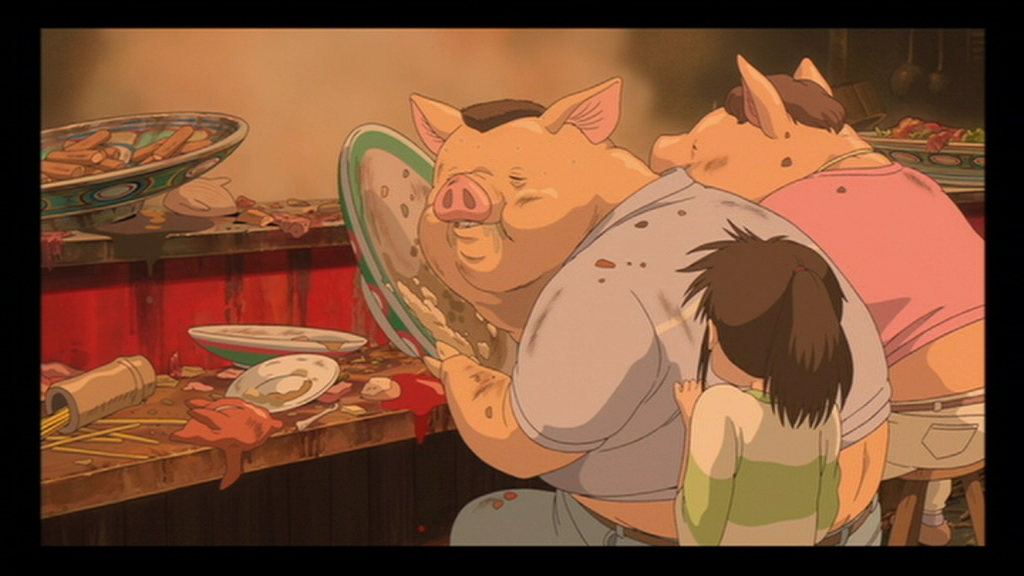
Why do Chihiro’s parents turn into pigs?
When you have crossed over to the spirit world, one of two things happen.  The first is you disappear.  That’s because humans don’t belong in the spirit world, so they wouldn’t exist there.  Haku has Chihiro eat a bit of the spirit world’s food, which gives her a place in the world.

Second, in the spirit world, you look like who you really are.  So the beautiful cheerleader who teased you in high school?  In the spirit would she’d be as ugly as her inner person was.  Even so, Chihiro’s parents showed themselves to be gluttons, so they turned into pigs.  The fact that Chihiro remained herself, shows how strong her character was.

Why does Haku help Chihiro?
Haku from the very first is concerned about Chihiro and her well-being.  But why?  As we find out more about him, we know that he isn’t a tenderhearted guy.  Everyone talks about him as the kind of person who would see a baby on the ground, crocs coming to eat him and he’d cross over on the other side of the road.  And maybe kick the baby a little closer to the crocs, just for fun.  But he goes out of his way, even to get himself in trouble, to help Chihiro.

And that’s because, we find out later in the film, Haku is a slave to Yubaba.  He’s stuck and he doesn’t know who he is, or where he came from.  And his only clue is that he recognized Chihiro.   You can see it as soon as he glances at her.  So Chihiro is his only way to escape the slavery.  Somehow, she is a clue to his identity, which he can use to escape Yubaba’s clutches.  So he has to care for her until he is able to figure out how he can use her for his own escape plan.

So why is he so mean to her in the elevator?  Because as long as he is in the bathhouse, under Yubaba’s influence, he has to be 100 percent henchman.  If she suspects that he has some connection to Chihiro, his plan is lost.  So this means that all those girls fantasizing about a romantic relationship between Haku and Chihiro… nope.  He’s not interested.  Besides, he’s a spirit—they aren’t even of the same species.

Why does Yubaba take Chihiro’s name and give her the name Sen?
Yubaba is the spirit/witch who runs the bathhouse with authority and a business-like charm.  Her character is based on the Slavic folk story Baba Yaga, who was an old witch who lived in a house with chicken legs, who was sometimes mean and sometimes very helpful.  Possibly Yubaba’s sister Zeniba is supposed to be the nice side of Yubaba?  She just gets cranky around thieves.

In the ancient world, to have another’s name is to have power over them.  So Yubaba has her workers sign away their names, so that she might obtain power.  Not just the power of them forgetting who they are, but she can use the name to put curses or other magic on people through the use of their name.  It’s interesting that Yubaba lifts most of Chihiro’s name off of the paper, leaving only the word “Sen” (because the writing style they were using is pictorial, not phonetic).   This also means that everyone’s real name in the bath house is different from what they are called.  And everyone in the bath house is desperate for money—is this so they can buy back their names and escape slavery?

What’s going on with Stinky?
Yubaba claims that a stink spirit” is coming to the bath house and everyone does their best to dissuade him away, but it’s no use.  He comes in, smells up the place like a porta-potty that no one has ever drained, and he takes his bath with Sen helping.  Sen then finds a “thorn”, which Yubaba figures out, and after Lynn ties a rope onto the thorn, everyone in the bath house has to pull it out, which is a bunch of garbage.  Yubaba then declares that it is a river spirit, and he provides everyone with wealth.  Okay, what?

So a river spirit would be a spirit that lives in a river, but is also identified with the river.  So whatever happens to the river, happens to the spirit.  The river was polluted severely to such a degree that it smelled to high heaven.  He came to the bath house to get the human debris cleaned out of him.

The great thing is how everyone works together here.  Sen had the compassion to see that something was wrong.  Yubaba had the experience and smarts to put the pieces together.  And it took Lynn and the rest of the bath house to clean the river and send him on his way.  In this movie, the little girl doesn’t do all the saving herself—she is simply the key through which saving can be started.  But it takes a community to make peace.  Or to clean up a stinky river.  Pretty clever parable, there, huh?

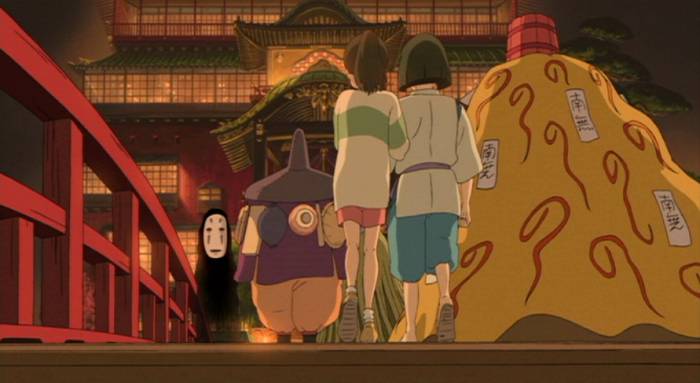
What’s the deal with No Face?
Although it’s kind of a side story, the plot surrounding No Face takes up the center of the film and it is arguably some of the most dramatic parts of the film.  And it is a key to the main theme of the movie.  Besides, much of what happens with No Face is simply gross, and why is Miyazaki putting us through all that?

No Face first appears on the bridge as Chihiro is trying to get across. He notices her immediately.  Later, Sen invites him into the bath house from a side window (oops, broke a rule there).  In response to her kindness, he tries to help her out—stealing bath tokens, for example.  He wanders about for a while, swallows a talking frog, offers some gold and demands food.  A lot of it.  All the food in the house, practically. All the while throwing gold about for everyone to get rich, while he turns into a huge, hideous monster.  Sen stumbles across him, and he offers her a huge pile of gold, which she wasn’t interested in.  Gold had nothing to do with helping Haku or her parents, so she didn’t care.  No Face then goes in a rampage, swallowing other attendants and demanding Sen.  Yubaba tries to help, but to no avail.  Finally Sen comes in, tells him he has to leave, and gives him a piece of medicine.  No Face starts vomiting all over the bath house, all the attendants and froggy comes out fine, and then he throws himself in the river, where he follows Sen to go to Zeniba’s house.

What is this insanity?

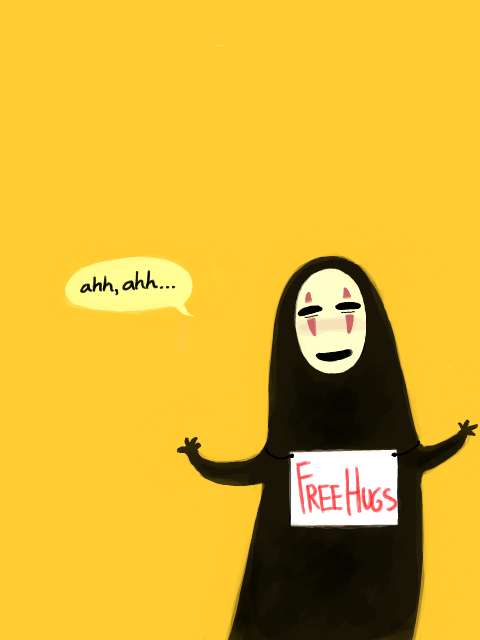
First, about No Face—he is a spirit without a center, without a base character.  He, like Haku, notices her immediately, but not because he remembers her.  He notices her because she has such a strong center.  Chihiro/Sen, from the time she enters the spirit world is determined to save.  She needs to save her parents, and then she needs to save Haku, and later she needs to save No Face.  Her center is her compassion or “love” for all of these people.  It is her determination to love that is her center throughout the film.  No Face, being an empty, lonely spirit, recognizes this immediately and is drawn to her. 

But once he gets in the bath house, he is turned away from Sen by the powerful center of the bath house itself, which is greed.  Everyone in the bath house is infected by Yubaba’s greed.  Some have the greed for gold that she does, but others have a greed for freedom, a greed for food (mmmm, roasted newt!), a greed for whatever they don’t have.  Caught up by this gluttony and avarice, he (literally) ingests it, and demands more and more, using his magic to make dirt look like gold, and an orgy of greed ensues.

But what No Face really wants is a true friend, someone who really cares about him.  So when Sen refuses his trade of gold-for-relationship (if only he had listened to the Beatles!), No Face is confused and goes on a rampage.  Realizing that Sen is the only one in the bathhouse that will give him the love he needs, he demands her like a crying toddler after his mommy.  Sen finally meets with him and realizes that he is sick, just as sick that Haku was with the paper wounds.  So she offers him the medicine, and he begins vomiting out the illness—the greed.  Only after the greed was completely expelled was he empty enough to accept the subtle but caring touches Sen offered him.

This greed v. love theme is the center of the film.  Haku got trapped in a cycle of greed when he came to the bathhouse, coming to steal magic and becoming a slave to Yubaba’s greed instead.  But he is set free from her curse by Sen’s love and compassion for him.  The parents are trapped because of their gluttony to eat that which did not belong to them, assuming that their money would buy anything.  Sen’s love and determination frees them.

Greed is a slavery that love delivers us from.  Do you hear that, capitalist pigs?

What is Spirited Away about, anyway?
Ultimately, Spirited Away is a coming of age movie, not too unlike Miyazaki’s film Kiki’s Delivery Service.  Like that movie, Spirited Away shows a girl who’s determination and hard work causes her to mature. 
But Spirited Away goes further.  At the beginning Chihiro was a normal pre-teen girl—grumpy, anxious, full of irrational complaints  (apologies to my pre-teen daughter).  The only thing that saved her in the movie was her determination to save others.  Only when she realized that her parents, Haku, No Face and others depended on her to deliver them, did she have the power to grow up.  Hard work is a factor, like all Miyazaki movies, but the hard work that makes changes in the world is the effort of compassion. That’s what makes the world better.  That’s what makes US better people.  Some people are lazy gluttons (the parents), and some people are hard working for their gold (bathhouse attendants), but to grow up, we have to determine to work for others.
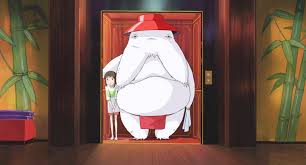

I love this movie because I love watching the imagination just go crazy.  I love watching the fanciful characters, and the adorable characters like the soot creatures, Kamaji the boilerman, and the Radish Spirit.  Yes, the Radish Spirit.  Love that guy. 


 But mostly I love this movie because I get to see Chihiro grow up.  She becomes a confident young woman, ready to face the world.  No longer naïve, but really understanding the power of compassion and how it changes people.  So awesome. 
Sunday, July 28, 2013

10 Reasons Why The Princess Bride is One of the Great Films of All Time

In 1987 I was in college and we studied hard.  A local three-dollar theatre was available and we were always looking for cheap entertainment.  A friend of my friends had seen The Princess Bride in its first run, and asked… no, actually, she demanded… that we go with her to see it.  We loved it.  It provided the perfect break from our everyday lives.  Pretty soon, we were seeing the film every week during its run at the theatre, which was a number of months.

At this point, I am a died-in-the-wool fanatic about the film.  It is a family favorite, along with a handful of Miyazaki and Monty Python and the Holy Grail.  Why do we love this film?  Let me count the ways…

1. The Two Frames
There are two versions of The Princess Bride—the movie and the 1973 novel written by the screenwriter, William Goldman. In the movie, a grandfather reads the old fashioned adventure story to his increasingly convinced grandson.  In the novel, we have a different frame.   To read the novel takes nothing away from the movie, but adds so much.  Primarily is the story of how the author of the “original” Princess Bride is S. Morgenstern who was writing a long satiric tome rejecting royalty.  Goldman’s father so loved the book he would read it to his son, but skip all the boring parts and spruce things up a bit.  Goldman sought this book for years and finally found it to read to his son, only to find it was a dusty, dull historic story.  So he rewrote the story in the way his father told it: the “good parts” version.   This story is as fictitious as the rest of the novel, but adds so much to the overall story.

2. Sincerity of the characters
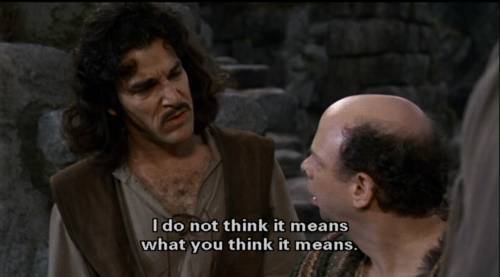
No matter how silly the story gets or the names, or the dialogue, almost every character isn’t playing as if they were in a comedy, in which they are winking at the audience.  They are serious, at times deadly serious.  It is an old-fashioned, classic movies seriousness, a Douglas Fairbanks seriousness, but it is beautiful for that.  The comedy is deepened by the sincerity of every line.  But this just goes to prove that the film isn’t just comedy.  We are truly impressed by the honor of the Dread Pirate Roberts as he dispatches but does not kill Inigo or Fezzik.   We are furious at the hypocrisy of Prince Humperdink and feel a chill at the quiet sadism of the Count.  Not only is this one of the greatest comedies, but also one of the great adventure stories ever.

3. Great names
William Goldman pulled out all the stops, becoming one of the great namers next to Dickens, Rowling and Terry Pratchett.  The Cliffs of Insanity makes us wonder why people go insane at these cliffs.  Are they so tall that looking to their top causes an aneurysm?  Humperdink  sounds vaguely nasty, almost as if Miracle Max had named him.  The Machine is chillingly vague, as if once you have experienced this machine, there really is no other machine you would ever think of.  Buttercup is so over-the-top silly that every time I hear the phrase “Princess Buttercup” I smile and have images of Saturday Morning Cartoons made to sell another cereal.  ROUS, Fire Swamp, Dread Pirate Roberts—all classic names. 

4. Peter Falk
One of the great comedy/drama character actors of all time.  He is usually undersung, because after Colombo it was hard for anyone to take him seriously.   But he is so memorable in so many films: Wings of Desire, A Woman Under the Influence are two of many amazing performances.  He makes it look so easy, as if anyone could be slyly sincere, and underhandedly benevolent.  Not anyone can.  And no one could like Peter Falk.

5. Wallace Shaun
Wallace Shaun is another undersung performer and writer.  His day job is writer, especially small plays.  But he has some excellent roles as an actor, especially in My Dinner with Andre and as Rex the Dinosaur in the Toy Story films.  But I will always remember him as the proud Vizzini, self-confident to a fault, always proclaiming “inconceivable.”

6. Excellent quotes:
“There’s not much money in the revenge business.”  
“Tyrone, you know how I love to watch you work, but I’ve got my nation’s 500th anniversary to plan, my wedding to arrange, my wife to murder and Guilder to frame for it.  I’m swamped.”
“Life is pain, Highness.  Anyone who tells you differently is selling something.”
“Anybody got a peanut?”
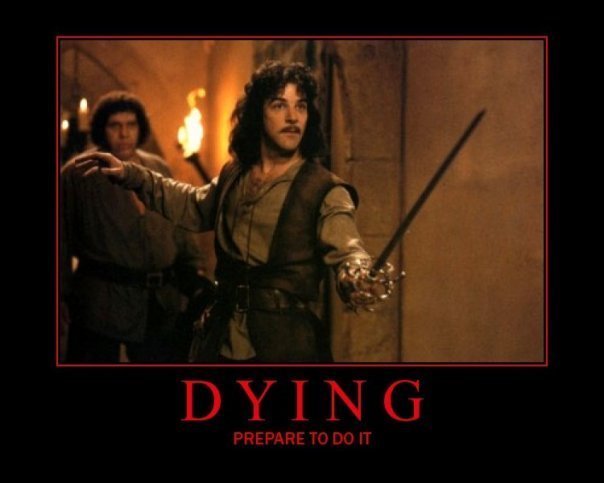
And we cannot forget the classic quote: “Hello.  My name is Inigo Montoya.  You killed my father. Prepare to die.”
That’s just a sampler.  I could fill this page with quotes.  And I will, if given half a chance.  Post your own favorite quotes in the comments, if you like.

7. Beautifully silly ideas
Goldman has created a number of concepts that enrichen the movie with comic gold:
“Mostly dead”—A person can be dead, but not really dead and then revived by forcing a large chocolate-covered pill down his throat.
“True love”—There is your regular, every-day love, but once in a while there is “true love” which cannot be broken by governments, kidnappings or even death.  And it results in remarkably effective kisses.
Brawn + sword  + brains= Unassailable plan.  Unless someone has greater brawn, sword technique and smarts.  
Iocaine powder—Odorless, tasteless, mixes well in liquid and kills instantly.  Yet a great tracker like Humperdink can sense it immediately.

8. Andre the Giant
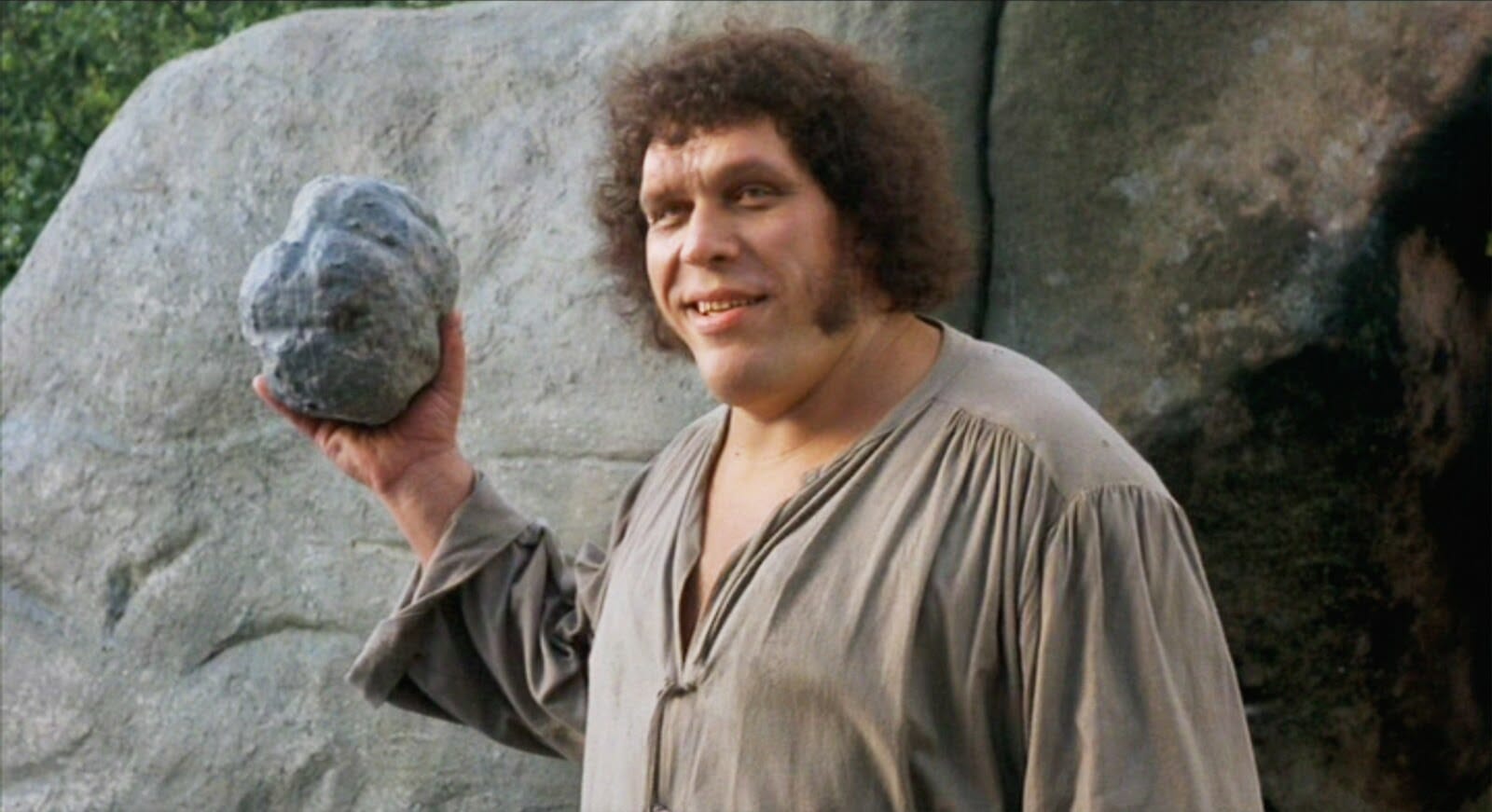
Andre first gained his fame by being a villain in opposition to Hulk Hogan in wrestling.  I never saw any of these bouts, but I find it hard to believe that he could be seen as a villain.  He was the gentlest, most wonderful people in the world.  Billy Crystal, after meeting him on the set of The Princess Bride, was inspired to make the film My Giant, in an attempt to show Andre’s real character.  Andre was famous for wanting to pay for a meal whether he was the host or guest.  At one point Arnold Schwartzanager snuck away to pay the bill ahead of him.  Andre caught wind of what he was doing, and he and Wilt Chambrilen picked Arnold up and deposited him at his car. (Can you imagine serving these three giants? Is there a restaurant that could hold them all?)  In this movie the role of Fezzik Goldman writes of Andres real nature, strong but gentle.  He died of heart failure in 1993.

9. A movie for all ages
The Princess Bride stands alongside of many Pixar films as being a true “family” film, good for both children and adults.  And it grows with one as well, even as the Wizard of Oz does.  As a child we might appreciate some of the humor and the adventure, but as we get older more and more of the humor hits home, as well as the abiding nobility. 

10. A movie for all eras
Although the frame is clearly placed in the 80s as the opening scene of the old-time baseball video game shows.  But really, this film is timeless.  The majority of the story takes place in a vaguely 18th century European fairy tale world, which could really be anytime, anywhere.  And the themes of the relationship between the grandfather and his grandson, romantic love, desire to right wrongs, and a sense of fairness never changes. 


In the end, The Princess Bride is a film for all ages, for all people.  Not everyone will appreciate the humor, for all such appreciation is subjective.  But there will never be a time in which a group of people won’t appreciate The Princess Bride, as it is one of the classic entertainments of cinema. 


Friday, July 19, 2013

Seeing and Feeling Love: Wall-E

#26-- Wall-E
It fascinates me, over the years of expressing my love for this film, that there are a number of men who agree with me, but most women I have spoken to think that it's okay, but not one of the greatest films ever made.

This is my guess as to why:

Wall-E works best as a fable about love. The environmental stuff is cool, the side characters are fun, but that's not where it tugs the heart. Yet this love-fable is really from a male perspective. Wall-E is how many men see themselves at their best. Working hard at an impossible task; lonely and romance is idealistic; we love our hobbies, but no one really understands. Finally, we fall in love, and the woman is strong, but distant... possibly even destructive (with her words, perhaps not with a laser cannon). But if a man is loyal and caring, even when she is unresponsive, he can eventually win her love.

This movie, along with perhaps City Lights, 50 First Dates, and Knocked Up (all speaking toward bumbling and perseverance winning the romance) give a particular male perspective to the idealized romance. The female version of this we have seen many times in romantic comedies-- Sleepless in Seattle, Pretty Woman. One isn't more realistic than the other, but the perspectives differ.


So call Wall-E the male (nerdy) version of a romantic comedy. But the other aspect of this film is the silence. With but a few words, all was communicated. Which makes me wonder, can we, as humans, actually recognize love without words?  Even with words, how do we know it?

You can show you care by making a Wall-E sandwich!
In the film, Eve didn't recognize Wall-E's love at first.  She thought he was cute, an idiot, imaginative, unique. The indications of his love were there when she was conscious-- the symbol of the flame, the scenes from Hello Dolly!  But it wasn't until she saw his everyday perseverance and care.  Perhaps his actions were sometimes useless or silly, but every one showed a concern and an over-the-top desire to please, to treat, to respect, to assist in achieving the other's goals.  Suddenly, Eve understood.  Perhaps for the first time she understood what love really was.  Not the hand-holding or the dancing, but the everyday concern.  

That kind of love doesn't happen right away.  It doesn't fit the quick mold that many movies require for falling in love.  It takes time and patience.  And this is why Wall-E is one of the great pieces of cinema.  It doesn't talk about love, it shows it.  It takes the times to display love in an entertaining fashion-- all with using as few words as possible.  Amazing as it is touching.

Wednesday, July 3, 2013

The Cost of Defanging Selfishness: Castle In the Sky

#68—Castle in the Sky (Laputa)

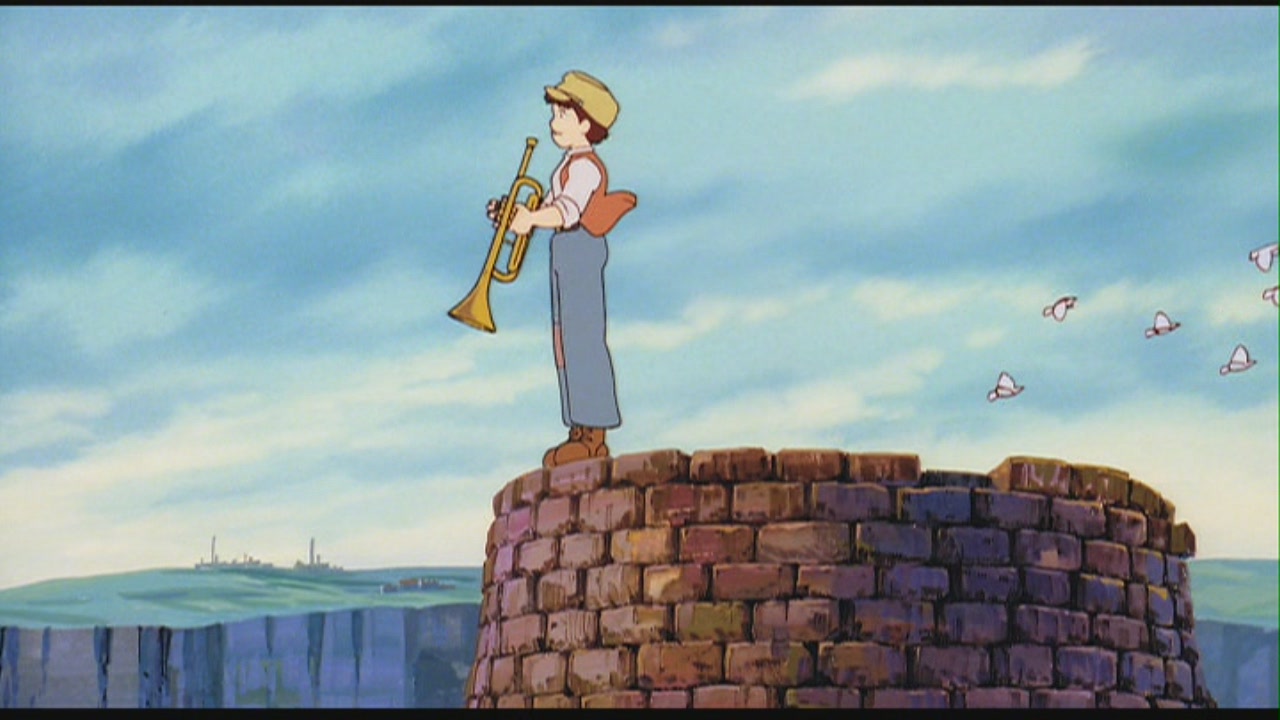
It is a small mining town in Great Britain, around the time of World War I.    Air power is just coming into its own and in Europe the great air power is Germany, with it’s magnificent floating military fortress, Goliath.  There are also air pirates to take advantage of the governments like the Dola Gang, a group of pirates under the head of their mother.  But there are also rumors and hints of an even greater power: an ancient floating city, Laputa.  Some say they have seen it, but no one is certain.  One pre-teen girl named Sheeta, however, holds the key: an amulet made of volucite (or “aetherium” in the Disney dubs) that is said to hold the key to Laputa and all its power.

This is the context of this Raiders-esque romp through a mining town and the skies above it.  It is one long chase scene, but what an exciting chase it is!  Air wars, floating girls, train chases (borrowing a bit from Keaton’s The General), a Babylonian city, secret ancient science, caves, robots (did The Iron Giant borrow from these?), military encampments—it just never stops!  The pirate boys are always around to drop a good laugh now and then, and we see the whole thing through the eyes of the ball of energy, Pazu.  Did I mention, best Pirate Mom ever?  What about awesome proto-Iron Giant robots?

The fact is, I think this film out-Raiders Indiana Jones.  It is more fun, and the heroes are real heroes and the (real) bad guys are smart and more sinister. 

Now that I’ve told you about this film, I want to give you my latest theory about Miyazaki.


No matter what kind of film he’s making, there seems to be a focused vice.  It is often repeated a number of times through each film.  In Nausicaa, it is fear—all the terrible events come about through fear of others, fear of nature, fear of what might happen.  In Princess Mononoke, it is hatred—the hatred one has of the enemy that is preventing you from living life as you think you ought to have.  In Spirited Away, it is greed—whether gluttony, greed for money or greed for love—that causes all the problems in that film. 

In Castle in the Sky, it is selfishness.  Greed is a factor, but ultimately all of the events play out because a nation and an individual wants to see reality changed from their own perspective, without regard to others.  This selfishness is caused by insulation from others and from the earth itself, to consider oneself above all others and all the earth, to see all others as simply tools for one’s own ideals.

The solution to this, as to all the vices in all Miyazaki’s films is a single solution labeled a number of different ways, even within Castle In The Sky.  It is called compassion, love, connection.  In summary, it could be called community living.  In each of the films we’ve seen in the marathon there is some kind of idyllic community used as an example.  The Valley of the Wind, the village of Prince Ashitaka are both examples of how humans can live with nature in harmony, and how people work hard for each other to create a good life for all. 

In Castle in the Sky, the idyllic community is not actually seen.  It is the community that young Sheeta was kidnapped from.  (What is it about the theme of kidnapped princesses?  Anyway…)  This is the community the Laputans formed when they determined that living in their city was too separatist, and that they needed to return to the earth, to live with nature and to the people whom they once ruled over. 

The ideal is not simply a virtue that one can live on one’s own.  There is no single hero that shines through any Miyazaki movie that solves all the problems.  Rather, solutions are determined by both heroes, leaders and community.  It is a way of life they decide to live out together.  It is a life of compassion, of concern for others, of hard work and of communion with nature.  Yes, each film has its hero, who through deep personal sacrifice, brave deeds, mediation and virtuous determination creates the opportunity for peace.  But ultimately they only point the way.  It is when the community decides to take this upon themselves that the hero’s brave deeds are fulfilled.

And in some films, such an idyllic state is never reached.  Perhaps the vice of a certain person is thwarted, but the future is still uneasy. 

With this moral basis throughout all Miyazaki films, it is no wonder that they are considered children’s films, even though Nausicaa and Princess Mononoke and Porco Rosso aren’t really for kids.  The moralism is a bit heavy handed.  Nevertheless, with all this high-mindedness, Miyazaki gives us amazing sights to see and adventures to live out in our minds.  And this is why I consider Miyazaki my favorite writer/director.  He offers us a unique and beautiful moral vision, and makes it completely entertaining.

Even with all this “made for children” action and moralizing, there is a very real point that is not for children—the position of Princess Sheeta.  In the end, she realizes that she has part control over a monstrous power to destroy whole cities.  And the other person who has control over this power is a madman, willing to not only threaten, but use this power at will.  What does she do? 

Of course, her position is the same as our own.  Some of our leaders have the power to destroy large populations with little effort.  We share in that power.  The answer in Castle in the Sky is to, of course, be rid of such weapons, at whatever cost.  The fate of innocent people is nothing compared to power, a paradise, and even our own lives.  It is worthwhile to make deep personal sacrifices for the sake of the world. 


Funny that our present world hasn’t made this decision.  I guess we don’t have the same ideals as Miyazaki.  What a shock.


Ambition and Sustainability: Princess Mononoke

#29—Princess Mononoke

Princess Mononoke is the most male-oriented of Miyazaki's films.  It has a lot of action, and although there is a love story, it isn't a significant part of the plot.  It is seen through the eyes of a young man, and it certainly is more gruesome than other Miyazaki. 

Alongside of Spirited Away, this is Miyazaki's most visually stunning films.  Every frame has so much to see and as ugly as some of the action sequences get, so many of the forest scenes are gorgeous.  Every movement is perfect, every background communicates as much as the foreground focus.  You could just turn the sound off with no subtitles and it is amazing to watch.

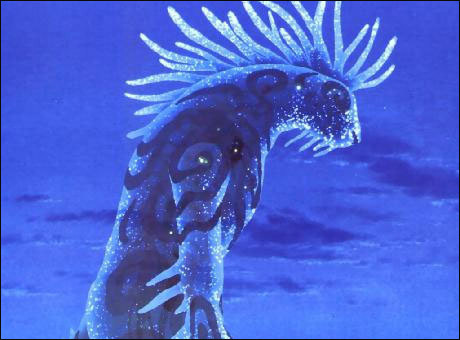
The setting is ancient Japan, just at the beginning of industrialization.  Gods roam the countryside, and every healthy tree has a spirit living with it.  The plot is focused around the wanderings of Prince Ashitaka, who is forced out of his idyllic home because he was cursed by a demonized boar-god. He gets involved in the ongoing battles of the up and coming industrial Iron Town and the gods of the nearby forest.  Ashitaka tries to remain neutral, but finds it difficult after seeing the desires to thrive on both sides of the war, and he is torn by the hatred on both sides.  And there are, of course, complications.  For one, he has fallen in love with a human on the forest side, San, who grew up with the wolf god.  And the Emperor, seeking the key to living forever, has sent a monk to retrieve the head of the forest spirit, which has the power of life.

For many of Miyazaki's movies, I think of them in pairs.  The partner to this one is Nausicaa.  They both deal with wars between communities and the connection between nature and humanity.  The great evil of Nausicaa is fear, while in Mononoke it is hatred.  At one point Ashitaka breaks up a fight between San and Lady Eboshi, saying, "You both have the same spirit," meaning hatred.  It is hatred that causes a god to become a demon and hatred that causes a human to become a monster, even if their appearance does not change. 

The point of the movie, as with Nausicaa, is that nature and humanity should be working together for the benefit of all, rather than battling each other for limited resources.  Ashitaka yells out at one point, "Why can't humans and the forest live together?"  Ashitaka is seen with distrust from all sides because he won't take a side.  But in the end, at least Lady Eboshi considers rebuilding Iron Town in a way that would not harm the forest.

Although Nausicaa takes place long after Mononoke, I think it is better to see Nausicaa before Mononoke, because the potentially idyllic relationship between humanity and nature is more clearly seen there, and the tradgedy of Mononoke can be better seen in this light. 

A question one might come from the film: "Why is it called Princess Mononoke?  She seems more like a supporting character."  I think the key is in the term.  "Mononoke" is not a name, but a word that means "spirit" or, more tellingly, "monster".  The title obviously applies to San, being as much wolf as human and siding with the spirits in the battle.  But the term also applies to Lady Eboshi, who is a marvelous ruler of her town, but when she is ruled by hatred then she is monstrous, horrific.  They are both a "princess mononoke" and it gets to the heart of the film.  For the true monster is the one who is filled with hatred for either humanity or nature-- the one who is controlled by hatred and pours it out on one's enemy. 

Because of this, I think that Lady Eboshi is the moral heart of the film, the driving force.  At first she truly does seem like a monster because from the perspective of the forest, she is ambitious, and doesn’t care what she harms in order to meet her goals.  But she is not a monster, rather she sees the needs of her people, and is just seeking peace and sustainability for them, not knowing that there is another equally sentient people that she is harming.  She and Sen despise each other and each other’s people’s because they see their opponent’s people as less than sentient, less than “human”, less than fully moral.  They hate because they do not recognize the other as an equal.  By the end of the film, Lady Eboshi especially realizes that both peoples are equally “human” and that her ambitions for sustainability can also embrace the forest.

It is easy to say that Miyazaki’s ideal is to have town and forest live together in harmony (which I just did up above).  But more than this is the ideal that the inhabitants of town and forest are equally deserving of peaceful life, and that any ideal of sustainability has to include all inhabitants of the land, not just the humans.

When I first saw Princess Mononoke almost ten years ago, I didn't find it that great.  The themes were beyond me, I think, and I couldn't grasp whether the movie was ugly or beautiful.  After seeing so many other Miyazaki, however, I can understand it better and appreciate it much more.  It still has weaknesses: I think that the motivations of the characters, especially Ashitaka, are unclear, and I spend part of the film in confusion. 

Nevertheless, I can now see that it belongs with the top Miyazaki films.  It enriches Miyazaki themes, and displays the power of animation in ways that few films can.  

Humanity and Nature: Nausicaa of the Valley of the Wind

#3--Nausicaa of the Valley of the Wind

Someone once mentioned that it is a pretty long title, but with Miyazaki one must expect that occasionally, such as Ponyo on the Cliffs By the Sea.

Nausicaa is Miyazaki's second feature film, and the first that begins using the themes that reflect his later films, among which are relationship between humanity and nature, flying machines, and war. It is based on a much longer, more complex manga written and drawn by Miyazaki.

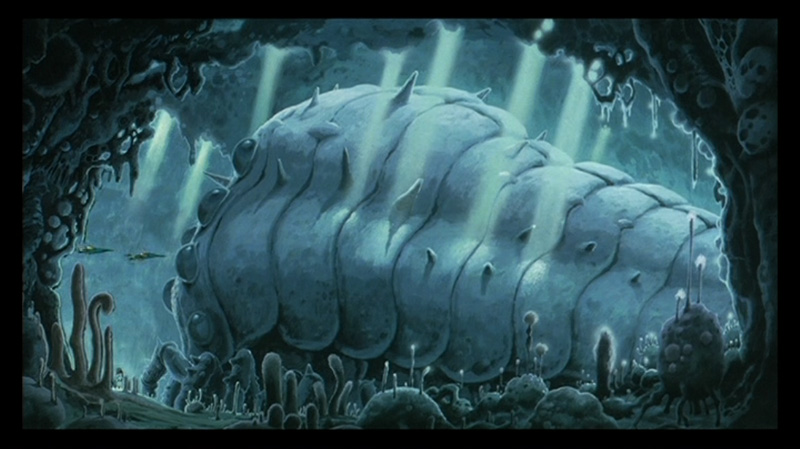
Nausicaa takes place a thousand years after human war has poisoned the soil of earth to such a degree that poisoned jungles grew up, insects became gargantuan and huge protectors of nature were created-- Ohms.  There are a number of human kingdoms, but the film deals with only three, Tolmekia-- a war-like kingdom that wants to rule the others; Pejite, the sworn enemies of Tolmekia; and the Valley of the Wind, a struggling utopia that gets caught up in the other kingdom's war. 

Nausicaa herself is Miyazaki's saint-- the ultimate peacemaker.  She is frankly an ideal Buddhist saint, who communes with all creatures, and seeks to make peace with all.  She is especially focused on creating harmony between humanity and nature, trying to heal the 1000 year old rift.  Throughout that thousand years, the poisoned jungles and humanity have been warring with each other, each attempting to overthrow the other's rule.  Only Nausicaa realizes that humanity would perish without the jungle and that the jungle can flourish under humanity's enlightened guidance.  Nausicaa is somehow able to understand the true nature of whatever she is facing.  Instead of reacting to a threat, she responds to the fear behind the threat.  Instead of seeing the death of the toxic jungle, she sees the beauty of it.  She works with the nature of whatever is before her in order to create harmony with all creatures.

Like all saints, Nausicaa presents us with an ideal of how humans should live.  We, as humans, should seek to discover the true nature of what is around us, whether human or natural, and respond to all with the care that they need. Sometimes she has to seek that true nature with research, such as the toxic forest.  Sometimes she responds with intuition, such as the fox squirrel.

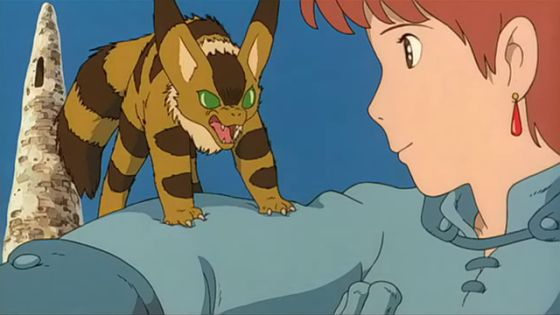
Honestly, the scene with the fox squirrel both amazes me and it is symbolic for the saint-like way Nausicaa acts throughout the film.  Master Yupa warns Nausicaa that the fox squirrel is dangerous, but she treats the small creature as if it were the cutest thing in the world.  To prove Master Yupa correct, the fox squirrel bites Nausicaa on the finger and won't let go.  But instead of reacting to her pain or to an attacking creature, she still coaxes him, comforting him.  She understands that his attack isn't personal, but a reaction to his fear.  She allows him to attack her, with no repercussions so that he can know that whatever he does, he has nothing to fear. Fear is the source of harm, the source of attack and oppression. Throughout the film, Nausicaa is placing herself in harm in order to convince others that there is nothing to fear, no need to attack or oppress. This is peacemaking in action.

On the surface, this film seems weaker than other Miyazaki.  Most Miyazaki are amazing in the detail of the world that was created for the film, and Nausicaa is no different in that.  But the dialog is less rich and entertaining, the colors seem washed, and the style of animation is not as fluid as other Miyazaki films.  Part of this, though not all, is due, I think because Miyazaki is trying to communicate the bleakness of the world in disharmony with nature.  War-- both human and natural-- has taken its toll, draining life from everything.  At the end of the film, [spoiler]after Nausicaa's messiahship is realized[/spoiler], the colors suddenly are brighter and everything changes. 

Despite it's weaknesses (including a truly lame 80s score), this film is one of my favorites of all time.  Despite it's bleakness, it is possibly the most joyful and optimistic of Miyazaki's films, and it plots out the general outline of hope for the future.  Other Miyazaki films may communicate that war is bad and that bad guys aren't really all that bad, but this film actually lays out what would need to be done to end war, to change people's hearts.  It isn't childish in any way, nor simplistic, if perhaps naive.  It communicates that self sacrifice, listening to the another's heart, boldness for another's good and some basic reasoning can create a path out of the bleak world.


Perhaps I like this film because it is very much a religious philosophy I agree with.  Perhaps it is because Nausicaa is such a strong character that to me she is the perfect moral hero.  But with each time I watch it, the higher my estimation of it is.

Thursday, March 21, 2013

When Leadership Reflects Societies Values (Being There 1979)

77. Being There (1979)


Chauncey Gardner is an up and coming politician.  He has got the support of movers and shakers.  He is becoming a powerful beacon of hope with his analogies of growing gardens and spring.

And he is a complete idiot.

Not in a bad way, mind you.  He is one of the nicest, most polite people you will ever meet (and the most rounded character Peter Sellers ever created).  But he doesn’t know about analogies, economics, politics, or votes.  He has a charming charisma, one that makes you want to think that he is saying more than he is.  He is frankly not suited to rule a household, let alone a country, as wonderful as it is to spend time with him. 
What he really likes to do is watch.  Watch TV.  His whole mindset is passive, allowing the world to pass over him, making no decisions except for the smallest changes that effects his garden, which is his sole responsibility.

And yet as a society it is frequent that we want a charming person to lead us, rather than the smart one.  It is amazing that Being There was release in 1979, a year before Reagan was elected president, who was the most charming affable person anyone could meet, but perhaps not the smartest person to run a country.  I have nothing wrong with the man, but his cabinet was full of people who took advantage of their positions for selfish gain, and caused one difficulty after another.  Both Bill Clinton and George W. Bush followed in this model.  Pleasant people, wonderful with a crowd, but not necessary the brilliant leaders the country needed to rule the world.   Who trusted untrustworthy people.  Whose leadership was so weak that almost nothing got done.  Who made deep mistakes and still cannot see what was wrong with them.

Obama, for all his moral problems, at least is a smart, capable politician, a trend away from Chauncey Gardener.   But the trend is set.  Soon we will have another Chauncey Gardner, an incapable leader who is capable at sound bites, broad ideas, and repeating what he’s heard.

What makes Being There so great is that it doesn't smash you over the head like I just did with a political message.  It is clearly a comedy, and while it is not subtle, it doesn't talk about political problems, it just shows them.  And it is truly funny.  It allows the context just soak in, while it puts our affable Chauncey into one outlandish situation after another.  

Being There wouldn't have been made except for Peter Sellers.  He wanted this film made, and he wanted to play the lead.  So it got done, no matter how many strings he had to pull. 


What Connects Revolution and Mental Breakdown? (Fight Club)


78. Fight Club (1999)

Spoilers here.  If you haven’t seen the film, don’t read this analysis.  Instead, go out and see it.

Edward Norton (nameless in the film) has unwittingly got caught up in a club of revolution.  They use creatively destructive means of communicating the degradation of consumerist society.   They are a militia, and they are about to embark on pulling the rug out from under the entire system by erasing the evidence of all financial records, allowing everyone a financial reboot.  This will both be destructive to society and cause a great opportunity for the unprivileged.  This is deeply disturbing to Edward, because he is the IKEA man, who has a love/hate relationship with consumerism, and because his good friend and roommate, Tyler Durdan is the mastermind of this militia.

What is more disturbing, of course, is when Edward finds out that Tyler is actually one of his own personalities and that he, himself, is the mastermind.  His love/hate relationship with consumer society is what is causing the revolution.  And the fact that is mind is malleable enough to create two separate personalities is what caused this destruction.

But isn’t that the case of revolution in general?  To cause the destruction of all we knew, doesn’t it take personalities that are twisted in a certain way to destroy what others hold dear?  It is one thing to talk about revolution in a general sense, but to actually purchase the guns and to enforce one’s vision of society on everyone else, isn’t that at least megalomania, if not psychopathology?  In the movie Carlos, about the real life revolutionary Carlos “the Jackel” it displays him as being on the outside, even within his own movement and less effective as he went on. 

Of course, we have brilliant people at the head of revolutions as well: George Washington, Che Guevara, Simon Bolivar, Vladimir Lenin.  The fact is, if there is a successful revolution, not only does it require megalomania on the part of a revolutionary, but also a deep societal illness that keeps people degraded and crushed, and piles guilt and punishment on the innocent.   When a revolutionary looks sane, like the best solution to societal ills, then the breakdown of society is complete.

Which is scary when Tyler Durdan or V (as in Vendetta) look more and more reasonable. 

Saturday, December 1, 2012

Is the Disciplined Life Worth Living? (Ghost Dog: The Way of the Samurai)

79. Ghost Dog: The Way of the Samurai (1999)


Ghost Dog is a man who lives by the text.  One book, Hugakure: The Book of the Samurai, determines his lifestyle, his every move, his passion and his habits.  He is a disciplined man, disciplined by the text.  He is a noble man, made noble by the noble principles which he upholds.  And he is a hit man.  For every man, no matter what their profession, is noble if they embody noble principles.

A man is not simply made by a text, however.  A principled man is made noble by how he applies the principles in a context.  A samurai must obey his master.  Thus, nobility is determined not only by the principles one follows, but by the nobility of one’s master.

The way of the samurai is not just a set of principles, but a way of looking at life as a noble war.  What if life isn’t noble?  A noble man cannot live where nobility is not honored. 

The disciplined life views all through one set of colored glasses.  Perhaps in our post-modern society, a variety of glasses, a variety of perspectives is necessary. Is nobility so great to be held above survival? Perhaps Rashomon is more noble than Hagakure. 

Ghost Dog is a film in a gritty urban criminal context based on two real books and one very cool film.  The film is Le Samourai, which stars Alain Delon as the coolest hit man ever filmed.  The one text is Hagakure, mentioned above, which is a real text and it quoted extensively in the film. To read more quotes, check it out. The final text is Rashomon, a short story by Akutagawa Ryūnosuke was made into a famous movie by Akira Kurosawa.  The story is quite different from the film and you can read it here

What Controls A Person? (Memento)


80. Memento (2001)

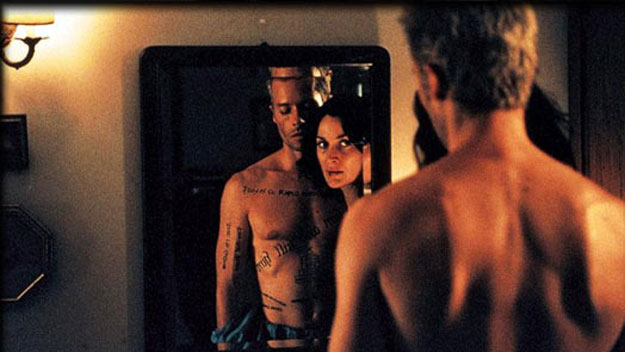
Leonard, an amnesiac, wakes up every morning having to learn the basic focus of his life: his wife was killed and the man responsible is still at large.  Leonard must track down the man and kill him, for her sake.  As the morning wears on, he discovers the notes, tattoos and clues he has left himself to discover the attacker.

As a unit, the human race is powerful, able to change the surface of the earth.  As an individual, a human being is weak.  Yes, a single human being can be amazingly creative or destructive.   single human can change the flow of history, potentially.  But any plans a human can make can be disrupted by another person.  Each person is limited by their weakness.  And if another knows a person’s weakness, in detail, they can manipulate them to their own devises.  If a person’s weakness is lust, those who have the ability to sate that lust have complete power over them.  If a person’s weakness is fear, those who manipulate fear successfully have complete control over them.

And if Leonard's weakness is obsession, the one who feeds that obsession knowingly has complete control over him.  It is not the obsession that controls him, but the one who knows how to use the obsession to make him do as they please.

To understand and use a person’s weakness is the ability to control them.

Is True Love Worth It? (The Princess Bride)


81. The Princess Bride (1987)

Sonny, True Love is the greatest thing, in the world-except for a nice MLT – mutton, lettuce and tomato sandwich— where the mutton is nice and lean and the tomato is ripe…” -Miracle Max

Not once in the midst of the Princess Bride, do we get a definition of True Love.  Nor do we see it in action, unless True Love is found in uncontrollable passionate kissing.

But we see the consequences of True Love.

Let’s just take Westley for example (spoilers ahead for both of you who haven’t yet watched the film).  For the sake of True Love,  he leaves the only home he knows, is attacked by Rodents of Unusual Size, drinks poison, becomes a pirate,  climbs a cliff, defeats a master swordsman, defeats the brute squad while paralyzed, and dies. 

You know, I don’t think that The Princess Bride is the best advertisement for True Love.  Seems to me that this nebulous idea causes an untold amount of suffering. 

Yet, oddly enough, like Fred Savage, I am strangely attracted by this odd mystery.  After all, if someone is so willing to suffer for something I do not understand, perhaps I too would like to hear more about those kissing parts.  There’s got to be something to it.

The Princess Bride is based on a novel by William Goldman where he recounts his rediscovery of the fictional S. Morgenstern classic The Princess Bride, which was primarily a political satire, but Goldman re-edited it so only the "good parts" were left.  If you loved the movie, you'll love the book just as much.

Thursday, November 29, 2012

What is the Cost of Art? (The Red Shoes, 1948)

82. The Red Shoes (1948)  

“When we first met you asked me a question to which I gave a stupid answer: You asked me whether I wanted to live and I said ‘yes’.   Actually, I want much, much more.  I want to create, to make something big out of something little…”

Vickie doesn’t want to just live, she wants to dance remarkably, memorably.  She wants the glory of being an artist.  We might give many definitions of “art” and certainly a two year old can create art without much effort or thought.  But when we speak of capital “A” Art, art as an ideal, then it becomes difficult.  Such art is not content with imitating reality, or outlining reality—such art must be bigger than reality itself. 

Just as the ballet in the Red Shoes has color more vibrant than reality can show and express emotion more poignant than reality can express, so Art is huge, requiring a canvas so large that no one can drink it in at a single glance.  Art requires not only talent and discipline but a vision that is larger than life.

Upon such a canvas nothing less than one’s life’s blood can be spilled.  To be bigger than life, Art requires life.  No one can touch the depth of a soul without placing one’s whole soul within it.  The cost, the worth of Art cannot be measured by materials, time and effort.  For who can place a cost on one’s soul?  What is a human life worth?  Art demands life, and so it is worth life.

Wednesday, November 28, 2012

Can We Live In Our Dreams? (Paprika, 2006)


83. Paprika (2006)

In Brazil, Sam chases his dreams.  In Inception, dreams are visited.  In Paprika, the line between dream and reality evaporates. 

In order to provide therapy for patients, dreams are viewed and eventually enter the real world.  But this becomes problematic, as the dream world is, at best, a cracked reflection of the real world, and our own personas in dreams are unlike who we are in reality.  In dreams, even our desires and ambitions are warped and unlike our awake selves.

Should there be no separation between dream and reality, it would be as if our evil twins came to life, accomplishing feats we would not wish to see out of our dreams.  But who can say that it is not ourselves?  Should we do an evil act in a dream, we can say that it was “only” a dream.  But if dream becomes reality, then are we not the source of the evil act, and should we not be held responsible? 

No, let it never be.  Let our dreams remain in their own ethereal, nebulous world, where they belong, mysterious and unknowable.

Must We Pursue our Desire? (Brazil, 1985; The Matrix, 1999)


84. Brazil (1985)

Sam is a low paid but expert bureaucrat who has a very specific woman in his dreams, drawing him to a utopia.  He accomplish his tasks with the utmost skill until he actually meets the woman he sees in his dream.  From that point on, he gives up on his life and pursues his dream, despite the objections of all the knows, the woman herself and the opposition of the entire system. 

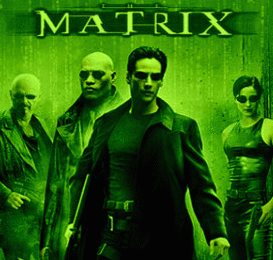
Imagination and love is all well and good, but is that worth trading in an existence in the real world?  In The Matrix, Neo trades in a false life for a harsher real one.  In Brazil, Sam makes the opposite decision—he would rather live in a glorious, unreal dream than to live in the harsh, stupid real world.  Who is to say which is the better choice?

In the end, does not the choice between the red and blue pills depend on our own deepest, heartfelt, intimate desires?  Will we not, in the end, pursue our desire, wherever it leads us?  And even though Neo chose reality and Sam chose fantasy, didn’t they each make the same choice: to pursue their true selves?