Showing posts with label Keislowski. Show all posts

Wednesday, June 20, 2012

What Does a Great Director Look Like?


Stanley Kubrick on a good day
What exactly does a director do?  A film can be a massively complex jigsaw puzzle.  There are actors, writers, producers, studio execs, cinematographers, special effects: both physical and digital, sound, music, props, make up, clothing, editing, lighting, catering, cameras, location, assistants, and more and more and more.  The director takes all of these details and works them all toward a (hopefully) coherent whole.   This is an amazing job, one that makes me wonder if it is humanly possible.  Obviously it is, with a lot of help.   What really amazes me are the directors who can produce one (or more!) films a year.  Woody Allen is a workhorse.  Johnny To is a madman.

So being a director is a difficult job, no matter whether you produce an art film, a blockbuster or something in between.   I think to call any director a “hack” isn’t fair.  Every director has a difficult job.  Some are just studio directors, producing whatever the studio told them to make—but even a studio director could be Victor Fleming who directed both The Wizard of Oz and Gone with the Wind the same year.  I don’t think any director is really lazy.  Kevin Smith might come close, but he’s such a good writer that we forgive him.  And besides, Red State wasn’t lazy directing at all.

But what makes a great film director?  What makes a director stand out from the pack?  We know a great director when we see their body of work, but what exactly does a great director do that others do not?  Below are a list of characteristics that I think great directors have:

1. Unique vision
It's a Wonderful Life
First of all a great director has a vision with the film he is creating.  Sometimes the same vision extends to different films, and sometimes a director has a different vision for each film.  Most importantly, each film has something that makes it special, that causes it to stand apart from all other films, and to be a glorious example of filmcraft.  Constantly working directors sometimes have a vision that is clearer in one film than another (everyone has a bad year), but still, a great director’s work stands out.   Frank Capra had a unique vision: that of the everyman changing the world despite opposition, and it made his films stand out in the midst of hordes of everyday films being produced in his time.

2. Theme
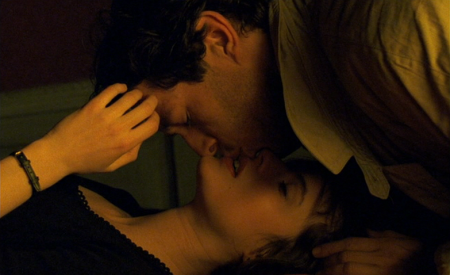
Three Colors: Blue
A great director isn’t just telling a fairy tale with a simple plot and a straightforward telling, but she or he has a theme or themes that run throughout the film, adding depth and power to the plot or characters.  Krystof Kieslowski often had simple plots with deep themes that ran through the visuals, the music, the characters and the sometimes odd events that occurred in his films.


3. Communication
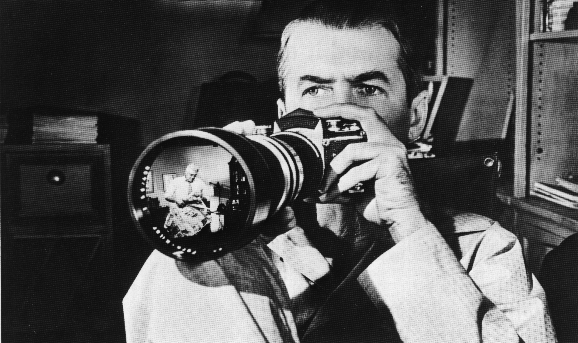
Rear Window
A good director often has themes and a unique vision, but he or she might have difficulty communicating this to his audience.  Part of this is knowing who your audience is, but a larger part is using all the complex pieces to make a coherent, never-before-seen whole that makes sense to the audience.  Hitchcock was brilliant at communicating his themes in often unique ways, using details to sometimes obviously and sometimes obliquely communicate his vision and themes.

4. Connection
The Godfather
The final aspect I want to emphasize is that a great director knows how to take all of these film pieces and to connect to his audience.  Not just that he touched them emotionally—a cat video could do that.  Rather, she or he gives his audience a memorable experience.  This director’s film isn’t just communication, it is magic.  He or she can take their work and make it a part of their audience’s life.  Their work becomes a reference point for other experiences, and the film is now a part of real life.  Even though a Mafia family is leagues away from most of our experience, the Corleone family is a part of our cultural heritage, and their unique morals and habits are a part of everyday conversation, to make us understand the rest of our world better.  “Corleone” is even in my Google spell check, for which I am very grateful.

Let's look at some directors who, I believe, are at the top of their game right now:

Howl's Moving Castle
Hayao Miyazaki—Some may say that an animator has less details to worry about.  However, those who understand animation knows that the director’s job is just as difficult to do well.  Miyazaki is a master of writing and direction. Even in his mediocre works (Lupin III; Kiki’s Delivery Service), his approach is fresh and fun.  In his masterpieces (Mononoke, Spirited Away) he is unlike any other director, yet a compelling storyteller.  At times, Miyazaki doesn’t communicate well because his stories are so foreign to us non-Asians.  Nevertheless, he wins most of us over in time because his very unique vision and compelling themes, as well as his characters that we enjoy spending time with.

Barton Fink
The Coen Brothers—I don’t appreciate some of their classic works as much as some (The Big L, Miller’s Crossing), but it doesn’t matter.  The Coens have a unique approach to storytelling, as well as unusual morals.  I have my favorites (A Serious Man, O Brother Where Art Thou, Barton Fink)… but so does everyone, and everyone’s favorites are different.  That’s a great director. Because they are both unique, but they communicate something to (almost) everyone.

Days of Heaven
Terrence Malick—Malick is a great director not just because of his message,  which is interesting, or the manner of his communication, which is unique (although sometimes hard work), but his method of creating film.  He, more than any other, takes the editing stage of filmmaking as a creative process, and by the end of his editing he may have a completely different film than the plan before the editing.  All the filming and the music are less communicating a narrative, but a concept and the film and even the plot are just resources for  him to use as toward the finished product, which isn’t realized until long after filming.  Again, that is a powerful director.

Wendy and Lucy
Kelly Reichardt—I think that Reichardt has the most unique vision of the current group of independent makers of low budget films (Miranda July might come close to that).  The stories are small and quiet, but the emotional resonance is deep and powerful.  She wants you to walk with her characters, to live their lives for a few days, even the silences and the confusion.  In this way, she hopes to teach us compassion and perspective.  I think this is powerful communication that is more than just telling a narrative.  It is throwing us in the deep end and hoping we will learn to swim.


Vera Drake
Mike Leigh—I have spent time with more real people through Mike Leigh than any other filmmaker.  Like Kelly R, Leigh throws us in the deep end of a community’s life and asks us to swim.  But the swimming isn’t deep, and often very pleasant, with only the occasional shark to gnaw on our legs.  He is a powerful filmmaker, the Michael Powell of our generation, always giving us what we don’t expect.  I can’t wait to see another film by him, which is as high a praise a director could get, I suppose.

Cache
Michael Haneke—Finally, the man who makes dramas that feel like horror films. He has a singular vision, and he seems to be determined to dismantle society bit by bit.  Everyone seems so normal, so typical, so pleasant until they are not and the underbelly of proper society is revealed.  But he also throws a generous helping of Hitchcock, presenting us with a puzzle or two that we might not ever solve.  Nor do we necessarily have to.  And if we did, we think we might exhaust ourselves.  So Heneke, for his singular vision and disturbing experiences goes on the list.


Thursday, August 11, 2011

Ain't Nothing But the Blue

A Review and Analysis of Three Colors: Blue


Have I ever told you that Krzsztof Kieslowski was a master of filmmaking?  I wish more people would see his films so more would recognize what a craftsman he really was. I don't think anyone should begin with my favorite, The Double Life of Veronique.  Perhaps some of his television show, The Decalogue. Perhaps A Short Film About Love, a film release of one of the stories of the Decalogue.

For myself, I started with Three Colors: Blue, and I was only mildly impressed by it at first.  It was so slow and didn't seem to have much of a plot. I didn't realize that Keislowski had a different style of storytelling, one that is uniquely suited to film.  He weaves all the aspect of film: the music, the characterization, the plot, the visual elements even the filter he uses in his cinematography, all of it is a symphony of a theme.  And like most symphonies, the theme may not stick out the first time you experience it.  How do you know if you want to listen to it again?  Because it won't leave you mind.  It has become a part of you.  And this is what happened to me with Blue.  The film haunted me.


It is the story of a woman dealing with her grief at the loss of her husband and daughter in a car accident.  Her grief is deep, caverns deep, but she cannot share it with anyone, so she isolates herself, trying to forget that she had ever had that life. However, life intrudes.

If you are not a fan of slow films, you will not like this movie at first blush.  However, it is not a slow film.  There is a lot going on in every scene.  What is happening is quiet, but it is powerful.  Allow yourself to be captured by it.

*        *         *

Spoilers below:

Of course, the Three Colors come from the French flag and it is well known that they are associated with the  three word motto: Liberty, Equality, Fraternity.   Like Keislowski's TV series The Decalogue, each film deals less with a certain theme, but rather reflects the whole of the subject.  Is Blue about Fraternity?  Or Liberty?  Or some aspect of each?  It might be better understood that this film deals with the opposite of them all: Isolationism.

At the beginning of the film we know nothing about Julie or her family.  We see the accident, but we have no feelings about it because we know almost nothing about them.  We only learn about the family and their day to day life as Julie is trying to destroy it, which reminds me so much of Michael Heneke's The Seventh Continent.

The grieving wife and mother feels that she can only live her life isolated from all people.  She attempts to destroy everything of her old life, leaving only the blue glass lamp to remind her of what she gave up.  What exactly does the color blue represent?  Her family, her grief that she has tried to shut out, humanity, the pain of humanity?  Perhaps all of that.  Blue is everything she no longer wants in her life.


This doesn't mean that she doesn't wallow in that same grief.  Poignient scenes take place as she swims in the pool, drenched in blue light, the only place where she allows herself to grief, to weep.  But as soon as she is with others, she dries her whole self and is as stoic, as independent as ever.  She sees a man being beaten by a group of other men and she does nothing, even when he comes to her door and seeks asylum.  She pushes away all neighborly interest because she doesn't want to be involved.

But she can't keep everyone away. A street flute player catches her interest.  A talkative neighbor impresses herself upon her.  A man at the scene of the accident finds her.  And finally, an old flame seeks her out, attempting to pull her back to life and humanity.


It is interesting to compare and contrast this film with the previous film Keislowski made: The Double Life of Veronique.  Grief is also present in that film, although the protagonist doesn't know who she is grieving for.  But two other themes are interesting connections: music and sex.

In The Double Life, music is a symbol of the spirit, that which draws one away from the earth (some disagree with my interpretation of this, and I'm okay with them being wrong).  In Blue, music is strictly fraternal.  It is a symphony with many players, many writers, a score being written for the unification of Europe.  Julie attempts to destroy it, because it is a part of everything she no longer wants to be a part of.  But it survives, because it cannot help but survive.  Life on earth is about fraternity, about connection, about association. No one can escape it forever.  The most stringent hermit, such as The Desert Fathers or a Trappist Monk in a vow of silence, none of them are completely isolated.  Rather, recognizing the need of hospitality, they welcome all who come their way.  Even so, Julie, although at first irritated by human interruption, eventually welcomes it.


Sex is also an interesting theme in both films.  In the Double Life, sex is that which keeps one bound to the flesh, attached and associated.  At first, Julie wants to use sex to show that she is just the same as any other woman, unworthy of notice, thus easy to leave alone.  But sex in Blue is clearly shown to be connection, association, intimacy with others.  Julie's neighbor says, "I can't spend a night alone" and "Everybody wants to do this"-- while Lucille was crudely talking about sex, in the end what was really meant was connection and intimacy.  Everyone wants what Julie has shut out of her life-- even Julie, although she doesn't know it.

In the end, I think that Three Colors: Blue is a magnificent symphony on how we all go through periods where we demand loneliness.  Humanity, in times of deep depression, is too much work, too many demands, too much stress.  And if we can get isolation, we might enjoy it for a time.  But humanity always beacons us back.  We are always woven together with others and we can't escape it forever.  One of the most touching parts of the film is the finale when we see the many people Julie has touched, even during her period of isolation  and the full musical piece that she has been avoiding plays in the background.


Almost at the beginning of the film, she awakens in the hospital after the accident and we see a close up of her eye.  It is empty, even hollow.  At the very end, we see her eye again, but the center of it is filled with the man with whom she has just made love, the man who dearly loves her in return.  That, in a nutshell, is the theme of the film.

Saturday, July 9, 2011

The Double Life of Veronique: Review and Analysis


Two girls are born on the same day in 1968, one in Poland, the other in France. One is called Weronika and the other Veronique.  They both are raised by loving parents, both of their mothers died young and they both have good relationships with their fathers. And even though they grew up thousands of miles apart, they both had this sense that they were not alone.  That somewhere there is a counterpart to themselves.


This is the heart of the Double Life of Veronique, and yet the film is so much more than this.  Directed by Krzysztof Keislowski, the film is much like his other films.  Like all his later films, it explores metaphysical and ethical issues.  Although the subject is very down-to-earth, the cinematography is full of ethereal beauty, full of golds and greens. It is simply one of the most stunning pieces of art ever created.

Why do you play out of tune? Is it because W sang out of tune when she died?.


In addition to that physical beauty, there is the beauty of the music.  The score was composed by Zbigniew Preisner who later also composed the beautiful score for Keislowski's next film, Three Colors: Blue.  Most of the score is a single piece of music, played or sung in different ways, different tempos with different instruments.  But the haunting, spiritual nature of the piece is perfect for the mood of the whole.


I've watched it twice now and each time I am drawn in, stunned by the beauty and power of the simple story.  It is intellectually stimulating and sensual, but somehow it is the beauty of it that captures me.  I am misty-eyed at the end of the film, and I don't know why.  It moves me as no other film does, and it is a mystery how it stirs my soul at all.  In all, The Double Life is one of my favorite films of all time.


Why the ring? Is it simply a connection between the two doppleganers?     


*   *    *


Below is the analysis, which contains spoilers and discusses details of the film: 


All of this gushing praise doesn't mean that Double Life is easy to understand.  There are a lot of seemingly meaningless details, but like all Keislowski films, the details add up to a singular whole.  Of course, the puzzle is, what is that whole?


I believe that the title is a misdirection, as is the main plot of having Veronique/Weronika be doppelgangers. Of course, it is significant, but it doesn't really add much to the main point of the theme.  This theme can be found right at the first two shots of the film.   


First, we see Weronika as a small girl, being held by her mother.  Her mother is interpreting what little Weronika is seeing: an upside down Polish city.  But rather than draw her attention to the city itself, her mother tells her to "look" at the stars.  And this heaven-gaze directs all of Weronika's life, which takes up the first half hour of the film.


Weronika is pulled back and forth between joy and a kind of an illness throughout her portion of the film. She is addicted to heaven, to the spirit realm. Keislowski puts many different symbols of this spiritual, non-earthy, viewpoint throughout the film: stars, rain, seeing the world upside down, but the main basis of spirituality in this film is art: music, dancing, drawing. And the purer the art, the more it is art for its own sake, the more spiritual the art is.  And thus, the less it belongs with the earth.


The illness Weronika struggles with is, frankly, a spiritual sickness.  She is so caught up with the spirit world that her body has a hard time living.  When she sings to practice for her recital, she is so weak she can barely walk.  She becomes pale and her eyes wander.  The connection to the spirit is the greatest joy in her life, but it finally kills her when she completely surrenders herself to the music.


Why did she not die before?  Because of her connection to the flesh, to the earth.  The earthly is seen in her relationship with her boyfriend, in her helping a friend in a legal situation. And whenever see connects in those ways, she becomes grounded again and her body is able to endure.  The funniest example of this is when, after a particularly spiritual practice for her concert, she wobbles out to the street and almost collapses onto a bench.  A man in a trench coat comes by and opens his coat, exposing himself.  This "grounds" Weronika, giving her a connection to the earth once more, so she feels better and gets up. 


In the end, Weronika's commitment to the spiritual kills her, because a soul so connected to the heavens can no longer live on earth.


Veronique, although a copy of Weronika in so many ways, is, in this aspect her opposite.  In the opening scene, Veronique is also with her mother, but her mother is showing her a leaf, describing the details.  Veronique is the one who is focused on the earth, on the flesh.
Love's not enough, in itself.  Or is it? 


The first scene in which the adult Veronique is focused on, we see her having casual sex with someone she hasn't seen for a long time. This demonstrates her groundedness.  But this is happening right at the same time as Weronika's death, an Veronique feels it.  Suddenly, in the middle of the lovemaking, she grieves.  She can't stop herself from crying and it makes no sense to her. This is because she has been free to live a life completely grounded, because her counterpart was living a life in the spirit.  Both are unbalanced, both are one-sided, because they had the other who unknowingly balanced them. Veronique has remained somewhat balanced, seeking music in a class instead of the pure form (she quits personal development of her music after her greiving).   


When Weronika dies, however, Veronique is imbalanced, undirected, seeking stasis.  And she finds this balance in the form of a marionette artist, Alexandre (as a side note, W's boyfriend and V's sought lover's names both begin with "A").  Just his art communicates balance, in that his art is embodied, grounded at all times.  There is always an audience and always a human shown behind the puppet.  His art is the kind of balance Veronique now so desperately seeks.


And for the rest of the film she seeks him and he seeks her.  In the climax, her grief for the loss of Weronika threatens to overwhelm her, but Alexandre makes love to her through her grief.  He brings her back to earth.   Because, for Veronique, her grieving of her lost spirit-component threatened to undo her. But the love of another, frankly, sex itself, grounds her, gives her balance between the grief and continued living in the world.  In the final shot, Veronique is touching a tree, even as her mother showed her the leaf, guiding her to the path of embodiment


I'd love to hear any comments on my analysis.