Showing posts with label Miyazaki. Show all posts

Monday, August 26, 2013

Spirited Away: A Guide to the Perplexed

I have been shocked at how many of my friends have called my favorite movie of all time “incomprehensible” or “really weird.”   Well, let’s get this part out of the way: Yes, Spirited Away is my favorite movie.  The top of all my Top 100 Movies lists.  In a range from 1 to 10, I give it an 11. I honestly have a hard time imagining that another movie would ever beat it, but it’s possible.  And Hayao Miyazaki is my favorite director.  I have four of his films in my top 100.

Now, back to my friends.  It stuns me how many people watch Spirited Away for the first time and just don’t get it.  It’s too confusing, too gross, too weird.  But I’ve never felt that.  Sure, there have always been details I never got, but the heart of the film always made sense to me. 

So I write this guide to assist those who don’t understand the film.  Partly because I want you to love it as much as I, but mostly because I at least want the film to have a chance.  If it’s just one weird image after another, that’s no fun.  And Spirited Away IS fun.  I just watched it again last night and I had a big silly grin on my face all throughout the film.  Okay, let’s try to stick to the facts.  I’ll try to calm my uber-geek down.

What is this world?
So Chihiro (the girl) and her parents wander into an abandoned theme park where there seem to be ghosts and weird creatures.  And Chihiro runs into a large, beautiful building, which we are told is a “bathhouse for the spirits”, but what does that even mean?  What is this place, anyway?

This is where your Religion 101 comes in handy...  What?  You never took a Religion 101?  You were drunk when you went to Sunday School? Okay, let’s start from the beginning.

The basis of almost every religion is that there is an alternative world that we will conveniently call “the spirit world.”  It occupies the same space that we do, but we cannot see it or feel it.  Occasionally the spirits of this alternative world (which we can call “ghosts” or “demons” or “angels” depending on your spin) make small changes in our human world, but mostly they leave our world alone.  They have their place, and we have ours.  Oh, and they can see our world, but we can’t see theirs.  That sucks, huh?

Hayao Miyazaki’s universe (an alternative universe to our own, which all his films are in) is deeply influenced by Shintoism, an organized folk religion in Japan.  In fact, Miyazaki’s film My Neighbor Totoro is an excellent introduction to Shintoism.  Like many other religions, every place, every body of water, every forest and desert has their own spirit.  Totoro is a forest spirit, and the two girls are learning the way to respect and live comfortably with their local spirits, which summarizes what Shintoism is about.

What happens to Chihiro and her parents is they wander into a place where the spirit world and the human world intersect.  You can read about these places in the Bible, too—ever hear of Jacob’s Ladder?  That’s what happened to that lying thief when he stumbled across a cross point between the spirit world and the human world.  Spirited Away is about Chihiro’s adventures in one of those crossover places.
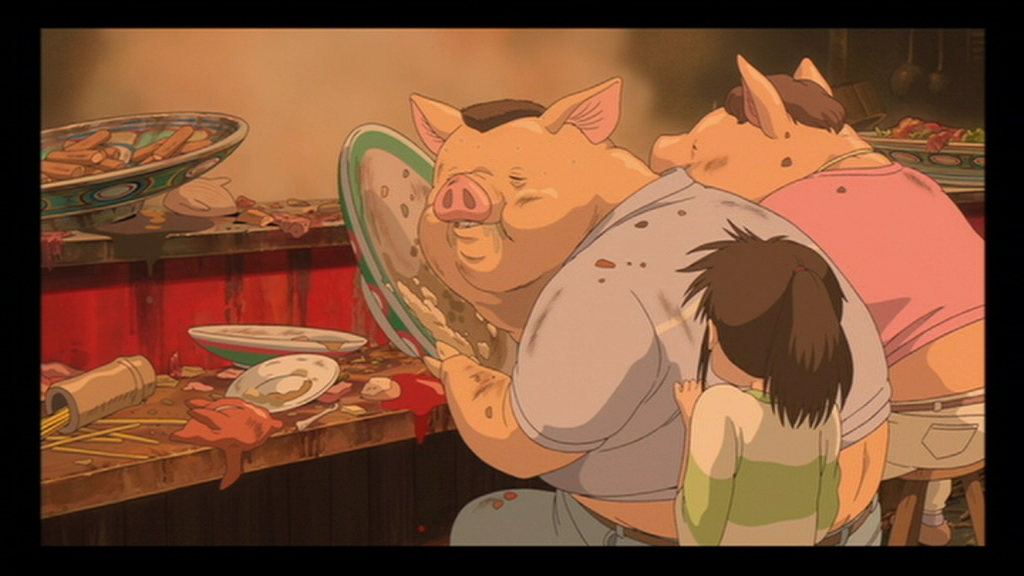
Why do Chihiro’s parents turn into pigs?
When you have crossed over to the spirit world, one of two things happen.  The first is you disappear.  That’s because humans don’t belong in the spirit world, so they wouldn’t exist there.  Haku has Chihiro eat a bit of the spirit world’s food, which gives her a place in the world.

Second, in the spirit world, you look like who you really are.  So the beautiful cheerleader who teased you in high school?  In the spirit would she’d be as ugly as her inner person was.  Even so, Chihiro’s parents showed themselves to be gluttons, so they turned into pigs.  The fact that Chihiro remained herself, shows how strong her character was.
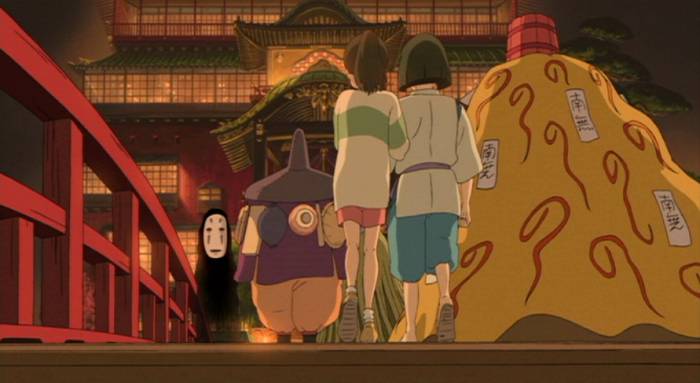
Why does Haku help Chihiro?
Haku from the very first is concerned about Chihiro and her well-being.  But why?  As we find out more about him, we know that he isn’t a tenderhearted guy.  Everyone talks about him as the kind of person who would see a baby on the ground, crocs coming to eat him and he’d cross over on the other side of the road.  And maybe kick the baby a little closer to the crocs, just for fun.  But he goes out of his way, even to get himself in trouble, to help Chihiro.

And that’s because, we find out later in the film, Haku is a slave to Yubaba.  He’s stuck and he doesn’t know who he is, or where he came from.  And his only clue is that he recognized Chihiro.   You can see it as soon as he glances at her.  So Chihiro is his only way to escape the slavery.  Somehow, she is a clue to his identity, which he can use to escape Yubaba’s clutches.  So he has to care for her until he is able to figure out how he can use her for his own escape plan.

So why is he so mean to her in the elevator?  Because as long as he is in the bathhouse, under Yubaba’s influence, he has to be 100 percent henchman.  If she suspects that he has some connection to Chihiro, his plan is lost.  So this means that all those girls fantasizing about a romantic relationship between Haku and Chihiro… nope.  He’s not interested.  Besides, he’s a spirit—they aren’t even of the same species.

Why does Yubaba take Chihiro’s name and give her the name Sen?
Yubaba is the spirit/witch who runs the bathhouse with authority and a business-like charm.  Her character is based on the Slavic folk story Baba Yaga, who was an old witch who lived in a house with chicken legs, who was sometimes mean and sometimes very helpful.  Possibly Yubaba’s sister Zeniba is supposed to be the nice side of Yubaba?  She just gets cranky around thieves.

In the ancient world, to have another’s name is to have power over them.  So Yubaba has her workers sign away their names, so that she might obtain power.  Not just the power of them forgetting who they are, but she can use the name to put curses or other magic on people through the use of their name.  It’s interesting that Yubaba lifts most of Chihiro’s name off of the paper, leaving only the word “Sen” (because the writing style they were using is pictorial, not phonetic).   This also means that everyone’s real name in the bath house is different from what they are called.  And everyone in the bath house is desperate for money—is this so they can buy back their names and escape slavery?

What’s going on with Stinky?
Yubaba claims that a stink spirit” is coming to the bath house and everyone does their best to dissuade him away, but it’s no use.  He comes in, smells up the place like a porta-potty that no one has ever drained, and he takes his bath with Sen helping.  Sen then finds a “thorn”, which Yubaba figures out, and after Lynn ties a rope onto the thorn, everyone in the bath house has to pull it out, which is a bunch of garbage.  Yubaba then declares that it is a river spirit, and he provides everyone with wealth.  Okay, what?

So a river spirit would be a spirit that lives in a river, but is also identified with the river.  So whatever happens to the river, happens to the spirit.  The river was polluted severely to such a degree that it smelled to high heaven.  He came to the bath house to get the human debris cleaned out of him.

The great thing is how everyone works together here.  Sen had the compassion to see that something was wrong.  Yubaba had the experience and smarts to put the pieces together.  And it took Lynn and the rest of the bath house to clean the river and send him on his way.  In this movie, the little girl doesn’t do all the saving herself—she is simply the key through which saving can be started.  But it takes a community to make peace.  Or to clean up a stinky river.  Pretty clever parable, there, huh?

What’s the deal with No Face?
Although it’s kind of a side story, the plot surrounding No Face takes up the center of the film and it is arguably some of the most dramatic parts of the film.  And it is a key to the main theme of the movie.  Besides, much of what happens with No Face is simply gross, and why is Miyazaki putting us through all that?

No Face first appears on the bridge as Chihiro is trying to get across. He notices her immediately.  Later, Sen invites him into the bath house from a side window (oops, broke a rule there).  In response to her kindness, he tries to help her out—stealing bath tokens, for example.  He wanders about for a while, swallows a talking frog, offers some gold and demands food.  A lot of it.  All the food in the house, practically. All the while throwing gold about for everyone to get rich, while he turns into a huge, hideous monster.  Sen stumbles across him, and he offers her a huge pile of gold, which she wasn’t interested in.  Gold had nothing to do with helping Haku or her parents, so she didn’t care.  No Face then goes in a rampage, swallowing other attendants and demanding Sen.  Yubaba tries to help, but to no avail.  Finally Sen comes in, tells him he has to leave, and gives him a piece of medicine.  No Face starts vomiting all over the bath house, all the attendants and froggy comes out fine, and then he throws himself in the river, where he follows Sen to go to Zeniba’s house.

What is this insanity?

First, about No Face—he is a spirit without a center, without a base character.  He, like Haku, notices her immediately, but not because he remembers her.  He notices her because she has such a strong center.  Chihiro/Sen, from the time she enters the spirit world is determined to save.  She needs to save her parents, and then she needs to save Haku, and later she needs to save No Face.  Her center is her compassion or “love” for all of these people.  It is her determination to love that is her center throughout the film.  No Face, being an empty, lonely spirit, recognizes this immediately and is drawn to her. 

But once he gets in the bath house, he is turned away from Sen by the powerful center of the bath house itself, which is greed.  Everyone in the bath house is infected by Yubaba’s greed.  Some have the greed for gold that she does, but others have a greed for freedom, a greed for food (mmmm, roasted newt!), a greed for whatever they don’t have.  Caught up by this gluttony and avarice, he (literally) ingests it, and demands more and more, using his magic to make dirt look like gold, and an orgy of greed ensues.

But what No Face really wants is a true friend, someone who really cares about him.  So when Sen refuses his trade of gold-for-relationship (if only he had listened to the Beatles!), No Face is confused and goes on a rampage.  Realizing that Sen is the only one in the bathhouse that will give him the love he needs, he demands her like a crying toddler after his mommy.  Sen finally meets with him and realizes that he is sick, just as sick that Haku was with the paper wounds.  So she offers him the medicine, and he begins vomiting out the illness—the greed.  Only after the greed was completely expelled was he empty enough to accept the subtle but caring touches Sen offered him.

This greed v. love theme is the center of the film.  Haku got trapped in a cycle of greed when he came to the bathhouse, coming to steal magic and becoming a slave to Yubaba’s greed instead.  But he is set free from her curse by Sen’s love and compassion for him.  The parents are trapped because of their gluttony to eat that which did not belong to them, assuming that their money would buy anything.  Sen’s love and determination frees them.

Greed is a slavery that love delivers us from.  Do you hear that, capitalist pigs?

What is Spirited Away about, anyway?
Ultimately, Spirited Away is a coming of age movie, not too unlike Miyazaki’s film Kiki’s Delivery Service.  Like that movie, Spirited Away shows a girl who’s determination and hard work causes her to mature. 
But Spirited Away goes further.  At the beginning Chihiro was a normal pre-teen girl—grumpy, anxious, full of irrational complaints  (apologies to my pre-teen daughter).  The only thing that saved her in the movie was her determination to save others.  Only when she realized that her parents, Haku, No Face and others depended on her to deliver them, did she have the power to grow up.  Hard work is a factor, like all Miyazaki movies, but the hard work that makes changes in the world is the effort of compassion. That’s what makes the world better.  That’s what makes US better people.  Some people are lazy gluttons (the parents), and some people are hard working for their gold (bathhouse attendants), but to grow up, we have to determine to work for others.


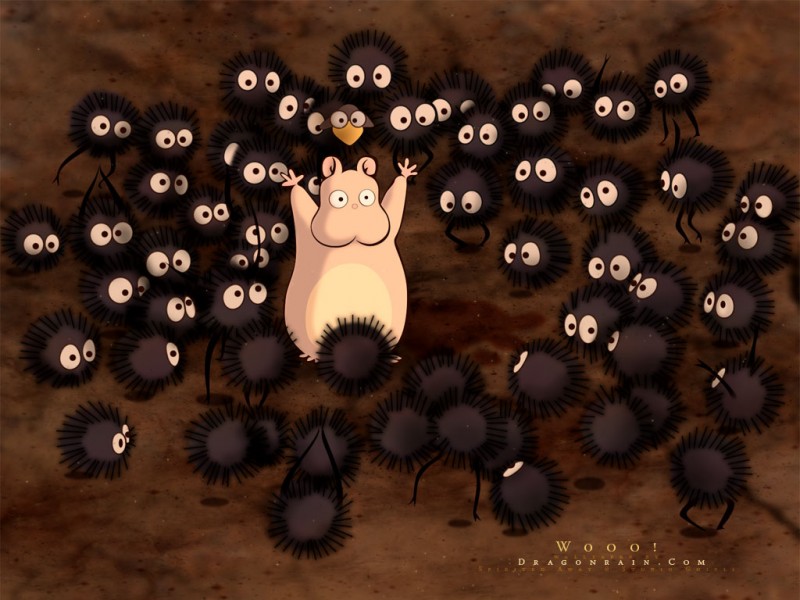
I love this movie because I love watching the imagination just go crazy.  I love watching the fanciful characters, and the adorable characters like the soot creatures, Kamaji the boilerman, and the Radish Spirit.  Yes, the Radish Spirit.  Love that guy. 


 But mostly I love this movie because I get to see Chihiro grow up.  She becomes a confident young woman, ready to face the world.  No longer naïve, but really understanding the power of compassion and how it changes people.  So awesome. 

Wednesday, July 3, 2013

The Cost of Defanging Selfishness: Castle In the Sky

#68—Castle in the Sky (Laputa)

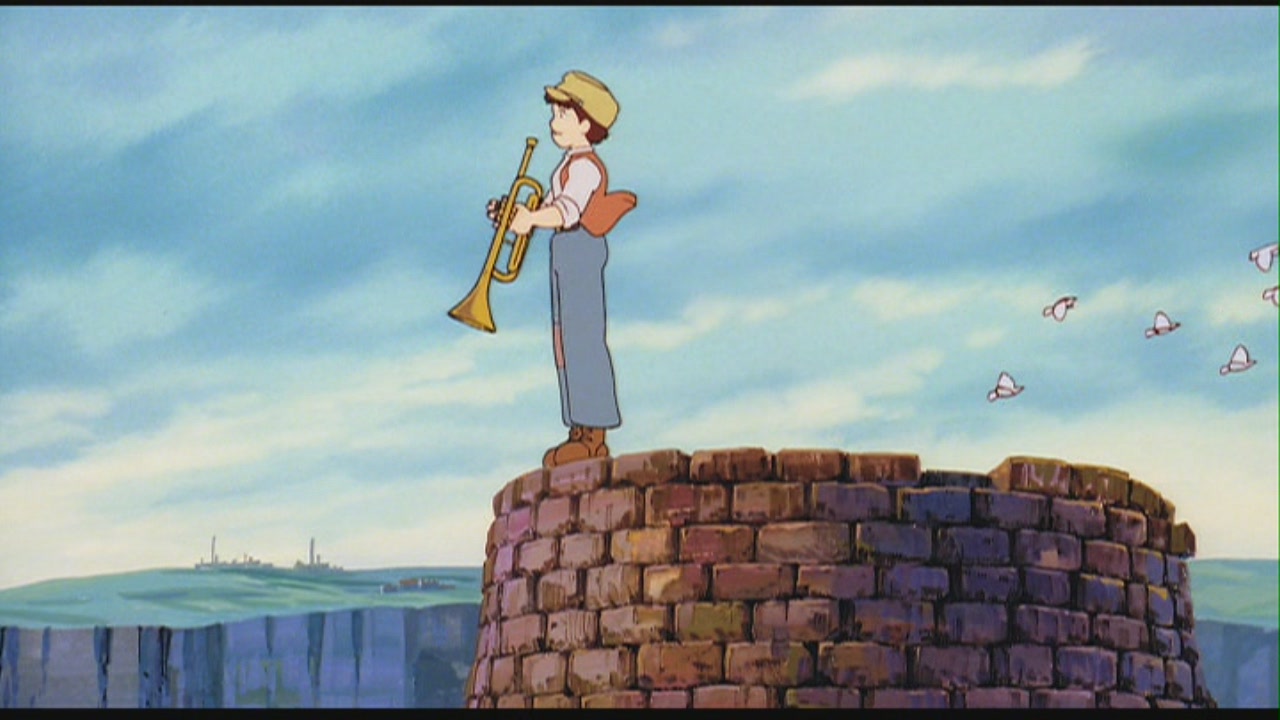
It is a small mining town in Great Britain, around the time of World War I.    Air power is just coming into its own and in Europe the great air power is Germany, with it’s magnificent floating military fortress, Goliath.  There are also air pirates to take advantage of the governments like the Dola Gang, a group of pirates under the head of their mother.  But there are also rumors and hints of an even greater power: an ancient floating city, Laputa.  Some say they have seen it, but no one is certain.  One pre-teen girl named Sheeta, however, holds the key: an amulet made of volucite (or “aetherium” in the Disney dubs) that is said to hold the key to Laputa and all its power.

This is the context of this Raiders-esque romp through a mining town and the skies above it.  It is one long chase scene, but what an exciting chase it is!  Air wars, floating girls, train chases (borrowing a bit from Keaton’s The General), a Babylonian city, secret ancient science, caves, robots (did The Iron Giant borrow from these?), military encampments—it just never stops!  The pirate boys are always around to drop a good laugh now and then, and we see the whole thing through the eyes of the ball of energy, Pazu.  Did I mention, best Pirate Mom ever?  What about awesome proto-Iron Giant robots?

The fact is, I think this film out-Raiders Indiana Jones.  It is more fun, and the heroes are real heroes and the (real) bad guys are smart and more sinister. 

Now that I’ve told you about this film, I want to give you my latest theory about Miyazaki.


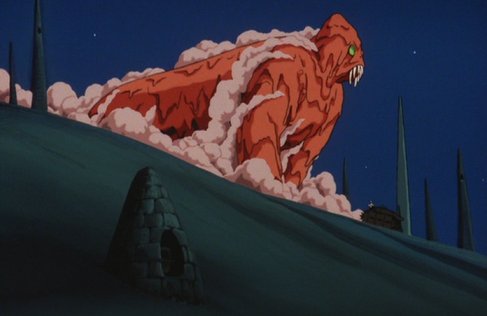
No matter what kind of film he’s making, there seems to be a focused vice.  It is often repeated a number of times through each film.  In Nausicaa, it is fear—all the terrible events come about through fear of others, fear of nature, fear of what might happen.  In Princess Mononoke, it is hatred—the hatred one has of the enemy that is preventing you from living life as you think you ought to have.  In Spirited Away, it is greed—whether gluttony, greed for money or greed for love—that causes all the problems in that film. 

In Castle in the Sky, it is selfishness.  Greed is a factor, but ultimately all of the events play out because a nation and an individual wants to see reality changed from their own perspective, without regard to others.  This selfishness is caused by insulation from others and from the earth itself, to consider oneself above all others and all the earth, to see all others as simply tools for one’s own ideals.

The solution to this, as to all the vices in all Miyazaki’s films is a single solution labeled a number of different ways, even within Castle In The Sky.  It is called compassion, love, connection.  In summary, it could be called community living.  In each of the films we’ve seen in the marathon there is some kind of idyllic community used as an example.  The Valley of the Wind, the village of Prince Ashitaka are both examples of how humans can live with nature in harmony, and how people work hard for each other to create a good life for all. 

In Castle in the Sky, the idyllic community is not actually seen.  It is the community that young Sheeta was kidnapped from.  (What is it about the theme of kidnapped princesses?  Anyway…)  This is the community the Laputans formed when they determined that living in their city was too separatist, and that they needed to return to the earth, to live with nature and to the people whom they once ruled over. 

The ideal is not simply a virtue that one can live on one’s own.  There is no single hero that shines through any Miyazaki movie that solves all the problems.  Rather, solutions are determined by both heroes, leaders and community.  It is a way of life they decide to live out together.  It is a life of compassion, of concern for others, of hard work and of communion with nature.  Yes, each film has its hero, who through deep personal sacrifice, brave deeds, mediation and virtuous determination creates the opportunity for peace.  But ultimately they only point the way.  It is when the community decides to take this upon themselves that the hero’s brave deeds are fulfilled.

And in some films, such an idyllic state is never reached.  Perhaps the vice of a certain person is thwarted, but the future is still uneasy. 

With this moral basis throughout all Miyazaki films, it is no wonder that they are considered children’s films, even though Nausicaa and Princess Mononoke and Porco Rosso aren’t really for kids.  The moralism is a bit heavy handed.  Nevertheless, with all this high-mindedness, Miyazaki gives us amazing sights to see and adventures to live out in our minds.  And this is why I consider Miyazaki my favorite writer/director.  He offers us a unique and beautiful moral vision, and makes it completely entertaining.

Even with all this “made for children” action and moralizing, there is a very real point that is not for children—the position of Princess Sheeta.  In the end, she realizes that she has part control over a monstrous power to destroy whole cities.  And the other person who has control over this power is a madman, willing to not only threaten, but use this power at will.  What does she do? 

Of course, her position is the same as our own.  Some of our leaders have the power to destroy large populations with little effort.  We share in that power.  The answer in Castle in the Sky is to, of course, be rid of such weapons, at whatever cost.  The fate of innocent people is nothing compared to power, a paradise, and even our own lives.  It is worthwhile to make deep personal sacrifices for the sake of the world. 


Funny that our present world hasn’t made this decision.  I guess we don’t have the same ideals as Miyazaki.  What a shock.


Ambition and Sustainability: Princess Mononoke

#29—Princess Mononoke

Princess Mononoke is the most male-oriented of Miyazaki's films.  It has a lot of action, and although there is a love story, it isn't a significant part of the plot.  It is seen through the eyes of a young man, and it certainly is more gruesome than other Miyazaki. 

Alongside of Spirited Away, this is Miyazaki's most visually stunning films.  Every frame has so much to see and as ugly as some of the action sequences get, so many of the forest scenes are gorgeous.  Every movement is perfect, every background communicates as much as the foreground focus.  You could just turn the sound off with no subtitles and it is amazing to watch.

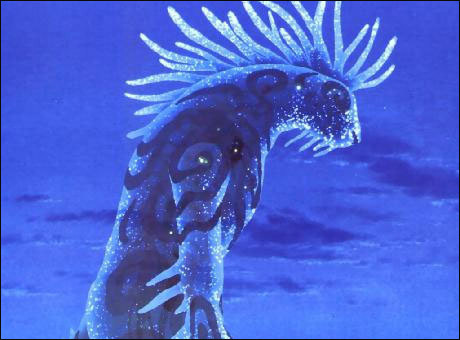
The setting is ancient Japan, just at the beginning of industrialization.  Gods roam the countryside, and every healthy tree has a spirit living with it.  The plot is focused around the wanderings of Prince Ashitaka, who is forced out of his idyllic home because he was cursed by a demonized boar-god. He gets involved in the ongoing battles of the up and coming industrial Iron Town and the gods of the nearby forest.  Ashitaka tries to remain neutral, but finds it difficult after seeing the desires to thrive on both sides of the war, and he is torn by the hatred on both sides.  And there are, of course, complications.  For one, he has fallen in love with a human on the forest side, San, who grew up with the wolf god.  And the Emperor, seeking the key to living forever, has sent a monk to retrieve the head of the forest spirit, which has the power of life.

For many of Miyazaki's movies, I think of them in pairs.  The partner to this one is Nausicaa.  They both deal with wars between communities and the connection between nature and humanity.  The great evil of Nausicaa is fear, while in Mononoke it is hatred.  At one point Ashitaka breaks up a fight between San and Lady Eboshi, saying, "You both have the same spirit," meaning hatred.  It is hatred that causes a god to become a demon and hatred that causes a human to become a monster, even if their appearance does not change. 

The point of the movie, as with Nausicaa, is that nature and humanity should be working together for the benefit of all, rather than battling each other for limited resources.  Ashitaka yells out at one point, "Why can't humans and the forest live together?"  Ashitaka is seen with distrust from all sides because he won't take a side.  But in the end, at least Lady Eboshi considers rebuilding Iron Town in a way that would not harm the forest.

Although Nausicaa takes place long after Mononoke, I think it is better to see Nausicaa before Mononoke, because the potentially idyllic relationship between humanity and nature is more clearly seen there, and the tradgedy of Mononoke can be better seen in this light. 

A question one might come from the film: "Why is it called Princess Mononoke?  She seems more like a supporting character."  I think the key is in the term.  "Mononoke" is not a name, but a word that means "spirit" or, more tellingly, "monster".  The title obviously applies to San, being as much wolf as human and siding with the spirits in the battle.  But the term also applies to Lady Eboshi, who is a marvelous ruler of her town, but when she is ruled by hatred then she is monstrous, horrific.  They are both a "princess mononoke" and it gets to the heart of the film.  For the true monster is the one who is filled with hatred for either humanity or nature-- the one who is controlled by hatred and pours it out on one's enemy. 

Because of this, I think that Lady Eboshi is the moral heart of the film, the driving force.  At first she truly does seem like a monster because from the perspective of the forest, she is ambitious, and doesn’t care what she harms in order to meet her goals.  But she is not a monster, rather she sees the needs of her people, and is just seeking peace and sustainability for them, not knowing that there is another equally sentient people that she is harming.  She and Sen despise each other and each other’s people’s because they see their opponent’s people as less than sentient, less than “human”, less than fully moral.  They hate because they do not recognize the other as an equal.  By the end of the film, Lady Eboshi especially realizes that both peoples are equally “human” and that her ambitions for sustainability can also embrace the forest.

It is easy to say that Miyazaki’s ideal is to have town and forest live together in harmony (which I just did up above).  But more than this is the ideal that the inhabitants of town and forest are equally deserving of peaceful life, and that any ideal of sustainability has to include all inhabitants of the land, not just the humans.

When I first saw Princess Mononoke almost ten years ago, I didn't find it that great.  The themes were beyond me, I think, and I couldn't grasp whether the movie was ugly or beautiful.  After seeing so many other Miyazaki, however, I can understand it better and appreciate it much more.  It still has weaknesses: I think that the motivations of the characters, especially Ashitaka, are unclear, and I spend part of the film in confusion. 

Nevertheless, I can now see that it belongs with the top Miyazaki films.  It enriches Miyazaki themes, and displays the power of animation in ways that few films can.  

Humanity and Nature: Nausicaa of the Valley of the Wind

#3--Nausicaa of the Valley of the Wind

Someone once mentioned that it is a pretty long title, but with Miyazaki one must expect that occasionally, such as Ponyo on the Cliffs By the Sea.

Nausicaa is Miyazaki's second feature film, and the first that begins using the themes that reflect his later films, among which are relationship between humanity and nature, flying machines, and war. It is based on a much longer, more complex manga written and drawn by Miyazaki.

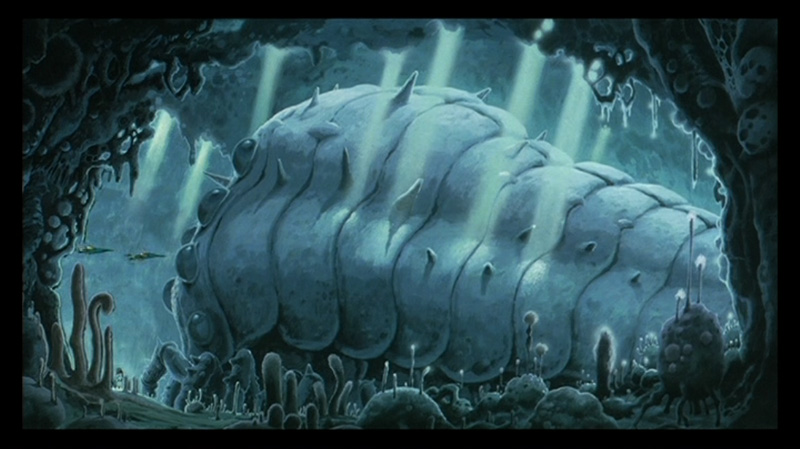
Nausicaa takes place a thousand years after human war has poisoned the soil of earth to such a degree that poisoned jungles grew up, insects became gargantuan and huge protectors of nature were created-- Ohms.  There are a number of human kingdoms, but the film deals with only three, Tolmekia-- a war-like kingdom that wants to rule the others; Pejite, the sworn enemies of Tolmekia; and the Valley of the Wind, a struggling utopia that gets caught up in the other kingdom's war. 

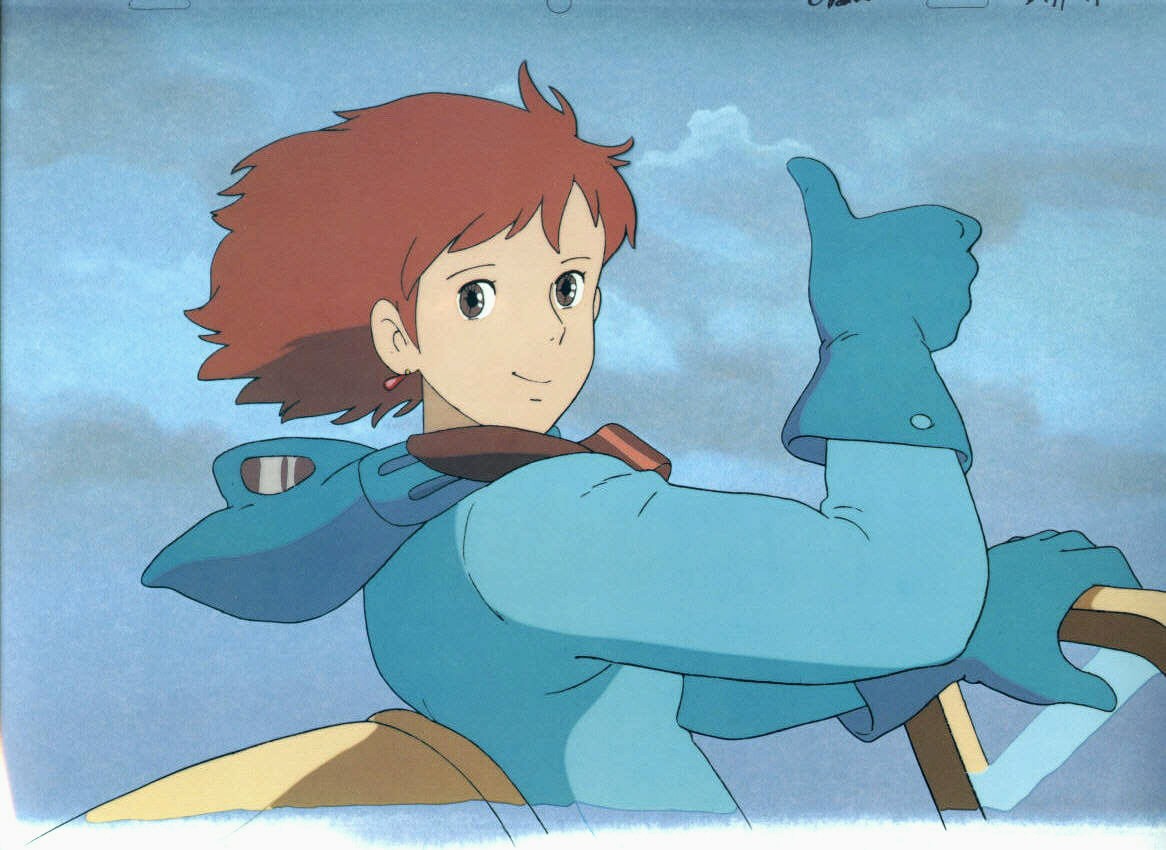
Nausicaa herself is Miyazaki's saint-- the ultimate peacemaker.  She is frankly an ideal Buddhist saint, who communes with all creatures, and seeks to make peace with all.  She is especially focused on creating harmony between humanity and nature, trying to heal the 1000 year old rift.  Throughout that thousand years, the poisoned jungles and humanity have been warring with each other, each attempting to overthrow the other's rule.  Only Nausicaa realizes that humanity would perish without the jungle and that the jungle can flourish under humanity's enlightened guidance.  Nausicaa is somehow able to understand the true nature of whatever she is facing.  Instead of reacting to a threat, she responds to the fear behind the threat.  Instead of seeing the death of the toxic jungle, she sees the beauty of it.  She works with the nature of whatever is before her in order to create harmony with all creatures.

Like all saints, Nausicaa presents us with an ideal of how humans should live.  We, as humans, should seek to discover the true nature of what is around us, whether human or natural, and respond to all with the care that they need. Sometimes she has to seek that true nature with research, such as the toxic forest.  Sometimes she responds with intuition, such as the fox squirrel.

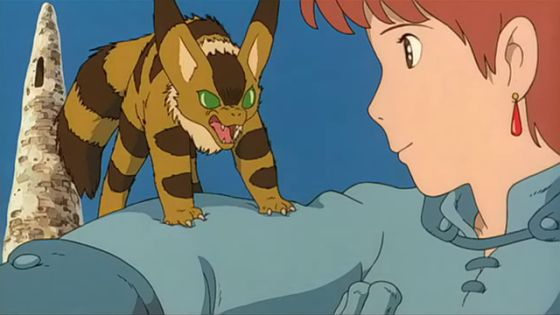
Honestly, the scene with the fox squirrel both amazes me and it is symbolic for the saint-like way Nausicaa acts throughout the film.  Master Yupa warns Nausicaa that the fox squirrel is dangerous, but she treats the small creature as if it were the cutest thing in the world.  To prove Master Yupa correct, the fox squirrel bites Nausicaa on the finger and won't let go.  But instead of reacting to her pain or to an attacking creature, she still coaxes him, comforting him.  She understands that his attack isn't personal, but a reaction to his fear.  She allows him to attack her, with no repercussions so that he can know that whatever he does, he has nothing to fear. Fear is the source of harm, the source of attack and oppression. Throughout the film, Nausicaa is placing herself in harm in order to convince others that there is nothing to fear, no need to attack or oppress. This is peacemaking in action.

On the surface, this film seems weaker than other Miyazaki.  Most Miyazaki are amazing in the detail of the world that was created for the film, and Nausicaa is no different in that.  But the dialog is less rich and entertaining, the colors seem washed, and the style of animation is not as fluid as other Miyazaki films.  Part of this, though not all, is due, I think because Miyazaki is trying to communicate the bleakness of the world in disharmony with nature.  War-- both human and natural-- has taken its toll, draining life from everything.  At the end of the film, [spoiler]after Nausicaa's messiahship is realized[/spoiler], the colors suddenly are brighter and everything changes. 

Despite it's weaknesses (including a truly lame 80s score), this film is one of my favorites of all time.  Despite it's bleakness, it is possibly the most joyful and optimistic of Miyazaki's films, and it plots out the general outline of hope for the future.  Other Miyazaki films may communicate that war is bad and that bad guys aren't really all that bad, but this film actually lays out what would need to be done to end war, to change people's hearts.  It isn't childish in any way, nor simplistic, if perhaps naive.  It communicates that self sacrifice, listening to the another's heart, boldness for another's good and some basic reasoning can create a path out of the bleak world.


Perhaps I like this film because it is very much a religious philosophy I agree with.  Perhaps it is because Nausicaa is such a strong character that to me she is the perfect moral hero.  But with each time I watch it, the higher my estimation of it is.

Wednesday, June 20, 2012

What Does a Great Director Look Like?


Stanley Kubrick on a good day
What exactly does a director do?  A film can be a massively complex jigsaw puzzle.  There are actors, writers, producers, studio execs, cinematographers, special effects: both physical and digital, sound, music, props, make up, clothing, editing, lighting, catering, cameras, location, assistants, and more and more and more.  The director takes all of these details and works them all toward a (hopefully) coherent whole.   This is an amazing job, one that makes me wonder if it is humanly possible.  Obviously it is, with a lot of help.   What really amazes me are the directors who can produce one (or more!) films a year.  Woody Allen is a workhorse.  Johnny To is a madman.

So being a director is a difficult job, no matter whether you produce an art film, a blockbuster or something in between.   I think to call any director a “hack” isn’t fair.  Every director has a difficult job.  Some are just studio directors, producing whatever the studio told them to make—but even a studio director could be Victor Fleming who directed both The Wizard of Oz and Gone with the Wind the same year.  I don’t think any director is really lazy.  Kevin Smith might come close, but he’s such a good writer that we forgive him.  And besides, Red State wasn’t lazy directing at all.

But what makes a great film director?  What makes a director stand out from the pack?  We know a great director when we see their body of work, but what exactly does a great director do that others do not?  Below are a list of characteristics that I think great directors have:

1. Unique vision
It's a Wonderful Life
First of all a great director has a vision with the film he is creating.  Sometimes the same vision extends to different films, and sometimes a director has a different vision for each film.  Most importantly, each film has something that makes it special, that causes it to stand apart from all other films, and to be a glorious example of filmcraft.  Constantly working directors sometimes have a vision that is clearer in one film than another (everyone has a bad year), but still, a great director’s work stands out.   Frank Capra had a unique vision: that of the everyman changing the world despite opposition, and it made his films stand out in the midst of hordes of everyday films being produced in his time.

2. Theme
Three Colors: Blue
A great director isn’t just telling a fairy tale with a simple plot and a straightforward telling, but she or he has a theme or themes that run throughout the film, adding depth and power to the plot or characters.  Krystof Kieslowski often had simple plots with deep themes that ran through the visuals, the music, the characters and the sometimes odd events that occurred in his films.


3. Communication
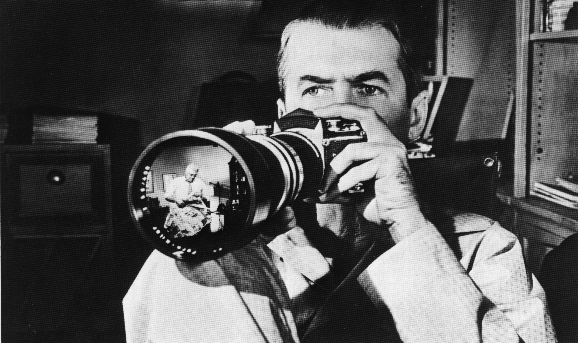
Rear Window
A good director often has themes and a unique vision, but he or she might have difficulty communicating this to his audience.  Part of this is knowing who your audience is, but a larger part is using all the complex pieces to make a coherent, never-before-seen whole that makes sense to the audience.  Hitchcock was brilliant at communicating his themes in often unique ways, using details to sometimes obviously and sometimes obliquely communicate his vision and themes.

4. Connection
The Godfather
The final aspect I want to emphasize is that a great director knows how to take all of these film pieces and to connect to his audience.  Not just that he touched them emotionally—a cat video could do that.  Rather, she or he gives his audience a memorable experience.  This director’s film isn’t just communication, it is magic.  He or she can take their work and make it a part of their audience’s life.  Their work becomes a reference point for other experiences, and the film is now a part of real life.  Even though a Mafia family is leagues away from most of our experience, the Corleone family is a part of our cultural heritage, and their unique morals and habits are a part of everyday conversation, to make us understand the rest of our world better.  “Corleone” is even in my Google spell check, for which I am very grateful.

Let's look at some directors who, I believe, are at the top of their game right now:

Howl's Moving Castle
Hayao Miyazaki—Some may say that an animator has less details to worry about.  However, those who understand animation knows that the director’s job is just as difficult to do well.  Miyazaki is a master of writing and direction. Even in his mediocre works (Lupin III; Kiki’s Delivery Service), his approach is fresh and fun.  In his masterpieces (Mononoke, Spirited Away) he is unlike any other director, yet a compelling storyteller.  At times, Miyazaki doesn’t communicate well because his stories are so foreign to us non-Asians.  Nevertheless, he wins most of us over in time because his very unique vision and compelling themes, as well as his characters that we enjoy spending time with.

Barton Fink
The Coen Brothers—I don’t appreciate some of their classic works as much as some (The Big L, Miller’s Crossing), but it doesn’t matter.  The Coens have a unique approach to storytelling, as well as unusual morals.  I have my favorites (A Serious Man, O Brother Where Art Thou, Barton Fink)… but so does everyone, and everyone’s favorites are different.  That’s a great director. Because they are both unique, but they communicate something to (almost) everyone.

Days of Heaven
Terrence Malick—Malick is a great director not just because of his message,  which is interesting, or the manner of his communication, which is unique (although sometimes hard work), but his method of creating film.  He, more than any other, takes the editing stage of filmmaking as a creative process, and by the end of his editing he may have a completely different film than the plan before the editing.  All the filming and the music are less communicating a narrative, but a concept and the film and even the plot are just resources for  him to use as toward the finished product, which isn’t realized until long after filming.  Again, that is a powerful director.

Wendy and Lucy
Kelly Reichardt—I think that Reichardt has the most unique vision of the current group of independent makers of low budget films (Miranda July might come close to that).  The stories are small and quiet, but the emotional resonance is deep and powerful.  She wants you to walk with her characters, to live their lives for a few days, even the silences and the confusion.  In this way, she hopes to teach us compassion and perspective.  I think this is powerful communication that is more than just telling a narrative.  It is throwing us in the deep end and hoping we will learn to swim.


Vera Drake
Mike Leigh—I have spent time with more real people through Mike Leigh than any other filmmaker.  Like Kelly R, Leigh throws us in the deep end of a community’s life and asks us to swim.  But the swimming isn’t deep, and often very pleasant, with only the occasional shark to gnaw on our legs.  He is a powerful filmmaker, the Michael Powell of our generation, always giving us what we don’t expect.  I can’t wait to see another film by him, which is as high a praise a director could get, I suppose.

Cache
Michael Haneke—Finally, the man who makes dramas that feel like horror films. He has a singular vision, and he seems to be determined to dismantle society bit by bit.  Everyone seems so normal, so typical, so pleasant until they are not and the underbelly of proper society is revealed.  But he also throws a generous helping of Hitchcock, presenting us with a puzzle or two that we might not ever solve.  Nor do we necessarily have to.  And if we did, we think we might exhaust ourselves.  So Heneke, for his singular vision and disturbing experiences goes on the list.


Tuesday, November 15, 2011

Miyazaki's Saint


As a Miyazaki fan, it is my sworn duty to occasionally post a review of a film by the greatest animated film maker ever.  No, I do not consider that hyperbole.  Today, it is on Nausicaa of the Valley of the Wind.  Deal with it.


Some important facts to know about Nausicaa:

-She is a princess.  Who flies. But she doesn't sing which is why she isn't a Disney princess.

-She lives in a poisoned world.  Poisoned by us modern warmongers.  Yeah, she lives in the future.

-She is a badass.  She's not all sweetness and light. She can carry a machine gun twice her size with a wounded leg.  When she really gets ticked off, she can kill a dozen men twice her size in a heartbeat. I guess that's another reason she's not a Disney princess.  

-She is an environmental scientist. She not only creates a garden pure from the deadly radiation that makes nature become poisonous, she also figures out how nature was cleansing poison out of the earth on its own.

-She is a nature goddess.  She can communicate with animals and they do what she says.  Maybe she's really Dr. Doolittle in disguise.

-She does NOT go around naked without any pants.  Her pants are flesh colored.  That confuses and embarrasses a lot of men. 


Someone once mentioned that it is a pretty long title, but with Miyazaki one must expect that occasionally, such as Ponyo on the Cliffs By the Sea.

Nausicaa is Miyazaki's second feature film, and the first that begins using the themes that reflect his later films, among which are relationship between humanity and nature, flying machines, and war. It is based on a much longer, more complex manga written and drawn by Miyazaki.

Nausicaa takes place a thousand years after human war has poisoned the soil of earth to such a degree that poisoned jungles grew up, insects became gargantuan and huge protectors of nature were created-- Ohms. There are a number of human kingdoms, but the film deals with only three, Tolmekia-- a war-like kingdom that wants to rule the others; Pejite, the sworn enemies of Tolmekia; and the Valley of the Wind, a struggling utopia that gets caught up in the other kingdom's war. 

Nausicaa herself is Miyazaki's saint-- the ultimate peacemaker. She is frankly an ideal Buddhist saint, who communes with all creatures, and seeks to make peace with all. She is especially focused on creating harmony between humanity and nature, trying to heal the 1000 year old rift. Throughout that thousand years, the poisoned jungles and humanity have been warring with each other, each attempting to overthrow the other's rule. Only Nausicaa realizes that humanity would perish without the jungle and that the jungle can flourish under humanity's enlightened guidance. Nausicaa is somehow able to understand the true nature of whatever she is facing. Instead of reacting to a threat, she responds to the fear behind the threat. Instead of seeing the death of the toxic jungle, she sees the beauty of it. She works with the nature of whatever is before her in order to create harmony with all creatures.

On the surface, this film seems weaker than other Miyazaki. Most Miyazaki are amazing in the detail of the world that was created for the film, and Nausicaa is no different in that. But the dialog is less rich and entertaining, the colors seem washed, and the style of animation is not as fluid as other Miyazaki films. Part of this, though not all, is due, I think because Miyazaki is trying to communicate the bleakness of the world in disharmony with nature. War-- both human and natural-- has taken its toll, draining life from everything. At the end of the film, the colors suddenly are brighter and everything changes. 

Despite it's weaknesses (including a truly lame 80s score), this film is one of my favorites of all time. Despite it's bleakness, it is possibly the most joyful and optimistic of Miyazaki's films, and it plots out the general outline of hope for the future. Other Miyazaki films may communicate that war is bad and that bad guys aren't really all that bad, but this film actually lays out what would need to be done to end war, to change people's hearts. It isn't childish in any way, nor simplistic, if perhaps naive. It communicates that self sacrifice, listening to the another's heart, boldness for another's good and some basic reasoning can create a path out of the bleak world.

Perhaps I like this film because it is very much a religious philosophy I agree with. Perhaps it is because Nausicaa is such a strong character that to me she is the perfect moral hero. But with each time I watch it, the higher my estimation of it is.


The final important fact about Nausicaa is:


I may be secretly in love with her.  You can go ahead and tell my wife.  She already knows.


Wednesday, February 9, 2011

Spirited Away: The Greatest Film of All Time


"An alternative universe coinciding with our own"

I really appreciate what a co-movie lover said recently, that as one gets to the top of one’s all time favorites list, that it becomes more personal. I think that is really true. My top ten is peppered with films that mean something important to me personally, but may not be as thrilling to others: Wendy and Lucy, The Mission, Being There. They all carry double meaning for me: not only being well done films in their own right, but also expressing messages that are important to my life. They not only speak to others in a general way, but they speak to my life directly in a way others might not understand.

So, with Spirited Away, I can give you the many reasons why this favorite film of my favorite director is generally excellent. The animation is top notch, for one. In re-watching Ponyo, I realized how much we are missing in focusing on computer animation instead of hand-drawn. It has taken hand-drawn animation almost a hundred years to reach this place, while computer animation is still a teen. Computer animation is wonderful, but it still has a long ways to go to establish a set of symbols we recognize as human emotion. Miyazaki, however, has taken the step that Disney never did to make characters that are so real we feel that we know them. This is certainly found in the writing and the voice acting (even the dubbed vocals!), but especially in the drawing. It is not because they are more realistic looking, but because we grew up with this kind of animation, and Miyazaki, adding in expressions found in manga and older anime, has given us a visual language we can truly connect with.


"Living in the stream of life, led by love"

Also, Spirited Away is one of the magnificent stories of imagination. Setting aside the Japanese spiritism (which we will talk about in a moment), the amount of imagination that creates both the setting—a bath house for spirits—and specific unique characters such as No Face and the Radish Spirit, takes even the imaginative achievements of The Wizard of Oz, The Neverending Story and Labyrinth to new heights. But more than that, this imaginary story is realized perfectly visually. We can see this world existing. This isn’t just an amusing tale with muppets or dressed up humans or poorly executed claymation. This is another world that we have the opportunity to visit for a couple hours, and that experience gets added to our own.

I am just saying what could really be said of almost any of what I call “first tier” Miyazaki. As well as this: Miyazaki’s characters are fully realized. These are real people, even the spirits are of a type of character we recognize. While there is sometimes comedy, it is the comedy of real life, not just pratfalls and one liners. When there is achievement, it is rarely of the deeply heroic kind. Rather, it is the daily success of those who act noble in small ways. In this way, Miyazaki can connect to us in ways that blockbusters rarely do. There are scenes in Miyazaki that, despite the outlandish settings, we can see as reflections of our lives. Or our lives as we wish them to be.


"Look, I can do it, too!"

There are two reasons, however, that Spirited Away especially speaks to me personally. First of all is because we get to see Chihiro/Sen grow up. I have three children of varying ages—17, 14 and 9—and they are all in different stages of development. All of them are, in a sense, Chihiro. At the beginning she is whiney and grumpy and self-centered. The move is hard on her, her parents realize this, but it is necessary and they need her to stay strong through the difficulty. But it is when her parents become self-centered that she is forced to grow up and become stronger than she—or her parents—ever thought she could be.

Step by step we can see her shed her self-centeredness and fully take on the task of being responsible as the best of grown-ups are. This is in contrast to Kiki of Kiki’s Delivery Service who begins the movie responsible and hard working. Chihiro had to struggle through every step of the way. First she expresses the moral outrage many young people express when they see grown ups acting irresponsibly. Then she follows important instructions for how to live in the new world (something most fairy tale protagonists fail to do). Then she learns boldness and tenacity in the face of threat. Then she learns about hard work under someone else’s orders. Then she learns about loving people even when they seem to not be lovable at times. Then she learns about sacrifice for love. And finally, she learns that intelligence balanced with care and wisdom is what truly saves the day.


"Soaring high"

These are the life lessons I want all of my children to learn. They are the lessons I see them learning, bit by bit. The art of raising children is the art of seeing them become the Chihiro at the end of Spirited Away. Every once in a while, as a parent, you can think to yourself, “I taught them that”, but most of the time you can’t. These are lessons they have to learn themselves in the midst of the struggles they have to face in life. But at the end of the movie, I am so proud of Chihiro, the buttons on my vest would burst, if I actually wore a vest. She is my children. My son becoming a responsible adult. My oldest daughter being self-confident and self-reliant. My youngest daughter learning to speak with respect and act in mercy. This is all I hope for my children, in the strange worlds they will have to challenge.

My final reason is my strangest, and probably my most significant personal reason why I love this film. I am only going to tell you guys, and I hope you won’t tell anyone else. Not because I’d get in trouble, but because it’d be difficult to explain to my denomination and especially my congregation. I could do it, but it wouldn’t do any good, so why bother? Anyway, here it is: the metaphysics of Spirited Away is pretty close to how I see the world functioning.


"Christianizing Shintoism"

No, I don’t think that spirits have their own bath house and restaurants. I don’t think that if humans eat spirit-food that they turn into pigs. Nor do I think that young girls could be hired by someone to serve spirits. I do, however, believe that there is an alternative universe, that runs on its own physics, that runs parallel to ours. I do think that there are beings—and you could call them spirits—that live in that universe. I also think that most of them are morally neutral, neither good nor bad, just trying to live their lives by their own values. And I think that, at times, the two universes can converge, and allow communication between them.

This is not an unusual worldview, in the broader scheme of things. Historically, before the Christian era, almost everyone in the world believed that summary of mine. Certainly the ancient Jewish people did, as well as the first Jewish Christians. It is Plato and his disciple Augustine that began to turn the world away from this notion. They saw the spirit world as either the realm of ideas or as under the control of a single unified being. Under their philosophy, the spirit world is neat and orderly, with everything politely lined up perfectly, within the mental grasp of humanity.

The ancient pagan world, the ancient first temple Judaism and the first century Christian church saw the spirit world as full of chaos as it was of spirits. Each spirit had its own focus and desires and hopes. They had their own realms of responsibility—jobs, if you will—of rivers and vegetation and winds and planetary beings. Part of the spirit world is described as a sea, filled with dragons of chaos, battling against spirits who desired order and peace in both the spirit world and on earth.

Spirited Away, although a fantasy, is based on Japanese spiritism, a form of that ancient worldview. In a twisted sense, the metaphysical basis of that movie is somewhat the same as the writers of the Bible. This is how I see the world working. I do not deny scientific reality—our world does operate on the laws of physics and development of life as discovered by scientists. But looking at the physical realm is only a part of the story, like Chihiro’s parents seeing an abandoned amusement park.

Some are content with this world and understanding its laws. Others get to see the wonder and magic of the world below the surface, on a level not usually seen by eyes. I wish to be one of the later.

Any who are concerned about my right to be a pastor, or my sanity, I would be glad to give the phone number of my denomination, and you can rat me out. I understand. Sometimes I don’t think I’m completely sane, either. By the way, my wife already knows, so you don’t need to bother calling her.