Although I grew up in Southern California, Oregon is my chosen home, and I love it. Not only do I choose Portland over Los Angeles, I choose Oregon cinema over Hollywood. I'd much rather see Gus Van Sant than Michael Bay or James Cameron and I'd rather watch Kelly Reichardt over Kathryn Bigelow (not that I would deny watching any of their films). And Kelly Reichardt is the most Oregonian of all filmmakers.
She has made three films, all of them quiet, meditative, perhaps some would call them ponderous. Old Joy, her first, is about two friends who live in Portland who drive to the wilderness to have one more adventure together. Wendy and Lucy is about Oregon's most prevalent social problem, homelessness, and gives a very personal viewpoint of the issues (more on that film another day). These two films were made very inexpensively, around Portland. They have a beauty to them, but something holds back.
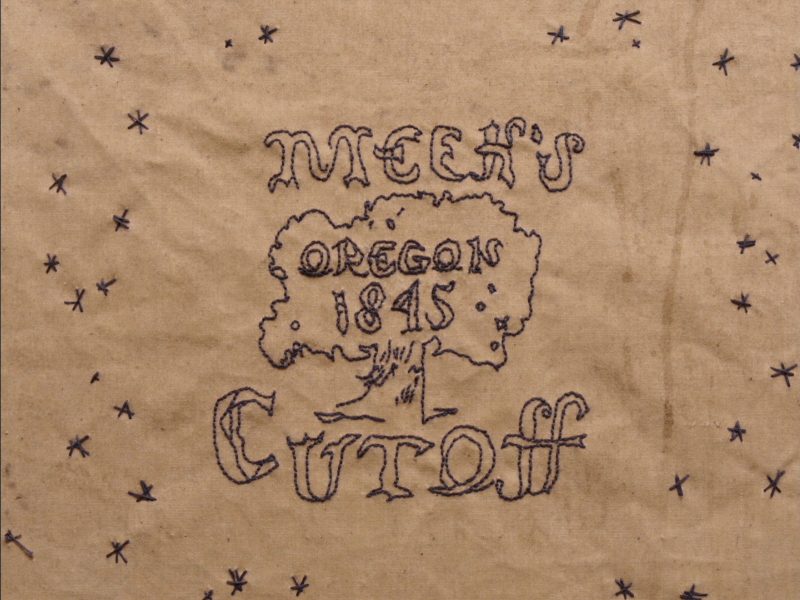
All of Reichardt's abilities and preferences work so well with the subject matter of Meek's Cutoff: the travails of travelling on the Oregon Trail in the beginnings of such pioneering. Finally Reichardt was able to purchase really excellent equipment and to film outside of the Portland area. The stark landscape of Eastern Oregon is contrasted with the gorgeous beauty of the skies. Please, someone, give her a million dollars to shoot her next film with the full potential of her abilities.
Yes, the film is ponderous, but it only highlights the nature of such traveling, when a day might lead you only a few miles. Also, like Wendy and Lucy, it is told from a female perspective, and we get a strong sense of how women are kept out of the loop in decisions that their lives depend on. Important conversations are muffled, hard to hear, or just don't take place within earshot.
It is easy to get frustrated with the film. Honestly, knowing Reichardt's nature, I waited until I was fully alert and able to really take in her film, so as to give it my full attention. (New Years Eve is a great time for me-- I'm not doing anything, and everyone else is busy with their own celebrating). It would be frustrating, except that it is supposed to be frustrating. We are supposed to get the idea of how it felt to be a woman on the Oregon Trail, dependent on men-- some wise, some idiotic-- to determine the best course for everyone.

I have a friend with whom I have been having an argument with. He proposes that women were never oppressed, at least in American history, and perhaps not in ancient history. He tells me "How can a segment of society be oppressed when men have to kneel on the ground and ask their permission for marriage?" This is the biggest load of rubbish I think I have ever heard. This movie is a perfect example of how women have quietly oppressed throughout history (when they weren't violently oppressed in war or rape). To only give men decision making powers and then to allow women no right to speak to those decisions because they weren't involved in the conversation is oppression.
This movie is told from a female point of view. Not a feminist point of view, necessarily. And not from the view of a particular woman. Rather, the viewer is almost a fourth woman amidst the travelers. We hold back when the women hold back. We can't hear everything because the women can't hear everything. We are only given certain pieces of knowledge, but there is much we are not given. Perhaps this is frustrating. But, on the other hand, perhaps we can understand more about the perspective of the quiet and lowly who are not given enough power to participate in decision making. Children in families. The homeless, who are kept out of policy decisions. Women in patriarchal societies. This is oppression.
The film is slow and can be frustrating. But it is also beautiful and brilliant. It is one of the best revisionist Westerns ever, alongside of Unforgiven. I highly recommend it, but be ready for what you are about to see. 4/5
Below is a brief analysis of the film that contains spoilers. Please do not read if you haven't seen the film yet:
Meeks Cutoff is a film in two acts. The first act revolves around Meek and the growing distrust of his ability to guide the troop. As this plays out, we experience the frustration of the women, and we learn of how difficult the trail is when there is little chance of finding water. Perhaps most of us are have some knowledge of the difficulty of pioneering life-- we have read some of the Little House books, we have played the Oregon Trail games (in which you die from cholera as frequently as you breathe-- no wonder Oregon only has a few million people a hundred years after a million people traveled that trail).

The film is roughly based on a true incident, which created the alternative trail Meek's Cutoff, that runs from Vale, Oregon to The Dalles at the Columbia River. Stephan Meek, a fur trader, suggested avoiding the Blue Mountains because it was thought that the Indians were murderous in that region. You can see in the map that it split into two parts. This is because, as hinted at in the film, the party original party split into two parts, one going north, another going south.
The movie takes place while the travelers were in Lost Hollow (which they named) where they couldn't find water. Probably, in the film, the reason they were carving "LOST" on a rock is to name where they were. Here is a quote from Betsy Bayley, who traveled from Ohio to Oregon in that trip:
We camped at a spring which we gave the name of “The Lost Hollow” because there was very little water there. We had men out in every direction in search of water. They traveled 40 or 50 miles in search of water but found none. You cannot imagine how we all felt. Go back, we could not and we knew not what was before us. Our provisions were failing us. There was sorrow and dismay depicted on every countenance. We were like mariners lost at sea and in this mountainous wilderness we had to remain for five days. At last we concluded to take a Northwesterly direction . . . . After we got in the right direction, people began to get sick.
You can read a fuller explanation of the history in this Wikipedia article.
The movie changed a number of facts of the history. In the original Meek Cutoff party, there were around a thousand wagons, while the movie represents only three. Many people died in creating the trail. They did eventually find water, but it was not an Indian who led them, but Meek himself, discovering a creek. The company did not follow Meek anymore, however after water was found. They did meet an Indian, historically, who gave them information for a blanket, but they did not follow him.
But to get involved in the history is to lose the power of the film, and what its true message is. The film is not there to give us a history lesson, although much about the history of the times can be learned. It is to teach us about ourselves.
Given the fact that the story of the second act isn't historical, what is his place in the film. The whole second act revolves around him and whether the party should trust him to lead them. Why is this so significant?
Reichardt and the script writer, Jonathan Raymond, went to some lengths to give the Native man a true voice. They hired Kristin Parr and Joan Burnside to translate the words written in English into Nez Perce, a language the Cayuse Natives of the Blue Mountains most likely spoke. Reichardt made the decision to not offer a translation of what the Cayuse spoke, wanting us to only see the perspective of the emigrants.
One of the most telling parts of the Cayuse's speeches is the conversation he holds with the moon, near the beginning of his section of the film:
"What does the earth say? I don't know. What does the sky say? I don't know. Who are these people? I have no idea. This still might be just a dream. I'm not sure. If onlymy brother were here I would have someone to talk to. Brother moon, you're very quiet tonight. You're no help at all. Is it a dream? I don't think it's a dream. I don't know these people. But they've come to me and they've spoken to me. They've made me bleed. I am almost sure they exist. That means this isn't a dream. If this is a dream, what a dream."
Eventually, the Native man agrees to arrangement that he is offered by the emigrants:
"For red, I'll take you to water."
Given all this, what is the film about? What is the point?
It is all about trust.
At the very beginning it is clear that Meek is no longer trusted by the party. He had led them to where he had no idea where he was going. One might as well follow one's own intelligence as to follow Meek, as he was as ignorant as the rest of them, and more dangerous because his pride demands that he continue to seem knowledgeable.
The women had to trust the men completely, and we, the viewers in the place of the women, are forced to participate in that trust. Such trust is frustrating, stressful and often painful. Some of the men were worth trust, some were not. But the trust had to be given anyway, despite the wisdom of the men. There was no other choice.
Finally, the Indian came. They didn't know what he knew, but it was determined that he knew more about the area than Meek. But trust requires more than knowledge, there has to be a benevolent attitude as well. The Indian could be leading them to life or death. And since they didn't share a language, they couldn't determine if the Indian was worth trusting as well. Emily fixes the Indian's shoe in order to make him worthy of trust. Millie finally breaks down because she can't trust the Indian, even though most of the rest of the party had.
Also, it turns out, the Indian didn't know whether he could trust this party of "Bostons" as well. They had already proven themselves untrustworthy by beating the Indian, just for his lack of understanding. They offered the blanket, and they fixed his shoe, but are they really trustworthy? Should he lead them to water or should he just let them die?

The climax of the film really happens at the end of the wagon loss. When Emily takes up the gun and points it at Meek, she is making a determination of trust. She distrusts Meek, because he is neither knowledgeable nor benevolent. They already knew the first, and he proved the second by his racist stereotypes, and his attempt to kill the Indian for no reason whatsoever apart from his personal prejudice. The message of the film isn't about the necessity of trust, but about the choice of trust. How do you know who to trust, even if you have insufficient knowledge? In the end, Emily decides to trust in the devil she doesn't know, rather than the one she does.
Because, in the end, what did they know about the Indian? He was alone in the wilderness, seemingly without connection to the rest of his tribe. Why? Was he a criminal, of sorts? Was he simple-minded? We don't know. We can't understand him. Emily makes the decision based on the fact that she assumes he knows something and that they accurately communicated to him that they wanted water and that he would actually bring them to it. That's a lot of assumptions. But really, what is the choice?
Isn't that what all of life is? We make decisions based on what we determine is sufficient knowledge. But this knowledge is based on trust of other's knowledge, and their positive use of that knowledge. If the right person lied to us, then all of our life is pointless. If a doctor isn't knowledgeable enough or doesn't have our best interests in heart, then we could die. Trust, even without enough knowledge, is necessary for life. But it could also lead us to death.
One way or the other, we have to make a decision to trust someone. For good or for evil. And who can dispute our decision? Because they have to make the same decisions themselves, based on the same quality of knowledge. Life is based on faith, like it or not.