Wednesday, September 26, 2012

How Is A Man's Life Measured? (Colonel Blimp, 1943)


#91-- The Life and Death of Colonel Blimp (1943)

The Life and Death of Colonel Blimp is probably the worst misnomer of a movie ever.  The main character—frankly no character—is called Colonel Blimp.  The main character is actually a Major General, not a Colonel.   And the main character (minor spoiler, here) doesn’t die.   So there is no death.  But there is a life.

When we first see Major General Clive Wynne-Candy, he is outmaneuvered by a younger commander, who sees Major General Candy as a buffoon, much like the Colonel Blimp comic books the movie is named after.  He sees him as stuck in foolish traditions and policies, a glutton and simple-minded: unworthy to command any armed forces.   The Major General claims that the young lieutenant has no right to judge him for he knows nothing about him.

As the movie continues on in flashback, we find this is true.  Candy proved himself not only able, but noble through many armed conflicts.  His closest friend was a German enemy, and he proved his worth in his noble dealings with his life-long love.   “Colonel Blimp” was nothing of the kind, and his upstanding, often humorous life is given depth and power in this film.

How often do we judge people by one event, even by a glance?  How often do we see a shallow character, a narrow mind, a limited experience?  While there may be narrow minds, there are no shallow characters.  Every life has experience and power, nobility and weakness,  love and impatience.  We can judge no one, and for every weak or evil person, we must look deeper to find the nobility that lies there as well. 

Fun Fact: Michael Powell and Emeric Pressburger, known as The Archers, were the directors of Colonel Blimp and they directed almost 20 films together, the best of which were completely iconic and the storytelling unique.  Among their films are The Red Shoes, Black Narcissus, A Matter of Life and Death and A Canterbury Tale.  I recommend them all. 

Does Journalism Create News? (Ace in the Hole, 1951)


#92-- Ace In the Hole (1951)

Chuck Tatum is a New York reporter, stuck in New Mexico, and he’s desperate.   He’s looking for an opportunity to get back on top, to achieve his ambitions of being a top journalist again.  When he hears about a miner trapped in a cave, he knows he has his opportunity.  If the story can last long enough, he can break it as a national story, get exclusive rights and force his way back to a job in New York.

It seems that every job is at least partly built upon ambition and competition.   The form of capitalism that is ruling the world is that of competition, where one must lose for another to win.  Where the creativity required of making a mountain out of a molehill is essential for any kind of professional success.   Even occupations for the public service, such as journalism, social work or teaching ultimately becomes about personal ambition and clawing to the top. 

The problem with including ambition in public service, is that the goals of the worker are that which encourages personal promotion, not the benefit of the public.  Chuck got his story, but only at the cost of individuals, not only exploiting a tragedy, but creating one.  When personal benefit and promotion comes first, the innocent, the hard working, and the simply talented get left behind.  Only if everyone is ambitious does this system even pretend to work.  But this system also discourages people from simply having integrity, from trusting, from supporting others without getting anything back.   One achieves success like this only by leaving destruction in his wake. 

If journalism is a public service, it can only remain so without ratings, without competition, without fighting for position.  In a competition climate, journalism must create stories, must make more of events than they really are.  They must create contexts of fear, of tragedy, of horror.

Fun Fact: Billy Wilder, the director of Ace in the Hole, made many classic films over the years, including Sunset Boulevard, Double Indemnity, The Apartment and Some Like It Hot.  Ace in the Hole was his first big failure, both financially and critically.  He was born in Austria-Hungary. 

What is the Best Response To Oppression? (Spirit of the Beehive, 1973)


#93-- The Spirit of the Beehive (1973)

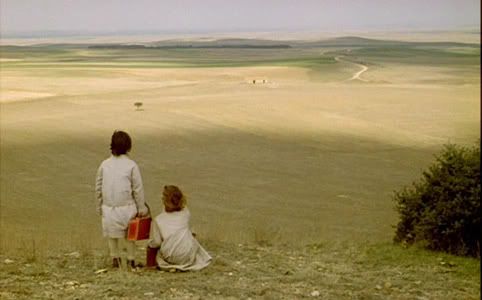
The Spirit of the Beehive is about a family paralyzed by an oppressive regime.   They lay, lifeless, like Ana, when she pretends to be dead, causing her sister torment.  There seems to only be two options when surrounded by an omnipotent evil: pretend to be dead, never moving, or rage against the evil, fight on every side, only to be captured and destroyed, like the naïve monster in Frankenstein.

Ana recognizes that she has this choice.  She may only be a child, but the choice is given to each individual.  She chooses to feed a rebel soldier, to keep him alive and hidden from those who rule over them.  This turns out badly for everyone.   But the lesson of Frankenstein is: of course it will turn out badly.  Fighting, even in small ways, against a great bear only leads to destruction. But must not the bear who crushes and destroys be fought, even if it means our own demise?  In the end, will it not bring freedom to everyone?

Isn’t martyrdom preferable to quiet suffering?  And can’t even a child do her small part, accept her own martyrdom, for the sake of the greater good?

Fun Fact: Spirit of the Beehive was made in the last years of Franco's fascist Spain, using Spanish actors. sites and resources to make this anti-Franco film.  It is symbolic to deceive the Spanish censors.  One of the scenes was copied in Pan's Labyrinth, which takes place during Franco's Spanish Civil War. 

How Can Corruption Be Defeated? (Chinatown, 1974)


#94-- Chinatown (1974)

Jake is a private investigator, of the old school variety.  He takes cases from suspicious dames, gets beat up on a regular basis, and speaks in staccato.  It was an everyday case to follow a husband to see if he is cheating on his wife, but it turns into something much deeper, much darker and more sinister.

Often truth is something we simply don’t want to know.  We always think we want to know the reality, the real motivations behind things, the facts of the matter, but often the only thing truth can do for us is depress us.  Jake found out not only about the corruption of innocent women, but about how Los Angeles became a power, created by evil men.

Jake would love to right this injustice, to repair the wrongs, to defeat evil.  But it is too complicated, too insidious.  Were he to defeat evil, the good would be harmed.  The corruption is too deep, too many people involved, and nothing can be done about it.  This is the state of Los Angeles, the United States, the whole world.  All anyone can do is throw up one’s hands and say, “Forget it, Jake.  It’s Chinatown.” 

This sounds like a cop-out.  Perhaps in some way it is.  But it is also a recognition of reality.  The only way to weed out the evil is to take the good with it.  Is that really justice?

How is Prejudice Overcome? (District 9, 2009)


#92-- District 9 (2009)

Wickus has been appointed an important task, which he is thrilled to fulfill.  It means a promotion and higher esteem in the government in which he works.  He and his team must serve eviction notices to the “prawns” who live in the alien—as in aliens from space— refugee camp.  They have been living a sickening, poor existence outside of Johannesburg, and it is time they moved on. 

In the midst of this increasingly complicated task, Wickus is infected with an alien chemical, which makes him terribly sick.  Bit by bit, he was turning into an alien.  He hoped his company would deliver him from his terrible fate of turning into one of these monsterous prawns, but they only used him as an experiment.

The only way to truly overcome oppression is to make the oppressors become that which they despise.  Only the deepest empathy overcomes our instinct to protect “our own” from that which fear.  Wickus only learned to appreciate the prawns after he became one and he lived among them.  Only then could he understand their motivation and their hopes.  

Monday, September 24, 2012

Touching Film: A Review and Meditation of I Am Love (2009)


There are some films that are so sensual that you can touch them.  

Please don’t misunderstand me.  For so many people in our pornography culture, “sensual” means sexual or nakedness.  But the meaning of “sensual” is “of the senses,” and it has the deeper meaning of stirring emotion, especially longing for an ethereal experience that is accomplished through the senses. 

Movies are a sensual medium, in general.  We see and hear and (if we watch with a fantastic sound system) feel the movie in the air.  In the best films, we experience new things, live the lives of others whom we had never met before the beginning of the film.  We see and hear through them, and so obtain a sense of their thought.

But a few films are so sensual, that I can almost use senses that aren’t actually available in a common film.  I can feel the cloth, taste the prawn, caress the face, smell the forest, move my fingertips over the roughness of the bark of the tree.  But more importantly, I can capture the very essence of a character’s emotions in my soul.

I would put I Am Love in that category of film.  It is a short list, frankly:   In the Mood for Love, about the unfulfilled longing for another.   The Double Life of Veronique, about the ethereal versus the corporal life.  The New World, about choosing one’s love or the one who loves you.  Babette’s Feast, about an aesthetic community that experiences the joy of earth.   There are, perhaps, a few others.  Three Colors: BlueThe Tree of Life.

But like I Am Love, they are lush, focusing on close cinematography, drawing on nature and food in a way that stirs both the senses and the soul.  These are films that expand our experience of reality, even as the finest sensual experiences do—that communicate not only the flesh, but the spirit behind the flesh.  
5/5

Meditation on the Film: What is love?
Love has many faces.  Somehow we know, at its core, it is singular, but it is displayed as many fractured, contradictory personalities.  Love is about the benefit of the other, but also desire for the self.  Love is adoration, but also a mirror displaying the harsh reality.  Love is granting freedom and stirring deep violation.  Love is in the touch, the taste, the sight, the sigh, but love is also the longing, the mourning, the restlessness, the isolation.   Wrap all this together and we have still only stirred the bare surface of the depths of love.  Love is life, and is as complex as life.

Love in the flesh is a glorious thing.  Love is longing, but not knowing for what.  It is the glance that opens one’s eyes, widens the pupils and the object of love is then written in one’s soul.  We are created for this love, for this awakening and rebirth of our very selves, for this unification with the other so the one who we used to be is but a memory, a wisp of the past.  Once we have become a new creation, we build.  We create foundations, give birth, form partnerships, instill values, restore the ancient that has never been seen on earth before.  From love are traditions formed, legacies initiated, knowledge discovered and cities built. 

Creation is not love’s only legacy, however.  All that is built can also be forsaken, rejected, destroyed.  Love is a god that requires sacrifice.  Upon the altar, at one time or another, we must place our marriage, our work, our children, our livelihood, our passions, our hopes, our very souls and the souls of those whom we most deeply care for.  Love is filled with bitter tears, deep resentment and furious anger.  It is the passion that demands us and tears lives into shreds.  Love gives and love shreds, blessed be the name of love.

Yet there is another love.  A love that is not strictly human love, for human love must protect itself and its creation within a bubble of security of its own making.  There is a spiritual love, which calls to the humans, which can be glimpsed, and then it shyly withdraws.   It is the love that always gives, always forgives, always provides, always sustains, always restores, always gives life.  Love that embraces the rejected, heals the broken, rebuilds the destroyed and welcomes the outcast.  Paradoxically, this love requires nothing from the other, yet calls all to sacrifice all for the other.   And the greatest desire of this love is a people that surrenders all desires for the sake of the need.   This love is the ultimate gift without sacrifice and the ultimate sacrifice that demands all.

And this is the love that will change the world.

Wednesday, September 19, 2012

Are the Outcast Ever Truly Welcome? (Edward Scissorhands, 1990)


#96--Edward Scissorhands (1990)

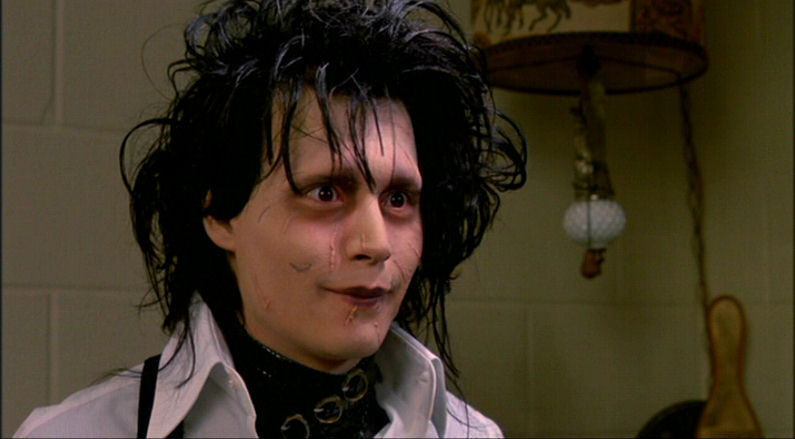
Edward is such a nice, caring, thoughtful boy.  So gentle, so talented.  And so, so lonely. 

Well, the answer to this is clear, right? All it takes is for one caring person to reach out her hand and grant Edward a place in a normal, caring family.  Then everything will be okay, right?

Well, this is movie, so we know not everything will be okay.  There has to be drama, tension, opposition.  Something has to go wrong.  But does everything have to go wrong?  Is Edward destined to loneliness forever?

Of course he is.  It is human nature.

There are two basic moral principles that all humans are bound to pursue, without exception.  First, there is the “high road” symbolized by the golden rule: “Love your neighbor as yourself.”   Peg sees Edward as a neighbor in need of some very basic love and she offers it to him.  Soon the whole neighborhood is following Peg’s example and Edward seems to have a new home.

However, this couldn’t last forever, for the second basic moral principle must reveal itself: “Protect your kith and kin.”  No matter how benevolent the attitude toward Edward, no matter how simple and gentle Edward seemed, in the end he must be rejected on the basis of his appearance.  For every good intention, for every positive attitude, below is a measure of fear, for Edward is a monster, a danger.  The fear of Edward can be set aside for a moment or two, but it must come out eventually.  And he will be rejected.

This is the basis of all hatred and prejudice, this determination to protect.  There is nothing wrong with it in itself, but it always leads to judgment and wall-building and eventually warring.  Thus it is best for Edward to stay in his castle.  It is best for the mentally ill to remain in their foster care homes.  It is best for the homeless to remain in their camps.  It is best for the new immigrants to remain hidden.  Not for the sake of society, but for their own sakes. 

Frankly, normal society is the most frightening monster of all.