Showing posts with label 1940s. Show all posts

Thursday, March 9, 2017

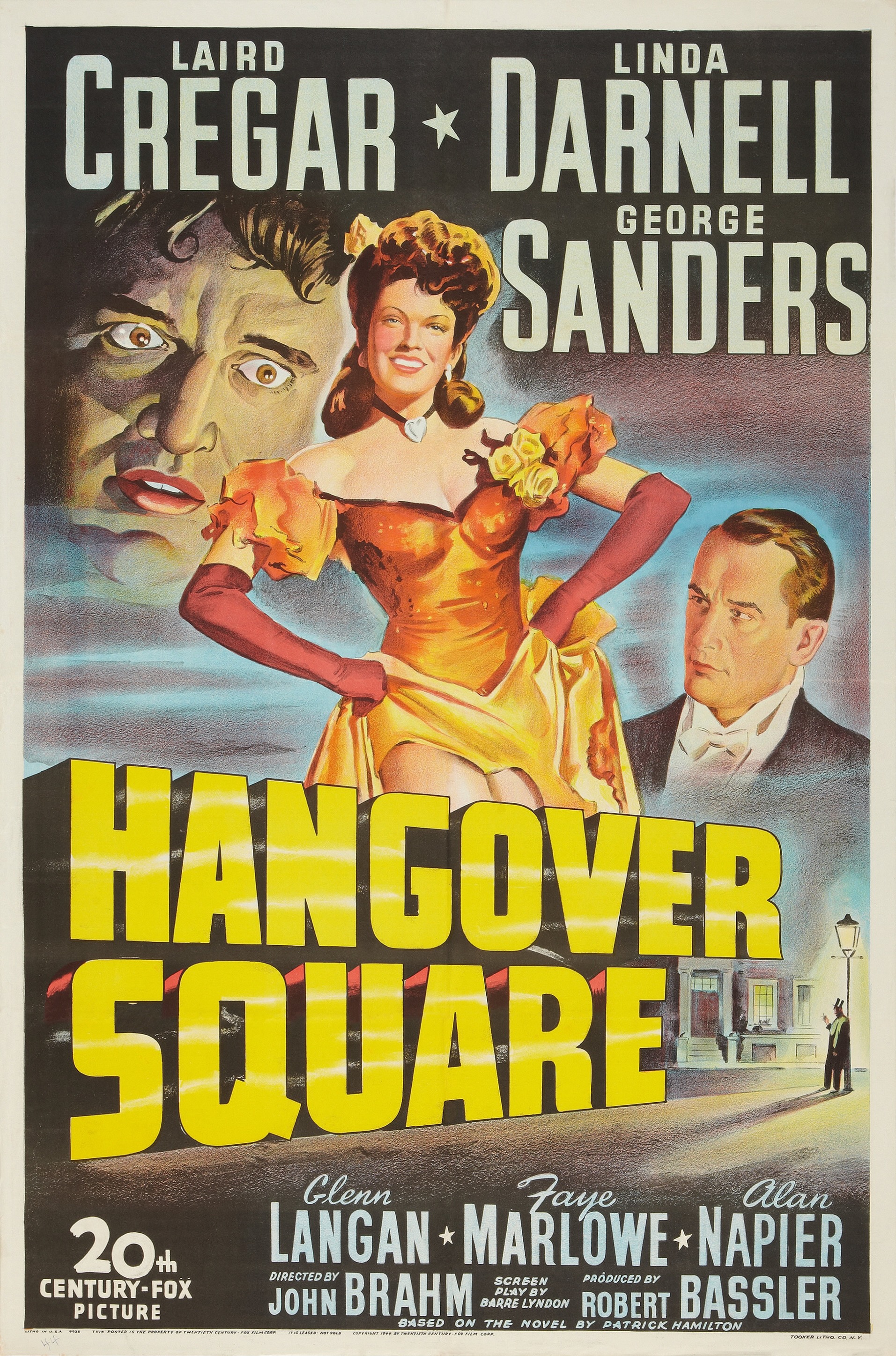
Hangover Square 1945

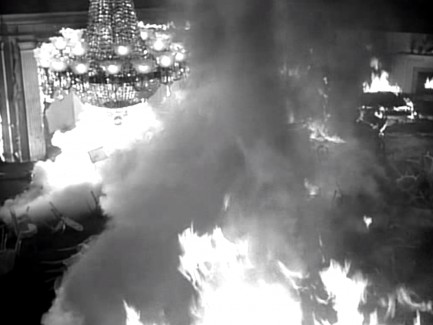
We can tell by the opening setting that this is a noir.  Dark, shadowy, haunting... but it takes place in London, 1899.  Odd setting for a noir.  Then we see a old Jewish man murdered before our eyes and a fire set.  Oh yes.  It's noir, all right.  

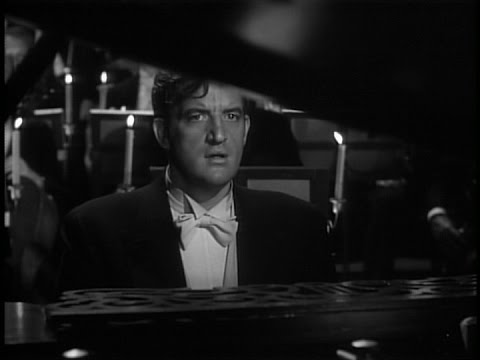
Then we follow our murderer to find out that he is a composer, on the cusp of success, loved by his fellow musicians and admired by a beautiful woman.  And he has fits of amnesia, and he is worried, deeply worried about what he does during these fits.  What does one do in this situation, go visit George Saunders.  That's what I would do.

What we end up with is a curious mix of Jekyll/Hyde, Hitchcock and Phantom of the Opera.  While not especially clever or mysterious, it is emotionally evocative and compelling.

There are two things I am still considering about this film.  First: will any American studio ever be able to present a believable Britain? The accents are a mess, they are all explaining Guy Fawkes Day to each other, and it all sounds more like Oliver! than Kes.   I guess Fox wanted to repeat their success of the previous year, The Lodger, so imprinted that film on this script.

The second is a connection between the response to the murderer and modern misogynists (mild spoilers).  The murder is acknowledged as dangerous and mentally unstable.  He has killed and it has been proven that he is completely unstable. This is related to his psycho-sexual needs being unmet.  The response of the police is, "You are dangerous, but we know it's not your fault. We'll take it easy on you."  Is this because they appreciate his standing as a white male, as a person of means who can spend his time composing music that hasn't been heard?  If he were poor or a woman, he would hang immediately.  It's all very believable.  Perhaps a bit too believable.

But the film is great.  Fantastic music, especially in the concerto scene, by Bernard Hermann, who also did the music for Citizen Kane, and the cinematography was beautiful, in classic noir style.  Highly recommended.

Sunday, February 26, 2017

Children of Paradise

It is the 1820s.

"Paradise", in this case, is the abode of the gods, and the gods are the audience of the theatres of the Boulevard of Crime (so called because adultery and murder happen in the theatres ever night).  Thus, the "children" are the actors, writers and producers of the stage who cater to these "gods", their whole lives revolving around the pleasure of the audience.

The central figure is Garance, a woman of such remarkable beauty that four men request, demand and battle for her hand, as well as her evening companionship.  She, on the other hand, smiles at them all, remains distant, and wanders where her interest takes her.  She never participates in crime, although observes many crimes.  She does not dance or sing or act, so she is only ever window dressing for the various theatres, never wanting a speaking role.  Three of the four men are up-and-coming central figures of the Boulevard, Baptiste, the gentle pantomime, Frederick the Shakespearean actor, and Lacenaire the boastful criminal.  Garance would like to dance like a butterfly between the three men, but a powerful fourth man appears, a proud nobleman who changes their whole world.

There are three sets of stories: that of the multiple-party romance, the highs and lows of the theatres and the stories on the stage, all reflecting what is happening in the actors' lives.  While there is a light touch on all of these deep real-life events, I prefer the stage productions, both silent and spoken, that portray both entertainment and serious themes.

This film is spoken of by some as the greatest French film, and it's epic scale, intermission and grand credit sequences indicate that it wants to be seen as an important film.  I am sure it is important.  It has it's significant place in the history of cinema.  But as a whole, I am not sure I want to give it too much credit.  It is good, the characters are well-drawn and it uses it's length of time well, but I do not know how much I will consider this film in the future.  It has to do with show business and with romance, and the presentation of both are far removed from my own experience, nor does it teach me much about the context.  The acting is an older style, almost vaudevillian, that keeps me distant from the characters, even as I am somewhat involved in their stories.

There are a number of things that I can admire about this film.  It was created and filmed in a Paris occupied by the Nazis. It presents it's worlds distinctly, each having their own manner of speaking and focus and running gags. And it also shows how there are pathways from the world of the stage to the world of the personal lives to the world of the theatre and back.

Yes, it's three hours.  But it is certainly a significant watch, and a generally enjoyable one.  

Sunday, November 27, 2016

Look for Friendship with Enemies: The Life and Death of Colonel Blimp

Powell and Pressburger are at their best when they claim to be giving you one genre, in this case a war film, but end up giving you something much better and surprising. This film depicts the friendship between a British General and a German officer through the wars of the first half of the 20th century.  Their relationship began as a rivalry between enemies, and then grew to grudging respect and then complete admiration, despite being on different sides and having wildly different opinions.  

Even so, we must realize that our allies and supporters might not come from people on “our” side.  Sometimes people who disagree strongly are still the human connection we need to keep going in life.

Also watch: How to Train Your Dragon, Catch Me If You Can, District 9, Joyeux Noel, The Son

Read more of The Way Forward

Friday, August 14, 2015

Familar, but with Depth: Brief Encounter

I do not understand how a single director knows the human emotional state to such a degree that he can make two such perfect films as Lawrence of Arabia and Brief Encounter. The movie Lawrence, from the early scenes, seem to tap into my inner ideas of heroism and draw them out, expand them and place O'Toole's character right in the heart of it, so that I will never again think about heroism without in some way relating it to this film.

Brief Encounter did the same thing. In different hands, this would have been a simple, even dull tale about a couple's extramarital affair. Instead, he took all my thoughts about tragic love, expands them and I will never forget that this film perfectly reflects it, even drawing me into the emotions of the couple doing what I have never done.

All the emotions are familiar: desire, regret, guilt, joy, denial, hope, yet Lean weaves all these familiar notes into a symphony of such power and tragic beauty that it can never be forgotten. It begins right from the first 15 minutes when we see the end of their affair. We know what is happening, although no one else pays any attention, and the hidden passion burns so brightly, yet it is frozen beneath a sheet of social ice so thick, it is as if the entire Arctic were a bright lantern.


We go through the story, and we feel what they feel and even more so because another couple in a similar situation plays before us, but takes it so lightly, so casually, that we understand the depth of passions of our focused couple. Finally, the entire movie rests on the final scene, all having run through Laura's mind, and her husband walks over and is perfect in a way that cannot be imagined. That's when I lost it and realized that this would be one of my favorite movies of all time.


Sunday, March 16, 2014

Cagney Is Red Hot in White Heat (1949)

The cops are all procedural and techy and full of schemes, while the gangsters are Homeric, not only in ideas but in hubris and angst. Because of this, we might have the most complex and human portrayal of gangsters until The Godfather. It isn't that I don't know who to root for, but I truly wanted to see this play out, and the ending, while possible over the top ("of the world", so to speak), was also perfect-- the only way it could have ended appropriately.


Brilliant, and with some great scenery-chewing by Cagney.

Thursday, May 16, 2013

Passion Without Prejudice: The Mortal Storm


Frank Borzage is the master of melodrama, and who better to direct the forerunner to many of the best dramas that take place in Nazi Germany.  I could see this movie's touch on many other great films: The Sound of Music, Cabaret and Schindler's List among others.  Yet this film both deserves to stand with those films and is to be honored as a special film in it's own right.

The surprising thing is that despite it being a melodrama about Nazi Germany, there is almost not a single stereotypical character, or a character that doesn't have its own strengths and weaknesses.  There are bad guys, but the biggest evil is narrow minded ideology, or fundamentalism as we call it today.  Truly, this is an honest film and a bold one at any time, let alone a year before the U.S. entered WWII.  It is clearly anti-Nazi, but all the characters are German, whether good or bad or mixed.  And many of the Nazis are sympathetic.  Even though this was made before the propagandistic push of later years, it is still a strong statement.

In this way, it is also the forerunner to films like, say, The Reluctant Fundamentalist, Zero Dark Thirty, or The Visitor, in which we are allowed to look into the face of a Muslim, even one who has some agreement with terrorism and to see different sides. It is a powerful experience when a film can take the prejudices of one's culture and say, "But wait, there's a human being under there."

In comparing it to the other Borzage films I've seen, it hits the same notes of effective melodrama.  I knew the scene with the bridal cup was coming, but when it came it still got dusty in the room.  I didn't expect the end, though I could have.

Great filmmaking.  I also recommend Borgaze's other films, especially Seventh Heaven (1927) and Lucky Star (1929)

Thursday, November 29, 2012

What is the Cost of Art? (The Red Shoes, 1948)

82. The Red Shoes (1948)  

“When we first met you asked me a question to which I gave a stupid answer: You asked me whether I wanted to live and I said ‘yes’.   Actually, I want much, much more.  I want to create, to make something big out of something little…”

Vickie doesn’t want to just live, she wants to dance remarkably, memorably.  She wants the glory of being an artist.  We might give many definitions of “art” and certainly a two year old can create art without much effort or thought.  But when we speak of capital “A” Art, art as an ideal, then it becomes difficult.  Such art is not content with imitating reality, or outlining reality—such art must be bigger than reality itself. 

Just as the ballet in the Red Shoes has color more vibrant than reality can show and express emotion more poignant than reality can express, so Art is huge, requiring a canvas so large that no one can drink it in at a single glance.  Art requires not only talent and discipline but a vision that is larger than life.

Upon such a canvas nothing less than one’s life’s blood can be spilled.  To be bigger than life, Art requires life.  No one can touch the depth of a soul without placing one’s whole soul within it.  The cost, the worth of Art cannot be measured by materials, time and effort.  For who can place a cost on one’s soul?  What is a human life worth?  Art demands life, and so it is worth life.

Wednesday, September 26, 2012

How Is A Man's Life Measured? (Colonel Blimp, 1943)


#91-- The Life and Death of Colonel Blimp (1943)

The Life and Death of Colonel Blimp is probably the worst misnomer of a movie ever.  The main character—frankly no character—is called Colonel Blimp.  The main character is actually a Major General, not a Colonel.   And the main character (minor spoiler, here) doesn’t die.   So there is no death.  But there is a life.

When we first see Major General Clive Wynne-Candy, he is outmaneuvered by a younger commander, who sees Major General Candy as a buffoon, much like the Colonel Blimp comic books the movie is named after.  He sees him as stuck in foolish traditions and policies, a glutton and simple-minded: unworthy to command any armed forces.   The Major General claims that the young lieutenant has no right to judge him for he knows nothing about him.

As the movie continues on in flashback, we find this is true.  Candy proved himself not only able, but noble through many armed conflicts.  His closest friend was a German enemy, and he proved his worth in his noble dealings with his life-long love.   “Colonel Blimp” was nothing of the kind, and his upstanding, often humorous life is given depth and power in this film.

How often do we judge people by one event, even by a glance?  How often do we see a shallow character, a narrow mind, a limited experience?  While there may be narrow minds, there are no shallow characters.  Every life has experience and power, nobility and weakness,  love and impatience.  We can judge no one, and for every weak or evil person, we must look deeper to find the nobility that lies there as well. 

Fun Fact: Michael Powell and Emeric Pressburger, known as The Archers, were the directors of Colonel Blimp and they directed almost 20 films together, the best of which were completely iconic and the storytelling unique.  Among their films are The Red Shoes, Black Narcissus, A Matter of Life and Death and A Canterbury Tale.  I recommend them all. 

Thursday, March 1, 2012

Just Another Review of The Great Dictator


Not comedies I like
I’m pretty particular about the comedies I enjoy.  Apatow is okay, I guess, but not my cup of tea.  The Farlley Brothers are the worst, for my taste.  Jim Carrey is occasionally good, but usually he just looks like he’s trying too hard.  And I don’t find impressions funny at all.

I do love the Marx Brothers and especially their film Duck Soup.   Yes, it is over the top silly, but the lines hit my funny bone and Harpo is always brilliant.  I especially like the none-too-subtle digs at the war mindset, especially at the beginning of WWI.

If someone had said, “What would you think about Charlie Chaplin making a remake of Duck Soup, as a talkie, not a silent, setting it at the beginning of WWII, playing an imitation of Hitler, and throwing in a healthy dose of holocaust?  Think that would be funny?”  Honestly, it sounds like the worst film ever.
And yet… somehow… after watching this very film, I have to put it alongside the greatest of Chaplin’s films.  Rarely have I laughed so often at a film.  And even though we don’t have The Little Tramp (perhaps only a semblance of that character), it is still that combination of poignient, funny and sweet that works so well in Chaplin’s other films.

 What Chaplin does with Hitler is not imitate him so much as re-imagine him as an easily misguided dictator, who only speaks German-speak when angry or in public speaking.  Chaplin, in his dual-role, is at his most brilliant, and shines in every scene.   And please, if you haven’t seen the film but heard it as some kind of prince-and-pauper story, the film is nothing like that.  The two characters don’t converge until the very end of the film.

Chaplin uses audio to the full extent.  This being his first talkie, he uses it like a novelty, something to take advantage of rather than an assumed aspect of film.  There are moments in which the scene continues all in audio, without any visual movement.  And he clearly worked hard at his vocals, and uses his voice to full effect.   What a comedic genius.  Whatever he focused his mind on, he could turn into brilliant humor.

Why should you watch this film, made before the United States entered into WWII?   Because it is comedic gold, but also because the final speech, which is going viral on YouTube and Facebook, is all the better for seeing the context in which it was originally placed.
4.5/5

Thursday, March 17, 2011

I'm Ready To Hate Citizen Kane


Orson Welles. Greatest film of all time. William Randolph Hearst under cover. Blah, blah, blah. Frankly, I’m sick of all the acclaim. Yeah, I saw it before. It was okay. But I think I really liked it because it was so acclaimed so I was ready to like it. This time, I told myself, I’m going to watch it objectively. I don’t care what anyone else thinks about this film. It’s just me and Welles, head to head. And I don’t think I’m going to like it near as much as I did before.

Technical—5/5—Okay, well everyone knows that this is one of the most technically perfect films ever made. Welles had too much time on his hands, that’s why its so great. Look at the camera angles and the lighting, cool. Yeah, but does it really work as entertainment. It must be praised because of its technical precision. Yeah, that’s it.


Interest—5/5
Characters—5/5

I forgot what a fantastic actor Welles was. I was amazed by Kirk Douglas’ performance as an irritating man who was fascinating to watch. Welles took it another step. Not only is Welles fascinating, but he is charismatic, likeable, loveable, even. No matter what a jerk he is, no matter how self-absorbed, so matter how irritatingly fly by night he is, you want to like him. You DO like him. If another actor had been the focus of this script, say someone along the caliber of Philip Seymore Hoffman or Meryl Streep, you’d appreciate the work and the acting would be magnificent and you call this a great film, but not an entertaining one. Under Welles at both the acting and directorial helm, though, you are laughing, crying, understanding, empathizing, through every scene with this spoiled brat of a man. I am amazed at this performance, at this character created.

Tension—3/5- This is a biopic and the “rosebud” tactic doesn’t really work to build up tension, nor even much of a mystery.

Emotional—4/5—Yes, yes, okay. I got a little dusty eyed. Perhaps I recognized my own narcissistic tendencies, my own drive to be loved that drives others away. Maybe I recognize my own frustrations at being unable to connect to others that I long for so desperately. But this silly multimillionaire made me gushy inside. Fine. I don’t care. I’m man enough to admit it.

Theme—5/5—This isn’t a film about greed or apathy. That would have been the easy road. Rather it is about loneliness. About the need to make a deep, intimate connection with another. And this is such a universal need, and so often lives are left empty of this, that, amidst all the other reasons is what makes this a great film.


Ethics—5/5—I like the way Kane tries to fill his relational void with many different attempts, but it isn’t obvious that is what he is doing. It looks like a man who has many interests and the money to make it all happen. But in the end it is about the search for love and how we can hurt everyone we know just looking and never taking the time to connect.
Personal—4/5—I am Kane, and at one time or another we all are.

Welles wins again. Dang, this truly is one of the greatest films of all time. It probably won’t make my top ten because I need a lot of room for Pixar and Miyazaki :) but it will be up there, somewhere.


Stop mocking me, Welles. I already said you won!
Tuesday, March 8, 2011

Just Another Review of The Treasure of the Sierra Madre

Yep, this was my first time watching this Bogie classic.  It's about searching for gold in 1925 Mexico.

Here are some things I loved:

-Having the lead actor play the undermining, mentally unstable person.  Usually this kind of role is secondary, just to move the plot along, but HB is rightly given this role and he does a great job making Dobbs both slimy and charismatic.


-Walter Huston.  Dang, so believable and likable.  I love him in this film.


-The Banditos.  They make many welcome interruptions to a fairly straightforward tale of greed and everything that goes with it.


What I didn't like:

The foreshadowing- "Please, old and wise prospector, tell us what is going to happen in the rest of the movie or else we wouldn't know what to do!"


The music-- please, tell me how I am supposed to feel again, because otherwise I wouldn't know


Most of the acting-- "I don't have to show you any stinkin' badgers!"

The fight scene- Not a single punch landed, but there he is on the ground


In sum, I have to give it a 3.5.  Some excellent memorable moments, but overall not great.

Friday, March 4, 2011

JAMB Featured in The Reelists!

Corey Atad of The Reelists approached me to do a regular column on their website. The first article was just posted and you can read it here.

Here's a taste...

A true love of film is a recent development for me but a love of literature was ignited when I was a schoolboy. I fell in love with poetry, novels and especially drama. Perhaps my love of drama and dialogue segues easily to cinema, as does my favorite dramatist, George Bernard Shaw. From the 30s to the 50s and on the BBC in the 70s a number of Shaw plays made their way to the screen, most famously in the musical My Fair Lady, based upon Shaw’s play Pygmalion. This is easy to understand, as Shaw is witty and smart and his themes are deep. On the other hand, his plays, while dramatic, do not emphasize the visual, but the conceptual. The visual presentation of Shaw’s vision is really dependent on the director and his supporters.

It is fascinating then to watch Major Barbara, the only Shaw work on film I’ve seen apart from My Fair Lady. It is fun to see Rex Harrison, a star best known for the My Fair Lady, as a young man, less confident but strong as the man romantically interested in the title character, a Major in the Salvation Army in London. Wendy Hiller is marvelous as the Major in the early scenes of the film where she is strong and in charge, but as her character’s morale falters, so does her performance. The real star of the show is Barbara’s father, Andrew Undershaft, played by Robert Morley. He is despicable in the most charming manner possible, so much so that it is impossible to hate him, especially as he plays his trump card at the end of the film.


Read the rest on The Reelist's website.