Showing posts with label 00s. Show all posts

Saturday, October 8, 2011

I [Heart] Nemo


My son, on his 18th birthday this last December decided to celebrate this first step into adulthood by inviting a couple of his friends to our home to watch Finding Nemo while eating homemade Portal Cake (recipe changed from the original).  This was a marvelous idea and a great opportunity for me to reevaluate one of my favorite movies of all time.

When I first watched Finding Nemo, my reaction was much like a comment made about this film, “A talking animals movie—how unique!”  The story was simple, and while Dorry is hilarious, overall the impression it left me was “meh”.   After watching it with my children more times than I can count, my appreciation for this film knows no bounds.  This is a deep film, a touching film, a truly human film that has to be told in the sea, for only the sea has the complexity of human society.  Yeah, it’s played for laughs—a lot of wonderful, freeing, joyous laughs—but it isn’t just a funny film.  It’s a film about love and relationships.



Technical—5/5—Amazing.  This is one of the peaks of Pixar’s art.  Every plant, every tentacle, every fin is perfectly realized.  The characters are completely fish and completely human, much in the way Disney has done at their best.  This is a marvel of computer animation.


Interest—5/5—How can I turn away from this film?  Every second is interesting.  It’s funny, then tense, then touching, then funny again. 


Tension—5/5—This is the first film I remember Mercy and I watching together.  We saw it in the theatre, she was three, and was scared to death.  The sharks, the lantern fish, the whale… it was all too intense for her (she still gets nervous about too much tension).  She wanted to leave, but I just held her in my lap and told her to shut her eyes if it was too much.  By the end of the movie she loved it, but it was touch and go for a bit.  Sure, it’s not really scary for adults, but the lantern fish still creeps me out a bit and the jellyfish scene still makes me tense.

Emotional—5/5—Yeah.  When the Pelican tells Nemo the story of his dad braving all of the dangers of the ocean to find his son, I get tears in my eyes.  Heck, they are there right now, just thinking about it.


Characters—5/5—This is the best.  Rarely is character better shown through plot than in this film.  The prologue which establishes the reason for Marlin’s fears, but especially the time taken for Marlin’s attempt at humor.  He can’t tell the joke because he needs to over explain everything, and that tells us everything we need to know, and we can see from the beginning how this damages his relationship with his son.  And instead of Dory and Nemo just being “the funny one” and “the object of desire”, they are given character arcs as well, where all three of them learn to trust.  Marlin learns to trust his son, Dory learns to trust a family and Nemo learns to trust himself.  Brilliant.


Theme—5/5—There’s a lot going on in the film, as it is a quest movie.  Most quest stories rely on the next thing coming to keep the interest, as does FN.  But this is the most human of quest stories, because it is about relationships and how trust is essential.  It isn’t just that the father needs to give the son more freedom (like the shallow Little Mermaid), but that they all needed to trust each other, and to trust the love that they have for each other.  And the way to develop trust is to see each other (and oneself) in crisis.  After the worst has happened and every acted heroically, there is no more need for fear.   This is simple, a child could get it.  But there’s enough in the telling of it that a psychologist or ethicist to spend hours on it, understanding how it works.

Ethics—5/5—Fear leads to overprotection, trust—even dangerous trust—builds love.  That’s powerful.


Personal—5/5—Despite it’s depth, its hilarity, its ethical nature… Finding Nemo is a story about parenting.  We all have a tendency to overprotect as parents (unless we are so wigged out on addiction we don’t notice our children).  It is interesting that a significant part of the story is Nemo learning from Gil what Marlin couldn’t teach him.  It isn’t that Marlin didn’t get Nemo back, but Gil is just as important to Nemo’s growth as Marlin was.   Letting go, in parenting, often means letting others teach what you cannot.  That is real trust.  It is hard to let our children go, and necessary.  These are all lessons I am still learning.

Okay, yeah.  It still belongs in my top 5. 

Wednesday, May 25, 2011

Hangin' With The Wild Things.

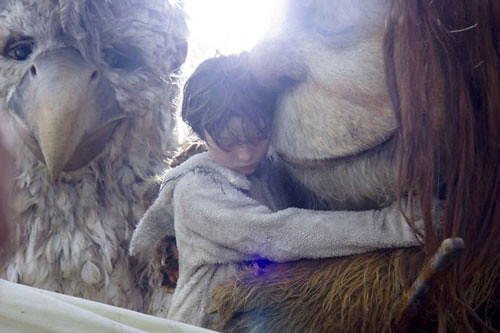
Where the Wild Things Are (2009)


Maurice Sendak is one of the greatest children’s picture book creators in the world and I don’t know why. If you have read a lot of his books—and I have—they are one part charming, one part creative and several parts creepy. Have you ever read the brief tale, Pierre, where a disobedient, disrespectful boy is eaten by a lion? Why do people read this stuff to their children? Why did I? Partly because Sendak gives us all a context to see darkness in the world and a mythological method for us to deal with it. We understand it is imagination, but we accept it. (Pierre turns out okay, btw.)

Spike Jonze and Dave Eggars captures that sense in their narrative version of Sendak’s most famous work. They provide some background and beauty to the original story that it lacks, as well as a spare story. And this movie is all about children, especially boys. It captures the dangerous imagination that boys have, as well as their incapacity to understand social mores. However, this film is not really for kids. My daughters didn’t really appreciate it. But I get it. It strikes me to my core. It is a film written for my inner child. Perhaps you think you don’t want to meet me face to face, but don’t worry—I keep my inner child locked up most of the time.


Technical—5/5—This was made brilliantly. It is a complete fantasy—life as seen from the point of view of a hyperactive, overimaginitive boy. Yet it has many touchstones of realism throughout it. Well done shaky-cam, moments where the perspective is from the mother, gorgeous landscapes. And the editing is brilliant—keeping us off guard by giving us long, slow views then suddenly quick jumps. We have no idea what will happen next. And the music—wow. Jonze crafted every scene to be this perfect combination of art, film, music and context.


Emotional—5/5—To me, this movie is all emotion. The story is barely an outline that can be fully realized in a paragraph. The whole fantasy sequence is actually conflict of the boy’s emotions and drives—anger, being ignored, drive for connection, loyalty, peacefulness, sadness—all pushing their agenda, attempting to reach some balance so they can all live together. I think you might be able to cut the film into sections which begins with anger, moves into sadness and concludes in peace… only to move to the next section of anger, etc. To me, this film isn’t about narrative, but about emotion. There is a story to emotion and the proper conclusion is finding how to give emotion its own logic and meeting its need.


Tension—5/5—WtWTA’s tension builds to an almost perfect climax. The danger is always there, but from the wild rumpus to the end of the film, it is all about the building of tension. It is written all over Max’s actions. He seems so confident at first, then nervous and finally outright hiding.

Interest—5/5—Some have complained that the movie is too slow, that it is just plain dull. And if seeing it on a strictly narrative level, I can see what they mean. Frankly, not much happens and there’s a question whether it actually gets resolved. But the same problem could be seen in the original picture book. Little happens and it doesn’t seem to have a point. The book and the film aren’t supposed to be understood intellectually, but emoted. We are supposed to follow the ups and downs of Max’s emotional state and appreciate the turmoil he’s going through. Not everyone senses that. But between the story of Max’s emotions, the ever-increasing tension, and the beauty, I couldn’t take my eyes off the screen.


Characters—4/5—The only fully developed character is Max, and that is as it should be, because the majority of the story takes place is Max’s head. The story is about the psychological healing of a young boy, and the monsters are simply parts of himself. The dialogue in the fantasy land is the kind of story a young boy would create—unrealistic, but expressing a part of himself and keeping the spare story moving. Yet, for all that, I have to give credit to the actors moving the monsters and the voice actors. These “pieces of Max” were excellent characters, especially Carol, voiced by James Gandolfini. Carol is “the angry one”, but his actions and voice were strangely calm with strong danger behind it. Carol’s anger is powerful and controlling and sudden, but it communicates the danger quietly long before it acts. This is powerful and adds to the horror of it.

Theme—5/5—The theme is anger. The film speaks less about how to deal with anger than seeing the results of it. It goes through a cycle of anger many times, giving us a fuller sense of it each time. And though the language and story is from a boy’s point of view, it is not just about children and it is not communicating in a way that children could necessarily understand. I don’t think children will come away with a better sense of what their anger is, but I think adults would.


Ethics—4/5—This film is nothing like a sermon. It gives no solution other than Max’s emotions need a mother. It is descriptive, however, and clearly speaks of consequences of one’s emotions. The cause and effect are not clearly pointed out because, like life, relationships are messy and there isn’t an easy finger to point at or solution to reach. This is a perfect film for discussion about issues revolving around anger.


Personal—5/5—Max is my inner child. He screams at injustices and refuses to look at things from all sides. When things don’t go right or his needs aren’t met, he screams and is violent and hurts others. He wishes people would understand him, but his emotional façade keeps that from happening. The best solution is to go away for a while, allow the inner demons to deal with their conflict, allow reason to prevail and then go home for a comforting meal. “And the food was still hot.”

This film hit all my emotional buttons. I can see that most people wouldn’t resonate with it, but it is beautiful to me in every way possible.

Sunday, May 22, 2011

Fight Club Fighting...


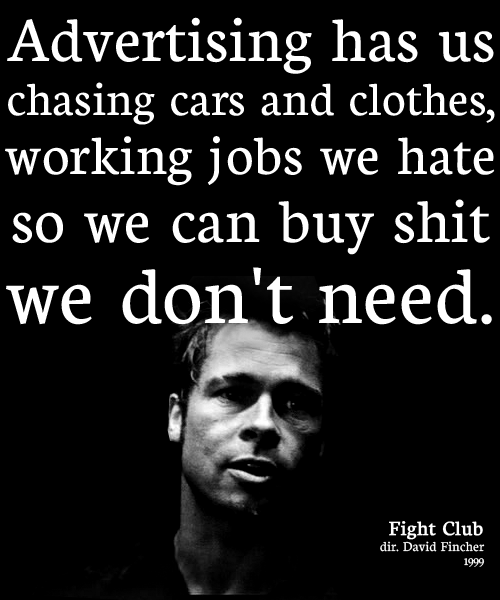
I have a terrible personal struggle with consumerist ideology. To be absolutely forthright, I hate it.

I hate the fact that those with money automatically have power. I hate the fact that the justice system is tilted toward those who can afford better and more lawyers. I hate the idea of “the bottom line is the bottom line” and how that perspective skews thinking from multi-national corporations to religious organizations to humanitarian non-profits. I hate the manipulation of the consumer, convincing them that what they want is what they need. I hate the debt culture and the destruction that it brings to so many.
Am I done?  Yes, I think that’s enough for now. 

All of that is by way of confession, to help you understand why I appreciate Fight Club so much. Because the presupposition of the story is that consumerist society is destructive to individuals. It preaches this point as strongly as any African American pastor on a roll. It shows us this destruction in mild ways, such as the IKEA lifestyle, to a philosophical ideal, describing how consumerist society rejects reality, to more graphic ways, as post-accident service workers joke about aspects of rotting corpses.  In the end, our society reflects dehumanization, which separates us from others, from life and even from ourselves. (I recognize the irony that while the Fight Club franchise critiques consumerist society, it also is one of the big winners in the deeply consumerist publishing and film industries).

The focus of the film and the book is not that consumerist society is “bad” per se, but what we, as individuals, should do about it. This is where there are multiple paths to take in the film, multiple ideals to pursue.


First, there is the path of The Narrator (Edward Norton). This is primarily an escapist path. Norton is fed up with consumerist society and he sees the Fight Club life as an alternative existence. He no longer pursues personal comfort or rigid obedience to his employee’s demands as the corner of his existence. Instead, he leaves his apartment (not pursuing the restoration of his former existence), living in a dive, fighting on the weekends in a club designed for exuberance and safety. The climax of his path is the manipulation of his boss to grant him finances without him having to work.  At that point, his escape from consumerist life is complete and he can embrace the edgy life, the “real” life that he has longed for, without the dehumanization of modern society.

As a contrast, we have Norton’s muse, Tyler (Brad Pitt).  For Tyler, it is not enough to escape consumerist society.  Because when one escapes, there is always the possibility of returning.  And one must have some sympathy for all the sad sacks still living in the condition of a half-life, blood being drained by debt and cable television. Tyler demands that consumerist society must fall, for the sake of the individual and for all humanity. That is the second path, the path of organized anarchy.


Rather than fill you will recollections of some of the most radical scenes of the movie, and thus becoming remarkably spoiler-full, I would just like to recount the rules of Fight Club, the most well-known portion of the film.  They are:

1st RULE: You do not talk about FIGHT CLUB.
2nd RULE: You DO NOT talk about FIGHT CLUB.
3rd RULE: If someone says "stop" or goes limp, taps out the fight is over.
4th RULE: Only two guys to a fight.
5th RULE: One fight at a time.
6th RULE: No shirts, no shoes.
7th RULE: Fights will go on as long as they have to.
8th RULE: If this is your first night at FIGHT CLUB, you HAVE to fight.

If you skipped these rules, go ahead and read them again.  From the Narrator’s perspective, these rules strike the perfect balance.  They clearly are a separation from the controlled, manipulative, comfortable consumerist society. To obey these rules is to embrace danger, but not too much. Although charged with testosterone, at the same time they encourage safety. It is about separation from a society of comfort, but the changes are private, individual, safe.

But Tyler sees something completely different. He sees the core of an anarchist army.  Everyone who participates in Fight Club is learning to accept violence as a way of life. They are learning to embrace life with only limited rules, an alternative set of rules from the rest of society. This is a group of rebels.

But only rebels to society. Fight Club becomes its own rule, its own society. Some of the rules are arbitrary (“No shirts”?), and some are demanding (“you have to fight”). And the most important aspect is secrecy. From the Narrator’s perspective, secrecy is safety. From Tyler’s secrecy is freedom. It illustrates the idea that Fight Club is only a seed. From here, this training in violence, it can go any direction as long as the direction is different from where society is at.

So what should we get from the film, what is its message? Perhaps it is just a testosterone-driven fantasy with a wake up call about spiritual death.  Perhaps it is just a clarion call to drift away from a dead-end society with a warning not to go too far. Or perhaps it is saying that the natural conclusion of freedom from consumerism is anarchy. And that such anarchy must be embraced and planned.

What we get out of this film might say more about ourselves than about the film.


Tuesday, April 19, 2011

The Real Gospel of The Passion of the Christ


My latest article at The Reelists is on Mel Gibson's famous (or among some, infamous) The Passion of the Christ:

Much of the American church has lauded The Passion of the Christ for its stark and gory depiction of the death of Jesus for being “realistic”. However, having done historical studies on the subject, I can say that Mr. Gibson went far astray of historical reality. First of all, his sixty-plus lashing of Jesus would not be allowed. Even Jesus Christ Superstar only had the “forty minus one” legal limit of a public lashing. Also, although it was an occasional practice for the Romans to weave bone into their whips, it was not a perpetual or necessarily a frequent use. We have no proof that every whip on Jesus’ back ripped his flesh to shreds. And, frankly, an adult body can lose about 2.2 liters of blood before death. And long before the Jesus of the Passion carried his cross, he had lost that amount of blood.

Read the rest at The Reelists

Sunday, April 17, 2011

A Duo of Brothers: Bloom and Blues

The Blues Brothers

Jake and Elwood. A couple of simple men, with simple desires. They love good music, good friends, fast cars and to stay away from their exes. But there is a crisis: the severe nun who raised them is about to lose her orphanage. So they embark upon their mission from God: they are going to get their rockin’ blues band back together and do one more big benefit show to keep the orphanage going. In the midst of this, they find that they must have a number of car chases, including one through a mall, insult some rednecks and run from a mysterious woman who wants to kill them. Just another adventure for God.

Technical 3/5—The acting is basic, sometimes it is basically bad. But that is all to remind us that most of these supporting characters aren’t actors, they are musicians. The cinematography is also pretty basic—nothing fancy or pretty. It’s your basic entertainment from the 80s.

Interest—4/5—What a fun film. The music is great, having some of the classics rock and soul songs from some great artists. And it is such a blast. The car chase through the mall is still classic, and the Brothers’ choices are amazingly stupid. For a skit brought to screen, it is really entertaining.

Tension—3/5—In a sense, it doesn’t really matter what happens. The important thing is that the movie goes from song to violence to song to violence. What happens to the characters aren’t so important. The only tension is really found when the Brothers’ are VERY late for the show. But Cab Calloway saves the day—how fantastic!

Emotional—3/5—If LOL is an emotion, then I was there.


Characters—3/5—Frankly, I like the fact that Belushi and Ackroyd played the Brothers deadpan. It offered a wonderful contrast to their stage presence and the insanity around them. It just added to the humor, even if it means no character development for them. Carrie Fisher, however, is perfect as the Ex. She steals every scene she’s in and is way better than all of Scott Pilgrim’s Exes combined.

Theme—2/5—Abusive nuns shouldn’t ever ask the kids she’s raised to help her. In anything more than painting walls.


Ethics—2/5—Ethically, the film is interesting. We are asked to withhold judgment on the various criminal activities of Jake and Ellwood because they are doing it to help out an orphanage and they are socially clueless as to what would be appropriate. In other words, since their moral imagination is low and their motivation is good, then we should wink at the damage they have done to relationships, buildings, families, as well as the countless laws they have broken. Besides, their band rocks.

Two things disturb me about this moral reasoning. First, that good motivation always produces moral actions. Clearly, in the Blues Brothers, this is not the case. And it is not the case in real life. The fact is, moral action not only needs positive motivation (“I want to help this person”), but it also requires wisdom to understand the best options. Which J and E clearly lacked.


Second, and what really bugs me, is J and E represent a certain kind of religious reasoning that damages the world. We can laugh at their idiocy, but others see their kind of religious experience without thought to be a fair assessment of proper religious action. They can be seen as a mockery of religion (which I don’t think the Blues Brothers is) or they can be used as a defense for a kind of religious action. Really, I’ve seen it. I know a number of Jake and Ellwoods. I know of people who pray for protection before they break into a store to steal thousands of dollars of goods, and believe that God has heard their prayers. This is horrible. Again, it’s not the fault of the movie. Perhaps the film is just laughing at this kind of reasoning. Unfortunately, knowing that the reasoning is actually out there, takes away some of the absurdity for me.

If God is in The Blues Brothers, He's the one who caused the orphanage to close down in the first place.

Personal—2/5—Nothing personal, it’s just an entertaining film.

The Blues Brothers is along the lines of The Emperor’s New Groove or the original Pirates of the Caribbean film. It is simply entertainment, nothing more. And it isn’t as great entertainment as those other films, so it won’t make my top 100. But it is worth rewatching about every decade.


The Brothers Bloom

Rian Johnson is a director whose name should be widely known. Honestly, he's young and he's only directed two films. But these two films are so filled with the knowledge of their particular genre, and both goes just that extra step that Johnson should be someone to really keep an eye on. His first film was Brick, a noir film that takes place in a high school. It is tense, smart, and just a pleasure to watch.

But even better is his follow up, The Brothers Bloom. I watched this for the second time with a dumb smile on my face the whole time. This is a con movie, but the real issue is not what the con is, but how the artists con themselves. How, in reality, we all invent ourselves and re-invent ourselves. That who we are is not accurate memory, but rather that our identity is found in the narrative we have placed ourselves.

The first time, Bang Bang enchanted me. This time, I fell in love with the whole cast. I understood what was going on, which made me lose some of the mystery, but it was just as good. The storytelling motif is not just interesting, but important. Oh yeah, this is a keeper.

Technical-- 5/5-- Johnson is an amazing filmmaker. Every frame is planned, and every moment carefully placed. And it is all a wonder to look at. Some of the sequences are so complex that you think you are watching one of those Rube Goldberg machines that take up a room in order to crack an egg. Perhaps it is unnecessary, but the entertainment is in going through the complexity.

Interest-- 5/5-- There isn't a frame without something amazing taking place. Unbelievably entertaining. Funny, touching, occasionally deep, and most of all, fun.

Tension-- 3/5-- The tension was certainly less the second time around. But the final scene was still intense.

Emotional 2/5-- This film doesn't really stir my emotions, which is why it won't make my very top films. The most I can say is "touching" at times.


Characters 4/5-- Not only was I entertained by these characters, I almost believed in all of them. Bang Bang, probably one of my favorite supporting characters of all time, is part Chaplain, part Harpo and part Basher Tarr. Oh, and she's Asian. But all of the characters are a lot of fun. The point was not to see the characters as "real" so much as to feel what they feel. All the characters, not just Bang Bang, felt, to a degree that they came from a much older day of cinema, which made them a bit more shallow, but still likable and you still wish you could spend more time with them.

Theme 5/5-- The idea of life as story and the power of writing one's own story is excellent.

Ethics 4/5-- Well, conning is bad. That's criminal. And lying. But making sure that everyone gets a benefit from the arrangement is good. Perhaps it is self-deception on Stephan's part, but interesting to think about. The interesting thing about this film and most con films is the idea of lying as a potentially positive thing. Deception is bad, not because people shouldn't be deceived, but because deception is almost only exclusively used for one's own personal benefit. But if one could lie in a self-sacrificial way, to benefit another, is it actually wrong?


Personal 2/5-- Didn't really connect personally, but you can't have everything.

It's a film of entertainment, with a little to think about, but it succeeds admirably for that. I was firmly entertained and I thought a little. I would place it above The Blues Brothers and I declare Rian Johnson as someone I will watch just because his name is attached to the project. Oh yeah and I think The Brothers Bloom will make my top 100 list.

Saturday, April 16, 2011

Simply Bleak: Songs From The Second Floor


I wouldn't call Songs just a black comedy but rather desperately bleak. The context is a nation where the economic situation is desperate, and no one has any idea what to do. Stockbrokers whip themselves in the street, economists gaze in a crystal ball, entrepreneurs come up with any crazy business plan, all to no avail. The economic situation is just getting worse.

And in that context we are told the story of Kalle, who has torched his business in the hopes that he would obtain the insurance money. His son is mentally ill and won't speak. But this movie is not so much a story as an observation. Kalle and others are in scene after scene, each displaying a single of desperation, of failure, of loss, but there is no progress or really regress. It is just bleak.


I wonder about the unreality of it, frankly. Sure, there are ghosts, but are they really ghosts or the selfish causes of the economic situation? Is it a reality or an unreality, or simply a perspective, and interpretation of our times? Both the style and themes are reminiscent of Brazil, but the running theme through Brazil is hope-- and there is no hope found in this film.

I can't say whether I liked the film or not. It took a while to get used to, and the ideas are interesting. But could I say I enjoyed it? Well, no. But is it good? Certainly. It is a unique perspective, a combination of Gilliam and Linklater with a dollop of Scandinavian humor. I recommend the experience.

Friday, April 8, 2011

Lake Of Fire: A Lesson On Rhetoric


Two words that in this day and age are an oxymoron when placed in conjunction: "abortion" and "objective."

It is almost impossible to discuss abortion while remaining balanced and unemotional, at least in the United States. It is difficult to speak about those who hold to an opposing view of abortion than oneself in a fair and unbiased manner. Words like "bigot" and "sexist" and "unAmerican" and "Nazi" tend to creep out. The whole context is one of high emotion and distrust. And, as is often the case in the politics of the United States, there are two sides, and ne'er shall they meet. Either you are on the one side or the other, and they cannot work together.
Take, for instance, the film Lake of Fire, a documentary on the abortion debate by Tony Kaye. Tony Kaye, a British filmmaker, claims that he does not know what stand he takes on abortion. However, everyone he interviews makes it clear that they know and they will tell the camera exactly what they think is true, in no uncertain words.

First up are the religious fundamentalists who are the focus of the first half of the film. They are the ones who say that the Bible teaches that abortion is murder and that America should be a Christian country. In a Christian country, they say, people would face the death penalty for killing innocent human lives. And yet they find some of their members being killed by society for killing doctors who kill fetuses.

The second half of the film focuses on the arguments of the pro-choicers. Although some of the arguments are the rights of women, most of them are about the need to recognize that sometimes killing must happen for a greater need. Most of them consider abortion, as one of the pro-life speakers said, "the lesser of two evils". At the end of the film, the pro-choicers are more articulate and more willing to recognize that we live in a secular society and we need secular reasoning to pass laws.

But despite all the talking heads, the most powerful segments of the film are the introduction and conclusion, each of which depict an actual abortion. The first is grizzly, with a chopped up tiny infant being displayed for the camera, a severed foot with clear toes measured at a half inch. The capstone of the film focuses on a woman, struggling with relationships, making a tortured decision with kind people leading her through the steps. Her scenes end with her weeping and saying, "It's hard... but I made the right choice." These abortions depict the two sides far better than the multiple talking heads. One focuses on the terrible death of an infant. The latter focuses on the life of a woman. In making a decision about abortion, both must be considered.

Lake of Fire is often considered an objective perspective on abortion. And it certainly has all the trappings of objectivity. It allows both sides to speak with equal air time. It shows, through the two abortions, the key features that stirs all the rhetoric. However, it is not a fair representation.

From the pro-choice side, I have read that there is a concern about not allowing enough women speak on the issue. I will say that although women do speak in the film, they are not the most articulate voices in the film. For the pro-life side, Norma McCorvey (AKA Jane Roe of the famous case, Roe v. Wade, which made abortion legal) was very articulate in telling her journey from being pro-choice to becoming pro-life. But for the most part, the "stars" of the film were men.

Now I'm going to come out of the closet and freely proclaim my lack of objectivity myself. I am pro-life and have been for a long time. And, although I am religious, I did not come to this position as a religious belief. Frankly, I don't think the Bible speaks to the issue at all, and the verses that relate to the unborn are vague at best when dealing with the issue of abortion. Nor do I have a church tradition that tells me what to believe. I came to my point of view from a philosophical perspective. And from that perspective I want to say why I felt that Lake of Fire is not objective.

The viewing of this film cut a hole in my heart. I felt like a knife was being driven into my chest again and again. At first because of the abortion that was depicted right at the beginning of the film. It is frankly the most graphic visual depiction of an abortion I have ever seen. If the film had been in color instead of black and white, I would have vomited.


But frankly, worse than that was the rhetoric used by the "pro-lifers". The religious fundamentalists who don't care about differing points of view or seeing things from another persons' perspective. They don't care that our country is secular and so public policy decisions must be discussed in a non-religious way. And the depiction of these religious fundamentalists are interspersed with stories and interviews with murderers of doctors who perform abortions. The point of view of these murderers is clearly articulated: "Mass murderers should be killed, and if my country won't do it, I will." Frankly, the rhetoric is offensive and the inclusion of murderers as representatives of the "pro life" movement is unbiased at best or a deliberate attempt to undermine the position at worst.

A number of the pro-choicers make the excellent position that if the pro-lifers were against war and were for saving all children, not just the ones in the womb, then perhaps they could be listened to. Another articulate (woman) on the pro-choice side said that if the pro-lifers were helping pregnant women with their pregnancies, giving them homes and helping their babies get adopted, then the pro-choice side might pay attention to them.

What the film doesn't represent is the more reasonable, articulate, and compassionate side of the pro-life movement. First of all, there is a strong side of the pro-life movement called "consistent pro-life." It is a side that is articulated by both conservatives and liberals, both religious and non-religious. It says that all human life is to be protected and that the life of an abortion doctor, a mother with AIDS, a child in Africa and a fetus all have the right to be protected from death. We say that abortion isn't the only issue that needs to be changed, but also war-- where innocents die almost daily by American bombs-- and the death penalty should be stopped, for they are all crimes against humanity.

The film doesn't depict the kind care and service of women that happen everyday in thousands of communities in the United States by pro-lifers. That there are Crisis Pregnancy Centers, adoption agencies, homes for unwed mothers, all set up to make it easier for women to carry out their pregnancies and to give the baby up for adoption.

I would love to have all pro-lifers watch the film Lake of Fire, to show how the pro-life movement is being displayed. No matter how reasonable some of these leaders seem, they all look like religious fanatics and they seem to be associated with murderers. We need more reasonable, articulate spokespersons for the pro-life cause. People of peace as well as people of learning. They are out there-- Ron Sider, Peter Kreeft, Ron Paul. It is sad that they are not given a part of the limelight to give a balanced perspective.

Wednesday, February 9, 2011

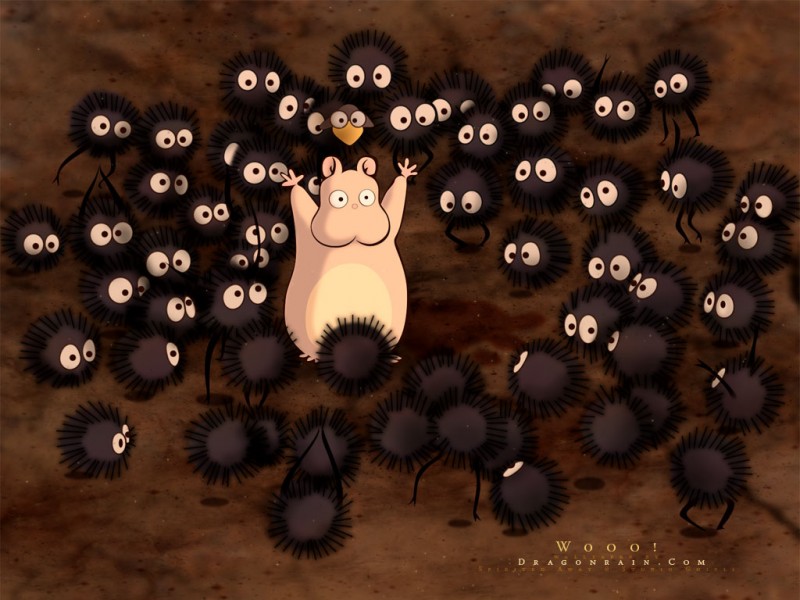
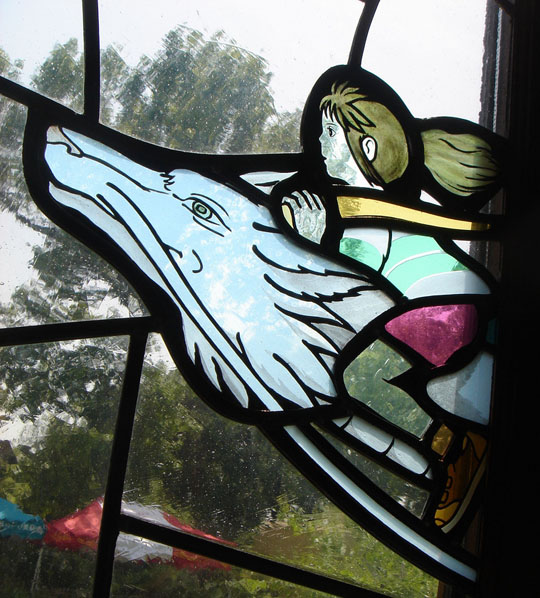
Spirited Away: The Greatest Film of All Time


"An alternative universe coinciding with our own"

I really appreciate what a co-movie lover said recently, that as one gets to the top of one’s all time favorites list, that it becomes more personal. I think that is really true. My top ten is peppered with films that mean something important to me personally, but may not be as thrilling to others: Wendy and Lucy, The Mission, Being There. They all carry double meaning for me: not only being well done films in their own right, but also expressing messages that are important to my life. They not only speak to others in a general way, but they speak to my life directly in a way others might not understand.

So, with Spirited Away, I can give you the many reasons why this favorite film of my favorite director is generally excellent. The animation is top notch, for one. In re-watching Ponyo, I realized how much we are missing in focusing on computer animation instead of hand-drawn. It has taken hand-drawn animation almost a hundred years to reach this place, while computer animation is still a teen. Computer animation is wonderful, but it still has a long ways to go to establish a set of symbols we recognize as human emotion. Miyazaki, however, has taken the step that Disney never did to make characters that are so real we feel that we know them. This is certainly found in the writing and the voice acting (even the dubbed vocals!), but especially in the drawing. It is not because they are more realistic looking, but because we grew up with this kind of animation, and Miyazaki, adding in expressions found in manga and older anime, has given us a visual language we can truly connect with.


"Living in the stream of life, led by love"

Also, Spirited Away is one of the magnificent stories of imagination. Setting aside the Japanese spiritism (which we will talk about in a moment), the amount of imagination that creates both the setting—a bath house for spirits—and specific unique characters such as No Face and the Radish Spirit, takes even the imaginative achievements of The Wizard of Oz, The Neverending Story and Labyrinth to new heights. But more than that, this imaginary story is realized perfectly visually. We can see this world existing. This isn’t just an amusing tale with muppets or dressed up humans or poorly executed claymation. This is another world that we have the opportunity to visit for a couple hours, and that experience gets added to our own.

I am just saying what could really be said of almost any of what I call “first tier” Miyazaki. As well as this: Miyazaki’s characters are fully realized. These are real people, even the spirits are of a type of character we recognize. While there is sometimes comedy, it is the comedy of real life, not just pratfalls and one liners. When there is achievement, it is rarely of the deeply heroic kind. Rather, it is the daily success of those who act noble in small ways. In this way, Miyazaki can connect to us in ways that blockbusters rarely do. There are scenes in Miyazaki that, despite the outlandish settings, we can see as reflections of our lives. Or our lives as we wish them to be.


"Look, I can do it, too!"

There are two reasons, however, that Spirited Away especially speaks to me personally. First of all is because we get to see Chihiro/Sen grow up. I have three children of varying ages—17, 14 and 9—and they are all in different stages of development. All of them are, in a sense, Chihiro. At the beginning she is whiney and grumpy and self-centered. The move is hard on her, her parents realize this, but it is necessary and they need her to stay strong through the difficulty. But it is when her parents become self-centered that she is forced to grow up and become stronger than she—or her parents—ever thought she could be.

Step by step we can see her shed her self-centeredness and fully take on the task of being responsible as the best of grown-ups are. This is in contrast to Kiki of Kiki’s Delivery Service who begins the movie responsible and hard working. Chihiro had to struggle through every step of the way. First she expresses the moral outrage many young people express when they see grown ups acting irresponsibly. Then she follows important instructions for how to live in the new world (something most fairy tale protagonists fail to do). Then she learns boldness and tenacity in the face of threat. Then she learns about hard work under someone else’s orders. Then she learns about loving people even when they seem to not be lovable at times. Then she learns about sacrifice for love. And finally, she learns that intelligence balanced with care and wisdom is what truly saves the day.


"Soaring high"

These are the life lessons I want all of my children to learn. They are the lessons I see them learning, bit by bit. The art of raising children is the art of seeing them become the Chihiro at the end of Spirited Away. Every once in a while, as a parent, you can think to yourself, “I taught them that”, but most of the time you can’t. These are lessons they have to learn themselves in the midst of the struggles they have to face in life. But at the end of the movie, I am so proud of Chihiro, the buttons on my vest would burst, if I actually wore a vest. She is my children. My son becoming a responsible adult. My oldest daughter being self-confident and self-reliant. My youngest daughter learning to speak with respect and act in mercy. This is all I hope for my children, in the strange worlds they will have to challenge.

My final reason is my strangest, and probably my most significant personal reason why I love this film. I am only going to tell you guys, and I hope you won’t tell anyone else. Not because I’d get in trouble, but because it’d be difficult to explain to my denomination and especially my congregation. I could do it, but it wouldn’t do any good, so why bother? Anyway, here it is: the metaphysics of Spirited Away is pretty close to how I see the world functioning.


"Christianizing Shintoism"

No, I don’t think that spirits have their own bath house and restaurants. I don’t think that if humans eat spirit-food that they turn into pigs. Nor do I think that young girls could be hired by someone to serve spirits. I do, however, believe that there is an alternative universe, that runs on its own physics, that runs parallel to ours. I do think that there are beings—and you could call them spirits—that live in that universe. I also think that most of them are morally neutral, neither good nor bad, just trying to live their lives by their own values. And I think that, at times, the two universes can converge, and allow communication between them.

This is not an unusual worldview, in the broader scheme of things. Historically, before the Christian era, almost everyone in the world believed that summary of mine. Certainly the ancient Jewish people did, as well as the first Jewish Christians. It is Plato and his disciple Augustine that began to turn the world away from this notion. They saw the spirit world as either the realm of ideas or as under the control of a single unified being. Under their philosophy, the spirit world is neat and orderly, with everything politely lined up perfectly, within the mental grasp of humanity.

The ancient pagan world, the ancient first temple Judaism and the first century Christian church saw the spirit world as full of chaos as it was of spirits. Each spirit had its own focus and desires and hopes. They had their own realms of responsibility—jobs, if you will—of rivers and vegetation and winds and planetary beings. Part of the spirit world is described as a sea, filled with dragons of chaos, battling against spirits who desired order and peace in both the spirit world and on earth.

Spirited Away, although a fantasy, is based on Japanese spiritism, a form of that ancient worldview. In a twisted sense, the metaphysical basis of that movie is somewhat the same as the writers of the Bible. This is how I see the world working. I do not deny scientific reality—our world does operate on the laws of physics and development of life as discovered by scientists. But looking at the physical realm is only a part of the story, like Chihiro’s parents seeing an abandoned amusement park.

Some are content with this world and understanding its laws. Others get to see the wonder and magic of the world below the surface, on a level not usually seen by eyes. I wish to be one of the later.

Any who are concerned about my right to be a pastor, or my sanity, I would be glad to give the phone number of my denomination, and you can rat me out. I understand. Sometimes I don’t think I’m completely sane, either. By the way, my wife already knows, so you don’t need to bother calling her.