Showing posts with label 2000. Show all posts

Wednesday, February 17, 2016

Saw

I avoided this film for a long time. It is on Netflix Instant, and I've had it on my list, but I couldn't make myself watch it. The phrase 'torture porn' kept running though my head, and I'm not a fan of gore. Honestly, I kinda despise it. Still this film is on so many lists and it's generally considered positively. Yesterday, my kids and I sat down to watch Ringu, and I slept through the whole movie. Waking up, I was still really groggy, so I decided I needed a movie to keep me awake. It was time to watch Saw.

And I am surprised at just how great it is. "Torture porn" is certainly not the phrase that would come to mind. Rather it is a psychological thriller, that amps up the tension about every ten minutes. It doesn't linger over torture. Frankly, it doesn't linger over anything. I was amazed at how fast-paced it was. It even eschews real-time speed when the action is a bit too drawn out. Having a fast drive between action? Just speed up the film, to get to the next action sooner. There is no filler in this movie, no time to really develop dread. Just intensity.


The whole time, as well, I thought I was smarter than the filmmakers. Nope. They played me every step of the way. It is a stunning, enjoyable film, and a great example of how entertaining and smart a horror film can be.

Tuesday, September 4, 2012

Review and Meditation on Dancer in the Dark


Acting is a brutal art.  To accomplish a real act of drama, not just a light and frothy musical scene, but deep sorrow and regret, requires something from one’s soul that must be torn out.   Bjork, the star of the 2000 film, Dancer in the Dark, said that the role of acting in this film was so emotionally wrenching that she would never act again.  She also may have given a hint that the director of extreme film, Lars Von Trier, could be the cause of this.  She had nothing good to say about him after the filming, calling him “sexist.”  Is it because he was demanding sacrifice more than she could give for the film?  Certainly he is more demanding of his female characters than his male ones. 

Sacrifice is never pretty.  Some demand our sacrifice, some compel us to sacrifice ourselves for them.  Most people don’t want anyone else to sacrifice for themselves.  They can take care of themselves, take care of their own.  Certainly Selma, the focus of the film, wanted no help.  Yes, she had a genetic disease, a sight disorder that had just about made her blind.  Her son has the same disorder.  But she has a plan.  She will work hard and save the money necessary in order to get her son an operation so he can see, and end the curse on her family.   It turns out that the cost was going to be much higher than she expected.

Selma loves musicals.  Although her life is focused on her son, her one real joy is music and dance.   Her friend, Jeff, wonders why she would love musicals so much.  “I don’t suddenly break into song and dance.”  “No,” Selma replies, “no, you wouldn’t.”   

But Selma does, in her mind.  She can hear the rhythms of everyday life, the beats of the factory, the pounding of a train, the sketching of an artist and turns them into songs.  She is the star of her own musical.  But like the film, the songs aren’t rushed, nor do they have a tight melody.  They linger in emotion, momentarily hesitating and then rushing past the natural beats.   They dance around, perhaps even fight against the very rhythm that is their source and pulse.  

So this film, with its documentary cinematography, musical sensibility but ultimately brutal nature is almost unnatural, fighting against the limits of our mind and demanding that we, too, sacrifice ourselves.  It is no-holds-barred cinema.  Not for the squeamish or overwrought.  But it’s hyper-drama may be what some need to retain hope.  Yes, hope.

*  *  *
Spoilers below

Like the train, though, the songs move forward, as does the film, pushing along.  As Selma’s eyesight fades, so the film becomes emotionally dark and Selma’s path toward her goal becomes more difficult, even brutal.   Despite the darkness that she can no longer ignore or hide, she is determined to reach her goal, no matter what it costs, no matter what she must sacrifice.

In the end, Selma is the scapegoat, the sacrificial lamb, the one whose life must be laid down for the sins of others.  She is the innocent one, the pure unblemished offering.  Through her is healing, through her is mercy, through her the guilt is washed away.

Watch her.  See how she is kindly brutalized, but she responds to all with gracious kindness and acts of mercy.  See how she is there to bring life and to heal life, to give precious gifts through her own veins.  Look at the glorious victim, one moment unable to stand, and the next joyfully accepting her fate!  Glory to the precious redeemer, tied to the beams and hung for our errors, the innocent for the guilty.  All we like sheep have gone astray, we have turned everyone to his own way, but the Lord hath laid on her the iniquity of us all. 

This is the greatest, truest passion of them all.

But this is not the last song.  Death is not the finale.  They do not know, but the last song is still to be sung.  For this is not the end.  Because she willingly poured herself out to death, and she was numbered with the transgressors,  she will be allotted with the great, she will prosper and will be highly exalted.

This is the state of the poor.  Selma works and does all she can, but nothing comes of it.  Because of her kind nature, and due to her human weakness, more is demanded of her than she can give.  She gives all, but it is not enough, there is always someone… more than someone… who demands more than she can give.  It is the way of the world.  Those who are kind and have little, more is demanded of them.  More than they can give.  Eventually, broken and bruised, brutalized and beaten, they surrender all for the sake of those they love.

But this is not the end of the story.  There is still hope, there is still a future.  While the poor do not see justice in their lives, it exists in the future.  They will be praised for their sacrifice.  The slaves, the falsely accused, the abused, the oppressed, the outcast—they will have their day.   This is not the last song.  We can just hear glimpses of the melody.  We know the last song is coming.  We just need to wait.

This last song is not for the pillars of society, the powerful, the respected, the comfortable.  They have had their chance, their song.  Those who see the penultimate song and call it the finale.  If they partake in the last song at all, it will be in a supporting role, for finally the weak who supported these pillars on their backs will have their due.

“It will be a day like this one when the sky falls down and the hungry and poor and the wounded are found.” -Switchfoot

Saturday, March 12, 2011

The Gleaners And I: A Personal Confession

I am a gleaner.

No, I am not found in fields after harvest, picking through the leftover fruit for what I can eat or share with others. I am a gleaner in the sense that Agnes Varda, the filmmaker of the film, The Gleaners and I, defines it in the course of her film.

Here's a pic of Agnes Varda:


She gives a dictionary definition of "gleaners" at the beginning of her film, but she broadens that definition, first subtlety, and then obviously throughout the film. In the end, her definition of "gleaner" might be rendered: "Someone who takes what was discarded and gives it use."

First, she shows us the famous painting of The Gleaners by Jean Millet. See, here it is:


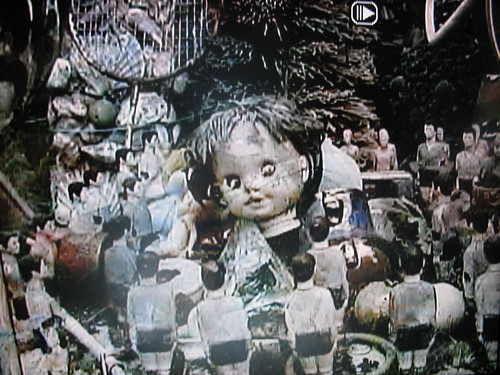
And she talks about modern day gleaners. People who harvest potatoes after the farmers have collected all they could. People who harvest grapes after vineyards were shut down (but not working vineyards in Burgundy, because that's illegal now). People who collect food from trash bins or from markets after they are closed. But also people who collect trash and make it art. People who find televisions and dolls and pieces of metal that have been discarded and find new use for them, if only for scrap.


Different gleaners do their gleaning for different reasons. Some do it for survival. Some do it for charity. Some glean for environmental reasons. Some glean for fun. Yes, fun. Because it's fun to glean. Taking what others think is useless and making it useful is creative and enjoyable. And when you glean, the sky is the limit for what you might find. Today, in my gleaning, I found 30 lbs of frozen kale, some fried chicken, an office chair with a drip of Pepsi syrup on it, some floor cleaner, a lot of burritos, radishes, folded paper towels amidst much more. Then I had the task of figuring out what I would do with all of this. The best part is to take a whole variety of food from different places and create a meal out of who-knows-what-you-will-get. If you make a delicious, nutritious meal from whatever you find, then your day was successful.

But the ultimate gleaner in The Gleaners and I is "I", Agnes Verdes herself. Let's look at her again:


She's beautiful, isn't she? The wheat she's carrying she didn't glean. She's just feeling her way through the painting above. She does do some gleaning in the film. Here's some heart potatoes she found and took home:


Her touch is all over the film. She speaks the narrative, and, like any older person, sometimes is distracted by the thing around her and she just rambles for a bit. Here she is trying to catch a truck:


But she doesn't glean wheat, or trucks (although she tries). Rather, she gleans people. People, some of whom are discarded by society, and she collects them and places them within her art. However, this isn't a sad film. Rather, it is full of joy. Instead of seeing lives of depression or injustice, she finds the joy in redemption. Much like the wonderful Finnish film, The Man Without A Past, the film could have been full of sorrow or guilt, but instead it has wry humor and personality and joy.

In this way, I, too am a gleaner. I am a modern gleaner, to be sure. I pay dues at a gleaning community service, which collects food and products that cannot be sold at supermarkets anymore and I go through their warehouse for a nominal fee and collect hundreds of pounds of food and miscelanious items to give it to the poor and homeless. I go to people who run food trucks and collect the food that could not be sold. I jump in dumpsters and find items that grocery stores couldn't sell. But more importantly, I take the discarded people of our society and tell them they are important, give them work to do and care for them. Sometimes they find homes and work. Sometimes they don't. But they are now gathered into a single community, helping and supporting each other to live better lives than they could have lived apart. Some of these folks live in my home now.

Anawim is a gleaner. I feel really connected to Agnes Verda now. That's pretty cool.

I'm giving the movie a 4.5/5

If you want to know more about Anawim, my organization, check out:
Nowhere To Lay His Head

Wednesday, February 9, 2011

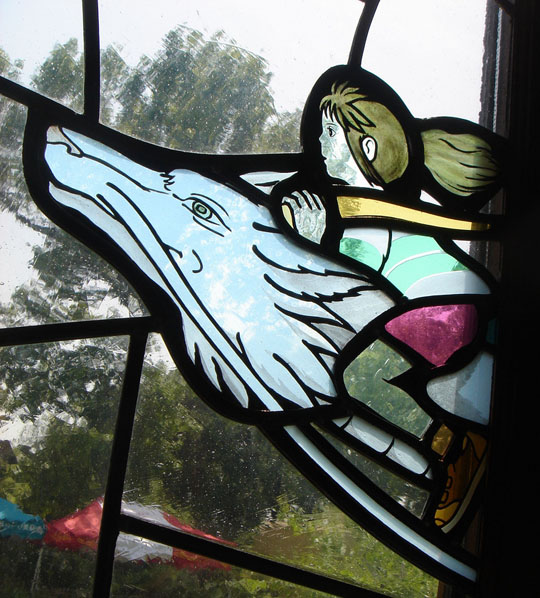
Spirited Away: The Greatest Film of All Time


"An alternative universe coinciding with our own"

I really appreciate what a co-movie lover said recently, that as one gets to the top of one’s all time favorites list, that it becomes more personal. I think that is really true. My top ten is peppered with films that mean something important to me personally, but may not be as thrilling to others: Wendy and Lucy, The Mission, Being There. They all carry double meaning for me: not only being well done films in their own right, but also expressing messages that are important to my life. They not only speak to others in a general way, but they speak to my life directly in a way others might not understand.

So, with Spirited Away, I can give you the many reasons why this favorite film of my favorite director is generally excellent. The animation is top notch, for one. In re-watching Ponyo, I realized how much we are missing in focusing on computer animation instead of hand-drawn. It has taken hand-drawn animation almost a hundred years to reach this place, while computer animation is still a teen. Computer animation is wonderful, but it still has a long ways to go to establish a set of symbols we recognize as human emotion. Miyazaki, however, has taken the step that Disney never did to make characters that are so real we feel that we know them. This is certainly found in the writing and the voice acting (even the dubbed vocals!), but especially in the drawing. It is not because they are more realistic looking, but because we grew up with this kind of animation, and Miyazaki, adding in expressions found in manga and older anime, has given us a visual language we can truly connect with.


"Living in the stream of life, led by love"

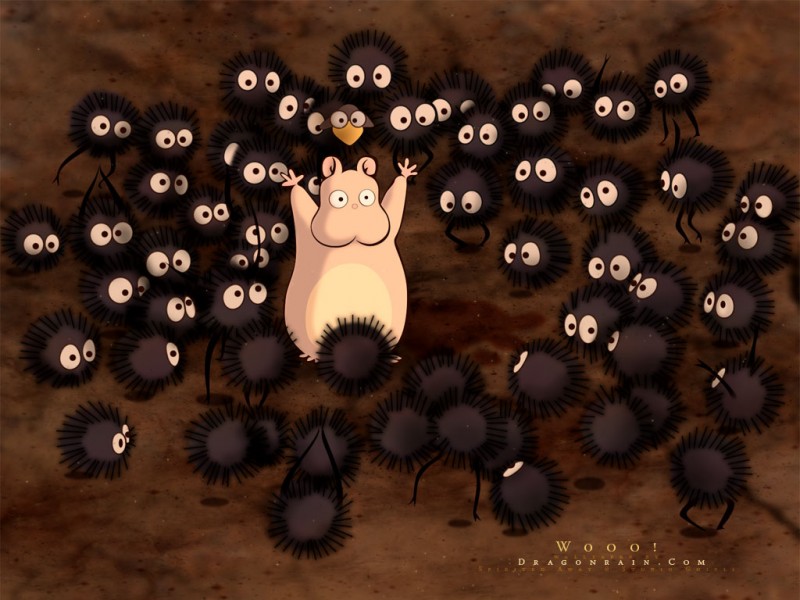
Also, Spirited Away is one of the magnificent stories of imagination. Setting aside the Japanese spiritism (which we will talk about in a moment), the amount of imagination that creates both the setting—a bath house for spirits—and specific unique characters such as No Face and the Radish Spirit, takes even the imaginative achievements of The Wizard of Oz, The Neverending Story and Labyrinth to new heights. But more than that, this imaginary story is realized perfectly visually. We can see this world existing. This isn’t just an amusing tale with muppets or dressed up humans or poorly executed claymation. This is another world that we have the opportunity to visit for a couple hours, and that experience gets added to our own.

I am just saying what could really be said of almost any of what I call “first tier” Miyazaki. As well as this: Miyazaki’s characters are fully realized. These are real people, even the spirits are of a type of character we recognize. While there is sometimes comedy, it is the comedy of real life, not just pratfalls and one liners. When there is achievement, it is rarely of the deeply heroic kind. Rather, it is the daily success of those who act noble in small ways. In this way, Miyazaki can connect to us in ways that blockbusters rarely do. There are scenes in Miyazaki that, despite the outlandish settings, we can see as reflections of our lives. Or our lives as we wish them to be.


"Look, I can do it, too!"

There are two reasons, however, that Spirited Away especially speaks to me personally. First of all is because we get to see Chihiro/Sen grow up. I have three children of varying ages—17, 14 and 9—and they are all in different stages of development. All of them are, in a sense, Chihiro. At the beginning she is whiney and grumpy and self-centered. The move is hard on her, her parents realize this, but it is necessary and they need her to stay strong through the difficulty. But it is when her parents become self-centered that she is forced to grow up and become stronger than she—or her parents—ever thought she could be.

Step by step we can see her shed her self-centeredness and fully take on the task of being responsible as the best of grown-ups are. This is in contrast to Kiki of Kiki’s Delivery Service who begins the movie responsible and hard working. Chihiro had to struggle through every step of the way. First she expresses the moral outrage many young people express when they see grown ups acting irresponsibly. Then she follows important instructions for how to live in the new world (something most fairy tale protagonists fail to do). Then she learns boldness and tenacity in the face of threat. Then she learns about hard work under someone else’s orders. Then she learns about loving people even when they seem to not be lovable at times. Then she learns about sacrifice for love. And finally, she learns that intelligence balanced with care and wisdom is what truly saves the day.


"Soaring high"

These are the life lessons I want all of my children to learn. They are the lessons I see them learning, bit by bit. The art of raising children is the art of seeing them become the Chihiro at the end of Spirited Away. Every once in a while, as a parent, you can think to yourself, “I taught them that”, but most of the time you can’t. These are lessons they have to learn themselves in the midst of the struggles they have to face in life. But at the end of the movie, I am so proud of Chihiro, the buttons on my vest would burst, if I actually wore a vest. She is my children. My son becoming a responsible adult. My oldest daughter being self-confident and self-reliant. My youngest daughter learning to speak with respect and act in mercy. This is all I hope for my children, in the strange worlds they will have to challenge.

My final reason is my strangest, and probably my most significant personal reason why I love this film. I am only going to tell you guys, and I hope you won’t tell anyone else. Not because I’d get in trouble, but because it’d be difficult to explain to my denomination and especially my congregation. I could do it, but it wouldn’t do any good, so why bother? Anyway, here it is: the metaphysics of Spirited Away is pretty close to how I see the world functioning.


"Christianizing Shintoism"

No, I don’t think that spirits have their own bath house and restaurants. I don’t think that if humans eat spirit-food that they turn into pigs. Nor do I think that young girls could be hired by someone to serve spirits. I do, however, believe that there is an alternative universe, that runs on its own physics, that runs parallel to ours. I do think that there are beings—and you could call them spirits—that live in that universe. I also think that most of them are morally neutral, neither good nor bad, just trying to live their lives by their own values. And I think that, at times, the two universes can converge, and allow communication between them.

This is not an unusual worldview, in the broader scheme of things. Historically, before the Christian era, almost everyone in the world believed that summary of mine. Certainly the ancient Jewish people did, as well as the first Jewish Christians. It is Plato and his disciple Augustine that began to turn the world away from this notion. They saw the spirit world as either the realm of ideas or as under the control of a single unified being. Under their philosophy, the spirit world is neat and orderly, with everything politely lined up perfectly, within the mental grasp of humanity.

The ancient pagan world, the ancient first temple Judaism and the first century Christian church saw the spirit world as full of chaos as it was of spirits. Each spirit had its own focus and desires and hopes. They had their own realms of responsibility—jobs, if you will—of rivers and vegetation and winds and planetary beings. Part of the spirit world is described as a sea, filled with dragons of chaos, battling against spirits who desired order and peace in both the spirit world and on earth.

Spirited Away, although a fantasy, is based on Japanese spiritism, a form of that ancient worldview. In a twisted sense, the metaphysical basis of that movie is somewhat the same as the writers of the Bible. This is how I see the world working. I do not deny scientific reality—our world does operate on the laws of physics and development of life as discovered by scientists. But looking at the physical realm is only a part of the story, like Chihiro’s parents seeing an abandoned amusement park.

Some are content with this world and understanding its laws. Others get to see the wonder and magic of the world below the surface, on a level not usually seen by eyes. I wish to be one of the later.

Any who are concerned about my right to be a pastor, or my sanity, I would be glad to give the phone number of my denomination, and you can rat me out. I understand. Sometimes I don’t think I’m completely sane, either. By the way, my wife already knows, so you don’t need to bother calling her.