Tuesday, May 8, 2018

Avengers Infinity War: Take Down of God


Warning: Spoilers of Avengers: Infinity War start up right away in this essay. 

My daughters and I saw Avengers: Infinity War last night and the darkness of what we saw are still running around in our heads.  The characters we've been watching for the last decade get little time, instead most of it is given understanding and appreciating the villain, who wants to, and succeeds in, destroying half of the sentient beings in the universe in order to achieve peace in his time.

My main concern going into the film was how many characters there were to focus on.  How could they all be given fair arcs?  I think the solution the filmmakers came up with-- focus on the villain, and give other characters moments-- was a good one.  Then you cut most of the main characters out of the plot completely, so if they don't show up until the end of the next film, we won't miss them and there's enough breathing room for the other characters to develop.

What is most stunning is how Thanos is clearly a representation of the Hebrew God, YHWH, whom I worship.   Thanos has a universal solution that doesn't seem unusual to a God who destroyed all of humanity except one family in a worldwide flood.

Sure, the flood was bad, but it isn't the same situation.  First, all of humanity was a murderous bunch at the time of the flood, so there was cause, not just a random pick, and God regretted his decision after, so that he would never do it again.  He repented, which is the opposite of Thanos, sitting on a porch, gazing at the peace he created.

No, a closer comparison would be to what is commonly called Armageddon. This is the apocalypse in which all humanity will suffer death or life, most of whom will be placed in their location without knowing why. Even if it isn't random, it will feel random to most of humanity.  And Thanos' priest/prophet is the representation of the church, proclaiming this genocide as salvation and hope, and the sacrifice of (most of) humanity as the just sacrifice.  Frankly, the Christian God is worse, because he will take the majority of humanity and torture them for all of eternity, millions upon millions of years, for not believing correctly.

This is seen in his killing of Gomora, as well.  First, I think his love of his step daughter is seen clearly from the GotG and all through this film.  He played favorites between his step-daughters, seen even in the first Guardians film, not because he despised Nebula, but because he only loved one daughter.  In Genesis, Abraham didn't care for his firstborn son, Ishmael, allowing his wife to do whatever her bias motivated her to do with Ishmael and his mother, her slave, so she left them in the desert to die of thirst.  But Isaac was Abraham's favorite and the one he dearly loved with all his heart.  God told Abraham to sacrifice Isaac on an altar, saying, "Take your son, your only son, the son whom you love..." repeating three times to emphasize the close relationship they have.  And that relationship was to end in physical abuse, except that God pulled his punch at the end.

According to Chrisitian theologians, this was primarily done to provide a type of what God would do himself with his son. Kill and torture his son despite his love, because the salvation he would provide is worth the price. And that salvation also comes with a cost of killing and torturing (at least) half of humanity.

Ebony Maw is the leader of the cult of Thanos, proclaiming the salvation of Thanos, and calling all of those subjected to the will of Thanos the Children of Thanos.  In Christian theology, all of humanity are children of God because they are all created by God, but they are also in the kingdom of God, and so subject to the will of the all-controlling God.  The church calms the people, trying to make them all amenable to the will of God, especially when it seems evil, when God enacts random judgment against them, such as he did to Job.

From this perspective, Infinity War has a clear theological objective: to reveal the Hebrew God for who he is.  A sympathetic character to a certain degree, but ultimately evil. His will is arbitrary and hateful, even though his ultimate aim is peace in the universe. At best, God is considered misguided and immoral.  The Avengers, despite their misdeeds and errors are better than the one whom millions worship.  It is a takedown of the most popular theology on earth.

In defense of some who honor God, it is a heated discussion within Christianity whether the standard orthodox theology is correct.  Some say that the Bible never teaches eternal torture of humanity, that the separation of humanity is not based on belief, that God's people are supposed to receive but never give persecution, and the inclusion of all people.   Despite this discussion, the takedown of monotheistic religion in Infinity War is mostly correct.  Thanos must be seen as a lesser-evil version of God and if Thanos is wrong and evil, then God of orthodox theology is worse.

Sunday, March 12, 2017

Loony Tunes Classics, 1936-1938

All of these cartoons can be Googled and found intact on Daily Motion.

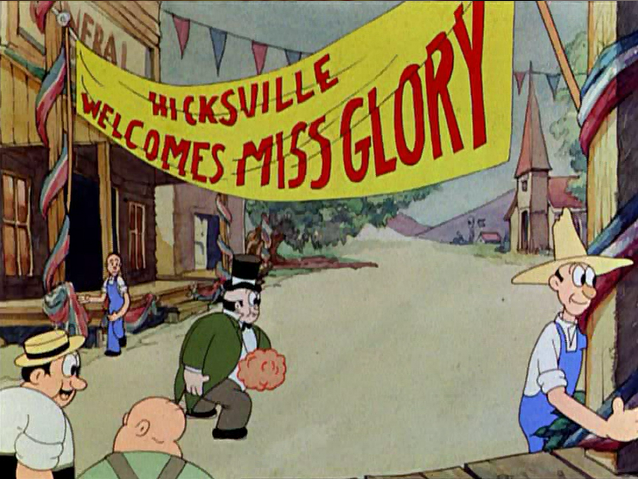
Page Miss Glory
This first Warner Bros cartoon takes its name from a movie released the previous year about a country woman who dreams about becoming a starlet, and gets her chance to play a starlet, which becomes real.  In this cartoon, we see a page dreaming of serving a starlet in a fancy hotel, although he is in a small town.  It is interesting that there are a lot of references to alcohol here, as prohibition just ended a few years before, so people are pretty giddy at the opportunity to partake openly. 

As an early cartoon, it isn’t bad, but it doesn’t have lasting power.  I also don’t think it was intended to.  Warner Bros. cartoons were more successful when they tapped into a lasting myth (e.g. the rabbit and the hunter reversing roles), but many of the cartoons were simply reflections of the culture at the time of the cartoon.  That works for newsreels, but not necessarily for later generations.

I Love to Singa
This cartoon is based on the Warner Bros. movie, The Singing Kid, starring Al Jolson, which has the song “I Love to Singa”, played three times in the film.  The tune is repeated a number of times in the cartoon as well.  The main characters are owls so they can have the joke, “Owl Jolson”.  Note that Chuck Jones is a main animator here.


I remember seeing this one as a kid on television.  It is more successful than Paging Miss Glory because it reflects the trope of the child who is naturally opposite to his parents.  At this point the trope is overused, but the cartoon still has it’s fans.  I love the reference to Jack Benny (a bunny) and the old amateur hours that was similar to American Idol today. An interesting point is that Mel Blanc was on the old Jack Benny radio show, as well as the Warner Bros. cartoons.    This is as much about radio as it is a movie, and the popularity of it.  Overall, fun.

Wholly Smoke
Porky Pig was introduced in cartoons in 1935 in the film “I Haven’t Got a Hat”.  He was originally voiced by Joe Dougherty, who had a severe stutter.  In fact, the stutter was so severe that production costs were too high to keep him as the voice, so Mel Blanc took over as the voice of the popular Porky Pig in 1937.

There are a couple places that seem influential on Disney—the position and look of the “bad kid” on Lampwick in Pinocchio, and the chaotic end of the dream sequence on Dumbo.  The original was black and white, but it was colorized later on.  The song “Little Boys Shouldn’t Smoke” is based on the song “Mysterious Mose”, which was used to better effect in a Betty Boop cartoon in 1930.

I like a good sermon, but this one just seems dumb—a repetition of “children shouldn’t smoke” and a weird dream sequence.  The cameos work better—the Three Stooges, Bing Crosby and many puns based on different cigars/cigarettes.

Okay, but I’m not impressed.  

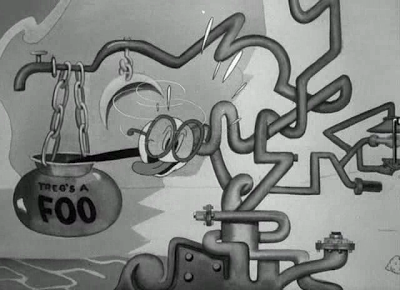
Porky in Wackyland
I remember much of this, but I wonder if I didn’t see a colorized version of this film called Dough for the Do-Do from 1948, which cut some of the scenes, added a couple others and tried to avoid most of the racial stereotypes by giving the “African” characters skin of primary colors.

Honestly, I think that the imagination and animation quality are excellent here.  The Dali/Seussian landscapes and the number of unique creatures are fascinating and fun.  This is basically a “hunt daffy duck” cartoon, but the insanity of those early cartoons really work with the unique insanity of this one.  It also has a great punchline at the end.

It isn’t laugh out loud funny, but there’s a lot to see and be interested in, even today.  Quite surrealistic and fun.   

The animation is really smooth, unlike most of the cartoons at this time.  It doesn’t have any fuzzy edges but is perfectly clear.  Even Porky Pig’s voice is clearer.  They worked hard at this one and it shows.

Porky in Egypt
The introduction of “Egypt” containing not only Arabic, but black and East Indian stereotypes is pathetic, but expected.  The film really gets on when Porky and his camel  Humpty Dumpy goes into the desert.

My favorite part is the camel’s speech about “desert madness”.  It must be based on some speech, but I can’t find out what.  Very well done.  The depiction of madness devolves into the desert mirage joke and Daffy Duck imitations, but there are some good sections here.


Still, I probably wouldn’t recommend it apart from the middle section with the sun hammering down and Humpty going crazy.  

Thursday, March 9, 2017

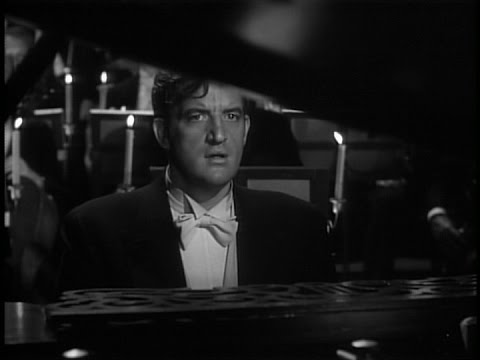
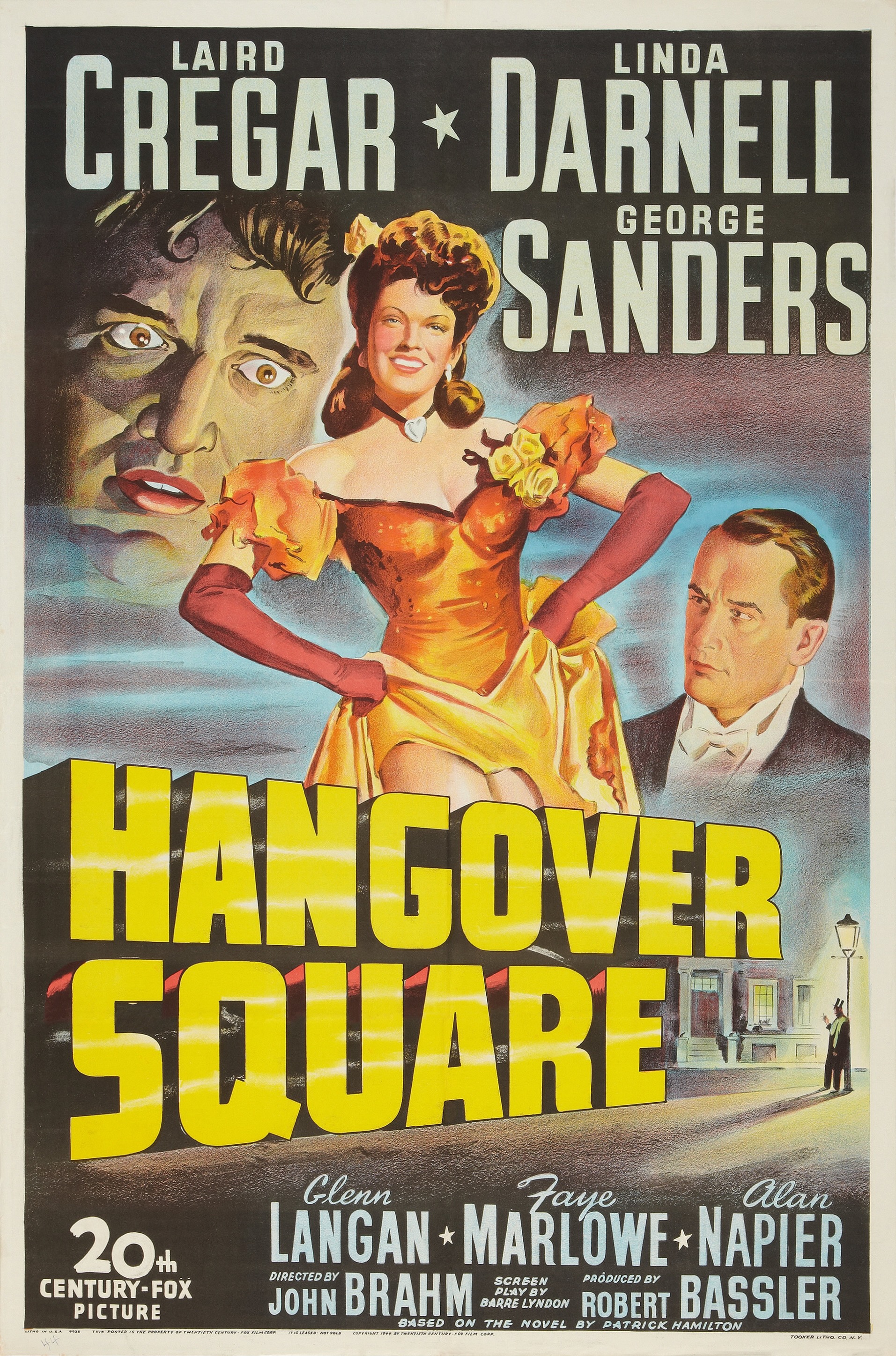
Hangover Square 1945

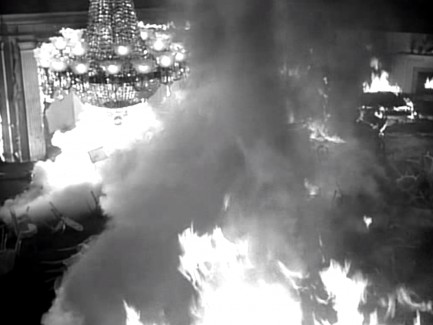
We can tell by the opening setting that this is a noir.  Dark, shadowy, haunting... but it takes place in London, 1899.  Odd setting for a noir.  Then we see a old Jewish man murdered before our eyes and a fire set.  Oh yes.  It's noir, all right.  

Then we follow our murderer to find out that he is a composer, on the cusp of success, loved by his fellow musicians and admired by a beautiful woman.  And he has fits of amnesia, and he is worried, deeply worried about what he does during these fits.  What does one do in this situation, go visit George Saunders.  That's what I would do.

What we end up with is a curious mix of Jekyll/Hyde, Hitchcock and Phantom of the Opera.  While not especially clever or mysterious, it is emotionally evocative and compelling.

There are two things I am still considering about this film.  First: will any American studio ever be able to present a believable Britain? The accents are a mess, they are all explaining Guy Fawkes Day to each other, and it all sounds more like Oliver! than Kes.   I guess Fox wanted to repeat their success of the previous year, The Lodger, so imprinted that film on this script.

The second is a connection between the response to the murderer and modern misogynists (mild spoilers).  The murder is acknowledged as dangerous and mentally unstable.  He has killed and it has been proven that he is completely unstable. This is related to his psycho-sexual needs being unmet.  The response of the police is, "You are dangerous, but we know it's not your fault. We'll take it easy on you."  Is this because they appreciate his standing as a white male, as a person of means who can spend his time composing music that hasn't been heard?  If he were poor or a woman, he would hang immediately.  It's all very believable.  Perhaps a bit too believable.

But the film is great.  Fantastic music, especially in the concerto scene, by Bernard Hermann, who also did the music for Citizen Kane, and the cinematography was beautiful, in classic noir style.  Highly recommended.

Sunday, February 26, 2017

Tower

I'm watching a documentary called Tower about a campus shooting in Austin, 1966.

A pregnant woman and her boyfriend were shot, her boyfriend died. A professor walks by, not hearing the shots and is disgusted with them, "Pick up your books and get up," he says.

This reminds me of some who respond with disdain to those who suffer in poverty or under racism or with those oppressed by our government. "Get up," they say angrily. Those trapped say, "Could you get us some help?" But because the disdainful don't see the danger, don't see the blood --don't see the horror that exists for all of us, but especially those racially, sexually, economically and religiously vulnerable-- they ignore the plight and resume living ignorantly. Mocking those in pain and tragedy because they don't feel it.

***

I am shocked as to how much human experience one can pack into an hour and a half under the hot Texas sun. Victims, heroes and observers of a horrible sniper shooting at the University of Texas in Austin speak about their experience, actions and emotions in the most dramatic hour of their lives.


It feels so much like a Richard Linklater film, perhaps it is very influenced by his work. Rotoscope, Austin, real conversations speaking on intense, big subjects... I was all ready to love this film. Even so, it was more dramatic and personal than I expected. Everyone seemed so real-- funny, hopeful, brave, entranced, scared. It's a powerful film, not only about that day, but about the human reaction to death.

Children of Paradise

It is the 1820s.

"Paradise", in this case, is the abode of the gods, and the gods are the audience of the theatres of the Boulevard of Crime (so called because adultery and murder happen in the theatres ever night).  Thus, the "children" are the actors, writers and producers of the stage who cater to these "gods", their whole lives revolving around the pleasure of the audience.

The central figure is Garance, a woman of such remarkable beauty that four men request, demand and battle for her hand, as well as her evening companionship.  She, on the other hand, smiles at them all, remains distant, and wanders where her interest takes her.  She never participates in crime, although observes many crimes.  She does not dance or sing or act, so she is only ever window dressing for the various theatres, never wanting a speaking role.  Three of the four men are up-and-coming central figures of the Boulevard, Baptiste, the gentle pantomime, Frederick the Shakespearean actor, and Lacenaire the boastful criminal.  Garance would like to dance like a butterfly between the three men, but a powerful fourth man appears, a proud nobleman who changes their whole world.

There are three sets of stories: that of the multiple-party romance, the highs and lows of the theatres and the stories on the stage, all reflecting what is happening in the actors' lives.  While there is a light touch on all of these deep real-life events, I prefer the stage productions, both silent and spoken, that portray both entertainment and serious themes.

This film is spoken of by some as the greatest French film, and it's epic scale, intermission and grand credit sequences indicate that it wants to be seen as an important film.  I am sure it is important.  It has it's significant place in the history of cinema.  But as a whole, I am not sure I want to give it too much credit.  It is good, the characters are well-drawn and it uses it's length of time well, but I do not know how much I will consider this film in the future.  It has to do with show business and with romance, and the presentation of both are far removed from my own experience, nor does it teach me much about the context.  The acting is an older style, almost vaudevillian, that keeps me distant from the characters, even as I am somewhat involved in their stories.

There are a number of things that I can admire about this film.  It was created and filmed in a Paris occupied by the Nazis. It presents it's worlds distinctly, each having their own manner of speaking and focus and running gags. And it also shows how there are pathways from the world of the stage to the world of the personal lives to the world of the theatre and back.

Yes, it's three hours.  But it is certainly a significant watch, and a generally enjoyable one.  

Friday, February 17, 2017

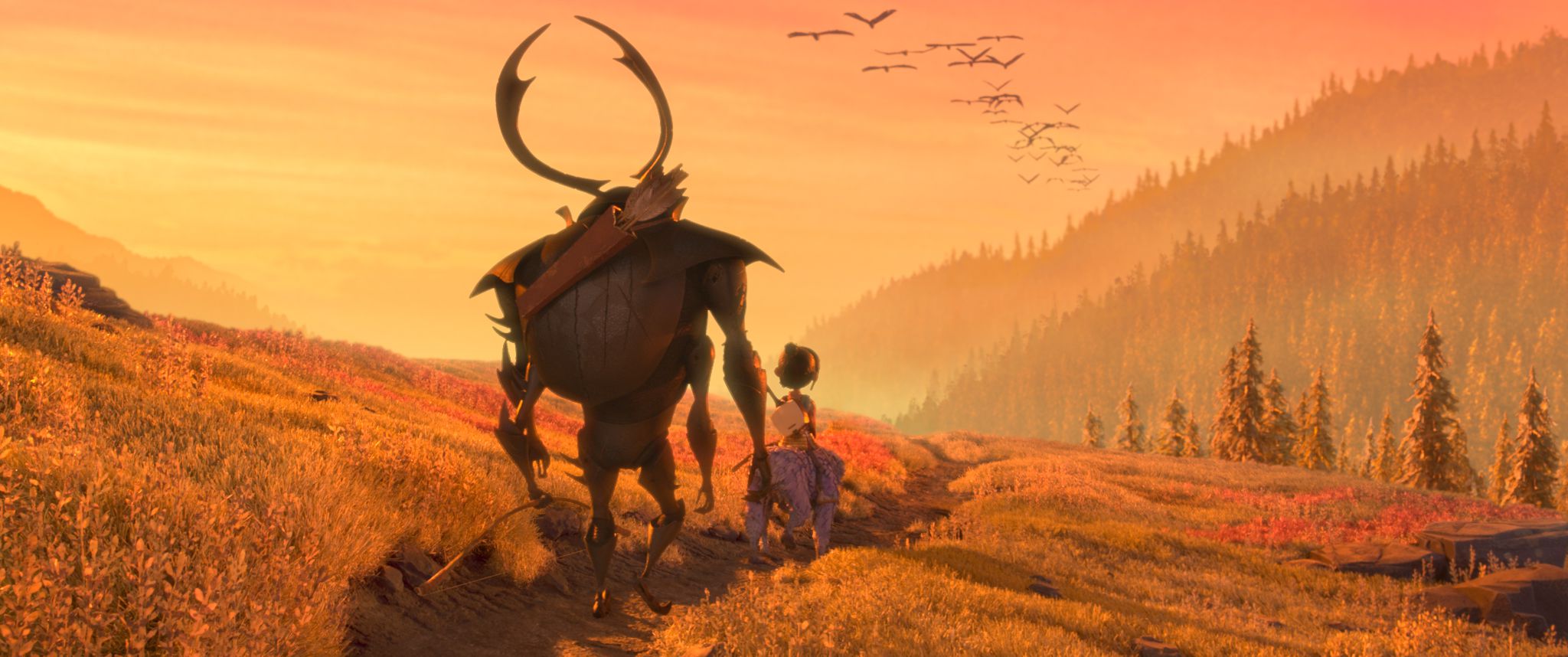
Reinterpretation of Life: Kubo and the Two Strings

I want to make my case why Kubo is not only the best animated movie of the year, but among a few best films of the year.  I haven't read any reviews that really get deep into the film beyond it's beauty, so I thought I'd write something that helps folks see how I saw it.

If you never saw this film on the big screen, then I don’t think you could really appreciate the line, “If you must blink, do it now.”  On the one hand, it is a line of a marketplace storyteller, the hyperbole of the campaigner, the exaggeration of the ad man.  But in the context of this most artful film of an artful studio, it is simple reality, without any stretching of the truth.  The film keeps the promise of this line with stunning sets and eye-popping animation.  I honestly didn’t want to blink.  And in those sets, the new direction of clamation, the master-stroke of this studio is presented and I didn’t want to close my eyes for a moment.  Right after I saw it, I wanted to see it again.

Part of this is not just due to the art.  Frankly, this story resonates within me.  It is the hero’s journey, which I love in its many forms from The Odyssey to Lord of the Rings to Star Wars to Moana.  But here, the hero’s journey is joined with the boy’s adventure, filled with dangers and adventures.  It is 1001 Arabian Nights and The Thief of Baghdad and The Boy’s King Arthur, as well as The Neverending Story.  It is monsters and enemies and magic and secrets and mythology, all revealed in a powerful mix.  If this were released in 1977, I would have gone to the theatre twelve times to see this instead of Star Wars, for the fine mix of hero’s journey and magical adventure resonates perfectly to my boy’s heart.

Add in the wonderful music, simple and emotionally resonant, as well as each relationship being a form of love and charity and I am sold.  All I need is a great theme and this film will be one of the great films of all time.

The theme, however, is considered one of the weaknesses of the film.  Everyone recognizes that it is about the power of stories, but most folks feel that it isn’t really saying anything new or interesting.  I would like to challenge that assumption.   But to do so requires an overview of the film.  And spoilers.

* * *

The story is about Kubo, a young storyteller who cares for his addled mother in a cave, and who is loved by a nearby town.  Disaster strikes when his aunts, daughters of the Moon, find him and cruelly bind him to take him to the Moon to take his eye out.  He escapes, to find his mother gone and he is led by a magical monkey, an origami representation of his father and a beetle-man to find his dead father’s armor.

The quest for the armor is a McGuffin, but it gives us an opportunity to see relationships grow, to see his parents fall in love again, to see Kubo learn his values on his own, not just because his mother taught them to him.

The plot is really a loose collection of events that barely hang together, as any epic odyssey is a collection of events.  As in any hero’s quest, the significance is the opportunities for the hero to learn significant lessons, which reach a climax of the hero’s stand.

But what we see by the end of the film is the figure who is always there, always making events occur, always watching, but never speaking until the film is ready to end: Kubo’s grandfather, the Moon.  We see that the film was always about the relationship between Kubo and his grandfather, and the challenge between the values each stands for.   The grandfather is a gentle man who just wants the respect he is due, and sees the world through eyes of logic.  Kubo is the product of that heritage, but also the heritage of his father who values relationship above logic and honor.  And of his mother, who chose love over the ways of his grandfather.  So far, so good.  Nothing really unique here.

The climax is what changes the perspective.  The grandfather, the Moon, is is transformed into humanity because of his desire to be connected to his grandson.  He wanted his grandson to be like him, to show him the respect his daughter and son in law didn’t display.  To reject his humanity and take on eternity.  But Kubo couldn’t refuse his heritage, and so brought his grandfather into his family.  The key is that the moon agreed to take part in Kubo’s story—the story of the battle between the evil but strong moon the  noble but weak boy. The moon took on Kubo’s story, that of him fighting a monster.  The moon chose to be a monster, thinking he could defeat Kubo with his own story.  But Kubo changed his story in the middle, so that it was no longer about a battle against a monster, but the story of a family, joined by experiences and uniting in their differences.  When the stark, cold moon took on a side in Kubo’s story, he could be transformed into a human, blended from both eternity and temporal, heavenly and earth.

What was an epic battle between good and evil became a story of thesis (the moon), antithesis (the parents) and synthesis (Kubo).  Kubo then uses the story to transform the moon into his own image—a kind man.  Kubo re-interprets his story and so re-interprets his grandfather who agreed to take part in Kubo’s story.

So the theme is not about the victory of story, but about the victory of reinterpretation.  About changing the paradigm and so changing reality.

What is a child supposed to get out of this? That his parents are not what they seem; everyone has their own point of view; family is the joining of contradictions; our life is the continuing story of our parent’s lives.  But I think what we can get out of it is more important.  How do we interpret our lives?  Rather than asking whether the interpretation is the closest one to the “truth”, rather we should ask if the interpretation is the one that benefits everyone.  Is a good v. evil story really what makes unity, what makes joy for all?  Or is there another way of creating a story of our lives that draws all people in?


Sunday, February 5, 2017

Mulholland Drive: Deadly Desire

The vision opens with a group of kids, circa 1950s, energetically dancing the Jitterbug. The sashaying and twirling is hypnotic until the dance is interrupted by a girl with short blonde hair laughing with her companions.  And then the story begins.

A car with two men up front and a glamorous woman in back stops.  She says, “This isn’t where we are supposed to stop,” and the man in the passenger seat pulls out a gun and commands her to get out.  Just as the tensions run high, two group of kids in impossibly speeding vehicles crash into their car.  The glamorous woman crawls out of the wreckage and collapses.  Then she gets up, confused, walks off of Mulholland Drive, wanders over to Sunset Blvd and then to a high-end apartment building in L.A.

The streets remind us of other movies that take place in a secret Hollywood, the Hollywood-behind-Hollywood in which violence and sex rules the lives of the stars, directors and producers of the films we all clamor to see.  Young actors are desperate for attention, and famous actors bask in their decadence and power over others.  How much of this is real is almost impossible to say, as the gossip about Hollywood is as creative as the on-screen entertainments.  But it is in the netherworld of speculation and desire that Mullholland Dr. takes place.

The filmmaking is almost perfect.  We enter quickly into the story of Betty and her companion “Rita” who has forgotten her identity.  The acting is odd, at a distance from reality, but Naomi Watts and her co-stars are so larger than life, so melodramatic that we aren’t concerned at all.

As the story moves on, we become more confused. What causes the run of horrendous luck of the director, Adam?  Why does Adam’s wife, when caught in bed with the pool man, say, “Now you’ve done it.”  Why can Betty and “Rita” so easily enter an apartment, although it is overseen by the police and a neighbor?  Why is there a full ashtray when no one is smoking? On the surface, we might think of these as simple contradictions—not like we haven’t seen such obvious errors before in film.  But this isn’t your average filmmaker.  This is David Lynch, who eats a few contradictions for breakfast, before spitting out an analogy that clarifies them into a paradox.  

More than a plot that becomes more confusing as the film goes on, this film is almost perfect cinematically.  Every shot is distinctive, having their own flavor, as if we were if a buffet of cinematic eras.  I finish the film and want to watch it again, not just to try to grasp some of what I didn’t understand, but to simply watch the colors and textures.  To hear the sounds and to glory in the latter insanity.  This is Lynch’s mysterious masterpiece, having hints of Blue Velvet and Eraserhead, but beautifully vanquishing both.

*** Spoilers Ahead***

The biggest question we are left with after the film is: WTF?  What was that all about?  And we scan the internet to see if we can find any clues.  It turns out that David Lynch himself, explaining nothing, has given us some details to explore, which might, he suggests, explain the film:

Pay particular attention in the beginning of the film: At least two clues are revealed before the credits.
Notice appearances of the red lampshade.
Can you hear the title of the film that Adam Kesher is auditioning actresses for? Is it mentioned again?
An accident is a terrible event—notice the location of the accident.
Who gives a key, and why?
Notice the robe, the ashtray, the coffee cup.
What is felt, realized and gathered at the Club Silencio?
Did talent alone help Camilla?
Note the occurrences surrounding the man behind Winkie's.
Where is Aunt Ruth?

Perhaps these are clues, but they are as Lynchian as anything in Eraserhead.  Not much help for those of us without a clue, although on my next viewing I might hold these clues before me and try to answer all of these questions.

I believe that a key to the film is found in a quote from Laura Harding’s attempt to grasp at the straws: “Who we are does not count for much—what matters instead is what we are about to do, what we want to do.”

I hold that the basic meaning of the film…or at least the meaning that means the most to me now… has to do with desire.  There are two Hollywoods in the film, and both are the Hollywood of imagination.  The first is the Hollywood of dreams, where a young girl gets ahead on talent alone.  The second Hollywood is that of gossip, where everyone famous is corrupt and takes advantage of the power they have.  Although the one we see dreaming is Rita, they are both fantasies of Diane.  The first is the dream of her desire, the second is the fantasy Diane thinks she lives in.

Betty is who Diane wishes she could be, innocent, professional, seeking after her ideals, letting nothing stand in her way.   Rita is who Diane wishes Camila would be, helpless, needing to be guided, ready to be loved.  Camila, meanwhile, is a separate character, who gets the role Diane wants because of a mob producer’s threats.  Adam, meanwhile, is remarkably consistent in the two distinct Hollywoods, although in the first he his hapless and punished, while in the second he is overjoyed at the same events of his life.

There are so many other themes: that of identity, that of illusion (and disillusionment), that of power and the cost of revenge.  All of it makes sense though, when we see the film through the haze of Diane’s desire and how she reacts when her desires cannot be met. 

Personally, her response reminds me of men’s rights activists, who look at women as objects of desire both in sex and in power.  When women will not submit to their desires, then they embark in a moral fantasy, creating “musts” for women that have no resemblance of who women are or should be.  At times, this fantasy becomes so pervasive that they must shatter reality in order to conform it to their desires.


But I think the point of the film is to talk about the power of desire and how broken we are when we are disillusioned. In the end, when Diane realizes that she is no Betty and Camila no Rita and that she is actually the evil one in the Hollywood she created, she kills herself, freeing her of both fantasies—the one she is forced to live and the one she only dreams about. 


Friday, December 9, 2016

Joy in the Struggle: The Gleaners and I

If the ultimate purpose of directors is to guide the tone of a film, then Agnes Verda is the most successful of all directors.  Even in the darkest of her films, she finds a way to infuse a lighthearted joy, allowing us to smile in surprising moments in her protagonist’s struggles.  This is a collection of real people, including the director herself, gathering up the discarded elements of our society and find it useful and even necessary.  We see a number of people on the edge of survival, and yet they matter-of-factly, even happily, pursue their lives, whether chosen or not.  

In the struggle there is joy, there is joy in the struggle. We might feel defeated, but we still must struggle, not just for ourselves, but for those around us.  And in that struggle, we need to laugh and make light of ourselves.  We need to feel the joy of love.  And in the midst of our joy, we need to recognize that it is also hard work, to keep afloat in a world with so much opposition, with so much difficulty.  Along with the joy, we can feel a pride in the work of love and compassion we participate in. 

Also watch: In America, 7th Heaven, Tideland

Keep reading our blog series, The Way Forward

Tuesday, December 6, 2016

Cycles Return: Spring, Summer, Fall, Winter... and Spring

Despite the title, this film is not about a year, but about a lifetime that takes place at a hermitage on a beautiful tiny island/dock in the middle of a lake.  A young boy is raised by a monk and goes through struggles, rebellion, despair, and eventually returns to take the place of the monk.  The protagonist must make changes in his own attitudes and how he sees the world in order to fit where he belonged in the first place.  

Spring, Summer, Fall, Winter... and Spring reminds us that no matter what struggle or difficulty we find ourselves in, no matter how the world seems to encroach on our freedoms and our abilities to do what we must, in the end, our lives are a cycle, the world is a part of a larger cycle, and all things come back to where they should me, if we would but endure.  At times, being who we should be then patiently enduring in that being is the best we can do, and we can watch the world return to where it should be.

Also watch: Wild Strawberries, Ikiru, Temple Grandin, Boyhood

Keep reading other posts in the series: The Way Forward


Sunday, December 4, 2016

Simple Joys: The Scent of Green Papaya

A deceptively simple film, we see a girl growing into herself through cooking, serving and dreaming. Although she is in a Vietnam of conflict, she is a servant with no way out, she is hopeless and helpless, yet the film doesn’t look at that reality.  It focuses on her joy in life, in food, in relationships.  And that joy is infectious.  

Not all of us can see the joy in life, especially in a time of conflict.  I know I can’t, not always.  But we should allow those who can find joy in simple things to inspire us, and we shouldn’t ever dampen what they understand: that God has given us the simple things to enjoy and we should let that happiness pierce through the skin of darkness that seems to surround us.

We need to experience the sensuousness of texture, the delight of a quiet conversation, the sacred presence of a good meal. The refreshing bath of a beautiful film. No matter what hell goes around us, we can still take time for joy.

Also watch: Bright Star, Life in a Day, Alamar, Babette's Feast

Read more of this blog series, The Way Forward


Saturday, December 3, 2016

Arrival: Communication and Truth

Chatter, beautiful noise, static, prattle, nonsensical, overwhelming talk.  It is Starbucks music to my soul, easily ignored until I despise it, ready to attack. It is my fear and focus of my anger, and yet, and yet, it is the core of love.

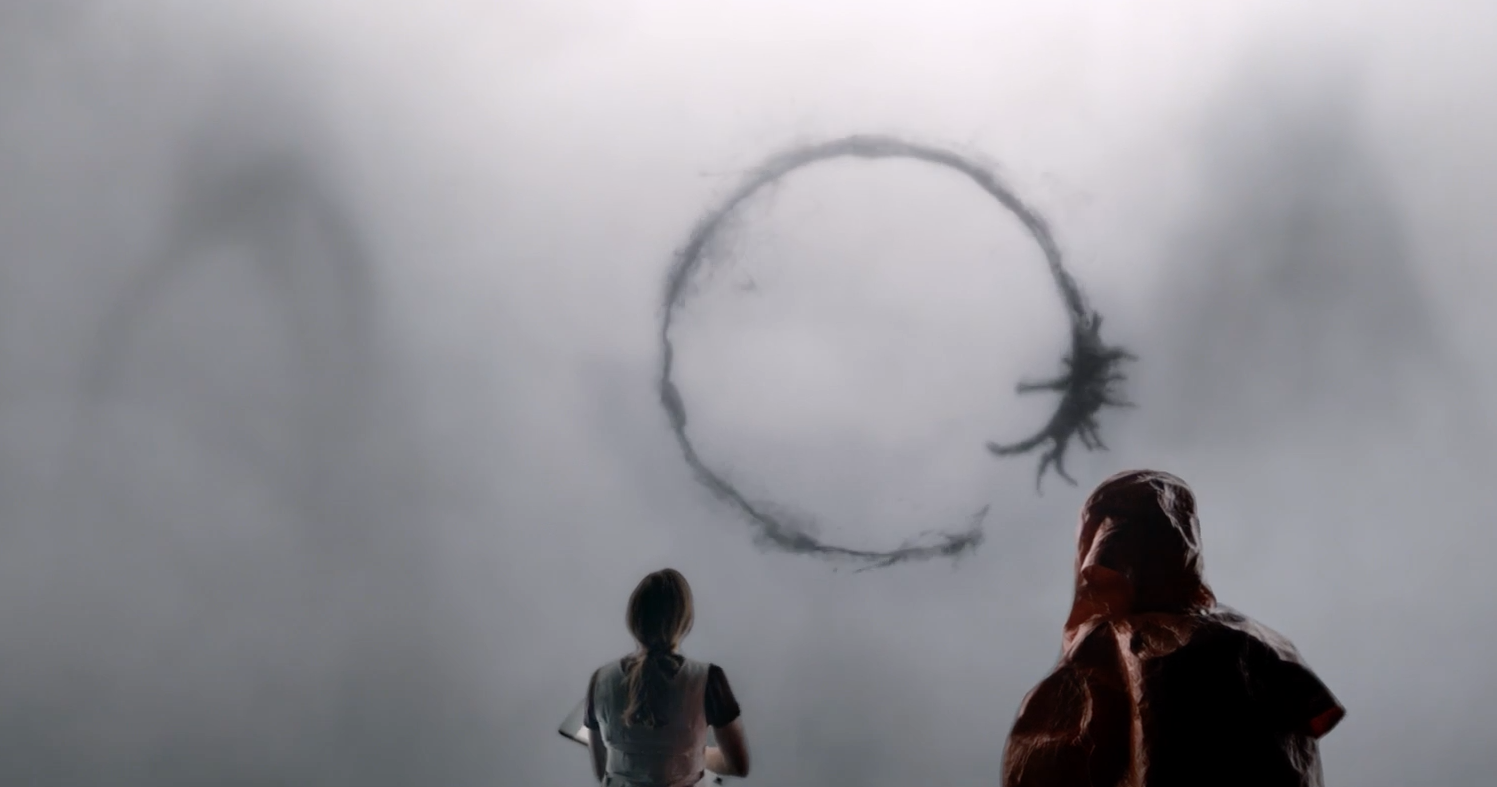
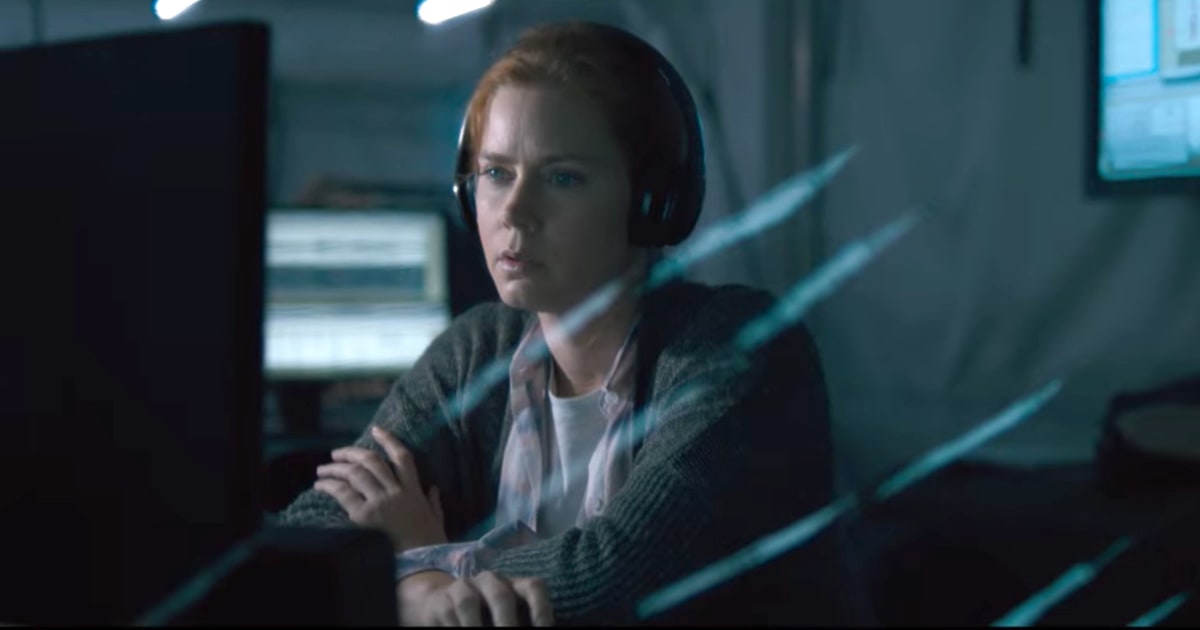
Arrival begins near the end of Close Encounter.  After the Up-like prologue (another few minutes and I'd have been bawling), the aliens have arrived and the government was communicating with them.  But they are at an impasse, so they gather Louise Banks and Ian Donnelly to find out what is really going on-- are the aliens attacking, are they wanting to help?  The pair immediately are allowed on one of the ships. Ian looks at the landscape scientifically, overjoyed with new discoveries, but scared out of his wits internally.  Louise is a linguist, and she clearly is frightened, but the enormity of the puzzle captivates her.  How will she learn to speak to these octopii who don't share even the fundamentals of human language?  Stakes raise, there is betrayal and power trips and so much more, getting to the core of human nature.

I was captivated. The aliens were simply not alien enough for me, and the communication happened too quickly, even under such enormous time pressures.  But so much of it is wonderful.  First of all, thank you, thank you, that the central event doesn't take place in New York or San Francisco, but the middle of nowhere in Montana.  Similar to Close Encounters' Wyoming, perhaps, but good enough for me.  The script lays out both the political puzzle and the intellectual exercise with increasing drama on both sides, increasing the tension and curiosity.  The score is easily the best one this year, both appropriate and innovative (I'm listening to it again right now).  The acting was fine, perhaps Whittiker was distracting occasionally, and the effects were thankfully subdued so as not to distract.  Frankly, this tops my list for this year.

***

Would that I had time to explain the themes of the film, so rich, full of the back and forth of seeking that which is most important.

There are, in this human world, two themes that push and pull us.  Language v. Science, Communication v. Truth.
Communication opens doors; to truth before communication is to close doors
Communication empathizes; truth assumes
Communication is human; truth is nature
Communication leads to mercy; truth is without compromise

Truth does not give any space for the human, for the person, the individual doesn’t matter

Communication is the necessary white around the yoke of truth, it comes before, it comes after, it cushions, it comforts, it is the home of truth.

Truth, without that cushion, is a hard, bare stone.  Impossible to swallow.


Fear does not close communication, but allowing fear to rule closes all paths to truth.

Wednesday, November 30, 2016

Find Family Where You Can: You Can't Take It With You

This early Frank Capra film gives us what we see often in later film: A group of rag-tag misfits who stick together although the odds are against them.  Some of them are related, some are not, but the point is that they are family because each of them have a unique vision of life and they are all encourage to pursue that vision. Each have a skill that they practice and they are given that chance to promote their own personal growth, despite the way they look.    

We are encouraged to find families, not necessarily connected through flesh and blood, of people that will support us being who we are, and will find ways to help us use our skills, even if they are rare.

Also Watch: Notting Hill, Delicatessen, Another Year, the Toy Story films

Read more of this blog series, The Way Forward

Sunday, November 27, 2016

Look for Friendship with Enemies: The Life and Death of Colonel Blimp

Powell and Pressburger are at their best when they claim to be giving you one genre, in this case a war film, but end up giving you something much better and surprising. This film depicts the friendship between a British General and a German officer through the wars of the first half of the 20th century.  Their relationship began as a rivalry between enemies, and then grew to grudging respect and then complete admiration, despite being on different sides and having wildly different opinions.  

Even so, we must realize that our allies and supporters might not come from people on “our” side.  Sometimes people who disagree strongly are still the human connection we need to keep going in life.

Also watch: How to Train Your Dragon, Catch Me If You Can, District 9, Joyeux Noel, The Son

Read more of The Way Forward