Sunday, January 1, 2012

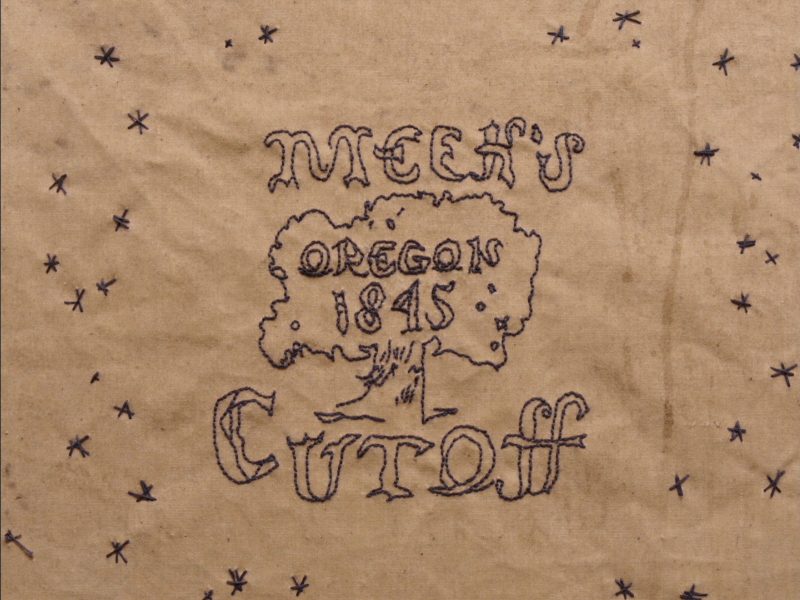
Meek's Cutoff: Review and Analysis

Although I grew up in Southern California, Oregon is my chosen home, and I love it.  Not only do I choose Portland over Los Angeles, I choose Oregon cinema over Hollywood.  I'd much rather see Gus Van Sant than Michael Bay or James Cameron and I'd rather watch Kelly Reichardt over Kathryn Bigelow (not that I would deny watching any of their films).  And Kelly Reichardt is the most Oregonian of all filmmakers.

She has made three films, all of them quiet, meditative, perhaps some would call them ponderous.  Old Joy, her first, is about two friends who live in Portland who drive to the wilderness to have one more adventure together.  Wendy and Lucy is about Oregon's most prevalent social problem, homelessness, and gives a very personal viewpoint of the issues (more on that film another day).  These two films were made very inexpensively, around Portland.  They have a beauty to them, but something holds back.

All of Reichardt's abilities and preferences work so well with the subject matter of Meek's Cutoff: the travails of travelling on the Oregon Trail in the beginnings of such pioneering.  Finally Reichardt was able to purchase really excellent equipment and to film outside of the Portland area.  The stark landscape of Eastern Oregon is contrasted with the gorgeous beauty of the skies.  Please, someone, give her a million dollars to shoot her next film with the full potential of her abilities.

Yes, the film is ponderous, but it only highlights the nature of such traveling, when a day might lead you only a few miles.  Also, like Wendy and Lucy, it is told from a female perspective, and we get a strong sense of how women are kept out of the loop in decisions that their lives depend on.  Important conversations are muffled, hard to hear, or just don't take place within earshot.

It is easy to get frustrated with the film.  Honestly, knowing Reichardt's nature, I waited until I was fully alert and able to really take in her film, so as to give it my full attention.  (New Years Eve is a great time for me-- I'm not doing anything, and everyone else is busy with their own celebrating).  It would be frustrating, except that it is supposed to be frustrating.  We are supposed to get the idea of how it felt to be a woman on the Oregon Trail, dependent on men-- some wise, some idiotic-- to determine the best course for everyone.

I have a friend with whom I have been having an argument with.  He proposes that women were never oppressed, at least in American history, and perhaps not in ancient history. He tells me "How can a segment of society be oppressed when men have to kneel on the ground and ask their permission for marriage?"  This is the biggest load of rubbish I think I have ever heard.  This movie is a perfect example of how women have quietly oppressed throughout history (when they weren't violently oppressed in war or rape).  To only give men decision making powers and then to allow women no right to speak to those decisions because they weren't involved in the conversation is oppression.

This movie is told from a female point of view.  Not a feminist point of view, necessarily.  And not from the view of a particular woman.  Rather, the viewer is almost a fourth woman amidst the travelers.  We hold back when the women hold back.  We can't hear everything because the women can't hear everything.  We are only given certain pieces of knowledge, but there is much we are not given.  Perhaps this is frustrating.  But, on the other hand, perhaps we can understand more about the perspective of the quiet and lowly who are not given enough power to participate in decision making.  Children in families.  The homeless, who are kept out of policy decisions.  Women in patriarchal societies.  This is oppression.

The film is slow and can be frustrating.  But it is also beautiful and brilliant.  It is one of the best revisionist Westerns ever, alongside of Unforgiven.  I highly recommend it, but be ready for what you are about to see. 4/5


Below is a brief analysis of the film that contains spoilers.  Please do not read if you haven't seen the film yet:

Meeks Cutoff is a film in two acts.  The first act revolves around Meek and the growing distrust of his ability to guide the troop.  As this plays out, we experience the frustration of the women, and we learn of how difficult the trail is when there is little chance of finding water.  Perhaps most of us are have some knowledge of the difficulty of pioneering life-- we have read some of the Little House books, we have played the Oregon Trail games (in which you die from cholera as frequently as you breathe-- no wonder Oregon only has a few million people a hundred years after a million people traveled that trail).

The film is roughly based on a true incident, which created the alternative trail Meek's Cutoff, that runs from Vale, Oregon to The Dalles at the Columbia River.  Stephan Meek, a fur trader, suggested avoiding the Blue Mountains because it was thought that the Indians were murderous in that region. You can see in the map that it split into two parts.  This is because, as hinted at in the film, the party original party split into two parts, one going north, another going south.

The movie takes place while the travelers were in Lost Hollow (which they named) where they couldn't find water. Probably, in the film, the reason they were carving "LOST" on a rock is to name where they were. Here is a quote from Betsy Bayley, who traveled from Ohio to Oregon in that trip:

We camped at a spring which we gave the name of “The Lost Hollow” because there was very little water there. We had men out in every direction in search of water. They traveled 40 or 50 miles in search of water but found none. You cannot imagine how we all felt. Go back, we could not and we knew not what was before us. Our provisions were failing us. There was sorrow and dismay depicted on every countenance. We were like mariners lost at sea and in this mountainous wilderness we had to remain for five days. At last we concluded to take a Northwesterly direction . . . . After we got in the right direction, people began to get sick.

You can read a fuller explanation of the history in this Wikipedia article.

The movie changed a number of facts of the history.  In the original Meek Cutoff party, there were around a thousand wagons, while the movie represents only three.  Many people died in creating the trail.  They did eventually find water, but it was not an Indian who led them, but Meek himself, discovering a creek.  The company did not follow Meek anymore, however after water was found.  They did meet an Indian, historically, who gave them information for a blanket, but they did not follow him.

But to get involved in the history is to lose the power of the film, and what its true message is.  The film is not there to give us a history lesson, although much about the history of the times can be learned.  It is to teach us about ourselves.

Given the fact that the story of the second act isn't historical, what is his place in the film.  The whole second act revolves around him and whether the party should trust him to lead them.  Why is this so significant?

Reichardt and the script writer, Jonathan Raymond, went to some lengths to give the Native man a true voice.  They hired Kristin Parr and Joan Burnside to translate the words written in English into Nez Perce, a language the Cayuse Natives of the Blue Mountains most likely spoke.  Reichardt made the decision to not offer a translation of what the Cayuse spoke, wanting us to only see the perspective of the emigrants.

One of the most telling parts of the Cayuse's speeches is the conversation he holds with the moon, near the beginning of his section of the film:

 "What does the earth say? I don't know. What does the sky say? I don't know. Who are these people? I have no idea. This still might be just a dream. I'm not sure. If onlymy brother were here I would have someone to talk to. Brother moon, you're very quiet tonight. You're no help at all.  Is it a dream? I don't think it's a dream. I don't know these people. But they've come to me and they've spoken to me. They've made me bleed. I am almost sure they exist. That means this isn't a dream. If this is a dream, what a dream."

Eventually, the Native man agrees to arrangement that he is offered by the emigrants:

"For red, I'll take you to water."


Given all this, what is the film about?  What is the point?

It is all about trust.

At the very beginning it is clear that Meek is no longer trusted by the party.  He had led them to where he had no idea where he was going.  One might as well follow one's own intelligence as to follow Meek, as he was as ignorant as the rest of them, and more dangerous because his pride demands that he continue to seem knowledgeable.

The women had to trust the men completely, and we, the viewers in the place of the women, are forced to participate in that trust.  Such trust is frustrating, stressful and often painful.  Some of the men were worth trust, some were not.  But the trust had to be given anyway, despite the wisdom of the men.  There was no other choice.

Finally, the Indian came.  They didn't know what he knew, but it was determined that he knew more about the area than Meek.  But trust requires more than knowledge, there has to be a benevolent attitude as well.  The Indian could be leading them to life or death.  And since they didn't share a language, they couldn't determine if the Indian was worth trusting as well.  Emily fixes the Indian's shoe in order to make him worthy of trust.  Millie finally breaks down because she can't trust the Indian, even though most of the rest of the party had.

Also, it turns out, the Indian didn't know whether he could trust this party of "Bostons" as well.  They had already proven themselves untrustworthy by beating the Indian, just for his lack of understanding.  They offered the blanket, and they fixed his shoe, but are they really trustworthy?  Should he lead them to water or should he just let them die?

The climax of the film really happens at the end of the wagon loss.  When Emily takes up the gun and points it at Meek, she is making a determination of trust.  She distrusts Meek, because he is neither knowledgeable nor benevolent.  They already knew the first, and he proved the second by his racist stereotypes, and his attempt to kill the Indian for no reason whatsoever apart from his personal prejudice.  The message of the film isn't about the necessity of trust, but about the choice of trust.  How do you know who to trust, even if you have insufficient knowledge?  In the end, Emily decides to trust in the devil she doesn't know, rather than the one she does.

Because, in the end, what did they know about the Indian?  He was alone in the wilderness, seemingly without connection to the rest of his tribe.  Why?  Was he a criminal, of sorts?  Was he simple-minded?  We don't know.  We can't understand him.  Emily makes the decision based on the fact that she assumes he knows something and that they accurately communicated to him that they wanted water and that he would actually bring them to it.  That's a lot of assumptions.  But really, what is the choice?

Isn't that what all of life is?  We make decisions based on what we determine is sufficient knowledge.  But this knowledge is based on trust of other's knowledge, and their positive use of that knowledge.  If the right person lied to us, then all of our life is pointless.  If a doctor isn't knowledgeable enough or doesn't have our best interests in heart, then we could die.  Trust, even without enough knowledge, is necessary for life.  But it could also lead us to death.

One way or the other, we have to make a decision to trust someone. For good or for evil.  And who can dispute our decision?  Because they have to make the same decisions themselves, based on the same quality of knowledge. Life is based on faith, like it or not.


Just Another Review of Winnie the Pooh


(Part of this review was posted as a comment in Bill's Movie Emporium, which you can visit if you click the link to the right)
Deep in the hundred acre woods, where Christopher Robin played/ We find the enchanted neighborhood of Christopher's childhood days. 
I don't remember watching Winnie the Pooh as a child, but I know I did-- on one of the many incarnations of the Disney television show, if nothing else.  My real introduction to the shorts came when my son was a toddler, and I was desperate for anything to make him not force me to read The Cat and the Hat again and again.  Wow, was I charmed.  The original three shorts were masterpieces.  The quiet gluttony of Pooh, the anxieties of Piglet,  the depressive Eeyore, the controlling Rabbit, and the supposedly wise Owl--  how wonderful they all were.  And the songs were both catchy and clever.  Later, Tigger was added in as the rambunctious sufferer of ADHD.  Part of what I loved about the films is that they kept all the charm and winking of the original books, added another layer with fourth wall references as well as some Disney magic.  The three original shorts didn't work as well thrown together to make  a "feature film" out of it in The Many Adventures of Winnie the Pooh.  And the fourth short, Winnie the Pooh and a Day for Eeyore lost some of the magic.  Nevertheless, the original shorts are among my favorite films of all time, individually.
There had been attempts made to bring Winnie the Pooh back to the screen.  A Disney television show was created, which was dull and simply moralistic.  From that show a couple films were released in the theatres, my favorite of which was The Tigger Movie, but all of them lacked the charm of the original, and especially the quality of the animation.
This last year, Disney tried again.  This time, they purposefully tried to re-create the magic of the first three shorts I loved so well.  The animation was very much the style of the originals, and the writers worked hard to re-establish what made the original shorts great.  They took the basic plot from an original story by A.A. Milne, they added a generous helping of sly humor, and the kept the characters to the simple stereotypes they were.  And for the most part it worked.
A mild controversy occurred about the film because of its run time.  It is only a few minutes over an hour. Even with the cute Toy Story short with it, it was a very short film.  Some said that the film wasn't long enough to pay full ticket price for.  I could understand what they meant, but in principle I agreed with my friend Bill, who said that what matters isn't length but quality.
I think if I had seen WtP in the theatres I would have been disappointed.  It isn’t that I didn’t enjoy my time with WtP, but that as much as it strove for the quality of the earlier shorts, it didn’t quite make it. For one, the songs were of lesser quality (of course, they had to be, because the Sherman Bros. weren’t writing them). But, in fact, the film was TOO long. They took a Pooh story that would have normally been told in 20-30 minutes and stretched it out to twice the time. It had all the charms of the earlier shorts, but not more than them, but added twice the time. I enjoyed the film, but I think it could have been trimmed more– if nothing else, the songs could have been shorter.
Oh well, at least we’ve got the real Pooh back again, complete with the charm, the breaking of the fourth wall, and the sly humor. How wonderful.  Thank you, Disney.  I can't wait to watch the next one. 3.5/5

Thursday, December 29, 2011

Melancholia: Review and Analysis


I haven’t watched a lot of films by Lars Von Trier.  I still haven’t seen his possibly most popular work with Bjork, Dancer in the Dark.  But in the few films I have seen by him, I know this:  Von Trier isn’t about subtlety.  He aims his 2 x 4 straight across the jaw, just to make sure you get it.  Yet this film, as opposed to many of his others, had many subtle touches and was a truly human film, filled with human touches.  The two main characters don’t represent Woman, but are characters we can recognize and appreciate, as extreme as some of their actions may seem.

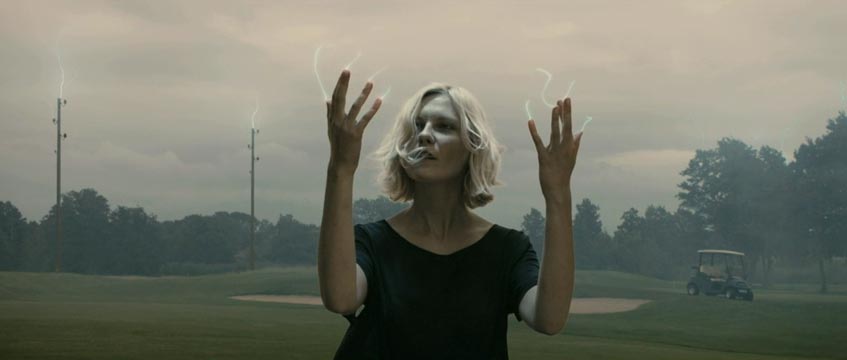
This is also possibly Von Trier’s most beautiful film.  The first five minutes of surrealistic shots, almost stills, took my breath away.   And though the film then moves quickly into narrative, it is still filled with the most gorgeous shots.  The lighting of the reception moving outside to the grass, the shot of Kirsten Dunst bathing in the light of the coming planet… all gorgeous.  And  Wagner’s score from Tristan und Isolde over it all just inhances the beauty.  Honestly, if you want me to love a film, make it surrealistic, with an amazing score and throw in beautiful images—yeah, it’ll be one of my favorites.

One of the most surprising things about this film is that though it is all about depression—we get that from the title—yet it is not depressing.  It is filled with humor, beauty, and even hope and joy.  Sure, it’s about the end of the world, but that doesn’t mean it has to be sad.  More about depression in the film in the analysis.
A much more straightforward film than Antichrist, but covers some of the same themes, about depression and nihilism.  I think this film might be the key to really “getting” Antichrist, which I will watch again to get the idea of it.  If I finally “get it” then I’ll write my findings in a new post.

Overall, Melancholia was a marvelous experience, excellently acted and brilliantly conceived.   I cannot recommend it to everyone.  If you have had no experience with depression or have never struggled with being overwhelmed by life, perhaps you wouldn’t appreciate it.  But for me, it was an amazing experience, and one I want to have again.  5/5

Below is my analysis of the film, including spoilers.  If you haven’t seen the film, I recommend not reading it until after you’ve seen the film.


As I was leaving the theatre after seeing Melancholia, I heard one woman say to her companion, “That was so stupid.”  And I could understand why.  After all, the film ends with Earth being destroyed and flames engulfing the audience, and finally, complete silence.  This isn’t subtle, nor is it an ending where you have to decide whether it is happy or unhappy.   Frankly, the film makes it clear: it just is.  This is reality.  For many people, this is simply silly.  They have never experienced the end of their world, nor dealt with the depression in which such an end is inevitable.  To end the film in this way is a slap in the face to their sensibilities, a pointless exercise in nihilism. 

But part of what the film communicates is that melancholia is a state of mind, an “illness” that cannot be gainsaid.  Either you have had this state as an experience or you haven’t.  If you haven’t, then such thinking is “stupid”, overdramatic and a rejection of reality.  But if melancholia is a part of you, then it is just how reality looks.   The end is truly nigh, and our body just is preparing for the inevitable.

What is exactly meant by melancholia?  In the ancient world, a melancholic personality is one who has too much of a certain “humor” (or fluid) in the blood.  The melancholic personality is introverted and creative, and when one develops too much of the humor that creates such a personality, then such a person becomes isolated, lack energy and depressed.  This is an early form of what today we call clinical depression.   Technically, clinical depression is usually caused by a lack of serotonin in the brain, which causes one to no longer feel pleasure in everyday experience.  This causes lethargy and a lack of energy.  Such a lack of serotonin can also cause one to be anxious, inflating little fears to inaction.   Depression is sometimes a way of the body indicating that it has had enough stimulation, and that it needs rest.  In chronic depression, the body never catches up on the “rest” it needs, and the victim can spend his or her time sleeping, staying away from people and hiding from anything that might cause stress or stimulation.

Von Trier adds one more layer to melancholia that isn’t usually found in ancient medicine or modern psychology: a philosophical side.  Attached to lack of energy, introversion, and creativity is a nihilism—a confidence that there is, in reality, no hope for life.  All life will end and there is no life or spiritual force that will replace that life when it is gone.   It is true that such hopelessness often accompanies depression, but it isn’t a necessary component of it.  However, what does accompany such depression is a satisfaction that life will end, because once life is over, then so is the stress and one can finally rest.

Obviously, Justine is the melancholic, the focus of the film—and the representative of Von Trier himself.  She has all the indicators of all the layers of melancholia, and Part I lays out exactly what such a condition is.  Justine, is in the midst of the “happiest day of her life” and it is clear that everyone expects her to—nay, demands that she— be happy.  But happiness is not in her nature, and frankly, such a social event with so much planning and detail is a clear trigger for a depressive event, demanding more energy than a melancholic has.  Everyone is disappointed with her, but she has no reserves to meet everyone’s demands.

Finally, she escapes the stress by undermining her entire life.  She publicly has sex with a visitor to the wedding, thus ending her short marriage.  She deeply and publicly insults her boss, thus ending the promotion he just gave her.  The only relationships she retains are those that give her comfort:  her father (who runs from her) and her sister.   In this way, she ends her own world, allowing the thoughts of the inevitability of such an end have their self-fulfillment.  Now she can rest.  There are no more demands.  Disaster is not something to fear, but it is to be embraced.  It is the end which is best met quickly and on one’s own terms.

In Part II, the focus changes.  Now it is about the impending disaster of the planet Melancholia coming to destroy the Earth.  For the characters, there is some ambiguity as to whether the planet will hit, but for us, who has already been given a preview of the event at the beginning of the film, there is no question, and the horses agree with us—the end is inevitable.

There are four responses to this impending doom.  The first is Justine’s.  She is not surprised by the end of all life, she not only expected it, but is content with such an end.  “The Earth is evil” she says, and so it is worthy that all life be destroyed, to be replaced with nothingness.  The funny thing is, that while pressures were being put upon Justine in the first part of the film that she couldn’t deal with, the only truly evil actions in the film are hers (except, perhaps, for John’s selfish end).  “Evil” then, must be a personal definition, not a moral one.  The Earth is evil to her because she can’t deal with it. 

Because of this attitude and approach to crisis, Justine is supremely able to deal with the ultimate crisis.  Her whole life has been in preparation for this very moment, in being able to deal with the ultimate disaster.  She creates the idea of a “magic cave” which will protect them from the coming disaster.  Of course she knows that such a protection doesn’t exist.  But she creates it to ease the anxiety of those around her.   The cave is much like the isolation that she participated in to shield herself from the end of her life.

I think that this is how Von Trier sees existentialism and probably religion.  They are necessary fictions to help the normal human deal with the inevitable, impending disaster.  This is not unlike Jean-Paul Sarte’s view of reality: Nihilism is fact, but we cannot live as if there is no hope or meaning to life.  Thus we have to create fictions, commitments to life, that we surrender ourselves to completely.  It doesn’t delay the inevitable, but it makes life easier to bear in the meantime.

The second response, which is the opposite of Justine’s, is John’s.  He is completely optimistic, he is absolutely confident that life will continue on as normal.  This crisis is simply a bump in life, one of the normal intrusions to the humdrum world that makes life interesting.  He rejoices in the planet, and takes as much pleasure as he can out of it.  Eventually, he expresses his real doubts and finally seeks out the truth of the matter.  When he discovers that Earth will actually be destroyed by the planet, he finds himself completely unprepared to deal with it, and commits suicide.  It is interesting that it is the sanguine John who commits suicide and not the depressive Justine, although in real life it is the depressive that often commits suicide.  The point is that when the world ends, it is the optimistic who can’t deal with reality, not the melancholic.

Another response is the horses.  (Not Leo.  He just follows his father’s response and then Justine’s).  They know that disaster is inevitable, and their first response is panic.  All they want to do is escape it, run away.  Augustine won’t cross the bridge because he knows what is coming there.   But after a time, they calm down.  There is no point to continue panic.  What will happen will happen.  In a sense, the horses reaction is the most logical.

Finally, we have Claire.  In normal life, Claire is the most practical, the one that holds everything together, the one that smoothes out the rough edges, who maintain relationships, who keeps her head in all of life’s little crises.  She is the kind of person who keeps life going.   So the possibility of life abruptly ending is the worst possible outcome, and the one thing she just can’t handle.   Her response to this, appropriately, is fear.  Her husband tells her that she is just anxious, fearing for nothing.  However, we find out later, that he simply just couldn’t deal with her fear in light of his need for hope, so he just denied her the logical response.

When it is clear that the end of life is inevitable, Claire’s first response is to perpetuate life.  Just to stand on the terrace with her sister and son, to drink wine and make small talk.  Justine refuses this, recognizing that when life is ending, such a response is inadequate, and only perpetuates denial, leading possibly to a worse breakdown.  Claire finally accepts Justine’s solution of participating in the “magic cave”, but in the end, the false protection means nothing to her and she remains anxious to the end, recognizing that her worst fears have been realized.

The final question I had about the film is the allegory of the planet Melancholia itself.  Certainly it represents the end of life.  Possibly the end of one’s social life, as what Justine experienced in the first part of the film.  Or perhaps it represents a personal end to life—the inevitability of death for us all. 

But Melancholia represents more than the object which precipitates an impending disaster.   As its name indicates, it is also a representative of depression itself.   Certainly it represented the mental state of impending doom for Justine.  She refused to undress for her husband on her wedding night, nor did she even undress for the young tool she used to end her marriage with.  But for the planet of Melancholia, she completely disrobed and opened herself completely to it.  Depression itself was the joy in her life, that which she could completely surrender herself to.

But is the planet a representation of depression to everyone?  Is the greatest disaster of everyone’s life in the film not the “end of life as we know it”, but Depression itself?  Is John actually denying depression in response to crisis as an option, and when depression comes he commits suicide?  Is Claire fearful of her lack of response to life?  Is she ultimately fearful of losing control, of no longer having the energy or drive to love, to hope, to smooth things out? 

I don’t know that Von Trier intended such a deep metaphor, but it is interesting to think about. 

Sunday, December 25, 2011

We Should Do Something About Us Fanatics

When I was a junior in high school, I took biology.  At that point I was an outspoken conservative fundamentalist Christian (now I am an outspoken social justice Christian... some would say I haven't changed much) and was waiting for the teacher to say something about evolution.  I didn't believe in "evolution", or what I thought was evolution at the time.  I realized years later that my conception of the science and the Bible were misguided, but at the time I held the fundamentalist belief that evolution was at best an error, and one that stands against God.  Although I had no interest in having a debate about evolution with the teacher, and didn't really want to say anything about the subject, I was not going to allow the teacher to compromise my beliefs.

Finally, the fateful day came and the teacher announced that he was going to be teaching on evolution.  His introduction included a statement which basically said this: "There are some who don't believe in evolution because of their religious beliefs.  I just want to make sure you all know that anyone who chooses their religion over what science says is stupid.  I am not here to teach stupidity.  I am here to teach science. Does anyone have anything they want to say on this subject?"

Perhaps you might think that this discouraged me from saying anything.  If so, you obviously don't know me very well.  If he had said anything other than insulting that which I believed, I would have let it pass.  But I had to say something.  So I raised my hand and he allowed me to murmur something incoherent about Genesis and biblical creation.  He allowed it to pass without comment, and, after seeing that no one else had anything to say, went on to teach what he needed to teach.

This is the incident I think of when I hear people speaking about the film Jesus Camp.

Jesus Camp is a documentary about a Pentecostal camp for children that train them in preaching, praying and conservative right-wing ethics, especially about the evils of abortion and evolution.  The children, ranging in elementary school ages, are taught and teach each other about these common religious views, which they all seemed to hold before they came to the camp.  The documentary has little commentary, and just observes what happens in the camp, although emphasizing some of the more dramatic (and so more interesting) events.

When I watched the film, I found it to be an interesting sociological piece of Pentecostals, whom I've already studied and taken in what I thought was positive about the group and left the rest behind.  What is interesting to me is the reaction by many who have seen it.  Most everyone considers the camp to be disastrous for the children, and those who taught at the camp to be monsters, both for the content of their lessons, and also for their teaching method.  A common reaction is to call the teaching "brainwashing" or "manipulative."   To call the teachers "stupid" or "biased."

The first time I heard this reaction, I was confused.  These are children raised by Pentecostals, and the teachers are conservative Pentecostals themselves, and this is what Pentecostals teach.  What did they expect?

After some thought I realized that they were offended that the teachers didn't give different points of view.  That a different view of evolution or woman's lives without abortion should be presented, just for balance.  Perhaps some acknowledgement that there are different points of view should be presented.

Ummm, yeah.

I understand that in a science classroom, we should only teach proven science.  That's appropriate because that is what that class is for.  Even so, no one should expect that a class on religion should present a "balanced" view of religion.  Sure, it would be great if the teachers of one subject or another would respect another side.  Perhaps they could have a discussion with the children offering their own thoughts.  But that's not the way it works.  Because the education of the young isn't about critical thinking, but rather about pedatics.  Critical thinking is taught (if one is lucky) in the late teens, or college.

Why complain that Jesus Camp is full of teachers teaching what they believe?  That's what teachers do.  All teachers.  Please don't expect objectivity in churches, in school, in parents or in yourself.  We all have beliefs and we all "teach" these beliefs.

And don't worry about children being "brainwashed."  Yes, children are taught a single perspective-- usually the perspective of their parents-- and are raised to think a certain way.  But this is the wonder of the teen years.  Those "brainwashed" kids will often rebel against the thoughts of their parents and think on their own.  So don't be worried about kids who are taught the "wrong" ideas when young.  You should rather be worried about your own kids who were taught all the "right" things by you.

Thursday, December 22, 2011

Hugonic Themes

For me, Martin Scorsese has been a hit-and-miss director.  I thought Taxi Driver was brilliant, but disturbing, while Raging Bull was just disturbing and Goodfellas was unwatchable and disturbing.  I enjoyed Shutter Island and adore The Last Temptation of Christ.  But I had no questions about seeing Hugo, Scorsese's latest.  He is, at his worst, a capable director, and I enjoyed the volume it was based on, even though it wasn't that  memorable.

I found my experience with Hugo immensely enjoyable.  I laughed out loud, cried at the appropriate scenes and generally just enjoyed my time.  No, it wouldn't make my top 100 films, or 200, but there was a lot there to really appreciate.  And this without the 3D (I can't watch 3D, because it all looks fuzzy to me.  That's fine, cheaper tickets!).

So I went to my film buff friends and told the naysayers my opinion.  Everyone took it well and we had a fine conversation.  But it turns out that no one disagreed with the quality of the film.  Some took issue as to the interest it held to the viewer, and there was certainly a question as to whether Scorsese was making a children's film-- or IF he could make a children's film.  All of these questions were lesser, however.

The big disagreement was what the movie was actually about.  What is the Big Theme.

Everyone agreed there was a Big Theme, a central point to the film.  But we all thought it was something else.

The cinephiles among us saw this as an advertisement for film preservation.  Mr. Scorsese has been deeply involved in the World Cinema Foundation, and certainly a bit of propaganda for the work of finding and digitally preserving all kinds of film is found in the film.  On the other hand, this is also mentioned in the book, and it isn't a main theme, there, and the film closely follows the book.

One of the main indicators, however, that those who think old film preservation is the theme is that they are bored with the film, although they appreciate that theme.  To me, if the movie is about "one thing" and yet you think that most of the film is "nonsense" or "pointless", then perhaps, I propose, you have the wrong theme.  I think that the glory of cinema is A theme in the film, but I see no evidence that it is the central theme, or even a main one.

Another theme that is discussed is finding one's place in the world.  This aspect is certainly discussed in the film, and is important.  One critic mentioned that it is harped upon so much that she wanted to say "enough already!  I got it!"   I think that this is significant in the film, but there are different aspects that are drawn out.

First is the idea that everyone has his or her place-- that no one is left out.  Some may consider you insignificant or useless, but they are simply wrong, even foolish to believe it.  One can even say as much for the minor characters of the film.  Some characters may seem unimportant, but each one has their role to play in the overall story about Hugo-- because in the end, as the title says, the story is not about George Melise, but about the simple boy whose life is always teetering on disaster.

Secondly, the theme is emphasized that to accept that one has a place in the world on faith is not enough-- we must go out and find it.  The fact is, more often than not, our place has already been marked.  We just must accept it.  This is almost a fatalistic touch-- as if God has fashioned George Melise to be a magician with film, and it was simply George's responsibility to accept it.  Even as it is Hugo's destiny to be a boy who fixes things-- anything, even people.

Finally, having our place in the world isn't enough.  We must also have recognition of this place.  We all need a certain amount of honor, of the respect due the place we have in the world.  It would be great if it were appreciation, but at least we need to be looked at and have people say, "They belong here.  They do..." whatever it is we do.

While some might argue with the work-oriented purpose in life, in the end, recognition of one's work is something both old people and young people have in common.  The young person says, "I am working, will anyone see me as a real person because of it?"  And the old person says, "I have worked, will anyone recognize that my life has been worth something?"  Between those times, most of us are so focused on the work itself that we don't seek that place, or a recognition of that place.

But in the end, it is this whole set of themes that I loved about Hugo.  The fact is, it is a complex and compelling film.  And I think, as people look at it closer and see its greater worth than just a beautiful but pondering children's film-- because it demonstrates much more than the love of film-- rather it is the love of all people and all the work they do.  That is a wonderful message for all of us. 

Wednesday, December 7, 2011

If I Were Directing A Jesus Film


I’m not a director or screenwriter or actor.  I'd love to write a screenplay, but I know how tough that is. A rank amateur like me shouldn't try it.  At the same time,  I don’t think I could hurt anyone by giving some tips to the next person who wants to bring Jesus to screen.

A special note to Chris Columbus:  (Director of the first Harry Potter film)  So I hear you are going to do a movie based on Anne Rice’s book Christ the Lord: Out of Egypt.  Wow, I wish you luck.  It’s not a problem.  After all, displaying fantasy and science fiction is your specialty.  But please don’t think you are making a REAL Jesus movie.  Still, it might be fun to portray ancient religious novels on the screen. That's where Anne Rice went for her sources for this material-- religious novels about Jesus from the early third century on.  But I don't need to tell you that, you probably already knew.

Here’s my real tips (for someone who is filming a real Jesus film):

Jesus was socially conscious.  He was trying to open up the temple to women and non-Jews.  He related to the poor and the socially outcast.  He was trying to give real solutions to difficult problems, with a religious spin.  Show that.  Don’t make him so heavenly minded that he is no earthly good.


Jesus was a radical, not a revolutionary.  He opposed the status quo, but determined that martyrdom would do more than revolution.


Try to keep the balance of attitude.  Jesus wasn’t gentle and mild, nor was he a jerk (usually).  He was an intellectual who went popular and was very clever.  He was smarter than anyone else around him.

Jesus became popular because of the healings, not because of his teaching.  At first, no one cared about the teaching.  They only listened to him because they were stuck in church with him speaking or because they were waiting their turn in the miracle line.  Only the disciples took notes (so to speak—they memorized his oral teachings).


Try to keep to a historical Jesus.  There are too many pitfalls in making a Jesus in the "here and now".  Have you ever seen the film Joshua (2002)?  Awful.  But in keeping to a historical Jesus, ignore the many books people will want to give you. There are a plethora of modern scholars to tell you who Jesus was “really” like.  Ignore them all.  Just stick with a gospel.  Luke is still relevant, but no one has done Mark, and Mark is the “action” gospel without so much teaching.   Focus on what Jesus did, but read the text yourself and make your own interpretation.  That’s what Tim Rice did with the original writing of Jesus Christ Superstar, and though the movie was pretty silly, the original libretto and lyric are deeply insightful.


Jesus had fun.  He had a wry humor and used hyperbole and puns to good effect.  I mean, “Don’t take the speck out of your friend’s eye if you’ve got a plank in your own.”  That’s good stuff.  Put that kind of humor in there, if it doesn’t seem too weird.

Anyway, I'm not trying to tell you what film to direct or write.  I guess what I'm saying is, let's keep it real.  Jesus was a real person, and the ancient writings don't make him too "holier than thou" and yet a person really focused on his goals.  

The Human Jesus on Film


From the early 300s to today, there have been discussions (aka arguments) about Jesus' nature.  Was he a god or a blood-filled flesh bag?  The orthodox answer is that Jesus is fully human and fully divine.  He was just as human as any of us, but also completely the Son of God.  But how do you show that in a movie?  The tendancy of film is to lean one way or the other-- to be a god-like person or to be more human with supernatural qualities.  Below are some films of that second category:


The Passion of the Christ—This Jesus doesn’t have much to do except suffer.  He has a few scenes, notably the “He who has not sinned cast the first stone” scene, where he can actually be a normal human being, but these are short, and offer few insights of Jesus as a person.   The movie is not about Jesus, but about The Christ—the symbolic sacrificial lamb.  The Christ isn’t supposed to be someone we identify with, but he is deeply human, in that he suffers and struggles and bleeds.  And bleeds.  In a sense, this is the perfect orthodox Jesus.  A Jesus who doesn’t teach anything specifically, but who dies for humanity and allows his followers to fill in the gaps.  No one has to listen to this Jesus, or obey him, nor does he say anything uncomfortable.  All we have to do is watch him die.  And while observing that is, at the very least, a difficult task, it is better than a Jesus that meddles in our lives, right?  I know that the film is only about one aspect of Jesus’ life, but I really need a Jesus that does something, not just one that winces. Jesus-2/5 Film-3/5

The Last Temptation of Christ—The most human of the human Jesus’.  Jesus struggles with the common desires of every man, he gets married and has kids.  We see that Jesus wasn’t interested at first in God acts, but had to be led and prodded every step of the way.   In this way, this Jesus is the one that is most identifiable, the one we can best connect with, of all films.  I only have one personal problem with it: Willem Dafoe.  He’s a great actor and he does a wonderful job.  But he also played a rather iconic role in the much more recent Lars Von Trier film Antichrist, which I watched a couple months before my rewatch of Last Temptation.  So I couldn’t see Jesus at all, only Dafoe.  I’ll watch it again later and see if I can distance myself from his other roles. Jesus- 4/5  Film-4/5

Jesus of Montreal—I like the way that Daniel isn’t Jesus from the very first scene.  Rather, he is a struggling actor with a girlfriend trying to make ends meet and to have integrity as an actor and director.  But as the movie progresses he becomes more and more like Jesus, until the role is completely embodied.  This is probably the best portrayal of the love of Jesus and a great human version.  Jesus-4/5 Film-3.5/5


Life of Brian—First, I want to point out that Brian isn’t Jesus.  He doesn’t intend to be the Messiah, and in one scene he is trying to hear Jesus speak the Sermon on the Mount.   But on the other hand, Brian IS a kind of Jesus.  The pathetic Jesus who stumbles upon his Messiahship unknowingly.  Brian is a terrible Jesus.  But Life of Brian is a wonderful poking at religious thought. Jesus- 1/5  Film- 4/5


Ordet—Before you read the second part of this paragraph, I want to say two things.  First of all, this is my favorite portrayal of Jesus ever.  Secondly, if you haven’t seen it you MUST NOT read any more.  Major spoilers, here.  Order the film from Netflix, watch it, and then finish this paragraph…


Okay, have you watched it?  Wow, huh?  My favorite part of this film is that Johannes is seen as clearly mad throughout the film.  Interestingly enough, this is how Jesus was seen in his day by contemporary scholars and by his own family.  After all, one who makes such exaggerated claims as Jesus MUST be mad, right?  The only thing that separates a madman from a saint is that the acts and words of the saint actually come to pass.  I can think of no film that better portrays the view of Jesus family during his ministry and the aftermath.  I was as stunned and pleased and overwhelmed at the end of this otherwise dry film as any of the characters.  Glorious, just glorious.  Jesus-5/5 Film- 5/5

If you cheated and read this without watching Ordet, go and watch it anyway.  It is an excellent experience and the best portrayal of Jesus I have ever seen.

The next section, I give some recommendations to the next film portrayal of Jesus.