Wednesday, April 11, 2012

Denying the Subversion: Musicals of 1957


Genre movies have a special place in my heart.  There is a comfort with them, you pretty much know what to expect, and that is a good thing.  There is a time for a film that shakes ones expectations, that brings us to places we’ve never been before, but sometimes we need the familiar.  We need tropes that affirm that the world is regular and follows certain rules—at least the film world, if not the world around us.  A good genre film may not make us laugh or cry, but it is a cozy flame in a fireplace on a winter day.  And sometimes we need just that.

The balance a genre film—whether noir, romantic comedy, western, musical or other—must achieve is to maintain that familiar, but to also be interesting.  There must be both the trope and the novel, the familiar and the surprise.  Because no film should make us so comfortable that we fall asleep.  But where that line is drawn is different for different people.   Some can find the unique in very subtle ways,  while others are more demanding of their genre films, demanding some kind of subversion of what is often expected. 

I usually prefer the remarkable as opposed to the comfortable, but this week I sat down to two musicals very comfortable in their genre: musicals.  In looking at their performers, we know that we shouldn’t expect much in the way of subversion:  Doris Day in The Pajama Game and Fred Astaire in Funny Face.  So I settled in to the familiar, and hoped that there would be enough uniqueness to keep me awake.

First comes The Pajama Game, which from the first scene we know that it is imitating a Broadway-style song-and-dance, which makes sense since the musical and all the performers (except from Doris Day) came straight from the successful stage play.   Doris Day is unexceptional here, but her co-lead John Raitt has a remarkable voice (I found myself wanting to sing along).  But the real star here is Carol Haney in the supporting role of Gladys.  Every time she participates in a song, the film brightens and gathers energy.

And, honestly, it needed some energy.  There is a wonderful scene when there is a revisit of an earlier song, except done at half speed.  In the end, this is how I felt the whole movie to be.  The dancing was uninspired, the songs unexceptional.  And there was something else missing… but I just couldn’t put my finger down on it.  With the exception of a few musical numbers—“Hernando’s Hideaway” and “Steam Heat” especially—this film was pretty much a snooze.

Then came Funny Face with Fred Astaire and Audrey Hepburn… and Kay Thompson playing a pivotal third wheel.  I have two confessions to make before I begin.  First, this is the first time I have seen Fred Astaire in a film since I saw Easter Parade as a young teen.  And I am not a fan of Audrey Hepburn.  I have seen both Breakfast at Tiffany’s and My Fair Lady and both films are wonderful—except for Ms. Hepburn.  She seems flat in both roles, just filling dresses, but not the characters (and this isn’t because of my deep disappointment that Julie Andrews wasn’t able to reprise her stage role as Eliza).  So I entered into this film not expecting much.

I was quite, quite pleased.  First, the Gershwin songs were clever, jazzy and fun—everything good you expect from Gershwin.  The dance was energetic and fun, a true pleasure to watch, all except Fred Astaire.  Okay, now I get it.  I mean, I’ve seen the rotating room dance, and some tap dancing by the master, but now I know why Astaire is the dance Master—it was like he floated, defying gravity.  When he and Audrey dance upon the water platform and drift to the middle of the stream, I gasped aloud—that was musical perfection.

But I also found in this film what I was unknowingly missing in The Pajama Game—chemistry.  Both movies are musical versions of a typical romantic comedy.  The secret to a good romantic comedy is chemistry.  You can put in as much ridiculous, insane, unrealistic situations and characters around the main characters, but the central relationship has to be believable.  As much musical time as The Pajama Game spent on the central relationship, I just didn’t buy it.  These were strangers, not lovers. 

Funny Face played it almost perfectly.  Fred, the experienced actor, acted the experienced man.  He expected nothing out of Audrey, and his love was pushed deep, coming out only in his plan to make her the next fashionista.   Audrey is the girl next door, even when she is a fashionista, and her performance is perfect in every scene.  Her love is intellectualism, but her attraction to Astaire seemed natural and wonderful.   The only fault I find in their relationship is when they confess their love to each other, which is so sudden and silly I’m surprised the performers didn’t burst out laughing in the midst of it (perhaps that was an earlier take). 

But overlooking that, the film was wonderful.  It was everything I expected from a great musical: perfectly performed and full of joy and great dancing.  I don’t care that a photographer and his subject doesn’t break into dance in the middle of a shot.  In this film, I believed it and I was glad to be with them, appreciating their happiness. 

Friday, April 6, 2012

Classic Cartoons of 1957

You may find that I am posting more about movies of 1957, like Paths of Glory in the last post.  The reason for this is because my movie comrades and I on the Filmspotting Forum are participating in Retrospots, where we grant awards for film of years gone by.  For our first round of Retrospots, we have chosen the year 1957.  This is a year of truly great film, like 12 Angry Men, The Sweet Smell of Success and Witness for the Prosecution and many others.

It was also a pretty good year for cartoons.  Yes, cartoons.

I like cartoons.  I grew up watching repeats of classic Popeye, Loony Toons, Woody Woodpecker, Droopy, Hanna Barbera, Japanese anime, and even Super Chicken.  And so, to provide a *ahem* service for the Filmspotting community, I watched a whole bundle of cartoons from 1957 and reviewed them.  For your reading pleasure, I share them with you, along with my rating out of five stars.  If you'd like to watch any of them, they are all available on YouTube under the name given.


The Candlemaker
A pretty standard Christian moral tale with a conclusion of working hard.  Occasionally the animation is interesting, but nothing exceptional here.  2.5/5


Ali Baba Bunny
A Bugs Bunny/Daffy Duck classic.  Some good laughs.  The tension the duck causes and the brains of the bunny are always enjoyable, and it’s a standard good time.  Hassan chop!  4/5


Piker’s Peak
The Bunny and Yosemite Sam, climbing the “Shmaterhorn”.   Sam is just sad.  3/5

Hooky Spooky
Casper the friendly ghost.  It started out so well, with a “night school” for ghosts, but as soon as Spooky wants to go to the zoo instead, the imagination ends. 3.5/5


The Story of Anyburg, USA
A Disney moral tale of who is responsible for good driving.  It’s not funny, and the point is pretty dumb, actually.  2/5

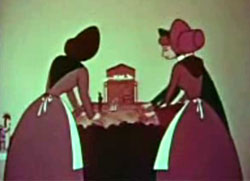
The Truth about Mother Goose
A history lesson on the background of three nursery rhymes by Disney.   Disney proves once again that they know how to educate better than anyone and that they really don’t know solid history.  Still, it was fascinating to watch. 4/5

Bedeviled Rabbit
Taz v. the Bunny.  Taz is smarter than he is in other cartoon, and it is better for it, although it really only makes him a substitute for Elmer.  Amusing.  3/5

Red Riding Hoodlums
A Woody Woodpecker knock off with his niece and nephew.  They try so hard and are occasionally funny, but they are just stealing jokes from Warner Bros, and the animation isn’t near as well done. 3/5

Byl Sobie Raz (Once Upon A Time)
A first effort by Polish/French director Borowczyk.  It’s got a lot of imagination put into it, but in the end it is simply too basic.  Not enough to keep ones interest even for its eight minute run. 

What’s Opera Doc?
Well, this is the star of the year, and no wonder.  It isn’t really funny, but it draws in a lot of elements—from Fantasia, Wagner and the basic plot from Bugs and Elmer—and it is dark.  Really dark.  It is the most different of any of the Warner Bros. cartoons, and the animation is truly artistic.  If you haven’t seen this since you were a kid, try it out.  (I still prefer Duck Amuck)   Kill the rabbit! 4/5

Romeo Rabbit
Elmer has to babysit a romantic (enormous) rabbit for his uncle who promises him 500 dollars to do the job.   Frankly, Elmer deserves every penny.  He forces Bugs to help him out, and Bugs at first is no match for the duo.  Of course,  he wins in the end.  A couple surprises, but a lesser Bugs. 3/5

Steal Wool
One of my favorite WB series is the Sam the Sheepdog and Ralph the Wolf (who is just Wile E Coyote behind a red nose).  These are just two working stiffs, doing their jobs, one to protect and the other to steal sheep.   The action between the bookends is pretty typical Road Runner stuff, except that Sam is almost miraculous in getting out of Ralph’s traps.  The ending of this one is one of my favorites. "Morning Sam."  "Morning Ralph."  4.5/5

Mucho Mouse
Time for a Tom and Jerry mini marathon.  Jerry is a Spanish mouse, who can never lose.  Tom is the champion mouse-catcher from the States.  Tom is too outmatched, it isn’t really fair and all the characters speak, which to me is breaking the rules.  I had no idea the series was created by Hanna Barbera, but this cartoon certainly has the look of later H/B series.  3/5

Tom’s Photo Finish
Spike is framed by Tom for eating the chicken, but Jerry has it all on film, and he begins placing copies of the photo all over the house where the masters will see them.  This is classic T & J.  And Tom doesn’t get beat up too badly.  4/5

Feedin’ the Kiddie
Jerry has a nephew visit for Thanksgiving, who is so focused on food that he doesn’t pay attention to the trouble he gets into with Tom.  I prefer the ones where Jerry actually has a challenge—he’s more fun on the defense than the offense.   3/5

Timid Tabby
Tom has his cousin George visiting, who is scared of mice.  Jerry thinks he can use this to his advantage, but because he can’t tell the difference between Tom and George, he is fooled.  Nice to see Jerry on the taking side for a change.  3.5/5

Tops With Pops
Tom and Jerry and Spike with his son Tyke.  Jerry hides with Tyke, whom Spike loves and protects from Tom.  Some good laughs here, although Jerry is infernally smug.  4/5

Give and Tyke
An unnamed dog is stealing Spike and Tyke’s dog collar so he doesn’t get taken into the pound.  While Spike’s voice is an imitation of Jimmy Durante, the unnamed dog is exactly like Yogi Bear.  However, Yogi Bear doesn’t appear until 1958, when Hanna Barbera open their own studio.  So this cartoon must be part of the vocal development of that most famous character.   There’s a lot of give and take here, but little decent comedy.  Still, this is historic, showing the development of MGM Hanna Barbera to their own studio work.  3/5

Scat Cats
Spike and Tyke have to keep a group of alley cats from getting into the masters’ house when they are away.  Another historic document.  Not only does the voice of Yogi return, but the alley cats clearly precede the series Top Cat, which began in 1961.  Some good laughs in this one.  3.5/5


Thursday, April 5, 2012

Paths of Glory: System of Leadership


The court martial movie is a well-trodden path.  And no wonder: it has the semblance of rebelling against authority, while supporting the system of authority.  It provides an opportunity for true actors to really shine in highly dramatic roles.  It has the best of both stage-- a presentation before a limited audience-- and the movies, providing context and drama outside the courtroom.  Some of the greatest movies have been court martial films: Mutiny on the Bounty, The Caine Mutiny, Breaker Morant, and A Few Good Men are among them.

Paths of Glory is certainly among them.  It stars Kirk Douglas as a Colonel in World War I, who is first ordered into a dubious battle and then forced to defend his men from accusations of cowardice.  Beside being a marvelous court martial movie, it  has one outstanding characteristic above the other films: it has amazingly good war scenes as well.  It isn't focused on the court, although it's focus is upon justice and the misuse of authority.  The most dramatic scenes are on the field.  Like another great war movie, The Life and Death of Colonel Blimp, PoG allows us to see inside the whole war machine, from those who command generals to the lowliest private.

The amazing thing about this film is that it doesn't just target a single bad commander.  Rather, it shows how the system as a whole is built to create those commanders to make decisions that unnecessarily costs lives.   How both a general and a sergeant are supported in evil decisions in order to cover their butt or to obtain a little more glory at the cost of many lives.  And it also shows how such a corrupt system cannot abide by integrity, nor even understand it.

And this makes Paths of Glory unique.  It isn't exactly an anti-war film, because Kirk Douglas, our hero and man of integrity, begins and ends a soldier.  And it doesn't just decry the misuse of authority.  Rather, it says that there is a systemic problem in all military leadership.  That is a remarkably bold statement.  Especially for a film made in the mid-50s.

I do wish that more of the supporting cast had been as stellar as some of the lead roles.  But the sound and cinematography are worthy of Academy Awards-- although the Academy didn't even give it a single nomination. The central battle scene is amazing and it seems to have influenced at least Spielberg, as I can see Saving Private Ryan and War Horse borrow aspects of it.   While not a perfect film, it's a keeper and worthy of the Kubrick label.

Oh, did I fail to mention that it was directed by Stanley Kubrick?

Thursday, March 15, 2012

Why Jessica Should Give Certified Copy Another Chance


My friend Jessica, aka “Lobby” of The Velvet Café and the Filmspotting Forum is a wonderful film blogger.  One of the best, actually (you can see a link to her site on the sidebar).   She has wonderful opinions of film and she expresses them in such a personal, interesting way.  However, sometimes—only occasionally, mind you—she is terribly wrong.

For instance, I would claim that 2011 has produced three masterpieces of film.  Perhaps more, after all I haven’t watched A Separation yet or This Is Not a Film.  But there are three that will be discussed and watched happily for decades to come: Tree of Life, Melancholia and Certified Copy.  Jessica didn’t really care for two of them, and hasn’t watched the third and probably is now nervous about watching the third, because I have lumped them all together.

Although I might want to defend Tree of Life, I am here to talk about Certified Copy.  Jessica said that she wasn’t really interested in a very long art discussion.  And it’s true, I wouldn’t either.  And that’s what the film begins with—a discussion about whether a piece of art is to be valued equally as it’s certified copy.  It’s an interesting notion, but one that has been discussed to death in other good films like F is for Fake, My Kid Could Paint That and Exit Through the Gift Shop. The subject has been exhausted, and I would be exhausted to watch another film about it.

But Certified Copy is not about art.  It’s about relationships.

It is using the example of a single relationship, which at times is a courtship and at times is a couple fifteen years married,  to talk about the nature of relationships in general—all of our relationships, but especially our most intimate, long-standing ones. 


There are many questions the film brings up about our relationships:

Do we change over time or are we just perceived differently by others?

Is our value intrinsically our own, or do we only have the value others give us?

Must our relationships have a goal, or is it enough that we just enjoy the experience?

Is the goal of life to produce, or to be happy?

Is it acceptable to avoid the difficult things in relationships, or should we work at “fixing” them?

I admit that the film is a difficult one to watch.  The two principles, brilliantly portrayed by Juliette Binoche and William Shimell, spend most of the film arguing, bickering.  The fact that we don’t know whether the couple are complete strangers or deeply intimate is a distraction. 

Actually, let’s talk about that—see how much of a distraction it is?  But it goes into the  theme of the film.  At the beginning of the film, it seems obvious that William and Juliette don’t know each other, that she’s attracted to him, but also extremely upset at some of his opinions.  About halfway through the film, they speak as if they have had a rocky marriage, one in which he separated himself from her and their son for most of the marriage.  They also have connection with another couple who are getting married in the same place they got married 15 years ago.  And most of the way through the film, they pass an older couple, leaning on each other in order to walk. 

I believe that all four of these portraits are of their marriage, or that they all speak to different parts of the same marriage, or all marriages.  There is the courtship, where we are getting to know each other.  Then the wedding, in which the relationship is most idealistic.  Then a number of years later when the ideals are cast aside and a choice is made to continue to live together or to separate.  And, finally, old age where the decision to remain together leads to interdependence.  

What I believe the film is saying is that all four of these stages are the same marriage.  They aren’t different relationships, but the same one.  The individuals haven’t really changed.  But each stage gives them a new opportunity to perceive each other and how we value each other differently.

And this is why I love this film: I have never watched a film that more helps me understand the nature of long term relationships.  Mind you, I haven’t seen Scenes From a Marriage yet (although I will soon), but this film is deeper and more thoughtful about relationships than any film I have ever seen.

So, Jessica, if you are reading, I hope that give Certified Copy a chance.  Another chance.  I think there’s a lot there, more than anyone can catch in one viewing.  Really, it’s the up and coming thing.  Like indoor plumbing ;)

Cool Hand Luke Superstar

This review is dedicated to ses who dictated the film to me

What is there to say about Cool Hand Luke that hasn’t already been said a hundred times before?  A high point of 60’s cinema, which already has a number of high points.  A brilliant script.  Magnificent performances, headed up by one of Paul Newman’s greatest roles.  There wasn’t a dull moment, or a misstep in the entire film.  It is almost a perfect film.

The only thing left to talk about is the theme, although that has been covered ad nauseum.  The general consensus is that Luke is a Christ figure, a reanimation of Jesus in celluloid, transported to a Southern work farm prison.  Although I had never seen the film, I had heard this idea, and it was difficult to watch the film without looking for hints of messianic complex. 

Except that I found very little that was messianic, or Christ-like.  And being a Jesus-student, I should know.  (Spoilers ahead)  Sure, Luke dies at the end.  He becomes a sign of deliverance.  He is unfairly treated and unfairly sentenced to death.  So those are elements.

But Luke isn’t a man seeking to save anyone.  He doesn’t even think he can save himself.  From the very beginning of the film, he felt he was destined to go nowhere.  Not because he needed to be anyone’s sacrifice.  I would say that Luke would claim that no one needed a sacrifice to be who they are.  Luke’s mother wasn’t particularly holy or heavenly-minded.  Rather, she is one of the most down to earth folks you’d ever meet.  And she isn’t there to hold her son after his death.  It is her death that sparks the events that flame into Luke’s demise.

Yet… and yet there is something.  Something about Luke’s story that gives a sense of religiosity to it.  If there is anything, I’d say it was this: Luke’s story is a gospel.  Not a gospel about a Messiah.  But a gospel about freedom.  A gospel particularly suited for those in prison. 
The original idea behind the old English term, “go-spel” is “good news” which is a direct translation of the Greek word “eu-angel-eo” which means “good message”.  The Greek word in the Roman era was a message of a victory or a message to a slave or prisoner about their freedom.  And Luke is one who lived out his message, who proclaimed his gospel to every prisoner that could see it, without words:

Every prisoner is already free.

Throughout this tale, Luke refused to be commanded, restricted or beaten into submission.  When he was locked in the box, he was free.  When he was bullied, he already had a plan to bring the bully down.  When he was beaten, he would choose to accept the beating, again and again, because no one could limit his freedom.  If he was in a place, he assumed he chose to be there.  He wouldn’t let anyone—not the warden, not the guards, not even God—tell him what to do.  He went when he wanted to go.  He stayed because it pleased him to do so.  And he never lost his freedom because, ultimately he had no fear, not even of death.   Because the one who does not fear death is slave to no one.

This is not a religious message, exactly.  But it is a gospel.  It is a proclamation of good news, of freedom for all.  Luke is a kind of a Messiah, but only in that he showed the way, much like Buddha did.  And his disciples told his story and proclaimed his message of freedom for those who needed to hear it.

This is not the message of Jesus.  Nor is it the life of Jesus.  Any similarities to other religions are just signs at how seriously the author and filmmakers wanted us to take this story.  

Thursday, March 1, 2012

Just Another Review of The Great Dictator


Not comedies I like
I’m pretty particular about the comedies I enjoy.  Apatow is okay, I guess, but not my cup of tea.  The Farlley Brothers are the worst, for my taste.  Jim Carrey is occasionally good, but usually he just looks like he’s trying too hard.  And I don’t find impressions funny at all.

I do love the Marx Brothers and especially their film Duck Soup.   Yes, it is over the top silly, but the lines hit my funny bone and Harpo is always brilliant.  I especially like the none-too-subtle digs at the war mindset, especially at the beginning of WWI.

If someone had said, “What would you think about Charlie Chaplin making a remake of Duck Soup, as a talkie, not a silent, setting it at the beginning of WWII, playing an imitation of Hitler, and throwing in a healthy dose of holocaust?  Think that would be funny?”  Honestly, it sounds like the worst film ever.
And yet… somehow… after watching this very film, I have to put it alongside the greatest of Chaplin’s films.  Rarely have I laughed so often at a film.  And even though we don’t have The Little Tramp (perhaps only a semblance of that character), it is still that combination of poignient, funny and sweet that works so well in Chaplin’s other films.

 What Chaplin does with Hitler is not imitate him so much as re-imagine him as an easily misguided dictator, who only speaks German-speak when angry or in public speaking.  Chaplin, in his dual-role, is at his most brilliant, and shines in every scene.   And please, if you haven’t seen the film but heard it as some kind of prince-and-pauper story, the film is nothing like that.  The two characters don’t converge until the very end of the film.

Chaplin uses audio to the full extent.  This being his first talkie, he uses it like a novelty, something to take advantage of rather than an assumed aspect of film.  There are moments in which the scene continues all in audio, without any visual movement.  And he clearly worked hard at his vocals, and uses his voice to full effect.   What a comedic genius.  Whatever he focused his mind on, he could turn into brilliant humor.

Why should you watch this film, made before the United States entered into WWII?   Because it is comedic gold, but also because the final speech, which is going viral on YouTube and Facebook, is all the better for seeing the context in which it was originally placed.
4.5/5

Review and Analysis of Martha Marcy May Marlene

For brevity's sake, from here on out the film, the story of a woman who escaped from a cult to live with her sister and husband in a beautiful lake house, will be called MMMM.


There are pieces of the film that I felt were brilliant.  I know that many people found the editing distracting, but I thought it was fantastic.  Frankly, how else could the story be told?  If it was told in a chronological fashion, it would give away too much, too soon.   The acting was fantastic, especially Elizabeth Olson, who plays the title role, and John Hawkes, who plays Patrick, the charismatic cult leader .  The fact that they make the commune a personality cult rather than a religious one, makes sense and was a smart move, because it is too easy to make a religious cult leader smarmy or crazy.  This cult was perfect as it displayed both the ideals and the weaknesses.  The sociological critique was also subtle and thoughtful.

For all the wonderful aspects of the film, it still left me a bit empty.  What is the film about, really?  Is it about the family relationships?  If so, it’s pretty depressing, because neither family really accepted MMMM for who she was.  Is it, ultimately, a thriller? If so, it may be the longest start of any thriller, and it isn’t very thrilling for most of the film.  Is the central point a subtle comparison/contrast between “normal” life and life in a radical cult?   This is the most interesting aspect of the film to me, but it seems to be undermined by the end, when the “thriller” aspect of the film takes over.   The interplay between two very different cultures displays the weaknesses of both cultures, but the end undermines the equality and gives all the serious negativity to one side alone—“Well, MMMM’s family may not be great, but at least they aren’t as bad as this.”

Personally, I think I’ll stick with the film as a critique of both society and alternative communities, and forget I ever saw the ending.


Below is the analysis of the film which definitely contains spoilers. 


Exactly what kind of critique is being offered by MMMM?  There are two worlds being presented in the film.  First is the world of the commune, an alternative community which exists on very little cash (they sell crafts in town), and have a peculiar pecking order for authority and sexual relationships.  It is an idealist society based on principles of peace and love and community.  The second world is the “normal” world of jobs and consumerism, privacy and genetic connections.   The world where you keep in touch with family,  a single family for a single home and you don’t say what you really think unless you’re really upset.

Apart from the more sinister aspects of the cult, the film offers a number of critiques of community life.  First of all, the economics of the community simply don’t work.  They are forced to steal to maintain their community of love.  The biggest critique has to be the authoritarianism that seems inherent in such community life.  Someone not only has to have a vision, but the community as a whole seems to be revolved around the Patrick's needs and quirks.  Every woman is brought into the community via a baptism of “date rape”.  The other men in the community seem to have the opportunities for sexual action after the Patrick is done with the most recent woman.   There is a highlighting of the sexual inequality, as the women only eat after the men are finished.  And there is a highly sexualized tone of the community in general, where each woman sees the Patrick as her boyfriend/husband, while the other men can be mocked or disregarded completely. 

But the film also pokes at society at large.  The demands of family seem unreasonable, and they clearly have no idea how to assist someone dealing with PTSD and depression, apart from veiled threats.  The outside world seems very uptight and narrow minded about many aspects of human life, including nudity and what is appropriate to communicate.  And the economics of capitalism, compared with community life, seems wasteful and self-centered.

But all of this critique can be taken with a grain of salt because it is made by a woman who has been clearly traumatized by her brush with community life.  As a person who lives in community, and is a leader of two different styles of alternative living (albeit distinctly Christian ones) I am disappointed that the movie seems to pull punches toward society at large.  The basic idea seems to be: “Sure, our society has weaknesses, but the alternative is worse.”   I would have preferred a stronger statement on the broader culture.

I am also a little uncomfortable at the critique of community living.  I don't think that Patrick's community is, in the film, necessarily representative of all alternative communities.  However, I think that there is a dig at all alternative communities-- while they all may not steal, they are not economically viable.  And they are too idealistic for their own good might be a critique of all communities.  Again, living in community and having visited many different kinds of communities, these critiques might sometimes be correct, but are often not. Certainly an implication of authoritarian leadership in   

One last thing I want to say, which is about the ending.  I don’t know if everyone who watched the film got this, but it seemed like a very subtle way to say that Martha ended up back in the community.  Perhaps a couple people would say, “How do you know this? The ending was pretty vague.”  Yes, visually we are left with the community approaching to attack the car carrying Martha, her sister and her brother in law.  But we are given two more pieces of information.  First of all, the final name in the title is Marlene—a name never mentioned in the film.  It implies that our protagonist is given four names, while only three were mentioned in the film.  And as the credits roll, we are given a song, sung by the cult leader, about Marlene, which means that the cult captured her, gave her another new name and then accepted her as this new person.  This leads to speculation about her family—what happened to the couple?  I can only come up with one conclusion.
Perhaps the ending was obvious to all of you who saw the film.  But while I dislike what it says about the message of the film, it was really well done and gave the final period to the statement:

 Creepiest. Cult. Ever.